Hubbardston
Apple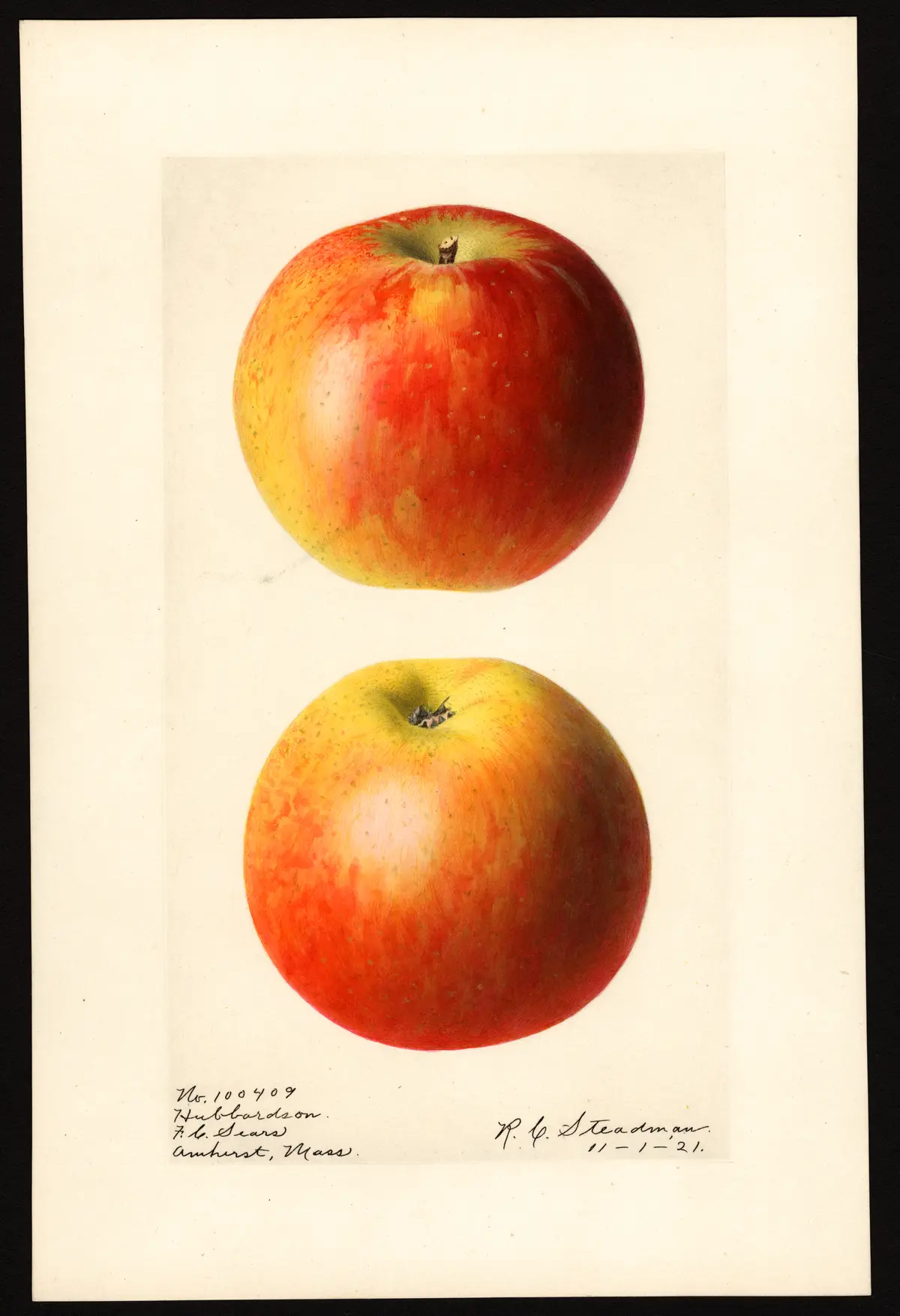
USDA Pomological Watercolor Collection
Hubbardston
Origin / History
Hubbardston is a native American apple which originated in the town of Hubbardston, Massachusetts, at least a century before Hedrick's 1922 account. Kenrick referred to it as early as 1832 as one of the most desirable varieties known in cultivation in Eastern Massachusetts. From its native locality it has been widely disseminated throughout the northern United States. Elliott notes that it succeeds even better when grown West than in its native locality. Beach observes that although it has long been widely disseminated in New York, there are many localities where it is yet unknown and many others where it has been introduced only within recent years; the planting of it for commercial purposes is gradually increasing. It has come to have various local names in different parts of the state, doubtless partly due to its variability. It is now generally conceded that the varieties known locally as American Blush, Van Vleet, and Orleans are identical with Hubbardston, or at the most are but selected strains of that variety.
Tree
The tree is a vigorous grower (Elliott, Downing, Thomas, Budd-Hansen, Beach, Hedrick), sometimes large, with strong, spreading growth (Budd-Hansen); Beach notes that if it is allowed to overbear and is not properly fed it is more often only moderately vigorous and of medium size. Form is erect to roundish, somewhat spreading, rather dense (Beach); Hedrick gives it as erect, spreading, dense. Downing describes it as forming a handsome branching head. It is spreading and very productive (Elliott), bearing very large crops (Downing), and generally comes into bearing at an early age, yielding heavy crops as often as every other year, in many places almost an annual bearer. It is apt to be productive to a fault, and for this reason should receive extra attention to keep the soil fertile and the foliage well protected from insects and diseases.
Shoots are rather slender (Elliott, Thomas), very different from the Baldwin (which has often been disseminated as this variety, per Elliott). Young shoots are dull grayish brown, slightly downy (Downing); Thomas calls them gray. Twigs (per Beach) are medium or rather long, spreading or erect, moderately stout, somewhat crooked, pubescent; internodes below medium to short. Bark dull olive-green with a tinge of reddish-brown and mottled with thin gray scarf-skin. Lenticels scattering, conspicuous, medium to small, round or oblong, raised, becoming laterally compressed on the older bark. Buds medium, broad, obtuse, appressed, pubescent. Leaves medium to rather small, rather narrow and inclined to become incurved (Beach); Hedrick gives leaves as small, narrow, incurved.
When grown upon its own trunk the body is sometimes injured by severe winters, and the tree is somewhat susceptible to attacks of apple canker; Beach therefore recommends planting a hardier and more vigorous variety such as the Northern Spy and the following year top-working the trees to Hubbardston. Hedrick adds that very often the trees do not hold the crop well, the apples drop badly, and the trees suffer from winter injury. Elliott notes it is "not always hardy."
Fruit
Size
Large (Elliott, Downing, Budd-Hansen, Lowther); Elliott adds "West very large." Thomas: large. Beach: above medium to large, sometimes very large; the crop is usually pretty uniform in size and shape but there is considerable variability with crops of different seasons and different localities. Hedrick: medium to large. Beach observes that fruit grown in Central and Western New York is usually somewhat smaller and keeps better than that grown in the lower Hudson valley, and that keeping quality is correlated to some extent with size — a medium crop with large fruit goes down quicker than a heavier crop with smaller, firmer individual fruits.
Form
Roundish ovate, very regular (Elliott). Roundish oblong, much narrower near the eye (Downing). Round-ovate, largest at the middle, nearly regular (Thomas). Roundish ovate or slightly oblong to roundish inclined to conic, characteristically rounded toward the cavity, usually symmetrical, often obscurely ribbed (Beach). Round-ovate to round-conic, characteristically rounded toward the cavity, symmetrical, often obscurely ribbed (Hedrick). Roundish oblong, conical, regular (Budd-Hansen). Lowther gives form simply as "re" (round-ellipsoid/regular).
Stem
Short (Elliott, Downing, Beach, Hedrick, Budd-Hansen — Budd-Hansen adds "slender"). Thomas: three-fourths to one inch long. Beach: short to very short.
Cavity
Narrow (Elliott). A russeted hollow (Downing, where the stalk sits). Acute, russeted (Thomas). Rather deep, acute, symmetrical, sometimes slightly furrowed, usually russeted (Beach). Deep, acute, symmetrical, sometimes furrowed, russeted (Hedrick). Deep, regular, narrow, russeted (Budd-Hansen).
Calyx
With short open segments (Elliott). Open (Downing, Budd-Hansen). Open (Thomas). Small to large, open to nearly closed; when large the lobes are usually reflexed and separated at the base exposing the yellowish calyx tube (Beach). Small, open or closed (Hedrick). Calyx tube medium in length, broad, cone-shape (Beach, Hedrick). Stamens median (Beach, Hedrick).
Basin
Deep, round, rarely ribbed (Elliott). Ribbed (Thomas). Moderately narrow to rather wide, shallow and somewhat obtuse to moderately deep and abrupt, distinctly furrowed, often marked with concentric flecks of russet in and about the basin (Beach). Narrow, shallow to deep, furrowed, often marked with concentric flecks of russet in and about the basin (Hedrick). Abrupt, wide, slightly ribbed and wrinkled, often russeted and leather-cracked (Budd-Hansen).
Skin / Color
Yellow ground, mostly overspread, and partially striped with rich red (Elliott). Smooth, striped with splashes, and irregular broken stripes of pale and bright red, which nearly cover a yellowish ground (Downing). Small broken stripes and numerous dots of light rich red on a rich yellow ground (Thomas). Yellow, covered with orange red and mixed bright brownish-red splashes and small stripes; dots few, gray, distinct (Budd-Hansen). Lowther: yellow-red. Stark Bros. (1910): a large yellow apple, mottled and shaded with rich red.
Beach gives the most detailed account: skin sometimes quite smooth but more often roughened with dots, flecks and fine veins of russet and sometimes covered with faint bloom; color yellow or greenish blushed and mottled with red which varies from dull brownish to clear bright red, and is more or less marked with deep carmine; dots pale or russet, often large and irregular, especially conspicuous on the red portions of the fruit; prevailing effect in highly colored specimens an attractive red, mingled with more or less of yellow. Hedrick concurs: skin smooth or more often roughened with dots, flecks and fine veins of russet, covered with faint bloom; color yellow, blushed and mottled with red which varies from dull brown to bright red, more or less marked with carmine; dots pale or russet, often large and irregular, conspicuous on the red portions of the fruit.
Flesh / Flavor
Yellowish, mild, sub-acid, juicy (Elliott). Yellow, juicy, and tender, with an agreeable mingling of sweetness and acidity in its flavor; very good to best (Downing). Yellowish, very rich, slightly sub-acid, with a strong mixture of a rich sweet flavor, excellent (Thomas). Yellow, tender, juicy, very rich, slightly subacid, mingled with an agreeable sweetness, very good (Budd-Hansen). Lowther: quality very good.
Beach: flesh whitish slightly tinged with yellow, moderately firm, breaking, rather fine-grained, tender, moderately crisp, juicy, aromatic, rich, at first sprightly but becoming mild subacid mingled with sweet, very good to best. Hedrick: yellow, firm, breaking, fine-grained, tender, crisp, juicy, aromatic, rich, at first sprightly but becoming mild subacid; very good to best. (Note: Beach gives flesh as whitish slightly tinged with yellow and moderately firm/moderately crisp; Hedrick gives it as yellow, firm, crisp — a slight divergence.) Thomas adds that it loses flavor by keeping. Hedrick observes that the apples, very good for dessert, are not at all suitable for culinary uses; Beach concurs that quality is excellent for dessert but less satisfactory for culinary use except very early in the season before the fruit loses acidity.
Core / Seeds
Core medium or rather small, more or less abaxile; cells usually pretty symmetrical, closed or partly open; core lines meeting or somewhat clasping; carpels broadly roundish, slightly emarginate, tufted; seeds numerous, medium to rather small, rather short, plump, acute, light brown (Beach). Hedrick: core small, abaxile; cells symmetrical, closed or partly open; core-lines meeting or clasping; carpels broad, round, emarginate, tufted; seeds numerous, small, short, plump, acute, light brown. Budd-Hansen differs: core large, closed or nearly so, clasping; seeds few, pointed.
Season
October to February (Elliott). October to January (Downing, Beach, Hedrick). Early winter (Thomas, Budd-Hansen). Winter (Lowther). Beach: reaches edible maturity in October and holds its flavor well till December or January, but after that time its quality usually deteriorates rapidly. It may often be kept in edible condition through the winter even in cellar storage but seldom with prime flavor. Its commercial limit in cellar storage does not extend much later than December. It is a very uncertain keeper, and in cold storage should go out in late fall or early winter, although sometimes it has been held in good condition till spring. Fruit of good color also has good keeping quality, other things being equal, but poorly colored fruit soon deteriorates in flavor and quality. There is also some loss from the early dropping of the fruit, particularly where picking is too long delayed. Stark Bros. calls it a good long keeper that, under favorable conditions, will keep in common storage till spring. Thomas notes it loses flavor by keeping.
Uses
Excellent for dessert (Beach, Hedrick — both noting it is less satisfactory or not at all suitable for culinary use except very early in the season before the fruit loses acidity). Lowther: both kitchen and market. Stark Bros.: very excellent for export; a reliable market apple. Beach considers it an excellent variety for commercial planting that deserves to be better known among New York fruit growers, ripening as it does between the perishable early autumn varieties and the late ripening winter apples. Thomas: a famous New England sort — fine at the North and Northwest; coming into favor as a commercial sort.
Subtypes / Variants
Beach reports that American Blush, Van Vleet, and Orleans are now generally conceded to be identical with Hubbardston, or at the most are but selected strains of that variety. The variety as a whole "varies remarkably under different conditions of soil and climate not only in vigor of tree but in certain fruit characters also, such as size, color, degree of smoothness or russeting of the skin and in the quality and flavor of the flesh." Hedrick echoes that the variety is so variable on different soils and in different climates in both tree- and fruit-characters as to be unsatisfactory for general culture.
Other
Distribution per Lowther's reporting-stations census: Northern Division — 18 reporting stations (also reported in another division); Central Division — 12 reporting stations (also reported in another division); Southern Division — not reported.
When trees are allowed to become greatly overloaded, as they often do where the apples are not thinned, there is apt to be a considerable portion of undersized and poorly colored fruit (Beach). Stark Bros. (1910) markets it commercially with the cryptic terminal notation "NCS."
Book Sources
Described in 7 period pomological works
- Beach, The Apples of New York Vol. 1 (1905)
- Budd & Hansen, Systematic Pomology (1914)
- Downing, Fruits and Fruit Trees of America (1900) — listed as Hubbardston Nonsuch
- Elliott, The Western Fruit Book (1865) — listed as Hubbardston Nonsuch
- Lowther (ed.), Encyclopedia of Practical Horticulture (1914) — listed as Hubbardston (H.'s Nonsuch)
- Hedrick, Cyclopedia of Hardy Fruits (1922)
- Thomas, The American Fruit Culturist (1903)
Nursery Catalog Sources
Found in 44 catalogs (1845–1921) from Alabama, California, Illinois, Massachusetts, Missouri, New Jersey, Oregon, Virginia, Washington
- Winship's Nursery (Brighton Nurseries , operated by the Winship family), Brighton (Boston) , Massachusetts — 1845 — listed as Hubbardston Nonesuch
- Hovey & Co. , Cambridge , Massachusetts — 1849 — listed as Hubbardston Nonesuch
- Azell Bowditch (Nursery / Fruit Catalog) , Boston , Massachusetts — 1850 — listed as Hubbardston Nonesuch
- Joseph Breck & Co. , Boston , Massachusetts — 1855 — listed as Hubbardston Nonesuch
- Hutchison Nursery , James Hutchison, Oakland , California — 1881 — listed as Hubbardston Nonesuch
- Felix Gillet , Barren Hill Nursery, Nevada City , California — 1884 — listed as Hubbardston Nonesuch
- Fancher Creek Nursery , Fresno , California — 1886 — listed as Hubbardston Nonesuch
- Felix Gillet , Barren Hill Nursery, Nevada City , California — 1888 — listed as Hubbardston Nonesuch
- California Nursery Co. , Niles , California — 1889 — listed as Hubbardston Nonesuch
- Felix Gillet , Barren Hill Nursery, Nevada City , California — 1889 — listed as Hubbardston Nonesuch
- Felix Gillet , Barren Hill Nursery, Nevada City , California — 1890 — listed as Hubbardston Nonesuch
- Felix Gillet , Barren Hill Nursery, Nevada City , California — 1891 — listed as Hubbardston Nonesuch
- Milwaukie-Canby Nurseries , Canby, OR (and Milwaukie, OR) — 1893 — listed as Hubbardston Nonesuch
- Sherwood Hall Nursery Co. , Timothy Hopkins (Menlo Park Nurseries), San Francisco / Menlo Park , California — 1893 — listed as Hubbardston Nonesuch
- Multnomah Nurseries , Russellville , Oregon — 1894 — listed as Hubbardston Nonesuch
- The Vineland Nurseries (Kelsey & Co. , Proprietors), St. Joseph, Missouri (Office: 13th and Atchison Sts., 2 Blocks East of the Citizens St. Car Line) — 1894 — listed as Hubbardston Nonesuch
- Felix Gillet , Barren Hill Nursery, Nevada City , California — 1895 — listed as Hubbardston Nonesuch
- The Lovett Company , Little Silver , New Jersey — 1896 — listed as Hubbardston Nonesuch
- Felix Gillet , Barren Hill Nursery, Nevada City , California — 1897 — listed as Hubbardston Nonesuch
- The Salem Nursery (John A. Francis , Proprietor), Salem , Virginia — 1897 — listed as Hubbardston Nonesuch
- Arthur J. Collins & Sons , Moorestown , New Jersey — 1898 — listed as Hubbardston Nonesuch
- Stark Bros. Nurseries & Orchards Co. , Louisiana , Missouri — 1898 — listed as Hubbardston Nonesuch
- Alabama Nursery Co. , Huntsville , Alabama — 1900 — listed as Hubbardston Nonesuch
- Central Experimental Farm , Dominion Department of Agriculture, Agassiz, British Columbia (under test; Bulletin No. 3, Second Series) — 1900 — listed as Hubbardston Nonesuch
- Washington Nursery Co. , Toppenish , Washington — 1901 — listed as Hubbardston Nonesuch
- S.L. Watkins , Grizzly Flats, El Dorado County , California — 1901 — listed as Hubbardston Nonesuch
- Phoenix Nursery Company (W. E. Rossney , President; Sidney Tuttle, Vice-President), Bloomington , Illinois — 1904 — listed as Hubbardston Nonesuch
- The Dalles Nurseries , The Dalles , Oregon — 1906 — listed as Hubbardston Nonesuch
- Stark Bros. Nurseries & Orchards Co. , Louisiana , Missouri — 1906 — listed as Hubbardston Nonesuch
- J.B. Pilkington , Portland , Oregon — 1907 — listed as Hubbardston Nonesuch
- Washington Nursery Company , Toppenish , Washington — 1909 — listed as Hubbardston Nonesuch
- C.F. Lansing , Salem , Oregon — 1910 — listed as Hubbardston Nonesuch
- Stark Bros. Nurseries & Orchards Co. , Louisiana , Missouri — 1910 — listed as Hubbardston Nonesuch
- Stark Bros. Nurseries & Orchards Co. , Louisiana , Missouri — 1911 — listed as Hubbardston Nonesuch
- Ballygreen Nurseries , Hanford , Washington — 1912 — listed as Hubbardston Nonesuch
- Pacific Nursery Company , Portland , Oregon — 1912 — listed as Hubbardston Nonesuch
- Stark Bros. Nurseries & Orchards Co. , Louisiana , Missouri — 1912 — listed as Hubbardston Nonesuch
- Vineland Nurseries Company , Clarkston , Washington — 1912 — listed as Hubbardston Nonesuch
- Washington Nursery Company , Toppenish , Washington — 1912 — listed as Hubbardston Nonesuch
- Benjamin Buckman (personal inventory) , Farmingdale , Illinois — 1913 — listed as Hubbardston Nonesuch
- Union Nurseries , J.B. Weaver & Sons, Union , Oregon — 1915 — listed as Hubbardston Nonesuch
- Manalapan Nurseries , Englishtown , New Jersey — 1916 — listed as Hubbardston Nonesuch
- Stark Bros. Nurseries & Orchards Co. , Louisiana , Missouri — 1918 — listed as Hubbardston Nonesuch
- Benedict Nursery Co. , Portland , Oregon — 1921 — listed as Hubbardston Nonesuch
View original book sources (8)
— F.R. Elliott, The Western Fruit Book (1865)HUBBARDSTON NONSUCH. Hubbardton Pippin. American : originated in Mass. A superior fruit, succeeding even better when grown West than in its native locality, but not always hardy. Tree, vigorous grower ; shoots, rather slender, very different from the Baldwin, which has often been disseminated as this variety ; spreading ; very productive. Fruit, large, West very large ; form, roundish ovate, very regular : color, yellow ground, mostly overspread, and partially striped with rich red ; stem, short ; cavity, narrow ; calyx, with short open segments ; basin, deep, round, rarely ribbed ; flesh, yellowish, mild, sub-acid, juicy. October to February.
— A.J. Downing, The Fruits and Fruit Trees of America (1900)HUBBARDSTON NONSUCH. John May. Old Town Pippin. Hubbardston. A fine, large, early winter fruit, which originated in the town of Hubbardston, Mass. The tree is a vigorous grower, forming a handsome branching head, and bears very large crops. Young shoots dull grayish brown, slightly downy. It is worthy of extensive orchard culture. Fruit large, roundish oblong, much narrower near the eye. Skin smooth, striped with splashes, and irregular broken stripes of pale and bright red, which nearly cover a yellowish ground. The calyx open, and the stalk short, in a russeted hollow. Flesh yellow, juicy, and tender, with an agreeable mingling of sweetness and acidity in its flavor. Very good to best. October to January.
— John J. Thomas, The American Fruit Culturist (1903)Hubbardston.* Large, round-ovate, largest at the middle, nearly regular; color with small broken stripes and numerous dots of light rich red on a rich yellow ground; stalk three-fourths to one inch long; cavity acute, russeted; calyx open, basin ribbed; flesh yellowish, very rich, slightly sub-acid, with a strong mixture of a rich sweet flavor, excellent. Early winter. A famous New England sort—fine at the North and Northwest. Shoots rather slender, gray. A native of Hubbardston, Mass. Loses flavor by keeping. Coming into favor as a commercial sort.
— S.A. Beach, The Apples of New York, Vol. 1 (1905)HUBBARDSTON.
REFERENCES. 1. Kenrick, 1832:47. 2. Manning, 1838:62. 3. Mag. Hort., 7:45. 1841. 4. Downing, 1845:113. 5. Mag. Hort., 14:545. 1848. fig. 6. Ib., 15:63. 1849. 7. Thomas, 1849:166, 167. fig. 8. Emmons, Nat. Hist. N. Y., 3:65. 1851. col. pl. 51 and 74. 9. Hovey, 1:67. 1852. col. pl. fig. 10. Am. Pom. Soc. Cat., 1852. 11. Hooper, 1857:46. 12. Oberdieck, Ill. Handb. der Obstk., 8:137. 13. Warder, 1867:600. fig. 14. Mag. Hort., 34:27. 1868. 15. Leroy, 1873:497. fig. 16. Barry, 1883:347. 17. Lyon, Mich. Hort. Soc. Rpt., 1890:292. 18. Wickson, 1891:244. 19. Bailey, An. Hort., 1892:241. 20. Green, Rural N. Y., 57:802. 1898. 21. Eneroth-Smirnoff, 1901:363. 22. Budd-Hansen, 1903:100. fig. 23. Can. Hort., 26:89. 1903. fig. 24. Powell and Fulton, U. S. B. P. I. Bul., 48:44. 1903. 25. Beach and Clark, N. Y. Sta. Bul., 248:125. 1904.
SYNONYMS. AMERICAN BLUSH (20). American Blush (25). American Nonpareille (15). Hubbardston (18). HUBBARDSTON NONSUCH (1, 2, 3, 5, 6, 7, 8, 9, 11, 13, 14, 16, 19, 21, 22). Hubbardston Nonsuch (15, 23, 24, 25). John May (15). NONPAREILLE DE HUBBARDSTON (15). NONSUCH (18). Nonesuch (24, 25). Orleans (25). SONDERGLEICHEN VON HUBBARDSTON (12). Van Vleet.
Hubbardston is an excellent variety for commercial planting and deserves to be better known among New York fruit growers. It varies remarkably under different conditions of soil and climate not only in vigor of tree but in certain fruit characters also, such as size, color, degree of smoothness or russeting of the skin and in the quality and flavor of the flesh. The fact that it has come to have various local names in different parts of the state is doubtless partly due to this variability. It is now generally conceded that American Blush, Van Vleet and Orleans are identical with Hubbardston, or at the most are but selected strains of that variety. In many parts of the state Hubbardston is one of the most profitable varieties of its season, ripening as it does between the perishable early autumn varieties and the late ripening winter apples. It has generally sustained the reputation of coming into bearing at an early age and yielding heavy crops as often as every other year and in many places it is almost an annual bearer. It is apt to be productive to a fault, and for this reason should receive extra attention to keep the soil fertile and the foliage well protected from insects and diseases. When grown upon its own trunk the body is sometimes injured by severe winters. The tree also is somewhat susceptible to attacks of the apple canker. For these reasons it is doubtless best for one who wishes to grow Hubbardston to plant some hardier and more vigorous variety such as the Northern Spy, and the following year topwork the trees to Hubbardston. Under favorable conditions the tree is a vigorous grower and the fruit is fair, smooth, uniform, of good size and pretty good color. The quality is excellent for dessert but less satisfactory for culinary use except very early in the season before the fruit loses acidity.
Its commercial limit in cellar storage does not extend much later than December. It is a very uncertain keeper and in cold storage should go out in late fall or early winter although sometimes it has been held in good condition till spring. Fruit of this variety grown in Central and Western New York usually is somewhat smaller and keeps better than that grown in the lower Hudson valley. It appears that its keeping quality is correlated to some extent with the size of the fruit. If there is only a medium crop on the tree and the fruit is large it goes down quicker than if the crop is heavier and the individual fruits smaller and firmer. Fruit of good color also has good keeping quality, other things being equal, but poorly colored fruit soon deteriorates in flavor and quality (25). When the trees are allowed to become greatly overloaded, as they often do where the apples are not thinned, there is apt to be a considerable portion of undersized and poorly colored fruit. There is also some loss from the early dropping of the fruit particularly where picking is too long delayed. Hubbardston reaches edible maturity in October and holds its flavor well till December or January, but after that time its quality usually deteriorates rapidly. It may often be kept in edible condition through the winter even in cellar storage but seldom with prime flavor.
Historical. Hubbardston is a native fruit which had its origin in Hubbardston, Massachusetts. As early as 1832 Kenrick referred to it as one of the most desirable varieties known in cultivation in Eastern Massachusetts (1). Although it has long been widely disseminated in New York there are many localities where it is yet unknown and many others where it has been introduced within recent years. The planting of it for commercial purposes is gradually increasing.
TREE.
Tree vigorous, sometimes large, but if it is allowed to overbear and is not properly fed it is more often moderately vigorous and of medium size. Form erect to roundish, somewhat spreading, rather dense. Twigs medium or rather long, spreading or erect, moderately stout, somewhat crooked, pubescent; internodes below medium to short. Bark dull olive-green with tinge of reddish-brown and mottled with thin gray scarf-skin. Lenticels scattering, conspicuous, medium to small, round or oblong, raised, becoming laterally compressed on the older bark. Buds medium, broad, obtuse, appressed, pubescent. Leaves medium to rather small, rather narrow and inclined to become incurved.
FRUIT.
Fruit above medium to large, sometimes very large. Form roundish ovate or slightly oblong to roundish inclined to conic, characteristically rounded toward the cavity, usually symmetrical, often obscurely ribbed. The crop is usually pretty uniform in size and shape but there is considerable variability in the fruit with crops of different seasons and different localities. Stem short to very short. Cavity rather deep, acute, symmetrical, sometimes slightly furrowed, usually russeted. Calyx small to large, open to nearly closed; when large the lobes are usually reflexed and separated at the base exposing the yellowish calyx tube. Basin moderately narrow to rather wide, shallow and somewhat obtuse to moderately deep and abrupt, distinctly furrowed, often marked with concentric flecks of russet in and about the basin. Skin sometimes quite smooth but more often roughened with dots, flecks and fine veins of russet and sometimes covered with faint bloom. Color yellow or greenish blushed and mottled with red which varies from dull brownish to clear bright red, and is more or less marked with deep carmine. Dots pale or russet, often large and irregular, especially conspicuous on the red portions of the fruit. Prevailing effect in highly colored specimens attractive red, mingled with more or less of yellow.
Calyx tube medium in length, broad, cone-shape. Stamens median. Core medium or rather small, more or less abaxile; cells usually pretty symmetrical, closed or partly open; core lines meeting or somewhat clasping. Carpels broadly roundish, slightly emarginate, tufted. Seeds numerous, medium to rather small, rather short, plump, acute, light brown. Flesh whitish slightly tinged with yellow, moderately firm, breaking, rather fine-grained, tender, moderately crisp, juicy, aromatic, rich, at first sprightly but becoming mild subacid mingled with sweet, very good to best.
Season October to January.
— J.L. Budd & N.E. Hansen, American Horticultural Manual, Part II: Systematic Pomology (1914)Hubbardston (Hubbardston Nonsuch). — Origin, Hubbardston, Massachusetts; tree of strong, spreading growth, very productive.
Fruit large, roundish oblong, conical, regular; surface yellow, covered with orange red and mixed bright brownish-red splashes and small stripes; dots few, gray, distinct; cavity deep, regular, narrow, russeted; stem short, slender; basin abrupt, wide, slightly ribbed and wrinkled, often russeted and leather-cracked; calyx open. Core large, closed, or nearly so, clasping; seeds few, pointed; flesh yellow, tender, juicy, very rich, slightly subacid, mingled with an agreeable sweetness, very good. Early winter.
— Granville Lowther (ed.), Encyclopedia of Practical Horticulture (1914)Hubbardston (H.'s Nonsuch). Size: large. Form: "re". Color: yellow-red. Quality: very good. Use: both kitchen and market. Season: winter. Northern Division: 18 reporting stations (also reported in another division). Central Division: 12 reporting stations (also reported in another division). Southern Division: not reported.
— U.P. Hedrick, Cyclopedia of Hardy Fruits (1922)HUBBARDSTON. Fig. 26. American Blush. Hubbardston Nonsuch. Nonsuch. Hubbardston, under favorable conditions, is a most excellent apple. The fruits are of large size, handsome color, good enough for dessert, smooth, uniform, and are produced abundantly on a vigorous tree. Unfortunately, several faults condemn the variety for general culture. The apples, very good for dessert, are not at all suitable for culinary uses. The variety is so variable on different soils and in different climates in both tree- and fruit-characters as to be unsatisfactory. Thus, very often, the trees do not hold the crop well, the apples are undersized, poorly colored, drop badly; the crop does not keep its allotted time, and the trees suffer from winter injury. The variety takes its name from Hubbardston, Massachusetts, where it originated at least a century ago, and whence it has been widely disseminated throughout northern United States.
Tree vigorous, large, erect, spreading, dense. Leaves small, narrow, incurved. Fruit medium to large, roundovate to round-conic, characteristically rounded toward the cavity, symmetrical, often obscurely ribbed; stem short; cavity deep, acute, symmetrical, sometimes furrowed, russeted; calyx small, open or closed; basin narrow, shallow to deep, furrowed, often marked with concentric flecks of russet in and about the basin; skin smooth or more often roughened with dots, flecks and fine veins of russet, covered with faint bloom; color yellow, blushed and mottled with red which varies from dull brown to bright red, more or less marked with carmine; dots pale or russet, often large and irregular, conspicuous on the red portions of the fruit; calyx-tube medium in length, broad, cone-shape; stamens median; core small, abaxile; cells symmetrical, closed or partly open; core-lines meeting or clasping; carpels broad, round, emarginate, tufted; seeds numerous, small, short, plump, acute, light brown; flesh yellow, firm, breaking, fine-grained, tender, crisp, juicy, aromatic, rich, at first sprightly but becoming mild subacid; very good to best; October to January.
— Stark Bros. Nurseries & Orchards Co., Stark Bros. Year Book (1910) (1910)A valuable, large yellow apple, mottled and shaded with rich red. A good long keeper. Under favorable conditions this fine apple is hard from keeping quite well. Will keep in common storage till spring, bearing the large specimens of an individual good quality. Very excellent for export. A reliable market apple. NCS