Cranberry Pippin
Apple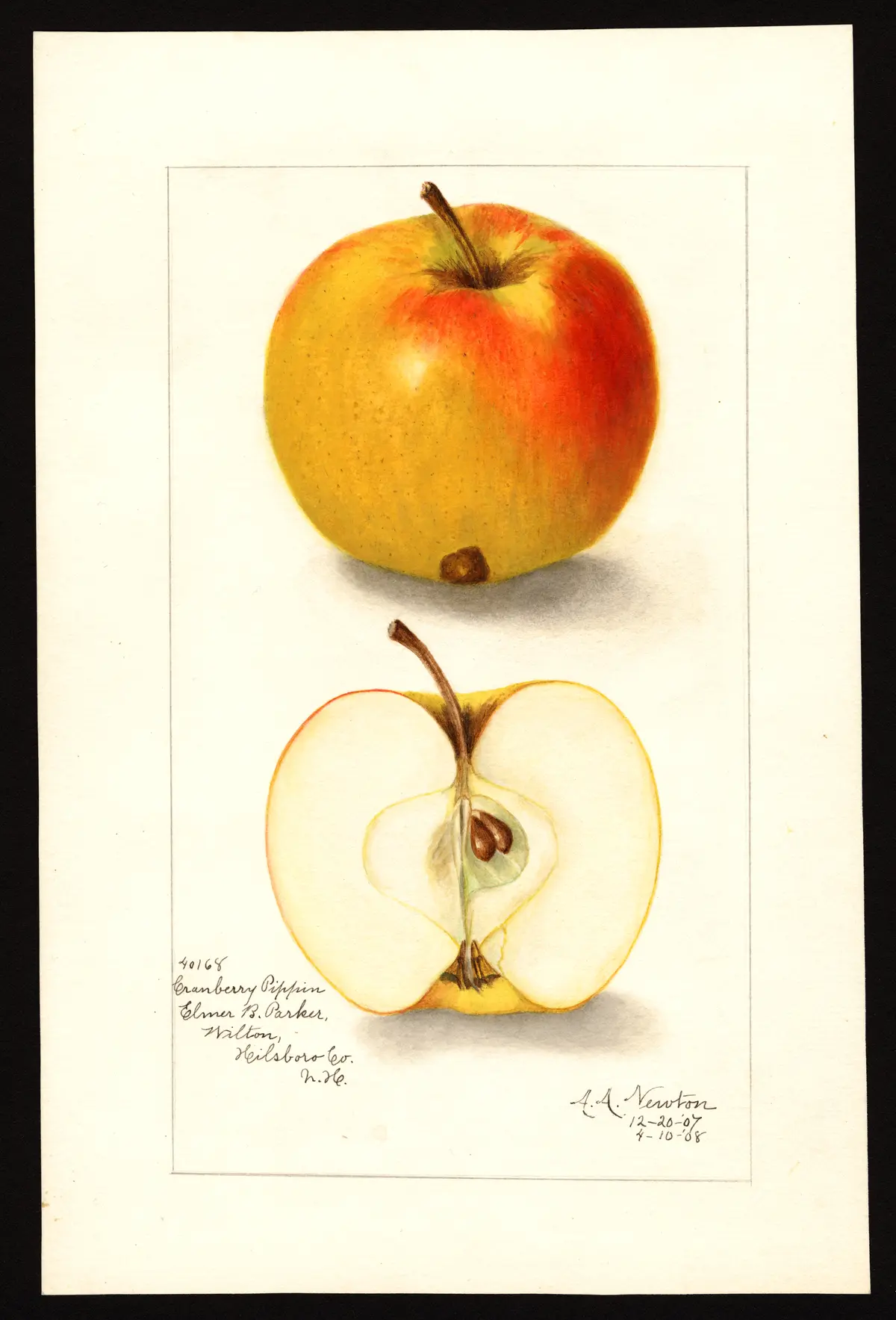
USDA Pomological Watercolor Collection
Cranberry Pippin
Origin / History
Cranberry Pippin is an American apple. It originated near Hudson, Columbia County, New York, where Downing says it "was found growing on a farm." Hedrick dates the origin "sometime previous to 1845, when Downing first set forth its merits."
Beach writes that "in some sections this has proved a desirable apple, but in others it has not been successful." He says it is well known in some localities in the Hudson valley, in Northern and Western New York, and in Ontario. There it is "favorably regarded as a fall or early winter apple because of its good size, bright and attractive color and its uniform size and shape."
Hedrick calls it "an excellent apple for some localities," citing its large size, bright color, uniform shape, good keeping qualities, pleasant flavor, hardiness of tree, and resistance to scab. He advises that "its local adaptabilities should always be determined before planting," and records that "its culture is confined to New York, New England, and the adjoining parts of Canada."
Tree
Tree large and vigorous, very vigorous by Beach's account, and hardy. Form upright, becoming somewhat spreading. Branches stout and spreading.
Twigs long, moderately stout, light grayish-brown, quite pubescent; internodes short. Bark dull reddish-brown with some olive-green, thickly mottled with scarf-skin. Lenticels scattering, medium to small, usually roundish. Buds medium or sometimes small, rather broad, deeply set, obtuse or sometimes acute, pubescent, appressed. Leaves dark green, broad, medium to large; foliage rather dense (Beach).
Productive to very productive, but uncertain. Beach says the trees are "often very productive," yet in some cases the variety is reported as undesirable because unproductive. He adds that "it is said to be a shy bearer when young, but becomes productive with age." Hedrick writes that "the trees do not bear young in some situations, and are capricious in bearing at all times." It "appears to be quite resistant to the attacks of scab" (Beach).
Fruit
Size: Medium to large, the sources dividing evenly between the two, with Elliott placing it above medium. Uniform in size (Beach).
Form: Roundish oblate, ranging to oblate or flat; regular, symmetrical, uniform in shape. Elliott calls it simply roundish.
Stem: Short (Beach); medium (Warder).
Cavity: Wide or broad, wavy.
Calyx: Closed or somewhat open. Eye small, short (Warder).
Basin: Wide, regular or wavy, moderately deep, russeted.
Skin: Very smooth, shining, bright, clear light yellow, with a bright, shining scarlet or red cheek, handsomely blushed, striped and splashed with scarlet (Beach). General appearance strikingly beautiful, handsome, and attractive.
Dots: Warder calls them minute. Beach gives them as many and large, often red areolar with a russet center.
Flesh and flavor: Flesh white, or with a slight yellowish tinge (Beach); breaking (Warder); juicy to moderately juicy. Flavor mild subacid, brisk subacid by Downing's account; "pleasant" (Hedrick).
A cooking fruit rather than a dessert fruit. Warder rates it "very good for cooking, not for dessert," and Hedrick "good to very good." Downing calls it "Good" but "only second-rate in point of flavor," and Thomas calls it "poor."
Core and seeds: Core small, oval, just meeting the eye; axis short; seeds numerous, long (Warder).
Season
Autumn into February, from October or November to February, with Warder giving November to February in New York. Elliott closes the season in December, and Thomas calls it an autumn apple.
Beach says that in the vicinity of its origin its season closes "from a month to six weeks earlier than either Hubbardston or Tompkins King." In Northern New York and Ontario its season is late fall and early winter and "often extends to midwinter." Beach calls it "a good storage apple."
Uses
A cooking and market apple, not for dessert, and suitable also for evaporating (Beach). Downing calls it "an excellent cooking and market apple." Beach says it "stands shipping well and brings good prices."
Subtypes / Variants
Not described in source.
Other
Beach cites earlier accounts by Downing (1845), Thomas (1849), Emmons in the Natural History of New York (1851), Elliott (1854), Warder (1867), and Lyon in the Michigan Horticultural Society Report (1890). He also cites Bailey in the Annals of Horticulture (1892), American Gardening (1895), and Woolverton in the Ontario Fruit Stations Annual Reports (1895 and 1896, with figures). The remaining references are Macoun in a Canadian Department of Agriculture Bulletin (1901) and Beach and Clark in a New York Station Bulletin (1904).
Book Sources
Described in 6 period pomological works
Nursery Catalog Sources
Found in 2 catalogs (1901–1913) from Illinois
- Benjamin Buckman (personal inventory) , Farmingdale , Illinois — 1901
- Benjamin Buckman (personal inventory) , Farmingdale , Illinois — 1913
View original book sources (6)
— F.R. Elliott, The Western Fruit Book (1865)Cranberry Pippin.
American. Above medium, roundish, clear yellow, red cheek; flesh, white, juicy, sub-acid. November, December.
— John A. Warder, American Pomology: Apples (1867)Cranberry Pippin.
This is a beautiful apple which originated near Hudson, New York. Tree vigorous, very productive. Fruit large, flat, regular; Surface very smooth, bright, clear yellow, with a shining scarlet cheek; Dots minute. Basin wide, regular or wavy; Eye small, short, closed. Cavity wide, wavy; Stem medium. Core small, oval, just meeting the eye; Axis short; Seeds numerous, long; Flesh white, breaking, juicy; Flavor mild, sub-acid; Quality very good for cooking, not for dessert; Season November to February in New York.
— A.J. Downing, The Fruits and Fruit Trees of America (1900)Cranberry Pippin.
This strikingly beautiful Apple was found growing on a farm near Hudson, N. Y. It is only second-rate in point of flavor— but it is an excellent cooking and market apple.
Fruit medium, roundish oblate, regular. Skin very smooth, light yellow, with a bright scarlet cheek. Flesh white, moderately juicy, brisk subacid. Good. November to February.
— John J. Thomas, The American Fruit Culturist (1903)Cranberry Pippin. Medium, oblate, with a handsome scarlet cheek; sub-acid, poor—cooking. Productive. Autumn. N. Y.
— S.A. Beach, The Apples of New York, Vol. 2 (1905)CRANBERRY PIPPIN.
References. 1. Downing, 1845:106. 2. Thomas, 1849:179. 3. Emmons, Nat. Hist. N. Y., 3:88. 1851. 4. Elliott, 1854:169. 5. Warder, 1867:402. 6. Lyon, Mich. Hort. Soc. Rpt., 1890:290. 7. Bailey, An. Hort., 1892:237. 8. Amer. Gard., 16:425. 1895. 9. Woolverton, Ont. Fr. Stas. An. Rpt., 2:9. 1895. fig. 10. Ib., 3:6. 1896. fig. 11. Macoun, Can. Dept. Agr. Bul., 37:43. 1901. 12. Beach and Clark, N. Y. Sta. Bul., 248:116. 1904.
Synonyms. None.
In some sections this has proved a desirable apple, but in others it has not been successful. It is well known in some localities in the Hudson valley, in Northern and Western New York and in Ontario, where it is favorably regarded as a fall or early winter apple because of its good size, bright and attractive color and its uniform size and shape. It is a good storage apple, stands shipping well and brings good prices. It is suitable for market, cooking and evaporating, but not for dessert. It appears to be quite resistant to the attacks of scab. The trees are hardy and often very productive, but in some cases it is reported as undesirable because unproductive. It is said to be a shy bearer when young, but becomes productive with age.
Historical. Originated near Hudson, Columbia county (1).
Tree.
Tree large, very vigorous; branches stout, spreading. Form upright becoming somewhat spreading. Twigs long, moderately stout, light grayish-brown, quite pubescent; internodes short. Bark dull reddish-brown with some olive-green and thickly mottled with scarf-skin. Lenticels scattering medium to small, usually roundish. Buds medium or sometimes small, rather broad, deeply set, obtuse or sometimes acute, pubescent, appressed. Leaves dark green, broad, medium to large; foliage rather dense.
Fruit.
Fruit large. Form roundish oblate, symmetrical. Stem short. Cavity broad, wavy. Calyx closed or somewhat open. Basin moderately deep, russeted. Skin smooth, shining, clear light yellow, handsomely blushed, striped and splashed with scarlet. Dots many, large, often red areolar with russet center. General appearance beautiful and attractive. Flesh white or with slight yellowish tinge, moderately juicy, mild subacid. Season October to February. In the vicinity of its origin its season closes from a month to six weeks earlier than either Hubbardston or Tompkins King. In Northern New York and Ontario its season is late fall and early winter and often extends to midwinter.
— U.P. Hedrick, Cyclopedia of Hardy Fruits (1922)CRANBERRY PIPPIN.
The large size, bright color, uniform shape, good keeping qualities, and pleasant flavor of the fruit, with hardiness of tree and resistance to scab, make Cranberry Pippin an excellent apple for some localities. Unfortunately the trees do not bear young in some situations, and are capricious in bearing at all times, so that its local adaptabilities should always be determined before planting. Cranberry Pippin originated near Hudson, New York, sometime previous to 1845, when Downing first set forth its merits. Its culture is confined to New York, New England, and the adjoining parts of Canada.
Tree large, vigorous, upright-spreading; branches stout. Leaves dark green, large. Fruit large, round-oblate, symmetrical; stem short; cavity broad, wavy; calyx closed or open; basin deep, russeted; skin smooth, shining, light yellow, blushed, striped and splashed with scarlet; dots many, large, often red-areolar with russet center; flesh yellow, juicy, mild subacid; good to very good; October to February.