American Blush
Apple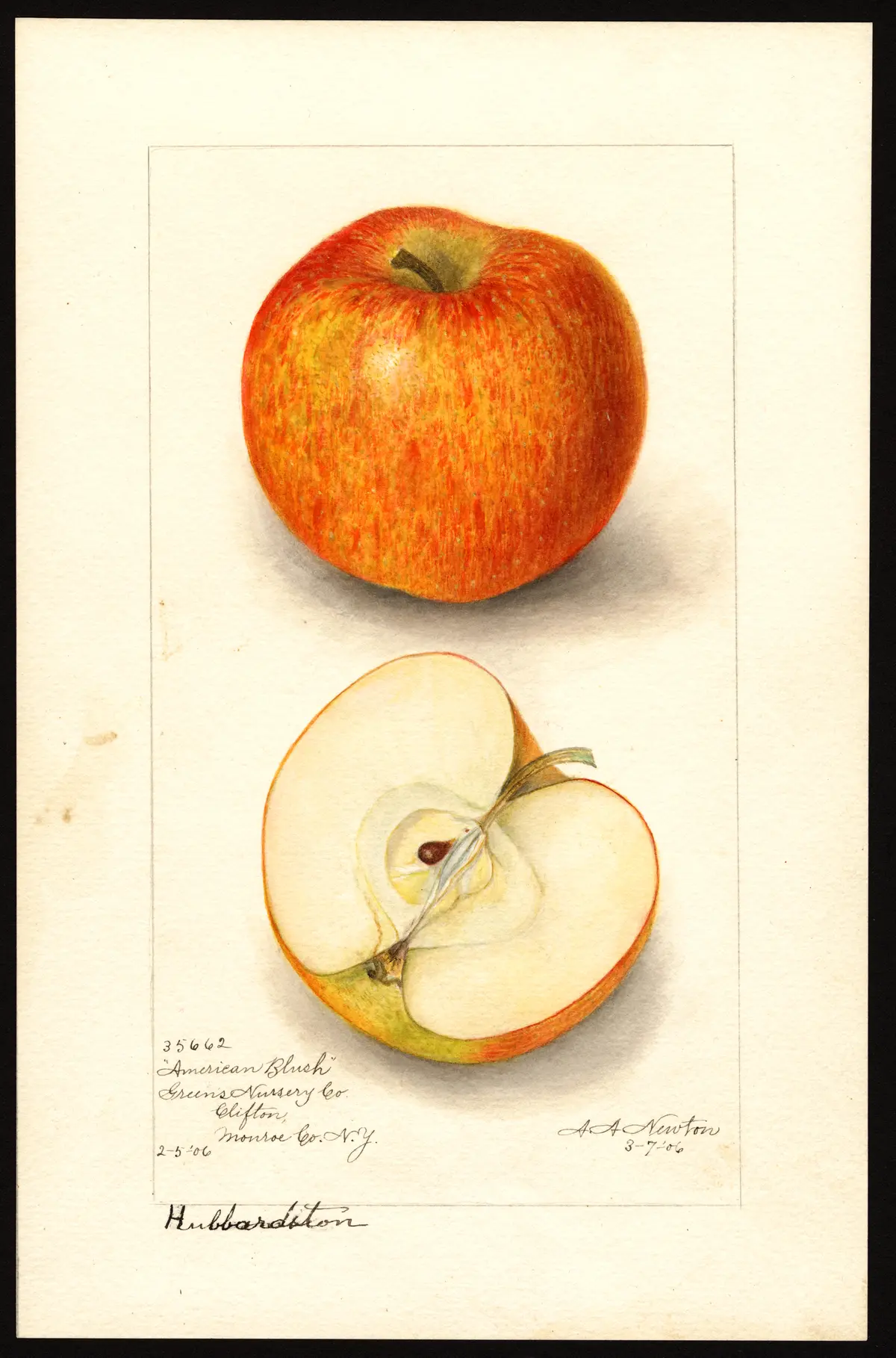
USDA Pomological Watercolor Collection
American Blush
Origin/History
The Hubbardston has long been known in some portion of Seneca and Tompkins counties under the name American Blush, and has been disseminated from that region under that name. The dissemination of the Hubbardston under alternative names is attributed to its remarkable variability in response to environmental conditions.
Tree
Not described in source.
Fruit
Not described in source.
Season
Not described in source.
Uses
Not described in source.
Subtypes/Variants
The Hubbardston displays such remarkable variations with changes in environment that the origin of observed differences—whether attributable solely to environmental factors or to the development of distinct strains under cultivation—has not been definitively determined. Some fruit growers maintain that American Blush is materially different from the standard Hubbardston, and if such differences are consistently maintained under propagation, American Blush should be regarded as a distinct strain of the Hubbardston.
Other
Not described in source.
Book Sources
Described in 1 period pomological work
Nursery Catalog Sources
Found in 1 catalog (1894) from New York
- Green's Nursery Co. (Charles A. Green) , Rochester , New York — 1894
View original book sources (1)
— S.A. Beach, The Apples of New York, Vol. 1 (1905)AMERICAN BLUSH.
The Hubbardston has long been known in some portion of Seneca and Tompkins counties under the name American Blush, and has been disseminated from there under that name. It is not surprising that the Hubbardston has been disseminated under other names because it shows such remarkable variations with changes in environment. Whether the variations which have appeared are all due to differences in environment or whether distinct strains of the Hubbardston have arisen under cultivation has not been definitely determined. Some fruit growers are very positive in the opinion that American Blush is different from the Hubbardston. If this be true and if these differences are maintained under propagation it should be regarded as a distinct strain of the Hubbardston.