Baxter
Apple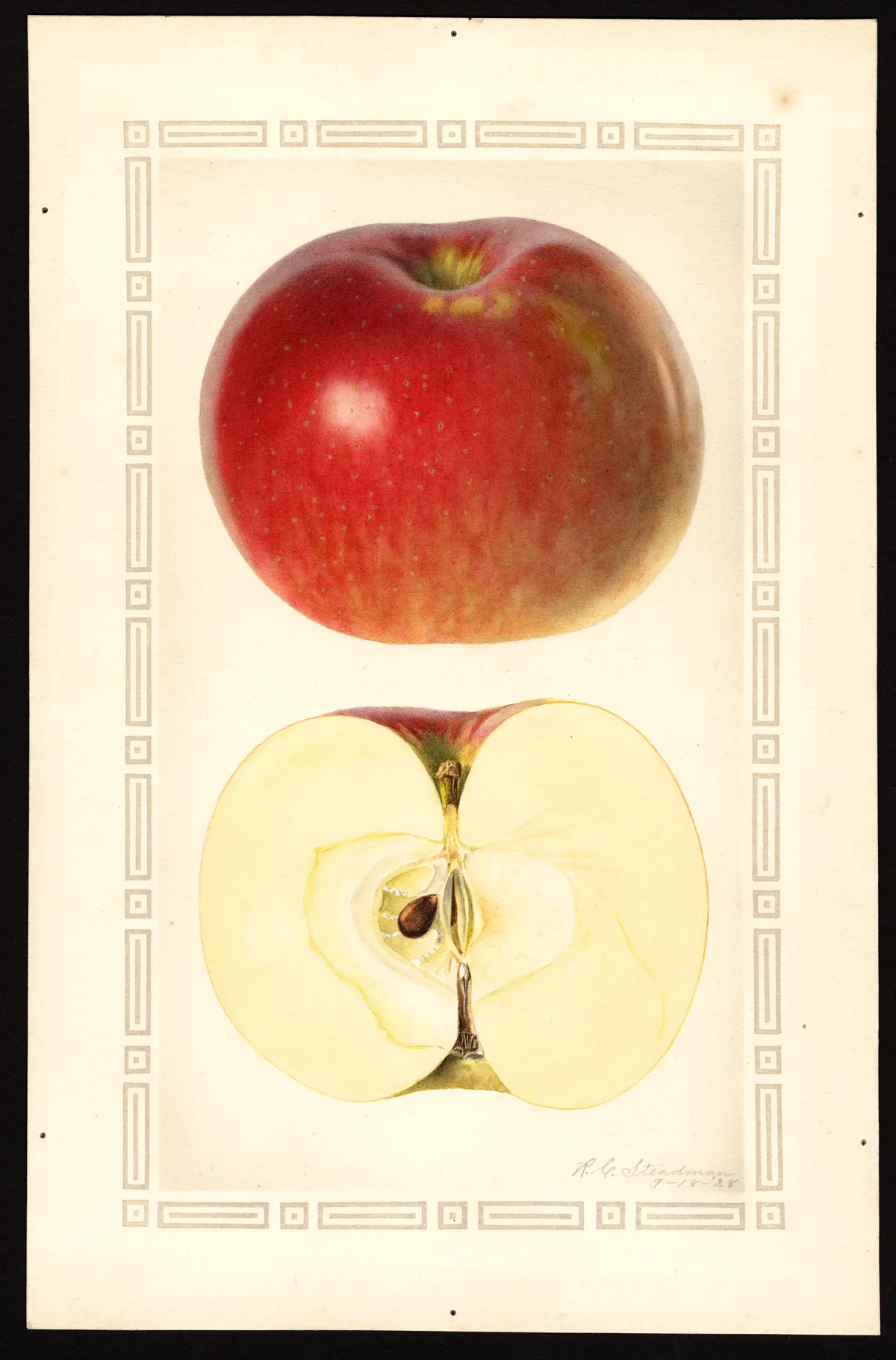
USDA Pomological Watercolor Collection
Baxter
Origin/History
Baxter came into local repute near Brockville, Ontario (in the St. Lawrence valley), around 1800 — one hundred years or more before Beach's 1905 account. The variety gradually found its way into nurseries and within the twenty-five years preceding 1905 had been quite extensively propagated. Its bluish bloom, large areolar dots, large size, form, color, and the character of its flesh and flavor all indicate a close relationship with the Blue Pearmain group of apples.
In the St. Lawrence valley, Baxter is regarded as a desirable commercial variety: strong-growing, hardy, productive, and not subject to scab. Its immunity to fungi and great hardiness make it desirable in regions too cold for Baldwin or Northern Spy. Beach, writing from Geneva, New York, found it vigorous and productive there as well, but considered it doubtful for commercial orchards of Western and Southern New York, given its inferior quality relative to Tompkins King, McIntosh, and Hubbardston. Hedrick notes that quality is only fair, but rates the variety's disease resistance and cold-hardiness as compensating merits.
Note on a distinct variety: Beach explicitly states that "Baxter's Pearmain" as described by Downing (p. 89) and Hogg (p. 16) is a different variety from Baxter as described above.
Tree
Tree productive and very vigorous. Form upright spreading, open. Branches long, medium to stout. Twigs medium to long, straight, rather stout, thick at the tips; internodes medium to long. Bark clear brownish-red streaked with olive-green; pubescent. Lenticels rather numerous, conspicuous, small (sometimes large), round, raised. Buds moderately prominent, imbedded in the bark, acute, appressed. Leaves large, broad.
Fruit
Size
Large to very large.
Form
Beach describes the form as roundish to conic, flattened at the base, or varying to somewhat oblong — often faintly ribbed, somewhat irregular; sides often unequal and frequently compressed; axis sometimes oblique. Hedrick similarly gives round-conic, faintly ribbed, sides often unequal, axis sometimes oblique. The Central Experimental Farm catalog (1900), by contrast, describes the fruit as oblong and tapering to the eye, which may reflect a difference in growing conditions or specimen selection.
Stem
Usually short.
Cavity
Large, deep, acute, broad (Beach) / large, deep, acute (Hedrick); usually partly russeted; often somewhat furrowed.
Calyx
Small to above medium (Beach) / small (Hedrick); sometimes closed or partly open.
Basin
Often oblique. Moderately shallow to rather deep (Beach) / shallow to deep (Hedrick). Rather narrow to wide (Beach) / narrow (Hedrick). Obtuse to moderately abrupt (Beach) / obtuse (Hedrick). Slightly furrowed, corrugated; sometimes compressed (Beach).
Skin
Thick, tough, slightly roughened by russet dots. Ground color pale yellow or whitish (Beach and Hedrick), though the Central Experimental Farm catalog describes the ground as green. Largely mottled and blushed with rather bright red, often deepening to purplish shades characteristic of the Blue Pearmain group; distinctly splashed and striped with purplish-red. Highly colored specimens show but little of the yellow ground color. A bluish bloom gives the skin a rather dull appearance, but when polished it becomes bright and glossy; Hedrick characterizes the bloom as heavy. Prevailing effect: attractive red or striped red.
Dots numerous, conspicuous, areolar — whitish or with a russet point (Beach); Hedrick confirms numerous, conspicuous, areolar dots but does not specify color.
The Central Experimental Farm catalog describes the skin simply as "green, nearly covered with dark red," consistent in the dominant red coverage but differing in the described ground color.
Flesh and Flavor
Flesh yellowish, sometimes stained with red. Firm, breaking. Rather coarse (Beach) / coarse (Hedrick). Tender. Moderately juicy (Beach and catalog) / juicy (Hedrick). Mild subacid. Slightly aromatic (Beach) / aromatic (Hedrick). Quality: fair to good (Beach and Hedrick) / good (catalog). The catalog additionally describes the flesh as crisp and pleasant.
Calyx Tube
Large, elongated, cone-shape or funnel-form (Beach) / large, elongated, funnel-form (Hedrick).
Stamens
Medium to marginal (Beach) / median to marginal (Hedrick).
Core
Medium (Beach); usually abaxile, open. Core lines meeting or slightly clasping (Beach) / clasping (Hedrick).
Carpels
Roundish varying to elongated ovate (Beach) / elongated-ovate (Hedrick); slightly emarginate, tufted.
Seeds
Numerous. Below medium / small. Rather wide, plump, obtuse, tufted, dark brown.
Season
November to January (Beach and Hedrick). The Central Experimental Farm catalog gives the season as November. The Central Experimental Farm specimen was planted spring 1892 and evaluated at Agassiz, BC.
Uses
Regarded as a commercial variety in the St. Lawrence valley. Not ranked highly in quality, but valued for hardiness, vigor, productivity, disease resistance (particularly freedom from scab), and suitability to cold climates beyond the range of Baldwin or Northern Spy.
Subtypes/Variants
Not described in source.
Other
Beach's references for this variety include: Ontario Fruit Growers' Association reports (1881, 1882, 1891); Bridge in Canadian Horticulturist (1884); Woolverton in American Pomological Society Report (1889); Vermont Station Annual Report (14:287, 1901).
Book Sources
Described in 2 period pomological works
Nursery Catalog Sources
Found in 12 catalogs (1889–1921) from California, Illinois, Maryland, Massachusetts, New Jersey, Oregon, Pennsylvania
- Felix Gillet , Barren Hill Nursery, Nevada City , California — 1889
- William H. Moon Co. , Morrisville, Bucks County , Pennsylvania — 1890
- Rogers Nursery Co. , Moorestown , New Jersey — 1893
- Reading Nursery , Jacob W. Manning, Proprietor, Reading , Massachusetts — 1898
- Brown Brothers Co. , Continental Nurseries, Rochester, NY (also operated from Toronto, Canada) — 1899
- Central Experimental Farm , Dominion Department of Agriculture, Agassiz, British Columbia (under test; Bulletin No. 3, Second Series) — 1900
- Brown Brothers Co. , Continental Nurseries, Rochester, NY (also operated from Toronto, Canada) — 1901
- Benjamin Buckman (personal inventory) , Farmingdale , Illinois — 1901
- Wm. J. Corse (successor to Robert Sinclair / Sinclair Nurseries) , Baltimore , Maryland — 1909
- Benjamin Buckman (personal inventory) , Farmingdale , Illinois — 1913
- Union Nurseries , J.B. Weaver & Sons, Union , Oregon — 1915
- Benedict Nursery Co. , Portland , Oregon — 1921
View original book sources (3)
— S.A. Beach, The Apples of New York, Vol. 1 (1905)BAXTER.
REFERENCES. 1. Ont. Fr. Gr. Assn., 1881:92. 2. Ib., 1882:83. 3. Bridge, Can. Hort., 1884:59. 4. Woolverton, Am. Pom. Soc. Rpt., 1889:155. 5. Nicol, Ont. Fr. Gr. Assn., 1891:89. 6. Vt. Sta. An. Rpt., 14:287. 1901.
SYNONYMS. BAXTER'S RED (3). La Rue (3). Red Pound (3).
A large red apple decidedly attractive in appearance. Some see in it a resemblance to Tompkins King, but there is more evidence of a relationship with the Blue Pearmain group of apples. This is seen in the form and color of the fruit, the bloom, the areolar dots and the character of the flesh. It does not rank high in quality. In the St. Lawrence valley it is said to be a strong grower, hardy, productive and not subject to the scab. It is there regarded as a desirable apple to grow for commercial purposes. At Geneva it has proved vigorous and productive, but because it is inferior in quality to other varieties of its season, such as Tompkins King, McIntosh and Hubbardston, it is doubtful whether Baxter is worthy of a place in the commercial orchards of Western and Southern New York.
Origin. It was known near Brockville, Canada, one hundred years or more ago. It gradually found its way into nurseries and within the last twentyfive years has been quite extensively propagated (3).
TREE.
Tree productive, very vigorous; branches long, medium stout. Form upright spreading, open. Twigs medium to long, straight, rather stout, thick at the tips; internodes medium, to long. Bark clear brownish-red streaked with olive-green; pubescent. Lenticels rather numerous, conspicuous, small, sometimes large, round, raised. Buds moderately prominent, imbedded in the bark, acute, appressed. Leaves large, broad.
FRUIT.
Fruit large to very large. Form roundish to conic flattened at the base or varying to somewhat oblong, often faintly ribbed, somewhat irregular, sides often unequal and also often compressed; axis sometimes oblique. Stem usually short. Cavity large, deep, acute, broad, usually partly russeted, often somewhat furrowed. Calyx small to above medium, sometimes closed or partly open. Basin often oblique, moderately shallow to rather deep, rather narrow to wide, obtuse to moderately abrupt, slightly furrowed, corrugated, sometimes compressed. Skin thick, tough, slightly roughened by russet dots; pale yellow or whitish largely mottled and blushed with rather bright red often deepening to purplish shades characteristic of the Blue Pearmain group, distinctly splashed and striped with purplish-red. Dots numerous, conspicuous, areolar, whitish or with russet point. A bluish bloom gives the skin a rather dull appearance but when polished it is bright and glossy. Highly colored specimens show but little of the yellow ground color. Prevailing effect attractive red or striped red. Calyx tube large, elongated, cone-shape or funnel-form. Stamens medium to marginal. Core medium, usually abaxile, open; core lines meeting or slightly clasping. Carpels roundish varying to elongated ovate, slightly emarginate, tufted. Seeds numerous, below medium, rather wide, plump, obtuse, tufted, dark brown.
Flesh yellowish, sometimes stained with red, firm, breaking, rather coarse, tender, moderately juicy, mild subacid, slightly aromatic, fair to good.
Season November to January.
Baxter's Pearmain of Downing, p. 89 and of Hogg, p. 16 is distinct from Baxter above described.
— U.P. Hedrick, Cyclopedia of Hardy Fruits (1922)BAXTER. Baxter's Red. Red Pound. The bluish bloom, large areolar dots, large size, form, color, and the flesh and flavor of the fruits of Baxter, all indicate close relationship to Blue Pearmain. In quality, the apples are only fair, but immunity to fungi and the great hardiness of the trees make the variety desirable in regions too cold for Baldwin or Northern Spy. Baxter came into local repute at Brockville, Ontario, about 1800.
Tree productive, very vigorous, upright-spreading, open; branches long, stout. Leaves large. Fruit large to very large, round-conic, faintly ribbed, sides often unequal, axis sometimes oblique; stem short; cavity large, deep, acute, partly russeted, furrowed; calyx small, closed or partly open; basin oblique, shallow to deep, narrow, obtuse, furrowed, corrugated; skin thick, tough, roughened by russet dots, pale yellow mottled and blushed with bright red deepening to darker shades, splashed and striped with purplish-red; dots numerous, conspicuous, areolar; bloom heavy; prevailing effect red or striped red; calyx-tube large, elongated, funnel-form; stamens median to marginal; core abaxile, open; core-lines clasping; carpels elongated-ovate, emarginate, tufted; seeds numerous, small, wide, plump, obtuse, tufted, dark brown; flesh yellow, sometimes stained with red, firm, breaking, coarse, tender, juicy, mild, subacid, aromatic; fair to good; November to January.
— Central Experimental Farm, Central Experimental Farm, Agassiz BC — Catalogue of Fruit Trees under Test (Bulletin No. 3, 1900) (1900)Planted Spring 1892. Tree a strong grower. Fruit large, oblong, tapering to eye. Skin green, nearly covered with dark red. Flesh yellowish, crisp, moderately juicy and pleasant, sub-acid, quality good. Season November.