King
Apple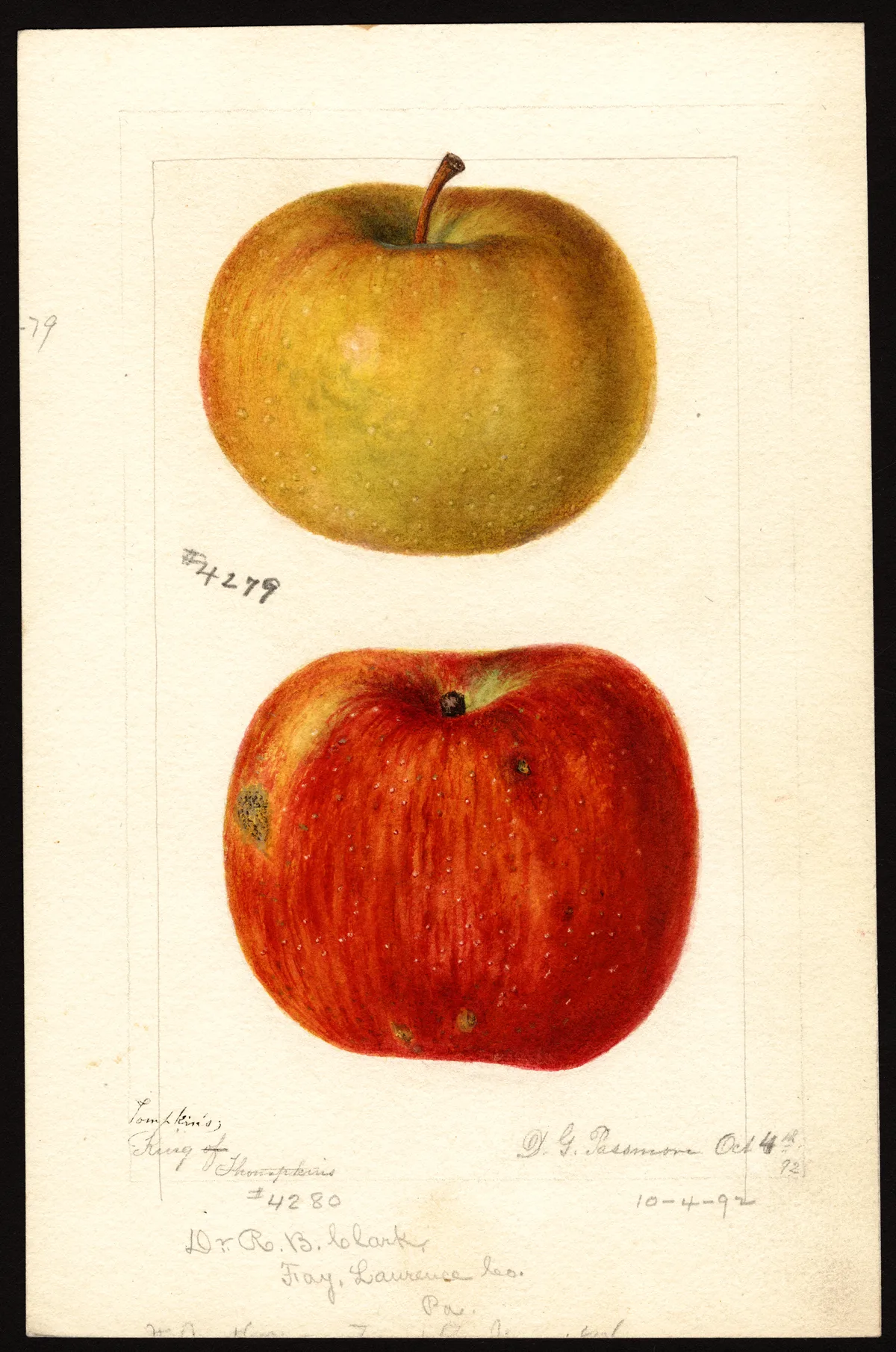
USDA Pomological Watercolor Collection
King
Origin / History
The origin of King has been a matter of some inquiry. Early accounts (Elliott, Warder) place its origin in Tompkins County, New York, where it was much cultivated, with Elliott noting it was "supposed to have been brought at an early day from New Jersey to Jacksonville, Tompkins Co., N. Y." Later and more thorough investigations established that the variety actually originated near Washington, Warren County, New Jersey, and was brought to Tompkins County, N. Y., by Jacob Wycoff about 1804, who named it King (Downing attributes its origin to Thomas Thacher of Warren Co., N. J.; Budd-Hansen give "supposed origin Essex Co., New Jersey, but was first noticed as a heavy bearer in Tompkins Co., New York, in 1838"; Hedrick gives Warren County, N. J., brought to Tompkins County about 1804; Bunyard's Handbook gives "Originated in New Jersey before 1800"). Bunyard's earlier investigation found that the tree at Jacksonville long supposed to be the original had been grafted, and could not be the original seedling. The Congress of Fruit Growers at Rochester added "Tompkins County" to the name to distinguish it from other King apples; the American Pomological Society included it in its 1856 Rochester catalogue under the name Tompkins King. Elliott emphasizes it is distinct from the "King" of Kentucky and the Newark King of New Jersey. Beach notes that Twenty Ounce Pippin has also been known locally to a limited extent as King, but is a very different variety.
Beach quotes in full James M. Mattison of Jacksonville, N. Y., who investigated the variety's origin during the winter of 1860 and published in the Horticulturist: about fifty-six years before (i.e., ca. 1804) Jacob Wycoff brought it from Warren County, N. J., having procured grafts on a visit there; Wycoff moved to Tompkins County about sixty years before and always claimed the variety to be a seedling, naming it King. Mattison traced the origin to a spot about one and a half to two miles from Washington, Warren county, N. J., on the north side of the Musconetcong mountain. He found very old grafted trees seemingly over fifty years old; two aged men, Daniel Fleet and William Crivling, near Asbury, were both acquainted with it from boyhood. Jesse Weller said he knew one very old tree on his farm forty years before, since dead. The apple is called Toma Red throughout that section and is confined to a small locality. Mattison reported the New Jersey fruit "not quite as high flavored" as that grown between Cayuga and Seneca lakes. He noted the tree's growth is entirely distinct, with limbs growing "so very horizontal that the tree needs scarcely any pruning," and that it is a regular bearer every year and a fine, thrifty grower. He reported barrels selling that year for four and five dollars in his vicinity, considering it the most productive and highest-priced market apple of the area. He noted the apple is "one of those crimson red with yellow ground that attracts the eye," with a flavor "equal to the Swaar," and that it "wants gathering ten to fifteen days before the Baldwin or Greening, and if carefully done, will keep good until the first of May."
The first published description Beach found is in the New Genesee Farmer in 1842 under the name King Apple. The earliest mention of nursery propagation is the statement by Ellwanger and Barry of Rochester, N. Y., in 1845, that they had trees of it for sale. In 1848 T. C. Maxwell and Brothers of Geneva, N. Y., began propagating it extensively. Thomas in 1848 described it as King and noted it was cultivated in Tompkins and Cayuga counties but not widely spread. Cole mentioned it in 1849 as King from Ellwanger and Barry. In 1851 Emmons described it as Winter King from Tompkins county. Over the following sixty years cultivation extended through New England, portions of Canada, Michigan, New Jersey, Pennsylvania, and Ohio. The variety has practically failed to establish itself in the Mississippi valley but is quite well known on the Pacific Coast from Washington southward into California.
Tree
Tree vigorous, healthy, large and spreading, open; an abundant annual bearer (Warder); annually productive (Elliott); Downing: "Tree very vigorous, spreading, an abundant bearer annually." Budd-Hansen: "tree very vigorous, large, spreading, an annual bearer, moderately productive usually." Thomas describes it as "a strong grower with few branches. Shoots slightly flexuous; a good but not heavy bearer." Hedrick: "Tree vigorous, spreading, open; lateral branches slender and drooping." Lowther: "Form of tree spreading, open; lateral branches rather slender and somewhat drooping. Twigs long to above medium, curved or irregularly crooked, moderately stout with thick tips; internodes long to below medium. Bark dark brownish red, mingled with yellowish green." Mattison reports the limbs grow "so very horizontal that the tree needs scarcely any pruning," and is a regular annual bearer and "fine, thrifty grower." Bunyard's Handbook: "Growth, vigorous, rather drooping; moderately fertile. Leaf, large, long-oval, upfolded, undulating, sharply serrate, down-hanging." Downing notes the young shoots are "very dark reddish brown, quite downy, especially toward the ends."
Beach treats productiveness with conflicting attribution: as a rule the tree does not come into bearing very young, but with maturity usually becomes a regular bearer, yielding rather light to moderately heavy crops biennially or sometimes nearly annually. He notes it is "frequently regarded as a shy bearer and too unproductive for a good commercial variety, and it nowhere has the reputation of being a heavy cropper," yet many fruit growers find it profitable. In New York State as a whole it probably ranks fourth in commercial importance, surpassed by Baldwin, Rhode Island Greening, and Northern Spy. Hedrick concurs that the trees "lack in hardiness, healthiness, longevity, and productiveness, so that few varieties are harder to handle." Beach notes that in the nursery it makes only a moderate root growth, and in the orchard it is subject to sun-scald and canker, as well as injury at the ground from "collar rot" or "collar blight" — cause not definitely known, suspected to be either a parasitic fungus or primarily winter injury. The variety is more liable to winter injury than most standard sorts of the region; on heavy, poorly drained soils, in unfavorable Central New York locations, trees have sometimes been entirely killed by winter. Beach quotes E. W. Catchpole of North Rose, Wayne county, who reports that in an 1861 orchard of Baldwin, Rhode Island Greening, and Tompkins King, the King has been neither as hardy nor as productive as the others, with considerable vacancies in the rows. H. D. Cole of Interlaken, southern Seneca county, reports an orchard of Tompkins King top-grafted about seventy years ago upon trees planted about one hundred years ago, still bearing good crops; he regards the variety as not sufficiently hardy on its own trunk, but vigorous, healthy, long-lived, and reliably productive when top-worked upon hardy stock. The general recommendation is to top-work on stronger-rooted, hardier varieties: common seedling stock, Tolman Sweet, Northern Spy, Rhode Island Greening, Oldenburg, Golden Russet, or Roxbury. Hedrick reiterates: "Many recommend working King on a more vigorous stock." Beach also notes the variety is generally more liable to loss from wormy fruit and less subject to apple scab injury than either Baldwin or Rhode Island Greening; Hedrick agrees that "Codlin-moth takes heavy toll, but there is comparatively little injury from apple-scab, though the trees suffer much from apple-canker, sun-scald, and collar-rot." Because the fruit is large, there is often considerable loss in windfalls, so a sheltered location away from prevailing winds is advised.
Fruit
Size
Large (Elliott, Warder, Budd-Hansen); "sometimes quite large" (Thomas); "uniformly large" (Beach); "large to very large, uniform in shape and size" (Hedrick); Bunyard's Handbook gives "large, 3¼ by 3¼"; George Bunyard catalogue gives "Medium sized"; Central Experimental Farm: "Fruit large"; Veitch: "large."
Form
Roundish oblong, somewhat ribbed (Elliott); large, handsome, globular, irregular, somewhat conic, angular (Warder); globular, inclining to conic, sometimes oblate, angular (Downing); roundish, ribbed (Thomas); globular, inclining to conical, sometimes roundish oblate, angular (Budd-Hansen); "oval, conical, irregular" (Bunyard's Handbook); "round or oblate, sometimes conic, regular or obscurely ribbed" (Hedrick); "large globular, conical" (Central Experimental Farm); "roundish" (Veitch). Hedrick adds: "uniform in shape and size."
Stem / Stalk
Stout, thick (Elliott); short or long, thick or slender, red (Warder); rather stout and short (Downing); long or short, stout or slender (Budd-Hansen); slender, in a wide slightly russeted cavity (Bunyard's Handbook); "short to long, sometimes thick and swollen" (Hedrick).
Cavity
Open, regular (Elliott); wide, shallow, wavy (Warder); large, somewhat irregular (Downing); large, often irregular, obtuse, yellow, with trace of russet (Budd-Hansen); wide, slightly russeted (Bunyard's Handbook); "large, obtuse, deep, narrow, furrowed or wavy, occasionally lipped, often russeted, sometimes with fine outspreading russet" (Hedrick).
Calyx / Eye
Calyx with long pointed segments (Elliott); eye large, short, closed (Warder); calyx small and closed (Downing); calyx small, closed; segments erect convergent (Budd-Hansen); eye closed, in a moderately ribbed basin, generally higher on one side (Bunyard's Handbook); calyx large, closed or open; segments long, acuminate (Hedrick).
Basin
Abrupt, slight furrows, and projecting ribs surrounding (Elliott); shallow, folded (Warder); medium, slightly corrugated (Downing); narrow, shallow, smooth, or slightly wrinkled (Budd-Hansen); moderately ribbed, generally higher on one side (Bunyard's Handbook); small, narrow, shallow, deep, abrupt, regular or obscurely ridged and wrinkled (Hedrick).
Skin / Color
Pale yellow ground, mostly covered with two shades of red, striped and splashed, brown dots, and russet patches on sunny side (Elliott); surface smooth, yellow, covered deep red, marbled and striped; dots numerous, gray, large (Warder); yellowish, mostly shaded with red, striped and splashed with crimson (Downing); deep red, in stripes (Thomas); surface deep rich yellow, mostly covered with shaded and dotted bright red, with dark crimson stripes and splashes; dots distinct, numerous, light russet, large (Budd-Hansen); "a beautiful red color, with enough clearly contrasting yellow to make a very attractive appearance" (Beach); "varies in color from striped to a beautiful red with enough contrasting yellow" (Lowther); "Skin smooth, somewhat roughened with russet dots, fine yellow mottled and washed with orange red, often shading to lively deep red, splashed and striped with bright carmine. Dots rather numerous, conspicuous, white or russet" (Lowther); "Colour, golden-yellow with bright red flush and broad broken stripes" (Bunyard's Handbook); "skin smooth or roughened with russet dots, yellow, mottled and washed with orange-red, often shading to deep red, striped and splashed with bright carmine; dots numerous, conspicuous, white or russet; prevailing effect red over yellow" (Hedrick); "Skin yellow, nearly covered with deep red" (Central Experimental Farm); "golden-yellow, flushed with carmine" (Veitch).
Flesh / Flavor
Yellowish, crisp, juicy, sub-acid (Elliott); yellowish-white, tender, breaking; flavor sub-acid, aromatic; quality best (Warder); yellowish, rather coarse, juicy, tender, with an exceedingly agreeable, rich, vinous flavor, delightfully aromatic; very good to best (Downing); tender, juicy, rich, high flavored (Thomas); yellow, juicy, rather coarse, tender, rich, vinous, very agreeable subacid, very good to best (Budd-Hansen); "crisp, rather dry, tender, markedly yellow, sweet and of excellent flavour, slightly fragrant" (Bunyard's Handbook); "attractive, yellowish, rather coarse, crisp, tender, aromatic, juicy subacid, very good" (Lowther); "rather coarse, it is crisp, tender, juicy, aromatic, and richly flavored… yellow, coarse, crisp, tender, aromatic, juicy, subacid; very good to best" (Hedrick); "yellowish, a little coarse, juicy, tender, with a very agreeable pleasant flavour, quality very good" (Central Experimental Farm); "juicy and fine-flavoured" (Veitch). Mattison: the flavor is "very agreeable perfumed flavor… equal to the Swaar." Beach summarizes: "excellent in quality for either dessert or culinary uses."
Core / Seeds
Warder: "Core very large, turbinate, regular, closed; Seeds imperfect, angular." Budd-Hansen: "Core closed, meeting, large, sessile, turbinate; cells elliptical, widely slit, with much exudate; tube funnel-shaped; stamens basal; seeds few, about half imperfect, large, long." Hedrick: "calyx-tube small, cone-shape; stamens median; core large, abaxile; cells symmetrical, closed or partly open; core-lines meeting; carpels ovate or obovate, tufted, mucronate, slightly emarginate if at all; seeds few, large, long, irregular, obtuse, often abortive, tufted."
Season
Elliott: December to February. Warder: December and longer. Downing: December to March. Thomas: "Early winter, and keeps through winter," noting it drops its fruit rather early and should be gathered soon. Beach: "in season from October or late September to December and January or later. In common storage its commercial limit is December, or exceptionally January, and in cold storage usually February, but in some cases later." The fruit often begins to show some decay in November and sometimes even in October; some fruit is often kept in cellars till spring, but not with prime flavor, for usually it begins to lose flavor by midwinter or earlier. Keeping qualities do not vary so much across seasons as is the case with many other sorts. Mattison reports careful handling can keep the fruit good until the first of May, and that it "wants gathering ten to fifteen days before the Baldwin or Greening." Lowther: "Its season is from late September to early December." Budd-Hansen: December to March. Bunyard's Handbook: "Dessert, till April." Hedrick: "In common storage, King keeps until January, and in cold storage two or three months later"; flesh season "October to April." Central Experimental Farm: November and December. Veitch: October to March. Beach notes it does not keep quite as late in storage as Rhode Island Greening, but rather later than Hubbardston.
Uses
Table, kitchen, and market (Warder); "a valuable market fruit" (Downing); "excellent in quality for either dessert or culinary uses. It is well adapted for marketing in fancy packages and is in good demand for both special and general trade, often selling at an advance over standard varieties in both domestic and foreign markets" (Beach); "well adapted for marketing in fancy packages, and is in good demand for the special or general trade" (Lowther); "A favorite for export as it keeps well and stands shipment well" (Budd-Hansen); "Dessert" (Bunyard's Handbook); "Very delicious when well grown" (Bunyard's Handbook); "one of the most widely planted apples in home orchards, and in either home or foreign market sells for a higher average than most other standard apples" (Hedrick); "an excellent variety for the home garden and highly esteemed in America" (Veitch); Mattison: dealers realized four and five dollars per barrel the previous fall, and the variety is regarded locally as the most productive and highest-priced market apple of his vicinity. The principal demand comes in late fall and early winter (Beach). George Bunyard catalogue: "Good keeper and good flavor. This variety will always be found in cultivation as its bearing is a regular variety."
Regional Performance
Beach: Tompkins King has been quite generally cultivated throughout the principal apple-growing districts of New York State, often with fairly good success, particularly on fertile, well-drained soils or when top-worked upon thrifty, hardy stock. In the lake region of Central and Western New York it often appears to succeed better on the uplands than close to the lakes. Thomas: "Succeeds East and West at the North, but not so well farther South." Lowther: "It is probably better adapted to the northeastern part of the United States than in any other part but it does fairly well in some other parts. In the Pacific Northwest it does not reach that high degree of perfection that makes it one of the most desirable in New York. While in this section the tree is a very vigorous grower, and the fruit well developed and of good quality, it is not relatively as desirable as some other varieties." Bunyard's Handbook: "This I have seen equal to American samples from a Sandstone soil." Hedrick notes it is widely distributed throughout the North and East, but most commonly grown in New York. Beach notes practical failure to establish in the Mississippi valley but good reputation on the Pacific Coast from Washington southward into California.
Subtypes / Variants
Not described in source.
Other
[NOTE: Source text may be incorrect — the Stark Bros. Year Book (1910) entry reads "Black; much larger than Concord, also more beautiful in appearance of bunches well-formed and showy like Concord, and to reliable." This describes a black grape variety (compared to Concord), not the King apple, and appears to be a misattribution or extraction error. It is not incorporated into the merged description above.]
Book Sources
Described in 9 period pomological works
- Bunyard, A Handbook of Hardy Fruits (1920)
- Beach, The Apples of New York Vol. 1 (1905) — listed as TOMPKINS KING
- Downing, Fruits and Fruit Trees of America (1900) — listed as King of Tompkins County
- Lowther (ed.), Encyclopedia of Practical Horticulture (1914) — listed as Tompkins King
- Hedrick, Cyclopedia of Hardy Fruits (1922)
- Thomas, The American Fruit Culturist (1903)
- Warder, American Pomology: Apples (1867) — listed as King of Tompkins County
- Budd & Hansen, Systematic Pomology (1914) — listed as Tompkins King (King of Tompkins County)
- Elliott, The Western Fruit Book (1865) — listed as King of Tompkins County
Nursery Catalog Sources
Found in 75 catalogs (1845–1955) from California, England, Illinois, Massachusetts, Missouri, Nebraska, New Jersey, New York, Oregon, Washington
- Winship's Nursery (Brighton Nurseries , operated by the Winship family), Brighton (Boston) , Massachusetts — 1845
- Hovey & Co. , Cambridge , Massachusetts — 1849
- Azell Bowditch (Nursery / Fruit Catalog) , Boston , Massachusetts — 1850 — listed as Tompkins King
- St. Helena Nursery , Howell's Prairie, Marion County , Oregon — 1864
- Hutchison Nursery , James Hutchison, Oakland , California — 1881
- Felix Gillet , Barren Hill Nursery, Nevada City , California — 1884
- Fancher Creek Nursery , Fresno , California — 1886
- W.R. Strong & Co. , Capital and Orange Hill Nurseries (Robert Williamson, prop.), Sacramento , California — 1886
- Felix Gillet , Barren Hill Nursery, Nevada City , California — 1888
- California Nursery Co. , Niles , California — 1889
- Felix Gillet , Barren Hill Nursery, Nevada City , California — 1889
- Felix Gillet , Barren Hill Nursery, Nevada City , California — 1890
- Felix Gillet , Barren Hill Nursery, Nevada City , California — 1891
- Puyallup & Yakima Nurseries , Puyallup, Washington (Lock Box 191) and North Yakima , Washington — 1892
- Oregon Wholesale Nurseries , Salem , Oregon — 1893
- Milwaukie-Canby Nurseries , Canby, OR (and Milwaukie, OR) — 1893
- The Vineland Nurseries (Kelsey & Co. , Proprietors), St. Joseph, Missouri (Office: 13th and Atchison Sts., 2 Blocks East of the Citizens St. Car Line) — 1894
- Multnomah Nurseries , Russellville , Oregon — 1894
- Woodburn Nurseries , Woodburn, Marion Co. , Oregon — 1894
- Felix Gillet , Barren Hill Nursery, Nevada City , California — 1895
- The Lovett Company , Little Silver , New Jersey — 1896
- Kelway & Son , Langport, Somerset , England — 1897
- Felix Gillet , Barren Hill Nursery, Nevada City , California — 1897
- Stark Bros. Nurseries & Orchards Co. , Louisiana , Missouri — 1898
- Arthur J. Collins & Sons , Moorestown , New Jersey — 1898
- George Bunyard & Co. , Royal Nurseries, Maidstone, Kent , England — 1900
- Central Experimental Farm , Dominion Department of Agriculture, Agassiz, British Columbia (under test; Bulletin No. 3, Second Series) — 1900
- The Dalles Nurseries , The Dalles , Oregon — 1901
- Washington Nursery Co. , Toppenish , Washington — 1901
- S.L. Watkins , Grizzly Flats, El Dorado County , California — 1901
- Benjamin Buckman (personal inventory) , Farmingdale , Illinois — 1901
- Forestville Nurseries , T.J. True, Forestville , California — 1902
- Pacific Nursery Company (W. O. Hudson & A. D. Hudson) , Tangent , Oregon — 1903
- Russellville Nursery Co. , Russellville, OR (three miles east of Portland, one mile from Montavilla car line) — 1903
- Phoenix Nursery Company (W. E. Rossney , President; Sidney Tuttle, Vice-President), Bloomington , Illinois — 1904
- Stark Bros. Nurseries & Orchards Co. , Louisiana , Missouri — 1906
- J.B. Pilkington , Portland , Oregon — 1907
- Russellville Nursery Co. , Montavilla Station, Portland, OR (three miles east of Portland, one mile from Montavilla car line) — 1907
- Carlton Nursery Co. , Carlton , Oregon — 1909
- Milton Nursery Co. (A. Miller & Sons , Proprietors), Milton , Oregon — 1909
- Washington Nursery Company , Toppenish , Washington — 1909
- C.F. Lansing , Salem , Oregon — 1910
- Stark Bros. Nurseries & Orchards Co. , Louisiana , Missouri — 1910
- Galbraith Nursery Co. (DeWitt Hansen , Pres.-Mgr.), Fairbury , Nebraska — 1911
- Stark Bros. Nurseries & Orchards Co. , Louisiana , Missouri — 1911
- James Veitch & Sons , Ltd., Royal Exotic Nursery, Chelsea, London (also Coombe Wood, Langley, and Feltham) , England — 1911
- Island Nurseries & Fruit Farm , Vashon (Vashon Island) , Washington — 1911
- Stark Bros. Nurseries & Orchards Co. , Louisiana , Missouri — 1912
- Ballygreen Nurseries , Hanford , Washington — 1912
- Pacific Nursery Company , Portland , Oregon — 1912
- Vineland Nurseries Company , Clarkston , Washington — 1912
- Washington Nursery Company , Toppenish , Washington — 1912
- J. B. Pilkington , Nurseryman, Portland, OR (nurseries near Newberg, forty miles from Portland) — 1913
- Van Holderbeke Nursery Co. , Incorporated, Spokane, Washington (nurseries at Otis Orchards WA, Pasadena WA, Kennewick WA) — 1913
- Samuel Fraser , Geneseo , New York — 1913
- Benjamin Buckman (personal inventory) , Farmingdale , Illinois — 1913
- George Bunyard & Co. , Royal Nurseries, Maidstone, Kent , England — 1914
- Island Nurseries & Fruit Farm , Vashon (Vashon Island) , Washington — 1914
- Island Nurseries & Fruit Farm , Vashon (Vashon Island) , Washington — 1915
- Union Nurseries , J.B. Weaver & Sons, Union , Oregon — 1915
- Island Nurseries & Fruit Farm , Vashon (Vashon Island) , Washington — 1916
- Manalapan Nurseries , Englishtown , New Jersey — 1916
- George Bunyard & Co. , Royal Nurseries, Maidstone, Kent , England — 1917
- Island Nurseries & Fruit Farm , Vashon (Vashon Island) , Washington — 1917
- Stark Bros. Nurseries & Orchards Co. , Louisiana , Missouri — 1918
- Fancher Creek Nurseries , George C. Roeding, Fresno , California — 1918
- Oregon Nursery Co. , Orenco , Oregon — 1920
- Christopher Nurseries / John Stewart & Sons , Christopher , Washington — 1920
- Island Nurseries & Fruit Farm , Vashon , Washington — 1921
- Benedict Nursery Co. , Portland , Oregon — 1921
- Fresno Nursery Co. , Fresno , California — 1924
- Columbia & Okanogan Nursery Co. , Wenatchee , Washington — 1925
- Hudson's Wholesale Nurseries , Tangent , Oregon — 1926
- Carlton Nursery Co. , Forest Grove , Oregon — 1955
- Rich & Sons Nursery , Hillsboro , Oregon
View original book sources (13)
— F.R. Elliott, The Western Fruit Book (1865)King of Tompkins County.
Winter King | King.
This variety we have had more or less acquaintance with for the past ten years. It is really one of the most valuable apples grown at the North. Its origin is uncertain. Supposed to have been brought at an early day from New Jersey to Jacksonville, Tompkins Co., N. Y. It is distinct from "King" of Ky., and Newark King of N. J. Tree, annually productive. Fruit, large, roundish oblong, somewhat ribbed, pale yellow ground, mostly covered with two shades of red, striped and splashed, brown dots, and russet patches on sunny side ; stem, stout, thick ; cavity, open, regular ; calyx, with long pointed segments ; basin, abrupt, slight furrows, and projecting ribs surrounding ; flesh, yellowish, crisp, juicy, sub-acid. December to February.
— John A. Warder, American Pomology: Apples (1867)King.
KING OF TOMPKINS COUNTY.
This splendid apple, which has attracted so much attention of recent years, had its origin, as is supposed, in Tompkins County, New York, where it has been much cultivated.
Tree vigorous, healthy, large and spreading, an abundant annual bearer.
Fruit large, handsome, globular, irregular, somewhat conic, angular; Surface smooth, yellow, covered deep red, marbled and striped; Dots numerous, gray, large.
Basin shallow, folded; Eye large, short, closed.
Cavity wide, shallow, wavy; Stem short or long, thick or slender, red.
Core very large, turbinate, regular, closed; Seeds imperfect, angular; Flesh yellowish-white, tender, breaking; Flavor sub-acid, aromatic; Quality best; Use, table, kitchen and market; Season, December and longer.
— A.J. Downing, The Fruits and Fruit Trees of America (1900)King of Tompkins County.
King Apple. Toms Red. Tommy Red.
Origin uncertain; said to have originated with Thomas Thacher, Warren Co., N. J. A valuable market fruit. Tree very vigorous, spreading, an abundant bearer annually. Young shoots very dark reddish brown, quite downy, especially toward the ends.
Fruit large, globular, inclining to conic, sometimes oblate, angular. Color yellowish, mostly shaded with red, striped and splashed with crimson. Stalk rather stout and short, inserted in a large, somewhat irregular cavity. Calyx small and closed, set in a medium, slightly corrugated basin. Flesh yellowish, rather coarse, juicy, tender, with an exceedingly agreeable, rich, vinous flavor, delightfully aromatic. Very good to best. December to March.
— John J. Thomas, The American Fruit Culturist (1903)King.* (Tompkins County King.) Sometimes quite large, roundish, ribbed; color a deep red, in stripes; flesh tender, juicy, rich, high flavored. Tree a strong grower with few branches. Shoots slightly flexuous; a good but not heavy bearer. Drops its fruit rather early, and should be gathered soon. Early winter, and keeps through winter. Fig. 421. Succeeds East and West at the North, but not so well farther South. New Jersey.
— S.A. Beach, The Apples of New York, Vol. 1 (1905)TOMPKINS KING.
References. 1. New Genesee Farmer, 3:57. 1842. 2. Cultivator, 1:390. 1844. 3. Ellwanger and Barry, Ib., 2:57. 1845. 4. Thomas, Ib., 5:306. 1848. fig. 5. Cole, 1849:122. 6. Emmons, Nat. Hist. N. Y., 3:73. 1851. col. pl. No. 38. 7. Hovey, Mag. Hort., 20:178, 509. 1854. fig. 8. Elliott, 1854:142. 9. Am. Pom. Soc. Cat., 1856. 10. Horticulturist, 11:397. 1856. fig. 11. Mag. Hort., 22:545. 1856. 12. Downing, 1857:84. fig. 13. Hooper, 1857:50. 14. Mag. Hort., 24:111. 1858. 15. Mattison, Horticulturist, 15:213. 1860. 16. Mag. Hort., 27:98. 1861. 17. Warder, 1867:655. fig. 18. Fitz, 1872:157. 19. Thomas, 1875:217. 20. Barry, 1883:348. 21. Hogg, 1884:124. 22. Wickson, 1889:245. 23. Lyon, Mich. Hort. Soc. Rpt., 1890:298. 24. Bailey, An. Hort., 1892:242. 25. Rural N. Y., 53:28. 1894. 26. Hoskins, Ib., 53:310. 1894. 27. Woolverton, Ont. Fr. Stas. An. Rpt., 2:10. 1895. fig. 28. Card, Gard. and For., 9:10. 1896. 29. U. S. Pom. Bul., 7:356. 1898. 30. Bunyard, Jour. Roy. Hort. Soc., 1898:356. 31. Waugh, Vt. Sta. An. Rpt., 14:297. 1901. 32. Can. Hort., 26:405. 1903. 33. Budd-Hansen, 1903:190. 34. Powell and Fulton, U. S. B. P. I. Bul., 48:58. 1903. 35. Beach and Clark, N. Y. Sta. Bul., 248:147. 1904.
Synonyms. Flat Spitzenburg (28). King (5, 7, 17, 19, 24, 27, 31). King (15, 34). King Apple (1, 2, 3, 4, 32, of New York 10, of Western New York 8 and 13). King Apple (12). King of Tompkins County (12, 14, 15, 16, 18, 20, 21, 22, 26, 30). King of Tompkins County (17, 27, 28, 33, 35). Toma Red (15). Tommy Red (21). Tompkins County King (19). Tom's Red (21). Winter King (6).
This apple is commonly called King. Less frequently it is called Tompkins County King or King of Tompkins County. Pomologists now accept Tompkins King as the correct name.
The fruit has a beautiful red color, with enough clearly contrasting yellow to make a very attractive appearance. It is symmetrical, uniformly large, and excellent in quality for either dessert or culinary uses. It is well adapted for marketing in fancy packages and is in good demand for both special and general trade, often selling at an advance over standard varieties in both domestic and foreign markets. The principal demand for it comes in late fall and early winter. It does not keep quite as late in storage as Rhode Island Greening, but rather later than Hubbardston. It is in season from October or late September to December and January or later. In common storage its commercial limit is December, or exceptionally January, and in cold storage usually February, but in some cases later. The fruit often begins to show some decay in November and sometimes even in October. Its keeping qualities do not vary so much in different seasons as is the case with many other sorts (35). Some of the fruit is often kept in cellars till spring, but not with prime flavor, for usually it begins to lose flavor by midwinter or earlier.
Tompkins King has been quite generally cultivated throughout the principal apple-growing districts of the state and often with fairly good success, particularly when planted on fertile, well-drained soils or top-worked upon thrifty, hardy stock. In the lake region of Central and Western New York in many cases it appears to succeed better on the uplands than it does close to the lakes. The fruit being large, there is often a considerable loss in windfalls, and on this account it is well to select a location for this variety that is well sheltered from prevailing winds. Generally it is regarded as more liable to loss from wormy fruit and less subject to injury from apple scab than either Baldwin or Rhode Island Greening. As a rule the tree does not come into bearing very young, but with maturity usually becomes a regular bearer, yielding rather light to moderately heavy crops biennially or sometimes nearly annually. Frequently it is regarded as a shy bearer and too unproductive for a good commercial variety, and it nowhere has the reputation of being a heavy cropper, yet many fruit growers find it a profitable commercial variety. Taking the state as a whole, it probably ranks fourth in commercial importance, being surpassed by Baldwin, Rhode Island Greening and Northern Spy.
Were the tree hardier, healthier, longer-lived and more productive, Tompkins King would be much more extensively grown in commercial orchards. In the nursery it makes but a moderate root growth, and in the orchard it is somewhat subject to sun-scald and canker as well as to injury at the surface of the ground from what is commonly called "collar rot" or "collar blight." The cause of this collar rot is not definitely known. Some suppose that it may be due to a parasitic fungus; others that it is caused primarily by winter injury. Tompkins King is certainly more liable to winter injury than are most of the standard sorts of this region. Even in some parts of Central New York, when standing in unfavorable locations, and particularly if on heavy, poorly drained soils, trees have sometimes been entirely killed by the winter, yet in many localities the variety has succeeded so well that it is regarded as pretty hardy and long-lived. E. W. Catchpole of North Rose, Wayne county, reports that in an orchard planted in that locality in 1861 with Baldwin, Rhode Island Greening and Tompkins King, the Tompkins King has been neither as hardy nor as productive as either of the other two varieties named and already shows a considerable number of vacancies in the rows. H. D. Cole of Interlaken, in southern Seneca county, reports that he has an orchard of Tompkins King top-grafted about seventy years ago upon trees which were planted about one hundred years ago. These trees are still bearing good crops. He regards this variety as not sufficiently hardy if grown on its own trunk, but vigorous, healthy, long-lived and reliably productive when top-worked upon hardy stock. The experience of many other fruit growers throughout the state corroborates that of Mr. Catchpole and Mr. Cole and goes to show, that because of its comparatively weak root development and liability to collar rot and winter injury, Tompkins King should be top-worked upon some variety which has a stronger root development and a more hardy trunk. Some have had good success in using common seedling stock for this purpose and others have found satisfactory results from top-working it upon Tolman Sweet, Northern Spy, Rhode Island Greening, Oldenburg, Golden Russet, Roxbury and other vigorous, hardy varieties.
Historical. Some have thought that the original tree of Tompkins King grew at Jacksonville, Tompkins county, N. Y., but Bailey found that that tree had been grafted and therefore it could not be the original seedling (28). The variety appears to have originated near Washington, Warren county, N. J. It is said to have been brought from that locality to Tompkins county, N. Y., by Jacob Wycoff in 1804 by whom it was named King. The Congress of Fruit Growers at Rochester added Tompkins County to its name to distinguish it from other King apples (15). James M. Mattison of Jacksonville, N. Y., investigated the subject of the origin of Tompkins King during the winter of 1860 and published an account of his investigation in the April number of the Horticulturist of that year. We quote his report in full.
"Having given the subject a pretty thorough investigation, I present the following as the true history of the King Apple of Tompkins County:
"About fifty-six years ago, Jacob Wycoff brought it from Warren county, N. J. Mr. Wycoff moved to this county about sixty years ago, and finding the art of grafting practised here, procured the grafts while on a visit fifty-six years ago. Mr. Wycoff is now dead, but always claimed it to be a seedling, and it was named by him, King. The Congress of Fruit Growers at Rochester added Tompkins County to it, to distinguish it from another of the same name.
"On a visit this winter I undertook to trace out its origin, and went to the place where it is said to have originated. This is about one and a half to two miles from Washington, Warren county, N. J. I found very old trees that had been grafted; they seemed to be over fifty years old; two aged men, Daniel Fleet and William Crivling, near Asbury, were both acquainted with it from boyhood. It originated on the north side of the Musconetcong mountain, about one mile from where these gentlemen live. Mr. Jesse Weller says he knew one very old tree on his farm forty years ago; it has been dead several years. They call the apple Toma Red throughout that section. It does not appear to be much disseminated, being confined to a small locality. I brought some of the apples with me, and compared them with mine. I also gave them some that were raised in my own orchard. They are not quite as high flavored in New Jersey as they are here between the lakes (Cayuga and Seneca).
"The tree is entirely distinct in growth. When I was in New Jersey I pointed out trees as I was going along the road, and inquired if they were not what we call the King of Tompkins County, and they said they were. The limbs grow so very horizontal that the tree needs scarcely any pruning, and one of its good qualities is, it is a regular bearer every year, and a fine, thrifty grower. Hundreds of barrels have been sold from this vicinity this year, and we are all of one mind, that it is the most productive, and will sell for the largest price per barrel of any market apple that is raised in this vicinity. Dealers realized four and five dollars per barrel last fall. The apple is one of those crimson red with yellow ground that attracts the eye, and its color will not disappoint you when you come to eat it. Its very agreeable perfumed flavor is equal to the Swaar. It wants gathering ten to fifteen days before the Baldwin or Greening, and if carefully done, will keep good until the first of May."
The first published description of the variety which we have found is that given in the New Genesee Farmer in 1842, under the name of King Apple (1). The earliest mention which we find of the propagation of this variety by nurserymen is the statement made by Ellwanger and Barry of Rochester, N. Y., in 1845, that they had trees of it for sale (3). In 1848 T. C. Maxwell and Brothers of Geneva, N. Y., began to propagate it extensively and were active in disseminating it. Thomas, in 1848, described it under the name of King and stated that it was cultivated in Tompkins and Cayuga counties but not widely spread (4). In 1849 Cole mentioned it under the name of King from Ellwanger and Barry, and in 1851 Emmons described it as the Winter King from Tompkins county (5, 6). In 1856 the American Pomological Society at its Rochester meeting included this variety in its catalogue under the name of Tompkins King, using the word Tompkins to distinguish it from other varieties which were then known under the name King. During the last sixty years its cultivation has extended through New England, portions of Canada, Michigan, New Jersey, Pennsylvania and Ohio. It has practically failed to establish itself in the Mississippi valley but is quite well known on the Pacific Coast, from Washington southward into California.
[Additional entry in this volume: "King", pp. 301–301]
KING.
Tompkins King, more often called King of Tompkins County, is usually known among fruit growers and fruit dealers as King. For an account of this variety the reader is referred to Tompkins King. Twenty Ounce Pippin has also been known to a limited extent locally as King, but it is a very different variety from Tompkins King.
— J.L. Budd & N.E. Hansen, American Horticultural Manual, Part II: Systematic Pomology (1914)Tompkins King (King of Tompkins County).—Supposed origin Essex Co., New Jersey, but was first noticed as a heavy bearer in Tompkins Co., New York, in 1838; tree very vigorous, large, spreading, an annual bearer, moderately productive usually. A favorite for export as it keeps well and stands shipment well.
Fruit large, globular, inclining to conical, sometimes roundish oblate, angular; surface deep rich yellow, mostly covered with shaded and dotted bright red, with dark crimson stripes and splashes; dots distinct, numerous, light russet, large; cavity large, often irregular, obtuse, yellow, with trace of russet; stem long or short, stout or slender; basin narrow, shallow, smooth, or slightly wrinkled; calyx small, closed; segments erect convergent. Core closed, meeting, large, sessile, turbinate; cells elliptical, widely slit, with much exudate; tube funnel-shaped; stamens basal; seeds few, about half imperfect, large, long; flesh yellow, juicy, rather coarse, tender, rich, vinous, very agreeable subacid, very good to best. December to March.
— Granville Lowther (ed.), Encyclopedia of Practical Horticulture (1914)Tompkins King
This apple is commonly called King. Less frequently it is called Tompkins County King, or King of Tompkins County.
The fruit varies in color from striped to a beautiful red with enough contrasting yellow to make it an attractive appearance. It is symmetrical, uniformly large, and excellent in quality, either for dessert, or culinary purposes. It is well adapted for marketing in fancy packages, and is in good demand for the special or general trade. Its season is from late September to early December. It is probably better adapted to the northeastern part of the United States than in any other part but it does fairly well in some other parts. In the Pacific Northwest it does not reach that high degree of perfection that makes it one of the most desirable in New York. While in this section the tree is a very vigorous grower, and the fruit well developed and of good quality, it is not relatively as desirable as some other varieties.
Historical. It is supposed to have originated near Washington, Warren county, New Jersey, and to have been brought from that place to Tompkins county, New York, in 1804, by Jacob Wycoff, who gave it the name of King.
Form of tree spreading, open; lateral branches rather slender and somewhat drooping. Twigs long to above medium, curved or irregularly crooked, moderately stout with thick tips; internodes long to below medium. Bark dark brownish red, mingled with yellowish green. Skin smooth, somewhat roughened with russet dots, fine yellow mottled and washed with orange red, often shading to lively deep red, splashed and striped with bright carmine. Dots rather numerous, conspicuous, white or russet. Flesh attractive, yellowish, rather coarse, crisp, tender, aromatic, juicy subacid, very good.
— E.A. Bunyard, A Handbook of Hardy Fruits (1920)KING OF TOMKINS COUNTY. New York, 346. (King, Winter King.) Dessert, till April, large, 3¼ by 3¼, oval, conical, irregular. Colour, golden-yellow with bright red flush and broad broken stripes. Flesh, crisp, rather dry, tender, markedly yellow, sweet and of excellent flavour, slightly fragrant. Eye, closed, in a moderately ribbed basin, generally higher on one side. Stem, slender, in a wide slightly russeted cavity. Growth, vigorous, rather drooping; moderately fertile. Leaf, large, long-oval, upfolded, undulating, sharply serrate, down-hanging. Originated in New Jersey before 1800. Very delicious when well grown. This I have seen equal to American samples from a Sandstone soil.
— U.P. Hedrick, Cyclopedia of Hardy Fruits (1922)KING: See Tompkins King.
[Additional entry in this volume: "TOMPKINS KING", pp. 82–82]
TOMPKINS KING. Fig. 56. King. Winter King.
Tompkins King, commonly shortened to King, has few superiors on the score either of beauty or quality of fruit; accordingly, it is one of the most widely planted apples in home orchards, and in either home or foreign market sells for a higher average than most other standard apples. The fruits are a beautiful red on a yellow background, handsomely moulded, uniformly large and symmetrical; while the flesh is rather coarse, it is crisp, tender, juicy, aromatic, and richly flavored. In common storage, King keeps until January, and in cold storage two or three months later. While the fruit is paramount, the trees are far from being so; they lack in hardiness, healthiness, longevity, and productiveness, so that few varieties are harder to handle. King thrives only in fertile, well-drained soils, and, since at best there are many windfalls, it must be sheltered from strong winds. Codlin-moth takes heavy toll, but there is comparatively little injury from apple-scab, though the trees suffer much from apple-canker, sun-scald, and collar-rot. Many recommend working King on a more vigorous stock. The variety originated in Warren County, New Jersey, whence, about 1804, it was brought to Tompkins County, New York, and given its present name. It is widely distributed throughout the North and East, but is most commonly grown in New York, where it ranks fourth in commercial importance.
Tree vigorous, spreading, open; lateral branches slender and drooping. Fruit large to very large, uniform in shape and size, round or oblate, sometimes conic, regular or obscurely ribbed; stem short to long, sometimes thick and swollen; cavity large, obtuse, deep, narrow, furrowed or wavy, occasionally lipped, often russeted, sometimes with fine outspreading russet; calyx large, closed or open; segments long, acuminate; basin small, narrow, shallow, deep, abrupt, regular or obscurely ridged and wrinkled; skin smooth or roughened with russet dots, yellow, mottled and washed with orange-red, often shading to deep red, striped and splashed with bright carmine; dots numerous, conspicuous, white or russet; prevailing effect red over yellow; calyx-tube small, cone-shape; stamens median; core large, abaxile; cells symmetrical, closed or partly open; core-lines meeting; carpels ovate or obovate, tufted, mucronate, slightly emarginate if at all; seeds few, large, long, irregular, obtuse, often abortive, tufted; flesh yellow, coarse, crisp, tender, aromatic, juicy, subacid; very good to best; October to April.
— Central Experimental Farm, Central Experimental Farm, Agassiz BC — Catalogue of Fruit Trees under Test (Bulletin No. 3, 1900) (1900)Planted Spring 1890. Tree a strong and spreading grower. Fruit large globular, conical. Skin yellow, nearly covered with deep red. Flesh yellowish, a little coarse, juicy, tender, with a very agreeable pleasant flavour, quality very good. Season November and December.
— George Bunyard & Co., George Bunyard Fruit Catalogue (1901) (1901)Medium sized, pale greenish with darker patches and fine striping. Good keeper and good flavor. This variety will always be found in cultivation as its bearing is a regular variety.
— Stark Bros. Nurseries & Orchards Co., Stark Bros. Year Book (1910) (1910)Black; much larger than Concord, also more beautiful in appearance of bunches well-formed and showy like Concord, and to reliable.
— James Veitch & Sons, Veitch's Fruit Trees (1911) (1911)large, roundish, golden-yellow, flushed with carmine. The flesh is juicy and fine-flavoured; an excellent variety for the home garden and highly esteemed in America. Oct. to Mar.