Wagener
Apple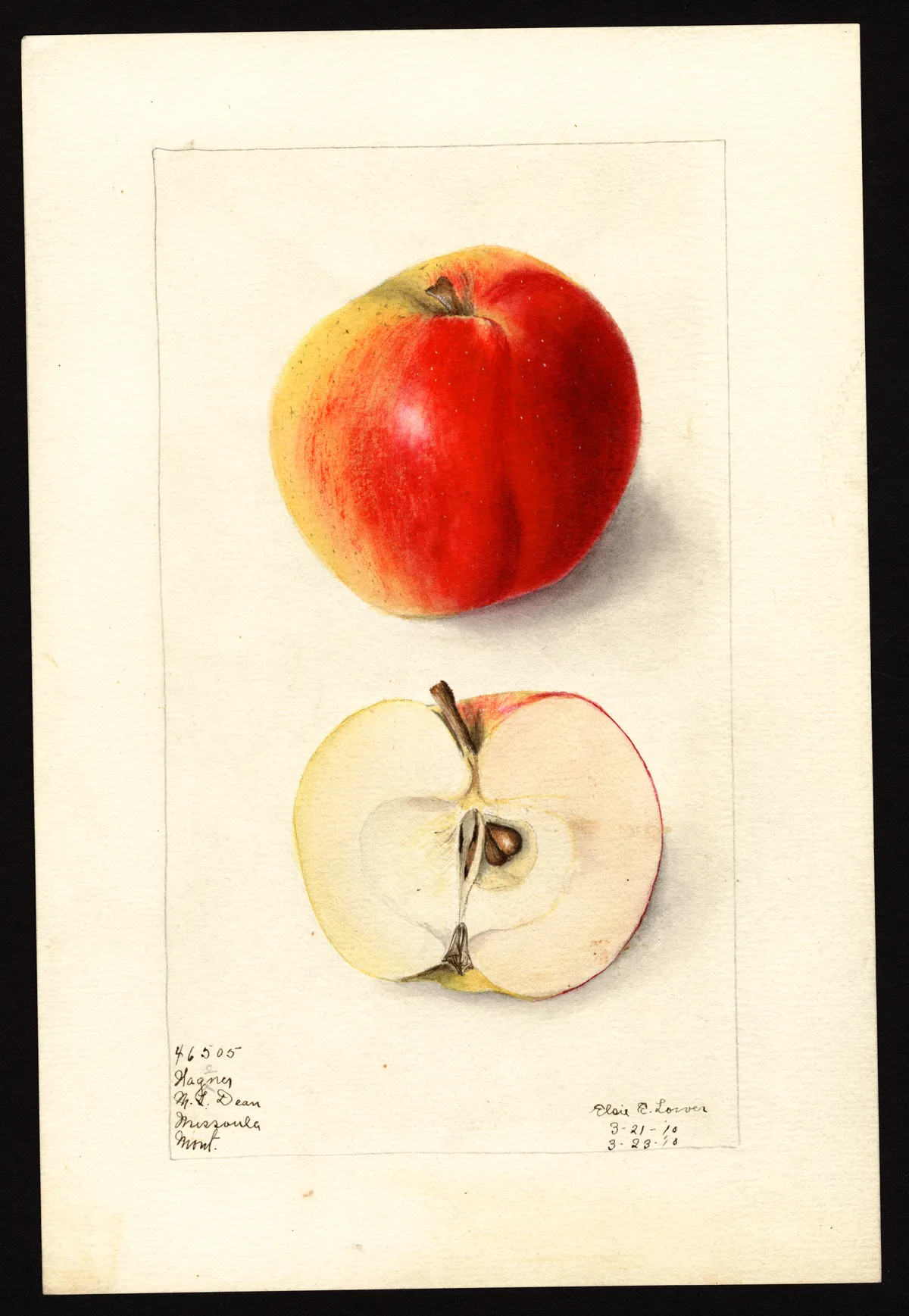
USDA Pomological Watercolor Collection
Wagener
Origin/History
Wagener originated at Penn Yan, Yates County, New York. The accepted history (Beach) traces it to the spring of 1791, when Mr. George Wheeler brought a quantity of apple seeds with him from Dover, Dutchess County, New York, to Penn Yan, and sowed them that spring in the nursery upon his farm, which he was then reclaiming from the wilderness. In 1796 Abraham Wagener, from whom the name of the apple is derived, bought this seedling nursery and planted trees from it upon his place in what is now the village of Penn Yan. Elliott likewise dates the seed sowing to 1791. Bunyard's account differs in detail, stating the variety was "raised in a garden of Abraham Wagener, about 1796, at Dover, New York State." Hedrick repeats that it came from seed planted in 1791, near Penn Yan, New York.
The first published reference appears in the Report of the N. Y. State Agricultural Society for 1847, where it was awarded second premium as a seedling of merit. In 1848 it was again presented for competition, placed by the committee in the list of first-class apples, awarded an additional premium and a diploma, and illustrated. The committee remarked: "This very fine apple the committee consider a desirable addition to the list of first-rate fruits. Its appearance is prepossessing as is also its size and form." In 1848 it was also noted that the old original tree was producing an annual and abundant yield of beautiful and delicious fruit, and it continued to bear full crops till about 1865. The Lowther account states that in 1848 Abraham Wagener propagated it so largely that it was given his name. After being brought to the notice of the State Agricultural Society, Wagener was propagated extensively and became widely disseminated throughout the country. By 1892 it was being offered quite generally by nurserymen throughout the country except in the North Mississippi valley, the Rocky Mountain region, and the plains from Nebraska to Texas. It is generally known throughout New York but is not planted extensively in any section of the state (Beach). It has been widely planted in all northern apple regions (Hedrick). Thomas notes it "succeeds well at the West."
Tree
Tree thrifty, upright, hardy, productive, and a very early bearer (Elliott, Warder, Downing, Budd-Hansen). Downing notes it requires thinning to produce good-flavored fruit and that when grown in the shade is wanting in flavor. Elliott states it "requires free trimming, in order to produce large sized fruit abundantly" and is an annual bearer. Young shoots pale green; old wood dark red (Elliott). Downing describes young wood as light reddish brown, slightly downy, with prominent buds.
Beach gives the fullest account: in the nursery, Wagener is a pretty good grower, upright and well-formed; in the orchard it is quite vigorous at first, but as it advances in maturity it usually becomes a rather weak grower, with branches full of fruit spurs. It comes into bearing at an early age and so long as it remains healthy is a reliable cropper, yielding moderate to rather heavy crops biennially or nearly annually. In many cases it overbears so that the fruit does not all develop properly in size and color; under such circumstances it is a great advantage to thin the fruit, ideally as early as June. The tree is often short-lived, but some report that it is longer-lived when top-worked upon hardier and more vigorous stock such as Northern Spy, Baldwin and Tolman Sweet. On account of its dwarfish form and habit of coming into bearing at an early age it is recommended by some fruit growers as a filler to plant between the rows of longer-lived apple trees.
Hedrick summarizes the tree as "most remarkable for precociousness in bearing," with merits of early bearing, annual and heavy crops, and hardiness, and faults of overloading, short life, susceptibility to blight, and vigorous at first but becoming very weak in growth with advancing age.
Detailed tree morphology (Beach): Tree dwarfish to medium size, at first moderately vigorous but soon becoming a slow grower; branches short, stout and filled with spurs. Form roundish to spreading, open. Twigs short to medium, often somewhat curved, moderately stout, usually quite blunt; internodes medium to short. Bark clear dark reddish-brown mingled with olive-green, lightly streaked with scarf-skin; pubescent near tips. Lenticels scattering, medium or below, elongated or sometimes roundish, not raised. Buds medium to rather large, sometimes projecting, plump, acute, free, pubescent. Hedrick gives substantially the same description: tree dwarf, at first vigorous but soon dwarfing, round to spreading, open; branches short, stout, and filled with spurs.
Lowther adds a regional observation: "as it grows in Washington, it is an upward grower, and branches shaped more like those of the Bartlett pear." Twigs are described as dark to medium, often somewhat curved, moderately stout, usually quite blunt, internodes medium to short. Bark clear dark reddish brown, mingled with olive green, lightly streaked with scarf skin; pubescent near the tips.
Bunyard records: Growth compact; fertile. Leaf long, pale, upfolded and twisted, regularly curved serrate.
The Central Experimental Farm (Agassiz BC, 1900) reports the tree (planted Spring 1893) as "a vigorous grower, and an early and regular bearer."
Fruit
Size
Medium (Elliott, Thomas); medium or above (Downing); above medium (Budd-Hansen, Central Experimental Farm); medium to rather large (Beach); medium to large (Lowther, Hedrick); large (Warder); large, handsome fruit (Stark Bros.). Bunyard gives specific dimensions: 2¾ by 2 inches.
Form
Roundish flattened, slightly ribbed at base (Elliott). Oblate or globular-oblate, pentangular (Warder). Roundish oblate (Downing). Oblate, distinctly ribbed (Thomas). Oblate, angular, often distinctly five-sided (Budd-Hansen). Oblate to roundish oblate, broadly ribbed or irregularly elliptical; sides often unequal (Beach, Lowther, Hedrick). Flat roundish, irregular (Bunyard). Roundish (Central Experimental Farm). Surface very smooth (Warder); surface smooth, polished (Budd-Hansen). Stark Bros. notes "smooth."
Stem
Slender (Elliott). Medium, green (Warder). Stalk nearly an inch long, rather slender (Downing). Stalk three-fourths of an inch long (Thomas). Stem medium (Budd-Hansen). Stem short to moderately long, moderately thick to rather slender (Beach). Stem short to long, slender (Hedrick). Stem rather long, slender (Bunyard).
Cavity
Wide, deep (Elliott). Regular, brown (Warder). Large, broad, irregular (Downing). Wide, rather obtuse (Thomas). Deep, obtuse, irregular, wide (Budd-Hansen). Variable, acute, moderately deep to deep, broad or sometimes compressed and rather narrow, often angular or furrowed, sometimes thinly russeted (Beach). Variable, acute, deep, broad or sometimes compressed and narrow, often angular or furrowed, thinly russeted (Hedrick). Deep, irregular, slightly russet (Bunyard).
Calyx
Small (Elliott). Eye small, closed (Warder). Small and closed (Downing). Calyx closed; segments erect convergent (Budd-Hansen). Small to medium, closed or partly open; lobes small, usually short, acute to acuminate, connivent, reflexed (Beach). Small, closed or partly open; lobes small, short, acute, connivent, reflexed (Hedrick). Eye closed (Bunyard).
Basin
Broad, open (Elliott). Wide, abrupt, regular (Warder). Rather abrupt, somewhat corrugated (Downing). Even, rather large (Thomas). Smooth, shallow, nearly regular, often abrupt (Budd-Hansen). Medium in width and depth, abrupt, somewhat furrowed (Beach). Medium in width and depth, abrupt, furrowed (Hedrick). Deep, rather broad, ribbed (Bunyard). There is some inconsistency in basin descriptions among the sources, with depth reported variously as shallow (Budd-Hansen), medium (Beach, Hedrick), and deep (Bunyard).
Skin / Color
Yellow ground, mostly covered with deep, glossy red, with stripes and splashes of light red, and marked with irregular light russet specks (Elliott). Yellow, well covered with mixed bright red, stripes not distinct; dots scattered, yellow (Warder). Yellow, mostly shaded with crimson, obscurely striped, and sprinkled with light dots (Downing). Shaded and indistinctly striped with pale red, and a full, deep red in the sun on warm yellow ground; often streaked with russet (Thomas). Surface smooth, polished, yellow, mostly covered with mixed bright red, with rather obscure crimson splashes and stripes faintly overlaid with whitish; dots distinct, few, not large, whitish (Budd-Hansen).
Beach gives the fullest treatment: skin thin, tough, smooth, glossy, bright pinkish-red striped with bright carmine and mottled and streaked with thin whitish scarf-skin over a clear, pale yellow background. Dots numerous, whitish or russet, sometimes mingled with light russet flecks. Prevailing color bright light red. Lowther and Hedrick give substantially the same skin description (Hedrick: "bright red striped with carmine and mottled and streaked with thin scarf-skin over a clear, pale yellow background; dots numerous, white or russet, sometimes mingled with light russet flecks; prevailing color bright red").
Bunyard: golden-yellow, with bright pinkish carmine flush and faint stripes. Central Experimental Farm: yellow, nearly covered with crimson and sprinkled with light dots. Stark Bros. describes it as a "beautiful colored red apple," "large, handsome fruit that is smooth, bright red." Beach's summary characterizes the color as "a beautiful bright red with some contrasting pale yellow."
Flesh / Flavor
Yellowish white, fine-grained, crisp, juicy, sprightly, vinous, sub-acid (Elliott). Yellowish-white, tender, fine-grained, juicy; flavor mild sub-acid; quality good (Warder). Yellowish, very tender, juicy, excellent, brisk, somewhat vinous; very good to best; "a very delicate apple" (Downing). Yellowish, fine-grained, tender, compact, mild sub-acid, aromatic, excellent (Thomas). Yellowish, juicy, very tender and delicate, fine-grained, brisk, mild subacid, very good to best (Budd-Hansen).
Beach: flesh whitish slightly tinged with yellow, moderately firm, rather fine-grained, crisp, tender, juicy to very juicy, subacid, aromatic, sprightly, very good to best. Lowther echoes this description (very good). Hedrick: firm, fine-grained, crisp, tender, very juicy, subacid, aromatic, sprightly; very good to best. Bunyard: firm, juicy, yellow, pleasantly flavoured. Central Experimental Farm: flesh yellowish, juicy, with a brisk pleasant flavour, quality very good.
Beach's overall assessment: "Wagener, at its best, is an apple of superior excellence... it has fine texture, high flavor and excellent quality." Hedrick: "The quality is much above the average either for dessert or cookery — some rank it excellent."
Core / Seeds
Core small, oblong ovate; seeds light brown, ovate pyriform (Elliott). Core regular, wide, heart-shaped, closed, meeting the eye; seeds numerous, large, angular; (Warder). Core closed, clasping, sessile, flattened, cordate; cells round, slit; tube funnel-shaped; stamens marginal; seeds not many, short, somewhat flattened (Budd-Hansen).
Beach gives the most detail: Calyx tube long, rather narrow, funnel-form, often elongated and extending to the core. Stamens median to marginal. Core below medium to moderately large, somewhat abaxile with hollow cylinder in the axis, varying to nearly axile; cells symmetrical, closed or open; core lines clasping the funnel cylinder. Carpels broadly roundish or approaching elliptical, but little emarginate if at all, smooth or nearly so, mucronate. Seeds moderately numerous, rather small to above medium, short to moderately long, moderately wide, obtuse, rather light brown; often some are abortive.
Hedrick: calyx-tube long, narrow, funnel-form, often elongated and extending to the core; stamens median; core large, abaxile with hollow cylinder in the axis, or nearly axile; cells symmetrical, closed or open; core-lines clasping the cylinder; carpels broadly round or elliptical, but slightly emarginate if at all, smooth, mucronate; seeds numerous, small, short, wide, obtuse, light brown, often abortive.
Sources disagree on seed number: Elliott does not specify; Warder says "numerous, large, angular"; Budd-Hansen says "not many, short, somewhat flattened"; Beach says "moderately numerous"; Hedrick says "numerous." There is also disagreement on seed size, with Warder calling them large, Beach and Hedrick describing them as rather small, and Budd-Hansen as short. Stamen position varies between marginal (Budd-Hansen), median to marginal (Beach), and median (Hedrick).
Season
November to March, but will keep to May (Elliott). November and December (Warder, Central Experimental Farm). November to February (Downing, Budd-Hansen). Ripens through winter (Thomas). October or November, to February or later; in season about with Tompkins King or from October to February, yet often some portion of the fruit may be kept in ordinary storage till late spring (Beach). October to February (Hedrick). "Till April" — "one of the best late varieties, keeps well without shrivelling" (Bunyard).
Beach notes the commercial limit is December, or, in cold storage, about February 1st. It does not stand heat well before going into storage and is quite apt to scald toward the close of the season, particularly if not well colored. After scalding it goes down quickly. Often there is some loss from drops, especially if the crop is not picked as soon as it is well colored, and many times there is a rather high percentage of loss in fruit that is unmarketable because it is undersized or misshapen.
Stark Bros. notes that it "will keep in condition for a month or more."
Uses
Market, table and kitchen (Warder). It is very desirable for culinary uses but is especially esteemed for dessert (Beach). Dessert or culinary (Bunyard). Hedrick: "much above the average either for dessert or cookery."
Beach: some fruit growers consider it a profitable variety, but many do not. Although introduced about a half century before his writing and now sufficiently well known so that it may perhaps be regarded as a standard market variety, yet it has not established itself to any considerable extent in the commercial orchards of New York state and is not being extensively planted. On account of its dwarfish form and early bearing, it is recommended by some fruit growers as a filler to plant between the rows of longer-lived apple trees.
Subtypes/Variants
Not described in source.
Other
Beach gives an extensive list of references in the pomological literature, including N. Y. Agr. Soc. Trans. (1847, 1848), Horticulturist (1848, 1862), Thomas (1849), Mag. Hort. (1850, 1863), Emmons's Natural History of N. Y. (1851), Elliott (1854), Am. Pom. Soc. Cat. (1856), Downing (1857), Hooper (1857), Warder (1867), Mich. Pom. Soc. Rpt. (1871, 1872), Fitz (1872), Barry (1883), Rural N. Y. (1888, 1897), Wickson (1889), Mich. Hort. Soc. Rpt. (1890), Can. Hort. (1891, 1893), Bailey's An. Hort. (1892), Vt. Sta. Bul. (1897, 1901), Va. Sta. Bul. (1901), Budd-Hansen (1903), U. S. B. P. I. Bul. (1903), and N. Y. Sta. Bul. (1904). Bunyard cites New York I., 354, and notes the German name Wageners Preis Apfel.
The Stark Bros. (1910) catalog entry is partly garbled but appears to associate Wagener with Stayman, King David, and Delicious as commercial varieties suitable for "all Northern sections." The Veitch's Fruit Trees (1911) entry is fragmentary: "(Colours bright red; very few will survive the former ages). Oct. & Aug."
Book Sources
Described in 9 period pomological works
- Beach, The Apples of New York Vol. 1 (1905)
- Warder, American Pomology: Apples (1867)
- Budd & Hansen, Systematic Pomology (1914)
- Bunyard, A Handbook of Hardy Fruits (1920)
- Downing, Fruits and Fruit Trees of America (1900)
- Elliott, The Western Fruit Book (1865)
- Lowther (ed.), Encyclopedia of Practical Horticulture (1914)
- Hedrick, Cyclopedia of Hardy Fruits (1922)
- Thomas, The American Fruit Culturist (1903)
Nursery Catalog Sources
Found in 67 catalogs (1881–1947) from Alabama, California, England, Illinois, Missouri, Nebraska, Oregon, Washington
- Hutchison Nursery , James Hutchison, Oakland , California — 1881
- Felix Gillet , Barren Hill Nursery, Nevada City , California — 1884
- Felix Gillet , Barren Hill Nursery, Nevada City , California — 1888
- California Nursery Co. , Niles , California — 1889
- Felix Gillet , Barren Hill Nursery, Nevada City , California — 1889
- Palouse Nursery and Pleasant Dale Fruit Farm , Colfax, Washington Territory (situated two miles northeast of Colfax) - undated (single-page broadside flyer; "Washington Territory" suggests pre — 1889
- Felix Gillet , Barren Hill Nursery, Nevada City , California — 1890
- Felix Gillet , Barren Hill Nursery, Nevada City , California — 1891
- Puyallup & Yakima Nurseries , Puyallup, Washington (Lock Box 191) and North Yakima , Washington — 1892
- Milwaukie-Canby Nurseries , Canby, OR (and Milwaukie, OR) — 1893
- Sherwood Hall Nursery Co. , Timothy Hopkins (Menlo Park Nurseries), San Francisco / Menlo Park , California — 1893
- Multnomah Nurseries , Russellville , Oregon — 1894
- The Vineland Nurseries (Kelsey & Co. , Proprietors), St. Joseph, Missouri (Office: 13th and Atchison Sts., 2 Blocks East of the Citizens St. Car Line) — 1894
- Woodburn Nurseries , Woodburn, Marion Co. , Oregon — 1894
- Felix Gillet , Barren Hill Nursery, Nevada City , California — 1895
- Stark Bros. Nurseries & Orchards Co. , Louisiana , Missouri — 1896
- Felix Gillet , Barren Hill Nursery, Nevada City , California — 1897
- Kelway & Son , Langport, Somerset , England — 1897
- Stark Bros. Nurseries & Orchards Co. , Louisiana , Missouri — 1898
- Alabama Nursery Co. , Huntsville , Alabama — 1900
- George Bunyard & Co. , Royal Nurseries, Maidstone, Kent , England — 1900
- Central Experimental Farm , Dominion Department of Agriculture, Agassiz, British Columbia (under test; Bulletin No. 3, Second Series) — 1900
- The Dalles Nurseries , The Dalles , Oregon — 1901
- Washington Nursery Co. , Toppenish , Washington — 1901
- S.L. Watkins , Grizzly Flats, El Dorado County , California — 1901
- Benjamin Buckman (personal inventory) , Farmingdale , Illinois — 1901
- Pacific Nursery Company (W. O. Hudson & A. D. Hudson) , Tangent , Oregon — 1903
- Phoenix Nursery Company (W. E. Rossney , President; Sidney Tuttle, Vice-President), Bloomington , Illinois — 1904
- Stark Bros. Nurseries & Orchards Co. , Louisiana , Missouri — 1906
- J.B. Pilkington , Portland , Oregon — 1907
- Russellville Nursery Co. , Montavilla Station, Portland, OR (three miles east of Portland, one mile from Montavilla car line) — 1907
- Carlton Nursery Co. , Carlton , Oregon — 1909
- Milton Nursery Co. (A. Miller & Sons , Proprietors), Milton , Oregon — 1909
- Washington Nursery Company , Toppenish , Washington — 1909
- C.F. Lansing , Salem , Oregon — 1910
- Quaker Nurseries (Patterson/Lansing) — 1910
- Milton Nursery Co./Montana Fruit Growers — 1910
- Stark Bros. Nurseries & Orchards Co. , Louisiana , Missouri — 1910
- Galbraith Nursery Co. (DeWitt Hansen , Pres.-Mgr.), Fairbury , Nebraska — 1911
- Stark Bros. Nurseries & Orchards Co. , Louisiana , Missouri — 1911
- James Veitch & Sons , Ltd., Royal Exotic Nursery, Chelsea, London (also Coombe Wood, Langley, and Feltham) , England — 1911
- Ballygreen Nurseries , Hanford , Washington — 1912
- Pacific Nursery Company , Portland , Oregon — 1912
- Stark Bros. Nurseries & Orchards Co. , Louisiana , Missouri — 1912
- Vineland Nurseries Company , Clarkston , Washington — 1912
- Washington Nursery Company , Toppenish , Washington — 1912
- J. B. Pilkington , Nurseryman, Portland, OR (nurseries near Newberg, forty miles from Portland) — 1913
- Van Holderbeke Nursery Co. , Incorporated, Spokane, Washington (nurseries at Otis Orchards WA, Pasadena WA, Kennewick WA) — 1913
- Benjamin Buckman (personal inventory) , Farmingdale , Illinois — 1913
- George Bunyard & Co. , Royal Nurseries, Maidstone, Kent , England — 1914
- Island Nurseries & Fruit Farm , Vashon (Vashon Island) , Washington — 1914
- Island Nurseries & Fruit Farm , Vashon (Vashon Island) , Washington — 1915
- Ornamental & Fruit Nursery Company , Wapato, County of Yakima , Washington — 1915
- Union Nurseries , J.B. Weaver & Sons, Union , Oregon — 1915
- Island Nurseries & Fruit Farm , Vashon (Vashon Island) , Washington — 1916
- George Bunyard & Co. , Royal Nurseries, Maidstone, Kent , England — 1917
- Island Nurseries & Fruit Farm , Vashon (Vashon Island) , Washington — 1917
- Fancher Creek Nurseries , George C. Roeding, Fresno , California — 1918
- Stark Bros. Nurseries & Orchards Co. , Louisiana , Missouri — 1918
- Oregon Nursery Co. , Orenco , Oregon — 1920
- Christopher Nurseries / John Stewart & Sons , Christopher , Washington — 1920
- Benedict Nursery Co. , Portland , Oregon — 1921
- Fresno Nursery Co. , Fresno , California — 1924
- Columbia & Okanogan Nursery Co. , Wenatchee , Washington — 1925
- Hudson's Wholesale Nurseries , Tangent , Oregon — 1926
- Milton Nursery Co. , Milton-Freewater , Oregon — 1947
- North-Western Nurseries , Walla Walla , Washington
View original book sources (12)
— F.R. Elliott, The Western Fruit Book (1865)Wagener.
American: "origin, Penn Yan, Yates Co., N. Y. ; seed sown in 1791. Tree, thrifty : young shoots, pale green ; old wood, dark red ; requires free trimming, in order to produce large sized fruit abundantly ; annual bearer."
Fruit, medium ; form, roundish flattened, slightly ribbed at base ; color, yellow ground, mostly covered with deep, glossy red, with stripes and splashes of light red, and marked with irregular light russet specks : stem, slender ; cavity, wide, deep ; calyx, small : basin, broad, open ; flesh, yellowish white, fine-grained, crisp, juicy, sprightly, vinous, sub-acid ; core, small, oblong ovate ; seeds light brown, ovate pyriform. November to March, but will keep to May.
— John A. Warder, American Pomology: Apples (1867)Wagener.
This beautiful and useful apple originated at Penn Yan,
Fig. 134.—WAGENER.
Yates County, New York; was described and figured in the Transactions of the State Agricultural Society.
Tree thrifty, upright, productive, and very early bearer.
Fruit large, oblate or globular-oblate, pentangular; Surface very smooth, yellow, well covered with mixed bright red, stripes not distinct; Dots scattered, yellow.
Basin wide, abrupt, regular; Eye small, closed.
Cavity regular, brown; Stem medium, green.
Core regular, wide, heart-shaped, closed, meeting the eye; Seeds numerous, large, angular; Flesh yellowish-white, tender, fine-grained, juicy; Flavor mild sub-acid; Quality good; Uses, market, table and kitchen; Season, November and December.
— A.J. Downing, The Fruits and Fruit Trees of America (1900)Wagener.
Origin, Penn Yan, Yates Co., N. Y. Tree thrifty, upright, hardy, and early bearer ; requires thinning to produce good-flavored fruit ; when grown in the shade is wanting in flavor. Young wood light reddish brown, slightly downy. Buds prominent.
Wagener.
Fruit medium or above, roundish oblate, yellow, mostly shaded with crimson, obscurely striped, and sprinkled with light dots. Stalk nearly an inch long, rather slender, inserted in a large, broad, irregular cavity. Calyx small and closed, set in a rather abrupt somewhat corrugated basin. Flesh yellowish, very tender, juicy, excellent, brisk, somewhat vinous. Very good to best. A very delicate apple. Ripe, November to February.
— John J. Thomas, The American Fruit Culturist (1903)Wagener.* Medium, oblate, distinctly ribbed; shaded and indistinctly striped with pale red, and a full, deep red in the sun on warm yellow ground; often streaked with russet; stalk three-fourths of an inch long; cavity wide, rather obtuse; basin even, rather large; flesh yellowish, fine-grained, tender, compact, mild sub-acid, aromatic, excellent. Ripens through winter. From Penn Yan, N. Y. Fig. 444. Succeeds well at the West. An early bearer.
— S.A. Beach, The Apples of New York, Vol. 1 (1905)WAGENER.
REFERENCES. 1. N. Y. Agr. Soc. Trans., 1847:315. fig. 2. Ib., 1848:275, 285. fig. and col. pl. frontispiece. 3. Horticulturist, 3:95. 1848. 4. Thomas, 1849:173. fig. 5. Mag. Hort., 16:158. 1850. 6. Emmons, Nat. Hist. N. Y., 3:73. 1851. col. pl. No. 41. 7. Elliott, 1854:114. fig. 8. Am. Pom. Soc. Cat., 1856. 9. Downing, 1857:110. fig. 10. Hooper, 1857:95. 11. Horticulturist, 17:150. 1862. 12. Hovey, Mag. Hort., 29:261. 1863. fig. 13. Warder, 1867:490. fig. 14. Waring, Mich. Pom. Soc. Rpt., 1871:40. 15. Wagener, Ib., 1872:454. fig. 16. Fitz, 1872:175. 17. Barry, 1883:356. 18. Rural N. Y., 47:749. 1888. 19. Wickson, 1889:248. 20. Lyon, Mich. Hort. Soc. Rpt., 1890:298. 21. Can. Hort., 14:91, 131. 1891. 22. Bailey, An. Hort., 1892:252. 23. Can. Hort., 16:406. 1893. 24. Rural N. Y., 56:317, 359. 1897. 25. Waugh, Vt. Sta. Bul., 61:32. 1897. 26. Ib., Rpt., 14:311. 1901. 27. Alwood, Va. Sta. Bul., 130:125. 1901. 28. Budd-Hansen, 1903:195. fig. 29. Powell and Fulton, U. S. B. P. I. Bul., 48:59. 1903. 30. Beach and Clark, N. Y. Sta. Bul., 248:148. 1904.
Wagener, at its best, is an apple of superior excellence. The color is a beautiful bright red with some contrasting pale yellow; it has fine texture, high flavor and excellent quality. It is very desirable for culinary uses but is especially esteemed for dessert. It is in season about with Tompkins King or from October to February, yet often some portion of the fruit may be kept in ordinary storage till late spring. Its commercial limit is December, or, in cold storage, about February 1st. It does not stand heat well before going into storage and is quite apt to scald toward the close of the season, particularly if not well colored. After scalding it goes down quickly (29, 30). Often there is some loss from drops, especially if the crop is not picked as soon as it is well colored, and many times there is a rather high percentage of loss in fruit that is unmarketable because it is undersized or misshapen. In the nursery Wagener is a pretty good grower, upright and well-formed; in the orchard it is quite vigorous at first, but as it advances in maturity it usually becomes a rather weak grower, with branches full of fruit spurs. It comes into bearing at an early age and so long as it remains healthy it is a reliable cropper, yielding moderate to rather heavy crops biennially or nearly annually. In many cases it overbears so that the fruit does not all develop properly in size and color. Under such circumstances it is a great advantage to thin the fruit. To get best results the thinning should be done as early as June. Under favorable conditions the crop is pretty uniform in size, color and quality.
The tree is often short-lived, but some report that it is longer-lived when top-worked upon hardier and more vigorous stock such as Northern Spy, Baldwin and Tolman Sweet. On account of its dwarfish form and habit of coming into bearing at an early age it is recommended by some fruit growers as a filler to plant between the rows of longer-lived apple trees. Some fruit growers consider it a profitable variety, but many do not. Although it was introduced about a half century ago and it is now sufficiently well known so that it may perhaps be regarded as a standard market variety, yet it has not established itself to any considerable extent in the commercial orchards of this state and is not being extensively planted.
Historical. The first published reference to the Wagener which we find is that given in the Report of the N. Y. State Agricultural Society for 1847, in which it is stated that it was awarded second premium as a seedling of merit (1). In 1848 it was again presented for competition and was placed by the committee in the list of first-class apples, awarded an additional premium and also a diploma. An illustrated description of it was published in the report of this Society for that year with the remark "This very fine apple the committee consider a desirable addition to the list of first-rate fruits. Its appearance is prepossessing as is also its size and form" (2). An account of the history of Wagener was also given in which it was stated that in the spring of 1791 Mr. George Wheeler brought with him from Dover, Dutchess county, N. Y., to Penn Yan, Yates county, a quantity of apple seeds which he sowed that spring in the nursery upon his farm which he was then reclaiming from the wilderness. In 1796 Abraham Wagener, from whom the name of the apple is derived, bought this seedling nursery and planted trees from it upon his place in what is now the village of Penn Yan. In 1848 it was remarked that the old tree was producing an annual and abundant yield of beautiful and delicious fruit (2). It continued to bear full crops till about the year 1865 (15). After it was brought to the notice of the State Agricultural Society, the Wagener soon began to be propagated quite extensively and it has since become widely disseminated throughout the country. In 1892 Wagener was being offered quite generally by nurserymen throughout the country except in the North Mississippi valley, the Rocky Mountain region and the plains from Nebraska to Texas (22). It is generally known throughout New York but is not planted extensively in any section of the state.
TREE.
Tree dwarfish to medium size, at first moderately vigorous but soon becoming a slow grower; branches short, stout and filled with spurs. Form roundish to spreading, open. Twigs short to medium, often somewhat curved, moderately stout, usually quite blunt; internodes medium to short. Bark clear dark reddish-brown mingled with olive-green, lightly streaked with scarf-skin; pubescent near tips. Lenticels scattering, medium or below, elongated or sometimes roundish, not raised. Buds medium to rather large, sometimes projecting, plump, acute, free, pubescent.
FRUIT.
Fruit medium to rather large. Form oblate to roundish oblate, broadly ribbed or irregularly elliptical; sides often unequal. Stem short to moderately long, moderately thick to rather slender. Cavity variable, acute, moderately deep to deep, broad or sometimes compressed and rather narrow, often angular or furrowed, sometimes thinly russeted. Calyx small to medium, closed or partly open; lobes small, usually short, acute to acuminate, connivent, reflexed. Basin medium in width and depth, abrupt, somewhat furrowed.
Skin thin, tough, smooth, glossy, bright pinkish-red striped with bright carmine and mottled and streaked with thin whitish scarf-skin over a clear, pale yellow background. Dots numerous, whitish or russet, sometimes mingled with light russet flecks. Prevailing color bright light red.
Calyx tube long, rather narrow, funnel-form, often elongated and extending to the core. Stamens median to marginal.
Core below medium to moderately large, somewhat abaxile with hollow cylinder in the axis, varying to nearly axile; cells symmetrical, closed or open; core lines clasping the funnel cylinder. Carpels broadly roundish or approaching elliptical, but little emarginate if at all, smooth or nearly so, mucronate. Seeds moderately numerous, rather small to above medium, short to moderately long, moderately wide, obtuse, rather light brown; often some are abortive.
Flesh whitish slightly tinged with yellow, moderately firm, rather fine-grained, crisp, tender, juicy to very juicy, subacid, aromatic, sprightly, very good to best.
Season October or November, to February or later.
— J.L. Budd & N.E. Hansen, American Horticultural Manual, Part II: Systematic Pomology (1914)Wagener. — Origin, Penn Yan, Yates Co., New York; tree thrifty, upright, productive, a very early bearer.
Wagener.
Fruit above medium, oblate, angular, often distinctly five-sided; surface smooth, polished, yellow, mostly covered with mixed bright red, with rather obscure crimson splashes and stripes faintly overlaid with whitish; dots distinct, few, not large, whitish; cavity deep, obtuse, irregular, wide; stem medium; basin smooth, shallow, nearly regular, often abrupt; calyx closed; segments erect convergent. Core closed, clasping, sessile, flattened, cordate; cells round, slit; tube funnel-shaped; stamens marginal; seeds not many, short, somewhat flattened; flesh yellowish, juicy, very tender and delicate, fine-grained, brisk, mild subacid, very good to best. November to February.
— Granville Lowther (ed.), Encyclopedia of Practical Horticulture (1914)Wagener
The Wagener is grown in certain sections of the country, and at its best is an excellent apple. The color is a beautiful red with some contrasting pale yellow; it has a fine texture, high flavor and excellent quality. Fruit medium to large. Form oblate to roundish oblate, broadly ribbed or irregularly elliptical; sides often unequal. Skin thin, tough, smooth, glossy, bright, pinkish red striped with bright carmine and mottled and streaked with thin whitish scarf skin over a pale yellow clear background. Flesh whitish, slightly tinged with yellow, moderately firm, rather fine-grained, crisp, tender, juicy, subacid, aromatic, sprightly, very good.
Tree dwarfish, at first moderately vigorous, but soon becoming a slow grower; branches short, stout, and filled with spurs. Form, as described in the "Apples of New York," roundish to spreading open. However, as it grows in Washington, it is an upward grower, and branches shaped more like those of the Bartlett pear. Twigs dark to medium, often somewhat curved, moderately stout, usually quite blunt, internodes medium to short. Bark clear dark reddish brown, mingled with olive green, lightly streaked with scarf skin; pubescent near the tips. It comes into bearing at an early age; but the tree is rather short lived.
Historical. The first historical reference to the Wagener is that given in the report of the New York State Agricultural Society for 1847, in which it was said that it was awarded second premium as a seedling of great merit. In 1848 it was entered again and took first prize. It is said to have originated from seed sown by George Wheeler of Dover, Duchess county, New York. In 1848 Abraham Wagener propagated it so largely that it was given his name.
— E.A. Bunyard, A Handbook of Hardy Fruits (1920)WAGENER. New York, I., 354. G., Wageners Preis Apfel. (Waggoner (error).)
Dessert or culinary, till April, medium, 2¾ by 2, flat roundish, irregular. Colour, golden-yellow, with bright pinkish carmine flush and faint stripes. Flesh, firm, juicy, yellow, pleasantly flavoured. Eye, closed, in a deep rather broad ribbed basin. Stem, rather long, slender, in a deep irregular, slightly russet cavity. Growth, compact; fertile. Leaf, long, pale, upfolded and twisted, regularly curved serrate. Origin, raised in a garden of Abraham Wagener, about 1796, at Dover, New York State. One of the best late varieties, keeps well without shrivelling.
Waggoner: see Wagener.
— U.P. Hedrick, Cyclopedia of Hardy Fruits (1922)WAGENER. Fig. 59. Wagener is most remarkable for precociousness in bearing, which makes it a general favorite for planting as a filler between permanent trees. Its merits and its faults are chiefly those of the tree. To name the merits first: besides coming in bearing early, the trees bear annually and heavily and are hardy. The several faults are that the trees overload, are short-lived, subject to blight, and, vigorous at first, become very weak in growth with advancing age. The apples are attractive in appearance because of their bright red color. The quality is much above the average either for dessert or cookery — some rank it excellent. Wagener came from seed planted in 1791, near Penn Yan, New York. It has been widely planted in all northern apple regions.
Tree dwarf, at first vigorous but soon dwarfing, round to spreading, open; branches short, stout and filled with spurs.
Fruit medium to large, oblate or round-oblate, broadly ribbed or irregularly elliptical, sides often unequal; stem short to long, slender; cavity variable, acute, deep, broad or sometimes compressed and narrow, often angular or furrowed, thinly russeted; calyx small, closed or partly open; lobes small, short, acute, connivent, reflexed; basin medium in width and depth, abrupt, furrowed; skin thin, tough, smooth, glossy, bright red striped with carmine and mottled and streaked with thin scarf-skin over a clear, pale yellow background; dots numerous, white or russet, sometimes mingled with light russet flecks; prevailing color bright red; calyx-tube long, narrow, funnel-form, often elongated and extending to the core; stamens median; core large, abaxile with hollow cylinder in the axis, or nearly axile; cells symmetrical, closed or open; core-lines clasping the cylinder; carpels broadly round or elliptical, but slightly emarginate if at all, smooth, mucronate; seeds numerous, small, short, wide, obtuse, light brown, often abortive; flesh firm, fine-grained, crisp, tender, very juicy, subacid, aromatic, sprightly; very good to best; October to February.
— Central Experimental Farm, Central Experimental Farm, Agassiz BC — Catalogue of Fruit Trees under Test (Bulletin No. 3, 1900) (1900)Planted Spring 1893. Tree a vigorous grower, and an early and regular bearer. Fruit above medium size, roundish. Skin yellow, nearly covered with crimson and sprinkled with light dots. Flesh yellowish, juicy, with a brisk pleasant flavour, quality very good. Season November and December.
— Stark Bros. Nurseries & Orchards Co., Stark Bros. Year Book (1910) (1910)Beautiful colored red apple with outstanding quality. Large, handsome fruit that is smooth, bright red or short lived, is overshadowed as a filler. Popular variety. It is prolific and will keep in condition for a month or more. Successful in all Northern sections and wherever the Wagener will move Stayman. King David. and Delicious. NC
— James Veitch & Sons, Veitch's Fruit Trees (1911) (1911)(Colours bright red; very few will survive the former ages). Oct. & Aug.