Bartlett
Pear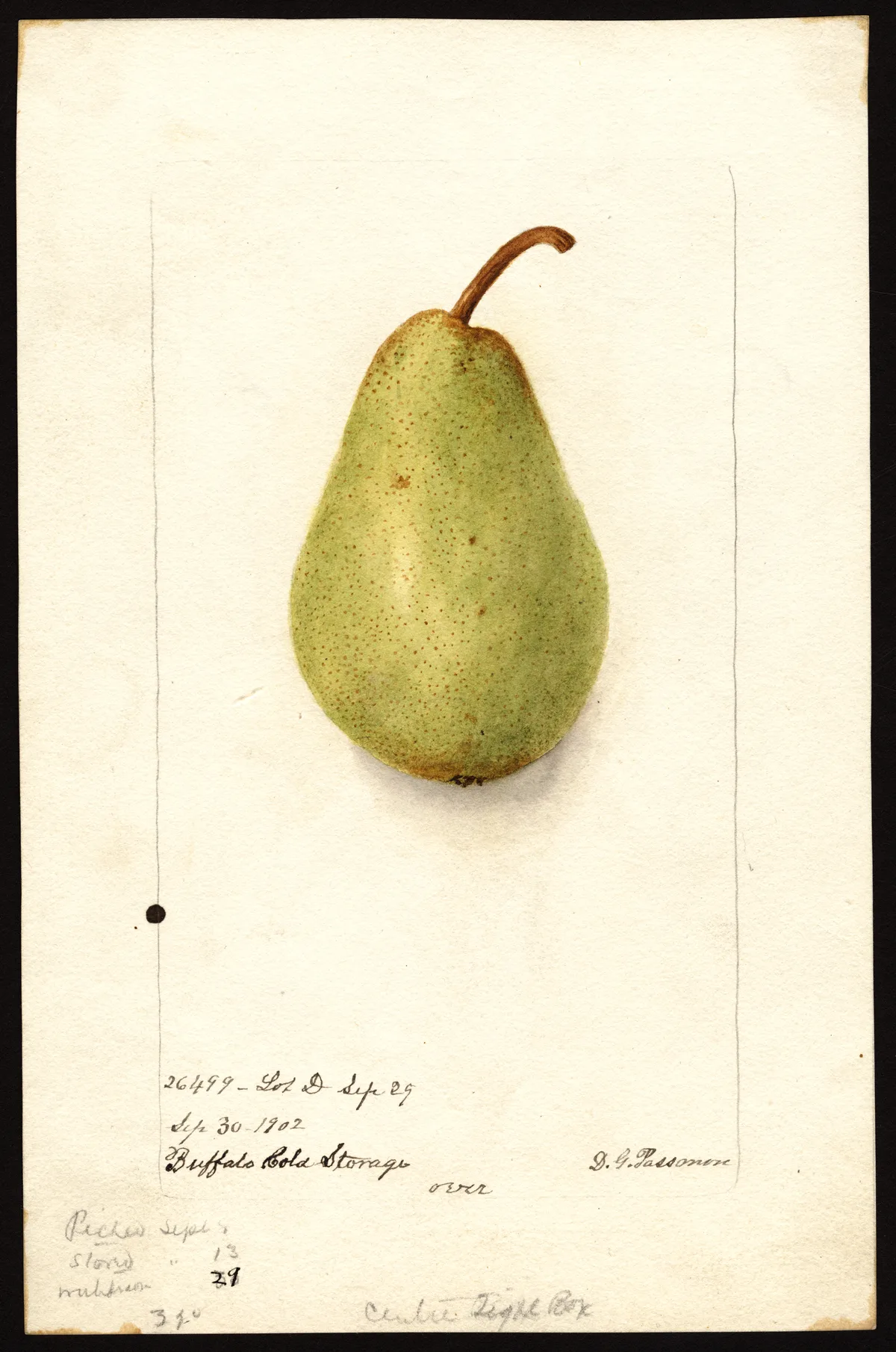
USDA Pomological Watercolor Collection
Bartlett
Origin / History
Bartlett is an English pear, originating about 1770 at Aldermaston, Berkshire. The Herefordshire Pomona says it was raised a short time before 1770 by a person named Wheeler, a schoolmaster at Aldermaston. Bunyard names the schoolmaster Stair and says that "in that county it is still called 'Stair's Pear.'" Hedrick says it was found as a wilding by a Mr. Stair, schoolmaster at Aldermaston, where it is still known as Stair's pear. From the raiser it passed to Mr. Williams, nurseryman at Turnham Green, Middlesex (Downing: "a London grower by the name of Williams"). Williams propagated it and first distributed it, and it took his name. As Williams' Bon Chrétien it was then, and still is, known in England and France.
The Herefordshire Pomona says Enoch Bartlett of Dorchester, near Boston, introduced it to America in 1799, and Bunyard likewise names Bartlett as its importer. Hedrick says James Carter of Boston brought it over in 1797 or 1799 for Thomas Brewer. Brewer planted it in his grounds at Roxbury, Massachusetts, as Williams' Bon Chrétien. In 1817 Enoch Bartlett became possessed of the Brewer estate and, not knowing its true name, allowed the pear to go out under his own; henceforth it was known in America as Bartlett. Downing says its name was lost when it was first introduced. Through Enoch Bartlett's cultivation and dissemination it "became so universally known as the Bartlett Pear, that it is impossible to dispossess it now." Hedrick cites accounts of it under Williams' Bon Chrétien from 1831 (Lindley, Prince) and under Bartlett from 1845 (Downing), with Hovey's plate of 1851. The American Pomological Society added it to its catalog-list in 1848. The Herefordshire Pomona says it "has even been brought back to England with its new name."
It is highly esteemed on both sides of the Atlantic. The Herefordshire Pomona calls it "this highly esteemed Pear," and the Rivers catalogue "a brilliant early and highly esteemed setting pear." The Herefordshire Pomona also says it "attains the highest perfection in America," where it is esteemed "the finest and best keeping Pear of its season." Its cultivation by the London market gardeners had nonetheless become more limited "in consequence of its fickleness in bearing." In England Veitch calls it "the greatest favourite in this country," and Bunyard "quite the best of early Pears."
In America Elliott calls it "now extensively grown, and too well known to really need description." Downing calls it "this noble Pear," justly one of the most popular of all the summer varieties, its size, beauty, and excellence entitling it to that estimation apart from its early, regular, and abundant bearing. He adds that it suits the American climate admirably, ripening better there than in England. Budd and Hansen call it "popular in nearly every fruit district of the Union." Thomas says that "although not of the first class as to flavor, the many fine qualities of this pear render it a general favorite."
Hedrick (1921) says Bartlett leads all other pears in number of trees in New York and vies with Kieffer for the greatest number in America. His Cyclopedia (1922) says it leads all pears in number of trees in America. Its fruits are more common and more popular in American markets than those of any other pear. "Although several poor ones of fruit and tree appear," its popularity "with growers and sellers, if not with consumers, seems justified." As with the leading variety of any fruit, its preeminently meritorious character is its great adaptability to different climates, soils, and situations. It is grown with profit in every pear-growing region in America, and in all in greater quantities than any other sort "excepting, perhaps, the notorious Kieffer." Since no other variety is so easily grown, nor so reliable in the markets, Hedrick says Bartlett "promises long to continue its supremacy for home and commercial plantations."
Tree
Vigorous, very vigorous in Hedrick's account, upright or erect; a thrifty grower at Agassiz and a good grower to Veitch. Bunyard alone calls the growth moderate. Hedrick gives the tree as medium in size, tall, pyriform, and upright, becoming tall and pyriform with age. His introduction says the trees attain large size, live long, are easily managed in the orchard, and thrive on both standard and quince stocks. Elliott found it early productive of fair, handsome fruit on either pear or quince root. The Herefordshire Pomona calls the tree healthy and vigorous. It says the tree succeeds best as a pyramid or standard on the pear or quince stock, where the fruit is much better flavored, though not so large, as when grown on a wall. Bunyard says it makes a good standard.
Branches stocky, smooth, reddish-brown overlaid with ash-gray scarf-skin, with few lenticels; branchlets short, with short internodes, reddish-brown, glossy, smooth, glabrous, with conspicuous lenticels (Hedrick). Shoots thrifty, yellowish or yellowish brown. Leaf-buds short, obtuse, pointed, mostly free; leaf-scars prominent (Hedrick).
Leaves oval, leathery; apex taper-pointed; margin finely serrate, tipped with small dark red glands; petiole 1½ in. long. Hedrick gives the leaf as 2½ in. long and 1½ in. wide in 1921, and 2¾ by 1¾ in. in 1922. Downing calls the leaves narrow and folded, and Thomas folded and slightly recurved. Bunyard gives the leaf as medium and round, finely and regularly serrate; it hangs late and turns rich crimson red.
Flower-buds large, conical, pointed, free. Flowers showy, in dense clusters averaging 7 buds to a cluster; pedicels 1⅛ in. long, slender, slightly pubescent. Hedrick gives the flowers as 1⅛ in. across in 1921 and 1½ in. in 1922. More than those of any other standard variety, the blossoms require cross-fertilization (Hedrick).
Bears young: very young (Thomas), very early (Downing), early productive (Elliott). Very productive in Thomas's and Hedrick's accounts, and to Veitch "an excellent bearer"; Bunyard rates its fertility good. At Agassiz, planted spring 1890, it was moderately productive. Downing says it bears regularly and abundantly. Hedrick says that, "barring frosts or freezes, the trees bear full crops year after year." The Herefordshire Pomona says it is "not a regular and abundant bearer."
Hardy in Hedrick's technical description. His introduction, however, says the trees are not as hardy to cold or to heat as those of some other varieties. They are "scarcely hardier to cold than those of the peach," and cannot withstand the summer heat of the southern or Mississippi Valley states. The trees "blight badly," and are not much above the average in resistance to blight, "the black plague of the pear."
Fruit
Size: Large; quite large (Thomas), fairly large (Bunyard). Hedrick gives 3½ in. long and 2½ in. wide (1921), or 2¾ in. wide (1922); Bunyard gives "3½ by 4½."
Form: Obtuse-pyriform; oblong, ovate (Elliott), or oval (Bunyard), somewhat pyramidal (Thomas), tapering toward the apex. The Herefordshire Pomona calls the outline irregular and bossed, and Bunyard calls the fruit uneven; Hedrick calls it symmetrical and uniform.
Stem: Stout to thick, short to 1½ in. long; most authors give 1 to 1½ in. Fleshy (Herefordshire Pomona); rather stout, generally set at an angle (Bunyard); often curved (Hedrick); slightly sunk (Thomas).
Cavity: Shallow, small, acute, usually lipped, with thin overspreading streaks of light russet (Hedrick); russet around the stem (Elliott).
Calyx: Open or partly open; medium (Elliott). Segments short, erect (Downing); lobes separated at the base, narrow, acute; calyx-tube long, wide, funnel-shaped (Hedrick).
Basin: Shallow to very shallow, or little or none; the Herefordshire Pomona sets the eye in a very shallow depression "but more generally even with the surface." Narrow, obtuse, furrowed and wrinkled, obscurely plaited, or irregular; Thomas finds the apex slightly plaited, sometimes smooth.
Skin: Thin to very thin, tender, smooth or nearly smooth, often dull (Hedrick); surface somewhat uneven or wavy. Pale green at first, changing as it ripens to clear yellow, clear light yellow, or golden yellow. A soft or faint blush on the sunny side of exposed specimens. Thomas says the blush comes sometimes, Budd and Hansen usually, and Elliott when ripe. The Herefordshire Pomona describes streaks of red next the sun, and Bunyard faint red stripes. Downing finds the skin rarely marked with faint russet; Bunyard gives russet marbling, and Hedrick says it is often thinly russeted around the basin. Fair, handsome, beautiful in appearance.
Dots: Russet; minute, over the whole surface (Elliott); many, small, conspicuous, greenish-russet (Hedrick).
Flesh and flavor: White, nearly white (Thomas), or yellowish white (Elliott); white and transparent (Bunyard). Fine-grained to exceedingly fine-grained (Downing), slightly granular at the center (Hedrick). Tender to exceedingly tender (Thomas), buttery, melting; juicy to very juicy. Sweet, with a highly perfumed vinous flavor (Downing); vinous, aromatic (Hedrick). The Herefordshire Pomona gives "a rich, sweet, and delicious flavour, and powerful musky aroma," and Bunyard "a strong musky flavour," less pronounced when grown on a north wall. Thomas calls it "nearly sweet, sometimes faintly sub-acid, fine, moderately rich." Downing says that in damp or unfavorable soils it is sometimes slightly acid. Hedrick says the pears lack "the rich, perfumed flavor of Seckel on one hand, and the piquant, vinous taste of Winter Nelis on the other."
Most authors rate it highly: "very good" (Budd and Hansen; Hedrick's technical description), "very fine flavour" (Agassiz), "of the finest quality" (Veitch). Thomas calls it "not of the first class as to flavor." Hedrick's introduction rates the pears "of good but not of the best quality," "satisfactory in all characters excepting quality," with "many better-flavored pears," yet "much above the average in quality."
Core and seeds: Core medium (Elliott) to large (Hedrick), closed, with clasping core-lines; Veitch calls it small. Seeds broad ovate (Elliott); wide, plump, acute, medium in size and length (Hedrick).
Season
August into October, centering on the last half of August and September; end of summer and beginning of autumn, and far North "strictly an autumn pear" (Thomas). The Rivers catalogue carries it into October.
Ripens off the tree. Downing calls it "the unusual property of maturing perfectly in the house, even if it is picked before it is full-grown," and Thomas says fruit not fully grown becomes of good quality if kept in the house a week or two. Bunyard says it should be gathered while still green and ripened in the fruit-room. The Herefordshire Pomona advises gathering before ripeness, at intervals of a few days, so that the fruit does not all ripen together, "for when ripe, it soon becomes mealy and decays." Hedrick says the pears keep and ship remarkably well.
Uses
Dessert; "an excellent Autumn Dessert Pear" (Herefordshire Pomona). Veitch also lists it as suitable for cooking and forcing. The Rivers catalogue calls it a "setting pear" for culture in the house or in pots at Sawbridgeworth. Downing says it "has no competitor as a summer market fruit." Hedrick says that, after Kieffer, it is the most desired of all pears by the canning trade.
Subtypes / Variants
Not described in source.
Other
[NOTE: Source text may be incorrect — the Rivers catalogue entry is garbled ("of Seville, has fine; in house or pots in a suitable summer house").]
Hedrick says Bartlett is the parent of several other well-known varieties and of many sorts of small importance. The Herefordshire Pomona cites "an excellent coloured representation" of the pear in the Transactions of the Horticultural Society (London), Vol. II, p. 250, where its history and description are given, with a further account in Vol. III, p. 357. Its entry opens with Rapin's lines from "The Orchard": "In Amitermis vale, the Sabine boors / Added Bon-cretiens to their former stores."
Book Sources
Described in 8 period pomological works
- Hedrick, The Pears of New York (1921)
- Budd & Hansen, Systematic Pomology (1914)
- Hedrick, Cyclopedia of Hardy Fruits (1922)
- The Herefordshire Pomona (1876–1885) — listed as Williams' Bon Chrétien
- Bunyard, A Handbook of Hardy Fruits (1920) — listed as WILLIAMS BON CHRETIEN
- Downing, Fruits and Fruit Trees of America (1900) — listed as Bartlett, or Williams' Bonchretien
- Elliott, The Western Fruit Book (1865)
- Thomas, The American Fruit Culturist (1903)
Nursery Catalog Sources
Found in 99 catalogs (1845–1955) from Alabama, Arkansas, California, England, Florida, Illinois, Kansas, Maryland, Massachusetts, Missouri, Nebraska, New Jersey, New York, Oregon, Pennsylvania, Virginia, Washington
- Winship's Nursery (Brighton Nurseries , operated by the Winship family), Brighton (Boston) , Massachusetts — 1845
- Hovey & Co. , Cambridge , Massachusetts — 1849
- Hovey & Co. , Cambridge , Massachusetts — 1849 — listed as Williams
- Azell Bowditch (Nursery / Fruit Catalog) , Boston , Massachusetts — 1850
- Joseph Breck & Co. , Boston , Massachusetts — 1855
- St. Helena Nursery , Howell Prairie, Marion County, OR (Marion Co., Ogn.) — 1864
- Hutchison Nursery , James Hutchison, Oakland , California — 1881
- Felix Gillet , Barren Hill Nursery, Nevada City , California — 1884
- Fancher Creek Nursery , Fresno , California — 1886
- Huntsville Wholesale Nurseries (Jessie S. Moss , Proprietor; W.F. Heikes, Manager), Huntsville , Alabama — 1886
- W.R. Strong & Co. , Capital and Orange Hill Nurseries (Robert Williamson, prop.), Sacramento , California — 1886
- Felix Gillet , Barren Hill Nursery, Nevada City , California — 1888
- California Nursery Co. , Niles , California — 1889
- Felix Gillet , Barren Hill Nursery, Nevada City , California — 1889
- Felix Gillet , Barren Hill Nursery, Nevada City , California — 1890
- William H. Moon Co. , Morrisville, Bucks County , Pennsylvania — 1890
- Felix Gillet , Barren Hill Nursery, Nevada City , California — 1891
- Missouri Nursery Co. , Louisiana , Missouri — 1891
- Puyallup & Yakima Nurseries , Puyallup, Washington (Lock Box 191) and North Yakima , Washington — 1892
- Glen St. Mary Nurseries (G.L. Taber , Proprietor), Glen St. Mary , Florida — 1893
- Milwaukie-Canby Nurseries , Canby, OR (and Milwaukie, OR) — 1893
- Oregon Wholesale Nurseries , Salem , Oregon — 1893
- Rogers Nursery Co. , Moorestown , New Jersey — 1893
- Sherwood Hall Nursery Co. , Timothy Hopkins (Menlo Park Nurseries), San Francisco / Menlo Park , California — 1893
- Green's Nursery Co. (Charles A. Green) , Rochester , New York — 1894
- Multnomah Nurseries , Russellville , Oregon — 1894
- The Vineland Nurseries (Kelsey & Co. , Proprietors), St. Joseph, Missouri (Office: 13th and Atchison Sts., 2 Blocks East of the Citizens St. Car Line) — 1894
- Woodburn Nurseries , Woodburn, Marion Co. , Oregon — 1894
- Felix Gillet , Barren Hill Nursery, Nevada City , California — 1895
- The Lovett Company , Little Silver , New Jersey — 1896
- Felix Gillet , Barren Hill Nursery, Nevada City , California — 1897
- Kelway & Son , Langport, Somerset , England — 1897
- The Salem Nursery (John A. Francis , Proprietor), Salem , Virginia — 1897
- Arthur J. Collins & Sons , Moorestown , New Jersey — 1898
- J.V. Cotta (Cotta Nursery) , Carroll County , Illinois — 1898
- Reading Nursery , Jacob W. Manning, Proprietor, Reading , Massachusetts — 1898
- Stark Bros. Nurseries & Orchards Co. , Louisiana , Missouri — 1898
- Brown Brothers Co. , Continental Nurseries, Rochester, NY (also operated from Toronto, Canada) — 1899
- Alabama Nursery Co. , Huntsville , Alabama — 1900
- George Bunyard & Co. , Royal Nurseries, Maidstone, Kent , England — 1900
- Central Experimental Farm , Dominion Department of Agriculture, Agassiz, British Columbia (under test; Bulletin No. 3, Second Series) — 1900
- Benjamin Buckman (personal inventory) , Farmingdale , Illinois — 1901
- Brown Brothers Co. , Continental Nurseries, Rochester, NY (also operated from Toronto, Canada) — 1901
- Mountain Grove Nurseries (Tippin & Moore , Proprietors; Geo. T. Tippin, J. W. Tippin, J. C. Moore), Mountain Grove , Missouri — 1901
- S.L. Watkins , Grizzly Flats, El Dorado County , California — 1901
- The Dalles Nurseries , The Dalles , Oregon — 1901
- Washington Nursery Co. , Toppenish , Washington — 1901
- Yarbrough Bros. , Stephens , Arkansas — 1901
- Forestville Nurseries , T.J. True, Forestville , California — 1902
- Pacific Nursery Company (W. O. Hudson & A. D. Hudson) , Tangent , Oregon — 1903
- Russellville Nursery Co. , Russellville, OR (three miles east of Portland, one mile from Montavilla car line) — 1903
- Henderson Luelling / Traveling Nursery (historical recall) , Oregon — 1904
- Phoenix Nursery Company (W. E. Rossney , President; Sidney Tuttle, Vice-President), Bloomington , Illinois — 1904
- Stark Bros. Nurseries & Orchards Co. , Louisiana , Missouri — 1906
- J.B. Pilkington , Portland , Oregon — 1907
- Russellville Nursery Co. , Montavilla Station, Portland, OR (three miles east of Portland, one mile from Montavilla car line) — 1907
- Carlton Nursery Co. , Carlton , Oregon — 1909
- Milton Nursery Co. (A. Miller & Sons , Proprietors), Milton , Oregon — 1909
- Washington Nursery Company , Toppenish , Washington — 1909
- Wm. J. Corse (successor to Robert Sinclair / Sinclair Nurseries) , Baltimore , Maryland — 1909
- A. Holaday , Monte Vista Nursery, Scappoose , Oregon — 1910
- C.F. Lansing , Salem , Oregon — 1910
- Island Nurseries & Fruit Farm , Vashon (Vashon Island) , Washington — 1910
- Stark Bros. Nurseries & Orchards Co. , Louisiana , Missouri — 1910
- Galbraith Nursery Co. (DeWitt Hansen , Pres.-Mgr.), Fairbury , Nebraska — 1911
- Island Nurseries & Fruit Farm , Vashon (Vashon Island) , Washington — 1911
- James Veitch & Sons , Ltd., Royal Exotic Nursery, Chelsea, London (also Coombe Wood, Langley, and Feltham) , England — 1911
- Stark Bros. Nurseries & Orchards Co. , Louisiana , Missouri — 1911
- Ballygreen Nurseries , Hanford , Washington — 1912
- Pacific Nursery Company , Portland , Oregon — 1912
- Stark Bros. Nurseries & Orchards Co. , Louisiana , Missouri — 1912
- Vineland Nurseries Company , Clarkston , Washington — 1912
- Washington Nursery Company , Toppenish , Washington — 1912
- J. B. Pilkington , Nurseryman, Portland, OR (nurseries near Newberg, forty miles from Portland) — 1913
- Samuel Fraser , Geneseo , New York — 1913
- Thomas Rivers & Son , Sawbridgeworth, Hertfordshire , England — 1913
- Van Holderbeke Nursery Co. , Incorporated, Spokane, Washington (nurseries at Otis Orchards WA, Pasadena WA, Kennewick WA) — 1913
- George Bunyard & Co. , Royal Nurseries, Maidstone, Kent , England — 1914
- Island Nurseries & Fruit Farm , Vashon (Vashon Island) , Washington — 1914
- Island Nurseries & Fruit Farm , Vashon (Vashon Island) , Washington — 1915
- Ornamental & Fruit Nursery Company , Wapato, County of Yakima , Washington — 1915
- Union Nurseries , J.B. Weaver & Sons, Union , Oregon — 1915
- Holsinger Bros. Nurseries (Holsinger Brothers Nursery) , Rosedale , Kansas — 1916
- Island Nurseries & Fruit Farm , Vashon (Vashon Island) , Washington — 1916
- George Bunyard & Co. , Royal Nurseries, Maidstone, Kent , England — 1917
- Island Nurseries & Fruit Farm , Vashon (Vashon Island) , Washington — 1917
- Fancher Creek Nurseries , George C. Roeding, Fresno , California — 1918
- Christopher Nurseries / John Stewart & Sons , Christopher , Washington — 1920
- Oregon Nursery Co. , Orenco , Oregon — 1920
- Benedict Nursery Co. , Portland , Oregon — 1921
- Island Nurseries & Fruit Farm , Vashon , Washington — 1921
- Columbia & Okanogan Nursery Co. , Wenatchee , Washington — 1925
- OSU Bulletin 216 — 1925
- Hudson's Wholesale Nurseries , Tangent , Oregon — 1926
- Stark Bro's Nurseries , Louisiana , Missouri — 1932
- Milton Nursery Co. , Milton-Freewater , Oregon — 1947
- Carlton Nursery Co. , Forest Grove , Oregon — 1955
- North-Western Nurseries , Walla Walla , Washington
- Rich & Sons Nursery , Hillsboro , Oregon
View original book sources (11)
— F.R. Elliott, The Western Fruit Book (1865)Bartlett.
William's Bon Chretien, | Poire Guillaume, William's, | Delavoult de Clement.
An English variety, originated about 1770. Now extensively grown, and too well known to really need description. The trees are vigorous, and early productive of fair, handsome fruit, either on Pear or Quince root.
Fruit, large, ovate, obtuse pyriform, surface somewhat uneven; color, clear light yellow, tinged with blush in sun when ripe, russet around the stem, and minute russet dots over whole; stem, short, thick; calyx, medium, partly open; basin, shallow, furrowed; core, medium; seeds, broad ovate; flesh, yellowish white, melting, juicy, vinous Middle August to middle September.
— Woolhope Naturalists Field Club, The Herefordshire Pomona (1885)
- WILLIAMS' BON CHRÉTIEN. [Syn.: Wheeler's; Bartlett; De Lavault; Williams'.]
"In Amitermis vale, the Sabine boors Added Bon-cretiens to their former stores." (Rapin, "The Orchard," translated by Gardener.)
This highly esteemed Pear was raised a short time previous to 1770, by a person of the name of Wheeler, a schoolmaster at Aldermaston, in Berkshire; from him it was obtained by Mr. Williams, the nurseryman at Turnham Green, Middlesex, and being by him first distributed, it received the name it now bears. In 1799 it was introduced to America by Mr. Enoch Bartlett, of Dorchester, near Boston, through whom it became generally distributed, and has ever since been known there by the name of the Bartlett Pear. It attains the highest perfection in America, and is esteemed as the finest and best keeping Pear of its season, it has even been brought back to England with its new name.
Description.—Fruit, large, obtuse-pyriform, irregular, and bossed in its outline. Skin, smooth, at first pale green, changing as it ripens to clear yellow, and tinged with streaks of red next the sun. Eye, open, set in a very shallow depression, but more generally even with the surface. Stalk, an inch long, stout, and fleshy, and inserted in a shallow cavity. Flesh, white, fine-grained, tender, buttery, and melting, with a rich, sweet, and delicious flavour, and powerful musky aroma.
An excellent Autumn Dessert Pear; in season in August and September. The tree is healthy and vigorous, but not a regular and abundant bearer. It succeeds best as a pyramid or standard on the pear, or quince stock, when the fruit is much better flavoured, though not so large as when grown on a wall. The fruit should be gathered before it is ripe, at intervals of a few days, that they may not all ripen together—for when ripe, it soon becomes mealy and decays. Its cultivation by the London market gardeners has become more limited than it was, in consequence of its fickleness in bearing.
An excellent coloured representation is given of this pear in the Transactions of the Horticultural Society (London,) Vol. II., p. 250, where, and in Vol. III., p. 357, its history and description are given.
— A.J. Downing, The Fruits and Fruit Trees of America (1900)Bartlett, or Williams' Bonchretien.
Bartlett, of all American Gardens. Williams' Bonchretien. Clement Doyenne. Poire Guillaume, of the French. Barnett's William. Bonchretien Barnett. Delavault.
This noble Pear is, justly, one of the most popular of all the summer varieties. Its size, beauty, and excellence entitle it to this estimation, apart from the fact that it bears very early, regularly, and abundantly. It is an English variety, originated about 1770, in Berkshire, and was afterward propagated by a London grower by the name of Williams. When first introduced to this country its name was lost, and having been cultivated and disseminated by Enoch Bartlett, Esq., of Dorchester, near Boston, it became so universally known as the Bartlett Pear, that it is impossible to dispossess it now. It suits our climate admirably, ripening better here than in England, and has the unusual property of maturing perfectly in the house, even if it is picked before it is full-grown. It has no competitor as a summer market fruit.
The tree grows upright, with thrifty, yellowish brown shoots, and narrow, folded leaves.
Fruit of large size, oblong, obtuse pyriform. Surface uneven. Skin very thin and smooth, clear yellow (with a soft blush on the sunny side in exposed specimens), rarely marked with faint russet. Stalk one to one and a half inches long, stout, inserted in a shallow cavity. Calyx open. Segments short, erect, set in a very shallow, obscurely plaited basin. Flesh white, and exceedingly fine-grained and buttery; it is full of juice, sweet, with a highly perfumed vinous flavor. (In damp or unfavorable soils it is sometimes slightly acid.) Ripens from last of August to middle and last of September.
— John J. Thomas, The American Fruit Culturist (1903)Bartlett.* (Williams' Bonchretien.) Quite large, obtuse-pyriform, somewhat pyramidal; surface wavy, clear yellow, sometimes a faint blush; stalk an inch and a fourth long, stout, slightly sunk; basin little or none; apex slightly plaited, sometimes smooth; flesh nearly white, fine-grained, exceedingly tender and buttery, with a nearly sweet, sometimes faintly sub-acid, fine, moderately rich flavor. Ripens end of summer and beginning of autumn, and far North, is strictly an autumn pear. The fruit, when not fully grown, ripens and becomes of good quality if kept in the house a week or two. Growth erect, vigorous, leaves folded, slightly recurved, shoots yellowish. Tree very productive, and bears very young. Although not of the first class as to flavor, the many fine qualities of this pear render it a general favorite. Fig. 645. England.
— J.L. Budd & N.E. Hansen, American Horticultural Manual, Part II: Systematic Pomology (1914)Bartlett. — Large, oblong, obtuse pyriform; color clear yellow with blush usually on sunny side; surface of skin usually uneven; stalk one to one and one-half inches long, inserted in shallow cavity. Flesh white, fine-grained, buttery, juicy, sweet, with rich perfumed flavor, very good. Popular in nearly every fruit district of the Union. England.
— E.A. Bunyard, A Handbook of Hardy Fruits (1920)WILLIAMS BON CHRETIEN. Her. Pom., I., 9. G. Williams Christbirn. (Bartlett.) Dessert, September, fairly large, 3½ by 4½, oval pyriform, uneven. Skin, nearly smooth. Colour, golden yellow with russet dots and marbling and faint red stripes. Flesh, white, transparent, very juicy and sweet, with a strong musky flavour. Eye, open, in shallow irregular basin. Stem, short, rather stout, generally at an angle. Growth, moderate ; fertility good. Leaf, medium, round, finely and regularly serrate, hangs late, turns rich crimson red. Origin, raised by a schoolmaster named Stair, of Aldermaston, about 1770. In that county it is still called "Stair's Pear." It took its name "Williams" from its distributor, a nurseryman of Turnham Green ; on its introduction to America it was again named after its importer, Mr. Bartlett. This is quite the best of early Pears, and should be gathered when still green and ripened in the fruit-room. The musky flavour is less pronounced when grown on a North wall. It makes a good standard.
— U.P. Hedrick, The Pears of New York (1921)BARTLETT
- Downing Fr. Trees Am. 334, fig. 134. 1845. 2. Horticulturist 2:169. 1847-48. 3. Proc. Nat. Con. Fr. Gr. 29. 1848. 4. Hovey Fr. Am. 2:11, Pl. 1851. 5. Horticulturist N. S. 3:350, Pl. 1853. 6. Field Pear Cult. 190, 276, fig. 66. 1858. 7. Downing Fr. Trees Am. 666, fig. 1869. 8. Ont. Dept. Agr. Fr. Ont. 148, fig. 1914.
Williams' Bon Chrétien. 9. Lindley Guide Orch. Gard. 350. 1831. 10. Prince Pom. Man. 2:137. 1831. 11. Hogg Fruit Man. 664. 1884.
Williams' Apothekerbirne. 12. Dochnahl Führ. Obstkunde 2:181. 1856.
Bon Chrétien Williams'. 13. Pom. France 1: No. 16, Pl. 16. 1863. 14. Mas Le Verger 2:23, fig. 10. 1866-73.
Williams. 15. Leroy Dict. Pom. 2:758, fig. 1869.
Williams Christbirne. 16. Lauche Deut. Pom. II: No. 18, Pl. 18. 1882. 17. Mathieu Nom. Pom. 298. 1889.
Bartlett leads all other pears in number of trees in New York, and vies with Kieffer for the greatest number in America. Its fruits are more common and more popular in American markets than those of any other pear. When the characters of the variety are passed in review, although several poor ones of fruit and tree appear, the popularity of Bartlett with growers and sellers, if not with consumers, seems justified. As with the leading variety of any fruit, the preeminently meritorious character of this one is its great adaptability to different climates, soils, and situations. Thus, Bartlett is grown with profit in every pear-growing region in America and in all is grown in greater quantities than any other sort excepting, perhaps, the notorious Kieffer. Another character which commends this variety to pear-growers is fruitfulness — barring frosts or freezes, the trees bear full crops year after year. Moreover, the trees are very vigorous, attain large size, bear young, live long, are easily managed in the orchard, and thrive on both standard and quince stocks. The pears are large, handsome, of good but not of the best quality, and keep and ship remarkably well.
Bartlett is not without serious faults, however. The trees blight badly, and are not much above the average in resistance to blight, the black plague of the pear. Neither are they as hardy to cold or to heat as those of some other varieties. They are scarcely hardier to cold than those of the peach, and cannot withstand the summer heat of the southern, or of the Mississippi Valley states. Another serious defect of the trees is that, more than those of any other standard variety, their blossoms require cross-fertilization. The fruits are satisfactory in all characters excepting quality. There are many better-flavored pears. The fruits lack the rich, perfumed flavor of Seckel on one hand, and the piquant, vinous taste of Winter Nelis on the other. But the pears are much above the average in quality, and since no other variety is so easily grown, nor so reliable in the markets, Bartlett promises long to continue its supremacy for home and commercial plantations. After Kieffer, it is the most desired of all pears by the canning trade. Bartlett is the parent of several other well-known varieties, and of many sorts of small importance.
This pear was found as a wilding by a Mr. Stair, a schoolmaster at Aldermaston, Berkshire, England. From him it was acquired by a Mr. Williams, a nurseryman at Turnham Green, Middlesex, and as it was propagated and distributed by him it became known by his name, although it is still known as Stair's pear at Aldermaston. It was brought to this country in 1797 or 1799 by James Carter of Boston for Thomas Brewer who planted the variety in his grounds at Roxbury, Massachusetts, under the name of Williams' Bon Chrétien, by which name it was then and still is known both in England and France. In 1817 Enoch Bartlett, Dorchester, Massachusetts, became possessed of the Brewer estate, and not knowing its true name allowed the pear to go out under his own. Henceforth it was known in America as Bartlett. The American Pomological Society added this variety to its catalog-list of fruits in 1848.
Tree medium in size, tall, pyriform, upright, hardy, very productive; branches stocky, smooth, reddish-brown overlaid with ash-gray scarf-skin, with few lenticels; branchlets short, with short internodes, reddish-brown, glossy, smooth, glabrous, with conspicuous lenticels.
Leaf-buds short, obtuse, pointed, mostly free; leaf-scars prominent. Leaves 2½ in. long, 1½ in. wide, oval, leathery; apex taper-pointed; margin tipped with small dark red glands, finely serrate; petiole 1½ in. long. Flower-buds large, conical, pointed, free; flowers showy, 1⅛ in. across, in dense clusters averaging 7 buds in a cluster; pedicels 1⅛ in. long, slender, slightly pubescent.
Fruit matures in September; large, 3½ in. long, 2½ in. wide, oblong-obtuse-pyriform, tapering toward the apex, symmetrical, uniform; stem 1½ in. long, often curved, thick; cavity small, usually lipped, with thin, overspreading streaks of light russet, acute, shallow; calyx partly open; lobes separated at the base, narrow, acute; basin very shallow, narrow, obtuse, furrowed and wrinkled; skin thin, tender, smooth, often dull, the surface somewhat uneven; color clear yellow, with a faint blush on the exposed cheek, more or less dotted with russet and often thinly russeted around the basin; dots many, small, conspicuous, greenish-russet; flesh fine-grained although slightly granular at the center, melting, buttery, very juicy, vinous, aromatic; quality very good. Core large, closed, with clasping core-lines; calyx-tube long, wide, funnel-shaped; seeds wide, plump, acute.
— U.P. Hedrick, Cyclopedia of Hardy Fruits (1922)BARTLETT. Fig. 70. Williams' Bon Chretien. Williams. Bartlett leads all other pears in number of trees in America. Its fruits are more common and more popular than those of any other pear. The preeminently meritorious character of Bartlett is its great adaptability to different climates, soils and situations. Thus, it is grown with profit in every pear-growing region in America and in all in greater quantities than any other sort. Another character which commends this variety is fruitfulness—barring frosts or freezes the trees bear full crops year after year. The trees are vigorous, attain large size, bear young, live long, and are easily managed in the orchard. The pears are large, handsome, of good but not of the best quality, and keep and ship remarkably well. Bartlett is not without serious faults, however: the trees are not above the average in resistance to blight; they are not as hardy as those of some other varieties; and more than those of any other standard variety the blossoms require cross-fertilization. The fruits are satisfactory in all characters excepting quality. They lack the rich, perfumed flavor of Seckel on one hand, or the piquant, vinous taste of Winter Nelis on the other. But they are above the average in quality, and since no other variety is so easily grown, nor so reliable in the markets, Bartlett promises long to hold its supremacy for home and commercial plantations. It is the most desired of all pears by the canning trade.
This pear was found as a wilding by a Mr. Stair, a schoolmaster at Aldermaston, Berkshire, England. It was first introduced to this country in 1797 or 1799 under the name of Williams' Bon Chretien, by which name it is known both in England and France. In 1817 Enoch Bartlett, Dorchester, Massachusetts, allowed the pear to go out under his own name. Henceforth it became known in America exclusively as Bartlett.
Tree medium in size, with age becoming tall and pyriform, upright; branches stocky, smooth, reddish-brown with few lenticels. Leaves 2¾ inches long, 1¾ inches wide, oval, leathery; apex taper-pointed; margin tipped with small dark red glands, finely serrate; petiole 1½ inches long. Flowers showy, 1½ inches across, in dense clusters averaging 7 buds in a cluster.
Fruit matures in September; large, 3½ inches long, 2¾ inches wide, oblong-obtuse-pyriform, tapering slightly toward the apex, symmetrical, uniform; stem 1¼ inches long, often curved, thick; cavity small, usually lipped, with thin, light russet overspreading streaks of russet, acute, shallow; calyx partly open; lobes separated at the base, narrow, acute; basin very shallow, narrow, obtuse, furrowed and wrinkled; skin thin, tender, smooth, often dull, the surface somewhat uneven; color clear yellow when fully mature, with a faint blush on the exposed cheek, more or less dotted with russet and often thinly russeted around the basin; dots many, small, conspicuous, greenish-russet; flesh fine-grained, although slightly granular at the center, melting, buttery, very juicy, vinous, aromatic; quality very good; core large, closed, with clasping core-lines; calyx-tube long, wide, funnel-shaped; seeds medium in size and length, wide, plump, acute.
— Central Experimental Farm, Central Experimental Farm, Agassiz BC — Catalogue of Fruit Trees under Test (Bulletin No. 3, 1900) (1900)Planted Spring 1890. Tree a thrifty grower and moderately productive. Fruit large, oblong, pyriform. Skin smooth clear yellow, with a blush on the sunny side. Flesh white, juicy, buttery, and of very fine flavour. Season August and September.
— James Veitch & Sons, Veitch's Fruit Trees (1911) (1911)large, tender, melting and juicy; with a small core; the greatest favourite in this country; a good grower and excellent bearer; the fruit is of the finest quality; suitable for cooking and forcing.
— Thomas Rivers & Son, Thomas Rivers Catalogue of Fruits (1914) (1914)a brilliant early and highly esteemed setting pear; of Seville, has fine; in house or pots in a suitable summer house at Sawbridgeworth. Sept.-Oct.