Las Canas
Pear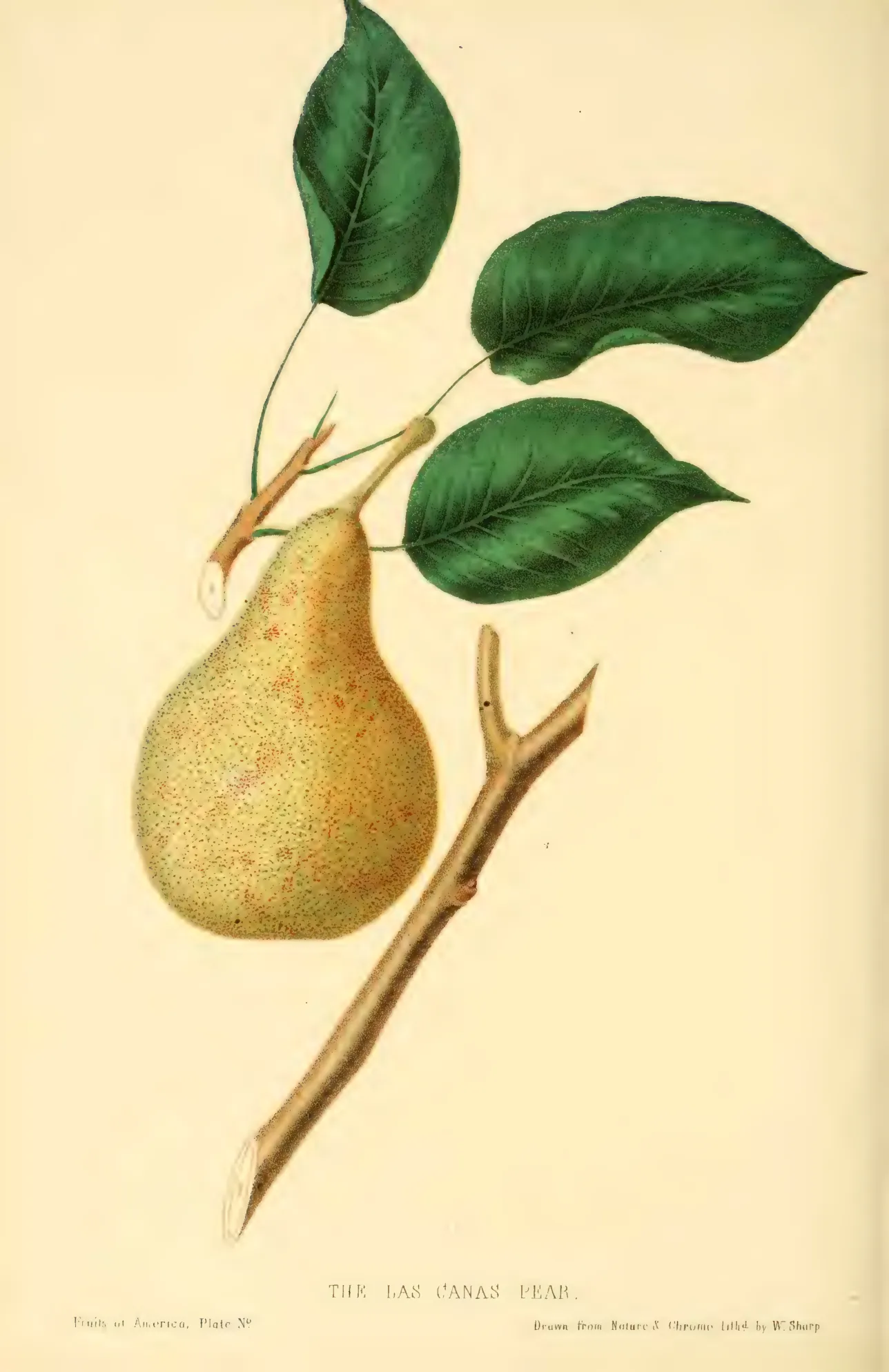
Las Canas
Origin and History
The Las Canas is one of numerous varieties introduced through the exertions of the late Mr. Manning of Salem. The scions were obtained from M. Emehen de Wael, an amateur cultivator of Antwerp and an intimate friend of Dr. Van Mons, who at that time possessed one of the most extensive collections of pears. M. de Wael visited this country about twelve years ago, and on his return home forwarded to Messrs. Manning and Kenrick scions of many new varieties of pears, of which the Las Canas was among the number. The variety was first described in the Magazine of Horticulture, volume XV, page 197, in 1849.
The variety first fruited in the Pomological Garden about five years before this account, giving promise of great excellence. The experience of successive years has proved it to be a most valuable acquisition. The origin of the Las Canas itself is unknown; it is probably a seedling produced by one of the Belgian amateurs, who are constantly raising new seedlings and to whom we are indebted for so many of our choicest pears.
Tree
The tree is of very upright and regular form while young, with branches which make very acute angles. Its general form is similar to the Williams's Bon Chretien (or Bartlett). The tree is moderately vigorous, upright, with erect annual shoots which ascend at very acute angles. Whether it will succeed well upon the quince has not yet been ascertained; the specimens from which this description was taken were from trees on the pear, and the quince as rootstock had not been tried.
Wood, Buds, Leaves, and Flowers
Wood: Dull yellowish brown, smooth, and speckled with small russet specks, moderately stout, rather short-jointed and blunt at the ends. Old wood is dull brownish olive.
Buds: Medium size, rather long and pointed, flattened, erect, incurved towards the ends, with small shoulders, and partially covered with grayish scales. Flower-buds are medium size and ovate.
Leaves: Small, ovate, dull green, cordate at the base, shortly pointed, slightly wavy, and nearly entire at the edge. Petioles are medium length (about one inch long), rather slender, and growing nearly erect.
Flowers: Medium size, in compact clusters. Petals are little cupped, roundish, with nearly entire edges and short claw.
Fruit
Size and Form: Medium size, about two and a half inches long and one and three quarters inches in diameter. Form is pyramidal and very regular, oblique at the crown. The crown is large and full, and contracting slightly in the middle, it tapers so regularly into the stem that it is scarcely possible to say where it begins or ends.
Stem: Medium length (about three quarters of an inch long), slender, curved, thick at the end attached to the branch, and swollen and fleshy at its junction with the fruit, which is oblique.
Eye, Basin, and Calyx: Eye is small and open, inserted in a small, scarcely perceivable basin. Segments of the calyx are short, very broad, and reflexed.
Skin: Slightly rough, dull yellowish green, very much russeted around the eye extending in patches and tracing towards the stem, mottled with green, and covered with small russet specks.
Flesh and Flavor: Flesh is yellowish white, fine, melting, and very juicy. Flavor is rich and saccharine, with a high and delicious aroma.
Core and Seeds: Core is medium size. Seeds are medium size and nearly black.
Season and Storage
Ripe in October and keeps two or three weeks.
Uses
Not described in source.
Subtypes/Variants
Not described in source.
Other Notable Characteristics
The Las Canas has much of the character of the fine sorts Tyson and Rostiezer, possessing the rich spicy aroma which renders those varieties so popular and generally esteemed. Although only a medium-sized fruit, its many fine qualities, added to its productiveness—bearing its fruit in clusters—vigorous habit, and early bearing, place it among the very best pears.
Book Sources
Described in 1 period pomological work
- Hovey, The Fruits of America (1852) — listed as THE LAS CANAS PEAR.
View original book sources (1)
— C.M. Hovey, The Fruits of America (1852)THE LAS CANAS PEAR.
Las Canas. Magazine of Horticulture, vol. xv. p. 197, 1849.
The Las Canas is one of the numerous varieties introduced through the exertions of the late Mr. Manning, of Salem, who obtained the scions from M. Emehen de Wael, an amateur cultivator of Antwerp, and an intimate friend of Dr. Van Mons, who at that time possessed one of the most extensive collections of pears. M. de Wael visited this country about twelve years ago, and on his return home forwarded to Messrs. Manning and Kenrick scions of many new varieties of pears, and the Las Canas was among the number.
It first fruited in the Pomological Garden about five years ago, giving promise of great excellence ; and the experience of successive years has proved it to be a most valuable acquisition. It has much of the character of those fine sorts, the Tyson and Rostiezer, possessing the rich spicy aroma which renders those varieties so popular and generally esteemed. It is only a medium-sized fruit ; but its many fine qualities, added to its productiveness, — bearing its fruit in clusters, — vigorous habit, and early bearing, place it among the very best pears.
The origin of the Las Canas is unknown ; it is probably a seedling produced by some of the Belgian amateurs, who are constantly raising new seedlings, and to whom we are indebted for so many of our choicest pears.
The form of this pear is somewhat peculiar ; the crown is large and full, and, contracting slightly in the middle, it tapers so regularly into the stem that it is scarcely possible to say where it begins or ends. The tree is of very upright and regular form while young, with branches which make very acute angles, and its general form is similar to the Williams's Bon Chretien, (or Bartlett.) Whether it will succeed well upon the quince has not yet been ascertained. Mr. Manning, from whom we received our specimens, and in whose collection the Las Canas has, so far, only fruited, informs us that they were from a tree on the pear, and that he had not tried it upon the quince.
Tree. — Moderately vigorous, upright, with erect annual shoots, which ascend at very acute angles.
Wood. — Dull yellowish brown, smooth, and speckled with small russet specks, moderately stout, rather short-jointed and blunt at the ends ; old wood, dull brownish olive ; buds, medium size, rather long and pointed, flattened, erect, incurved towards the ends, with small shoulders, and partially covered with grayish scales : Flower-buds, medium size, ovate.
Leaves. — Small, ovate, dull green, cordate at the base, shortly pointed, slightly wavy, and nearly entire at the edge ; petioles, medium length, about one inch long, rather slender, and growing nearly erect.
Flowers. — Medium size, in compact clusters ; petals little cupped, roundish, with nearly entire edges ; claw short.
Fruit. — Medium size, about two and a half inches long, and one and three quarters in diameter : Form, pyramidal, very regular, oblique at the crown, and tapering into the stem : Skin, slightly rough, dull yellowish green, very much russeted around the eye extending in patches and tracing towards the stem, mottled with green, and covered with small russet specks : Stem, medium length, about three quarters of an inch long, slender, curved, thick at the end attached to the branch, and swollen and fleshy at its junction with the fruit, which is oblique : Eye, small, open, and inserted in a small, scarcely perceivable basin ; segments of the calyx short, very broad, and reflexed : Flesh, yellowish white, fine, melting, and very juicy : Flavor, rich and saccharine, with a high and delicious aroma : Core, medium size : Seeds, medium size, nearly black.
Ripe in October, and keeps two or three weeks.