Tyson
Pear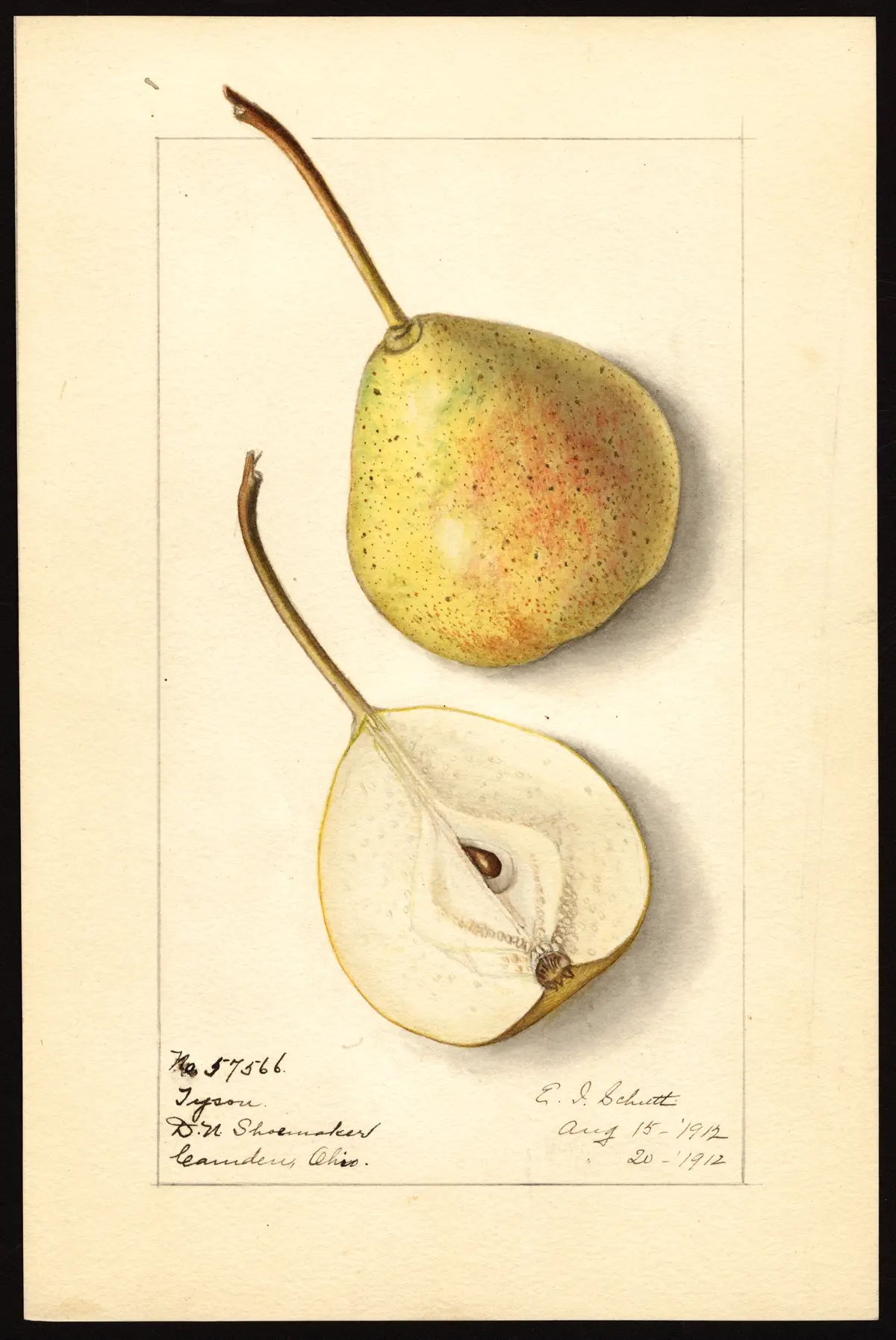
USDA Pomological Watercolor Collection
Tyson
Origin / History
Tyson is a native seedling, a wilding that sprang up in a hedge on the farm of Mr. Jonathan Tyson at Jenkintown, near Philadelphia, Pennsylvania. Hedrick dates the find to about 1794 and Elliott to about 1792–4. About the year 1794 the tree, then an inch or more in diameter, was removed to a more favorable situation. Five or six years later it began to bear, and the fruit proved so good that several trees were grafted with it. Hedrick puts first fruiting in 1800. Suckers taken from the original tree produced the same fruit, "thus showing its seedling origin" (Hovey). Mr. Tyson distributed cions among his neighbors, but the variety was not generally disseminated (Hedrick). In Hovey's time the original tree still stood in the village of Jenkintown. Dr. Brinkle of Philadelphia measured it in the spring before Hovey wrote and reported to the Massachusetts Horticultural Society a trunk six feet in circumference at two feet above the ground.
The late Dr. Mease of Philadelphia introduced Tyson into the vicinity of Boston about 1837 or 1838. Hedrick says Mease sent cions to B. V. French of Braintree, near Boston, who distributed them among his friends. Hovey records first fruiting in 1842 in the garden of the late Wm. Oliver, Esq., of Dorchester. In Hovey's time that tree was quite large and in the possession of Mr. J. H. Welch. The fruit was exhibited before the Massachusetts Horticultural Society under the name Tyson. In 1848 the National Convention of Fruit-Growers recommended Tyson for general cultivation. Since then the name has appeared continuously in the catalogs of the American Pomological Society (Hedrick). The Central Experimental Farm at Agassiz, British Columbia, planted it under test in the spring of 1890.
Hovey wrote that Tyson, "though of very recent introduction to notice, has justly been placed among the best pears which our country has yet produced." Budd and Hansen record it starred and double-starred in several States. Hedrick says Tyson competes with Clapp Favorite as the precursor of the pear season, which is really opened by Bartlett. He holds that it excels Clapp Favorite in every character of fruit and tree except size and color of fruit, and that "no other variety offers so many good starting points for the pear-breeder."
Tree
Vigorous, upright, a strong grower. Erect, of very regular pyramidal form (Hovey). Very large, tall, dense-topped, upright-spreading, of great vigor (Hedrick). Trunk very stocky, rough (Hedrick). Branches numerous, quite erect, thickly clothed with short spurs (Hovey). Thick, dull reddish brown, overspread with gray scarf-skin, with few lenticels (Hedrick).
Wood dull reddish brown, sprinkled with whitish specks, not very stout, short-jointed; old wood somewhat mottled or clouded with yellowish brown (Hovey). Young wood olive yellow brown (Downing). Shoots quite dark brown, erect, vigorous (Thomas). Branchlets slender, short, light brown mingled with green, smooth, glabrous, sprinkled with few small, inconspicuous lenticels (Hedrick).
Leaf-buds medium size, round, tapering to a point, diverging, with rather prominent shoulders; flower-buds medium size, obovate (Hovey). Hedrick calls both leaf-buds and flower-buds small, short, conical, pointed, plump. In his account the leaf-buds are appressed or free, and the flower-buds free and borne singly on short spurs.
Leaves medium size, ovate, tapering to each end, deep glossy green, a little waved on the margin, finely and regularly serrated; petioles medium length, moderately stout (Hovey). Hedrick measures the leaves at 2½ inches long and 1¼ inches wide, or 1½ inches wide in his Cyclopedia. He describes them as thin, with the apex abruptly pointed and the margin finely and shallowly serrate, on a petiole 1½ inches long. Flowers small; petals oblong, cupped, with a rather long claw (Hovey). Medium in season of bloom (Hedrick).
Slow in coming into bearing: "a tardy bearer" (Downing). It generally comes into bearing in the fourth or fifth year, the vigorous habit "probably" preventing earlier fruiting (Hovey). Hedrick calls this slowness the tree's only fault, "a comparatively trifling one." Productive: an abundant and very regular bearer, very productive, fruitful. Elliott alone calls it a moderate, regular bearer.
Exceedingly hardy (Hovey). Hedrick calls it certainly as hardy as any other variety, if not hardier. He adds that it "resists better than that of any other sort the black scourge of blight." For him the tree is "the most nearly perfect of that of any pear grown in America — the Kieffer, praiseworthy only in its tree, not excepted," and the trees "nearly flawless." Hovey wrote that its success on the quince had not yet been ascertained; Elliott reports that it "thus far succeeds on Quince."
Fruit
Size: Small to medium. The sources divide evenly between medium and somewhat below: "medium or below," "rather below medium," "below medium." Budd and Hansen alone extend the range to small. About 2½ inches long and 2 inches in diameter (Hovey). 2½ inches long by 1¾ inches wide (Hedrick), or 1⅞ inches wide in his Cyclopedia, which adds "although somewhat variable." Hedrick counts the fruit being "but medium in size" a defect.
Form: Pyriform, irregular and rather variable, with unequal sides: acute pyriform (Downing), roundish-acute-pyriform (Hedrick), roundish pyriform (Elliott), conic-pyriform, sometimes approaching obovate (Thomas). Hovey calls it pyramidal, rounded at the crown and regularly tapering into the stem. He adds that the stem end is often much elongated, giving a calabash shape, and the specimens received from Mr. Manning all partook of this character. Neck rounded (Thomas) or narrow (Budd and Hansen).
Stem: Long or rather long (Elliott), 1¼ inches (Thomas) to 1½ inches (Hovey, Hedrick), moderately stout, curved. Inserted by a fleshy ring or lip (Downing). Hovey describes it as obliquely attached by a fleshy junction, often much swollen on one side. Thomas has it set into a fleshy prominence abruptly contracted from the rounded neck, and Budd and Hansen put the fleshy ring at the top of the narrow neck.
Cavity: Very shallow, obtuse, roughened, usually drawing up as a lip about the base of the stem (Hedrick).
Calyx: Open, slightly sunk. Medium size (Hovey) or small (Hedrick). Segments short. Hedrick gives the lobes as separated at the base, short, narrow, acute, and the calyx-tube as short, wide, conical.
Basin: Shallow to very shallow, round, even (Thomas). Hedrick describes it as narrow, flaring, slightly furrowed, compressed.
Skin: Fair, clear, smooth or nearly smooth, tough (Hedrick), dull. Ground color dull yellow (Hovey), yellow, bright yellow (Thomas), or deep yellow, which Downing qualifies as "at full maturity." The sunny side is shaded with color. Hovey has it "brightly shaded with red on the sunny side." Others give a red cheek, a fine crimson cheek (Downing), or a reddish-brown softly shaded cheek (Thomas). Hedrick's Pears of New York says "usually blushed" and his Cyclopedia "usually without blush." He calls the pears often poorly colored. Slightly, little, or somewhat russeted, often with some russet (Thomas).
Dots: Numerous, minute or very small, obscure (Hedrick). Brown (Downing). Hovey gives black specks, irregularly covering the skin.
Flesh and flavor: Flesh white (Hovey), or tinged with yellow and granular around the basin (Hedrick). Fine or rather fine-grained, tender, buttery, melting to very melting (Thomas), juicy to very juicy.
Flavor sugary to very sugary, sweet, and aromatic. Hovey calls it "rich, very sugary, and delicious, with a high, aromatic perfume, to which we are at a loss to give a name." Thomas gives "nearly sweet, aromatic, slightly perfumed," Budd and Hansen "quite sweet," and Downing "somewhat aromatic." Hedrick writes of "a spicy, scented sweetness that gives the fruit the charm of individuality."
Hovey finds it "nearly, if not quite, equalling the Seckel in the rich, spicy aroma which distinguishes that delicious variety," and of larger size and more melting flesh. Hedrick ranks its flesh and flavor second only to Seckel among commonly grown pears. He says its quality far excels that of Clapp Favorite and is better than that of Bartlett.
Quality is placed high, from "very good" (Hedrick) through "excellent" (Thomas) and "nearly best" (Budd and Hansen) to "very good to best" (Downing). The Agassiz station says only "of good flavour."
Core and seeds: Core small, closed, with clasping core-lines (Hedrick). Seeds plump, small and brown (Hovey) or medium in size and width and acute (Hedrick).
Season
The recorded season runs from the middle of August to the middle of September; Hedrick gives that span for New York. The sources center on late August: the last of August and beginning of September, the last two weeks of summer, late August, or simply August. Hovey says it comes in just before the Williams's Bon Chretien, "when we have but few fine pears." Hedrick says the pears keep longer than those of Clapp Favorite.
Uses
Hedrick calls Tyson the best pear of its season for the home orchard and says it has much merit for commercial orchards. In his account it ships better than Clapp Favorite, and "were the fruits larger, it would rival Bartlett for the markets."
Subtypes / Variants
Not described in source.
Other
Hedrick notes that fruit grown on the grounds of the New York Station, shown in his illustration, displayed both defects: medium size and poor color. Early notices appeared in the Magazine of Horticulture (cited by Hovey as vol. xii, p. 434, and by Hedrick as 13:433, fig. 3, 1847) and in the Horticulturist (1:433, 1846–47). Hedrick's references also include the Proceedings of the National Convention of Fruit-Growers (1848), Downing (1857, 1869), Leroy's Dict. Pom. (1869), Oberdieck's Obst-Sort. (1881), Lauche's Deut. Pom. (1883), and the Ontario Department of Agriculture's Fruits of Ontario (1914). Hovey's two outline engravings show the variability of form, and his drawing was made from specimens of the Dorchester tree.
Book Sources
Described in 7 period pomological works
- Hedrick, The Pears of New York (1921)
- Budd & Hansen, Systematic Pomology (1914)
- Downing, Fruits and Fruit Trees of America (1900)
- Elliott, The Western Fruit Book (1865)
- Hedrick, Cyclopedia of Hardy Fruits (1922)
- Thomas, The American Fruit Culturist (1903)
- Hovey, The Fruits of America (1852) — listed as THE TYSON PEAR.
Nursery Catalog Sources
Found in 28 catalogs (1849–1932) from Alabama, California, Illinois, Massachusetts, Missouri, Oregon, Washington
- Hovey & Co. , Cambridge , Massachusetts — 1849
- Azell Bowditch (Nursery / Fruit Catalog) , Boston , Massachusetts — 1850
- St. Helena Nursery , Howell Prairie, Marion County, OR (Marion Co., Ogn.) — 1864
- Felix Gillet , Barren Hill Nursery, Nevada City , California — 1884
- Huntsville Wholesale Nurseries (Jessie S. Moss , Proprietor; W.F. Heikes, Manager), Huntsville , Alabama — 1886
- Felix Gillet , Barren Hill Nursery, Nevada City , California — 1888
- California Nursery Co. , Niles , California — 1889
- Felix Gillet , Barren Hill Nursery, Nevada City , California — 1889
- Felix Gillet , Barren Hill Nursery, Nevada City , California — 1890
- Felix Gillet , Barren Hill Nursery, Nevada City , California — 1891
- Sherwood Hall Nursery Co. , Timothy Hopkins (Menlo Park Nurseries), San Francisco / Menlo Park , California — 1893
- The Vineland Nurseries (Kelsey & Co. , Proprietors), St. Joseph, Missouri (Office: 13th and Atchison Sts., 2 Blocks East of the Citizens St. Car Line) — 1894
- Woodburn Nurseries , Woodburn, Marion Co. , Oregon — 1894
- Felix Gillet , Barren Hill Nursery, Nevada City , California — 1895
- Stark Bros. Nurseries & Orchards Co. , Louisiana , Missouri — 1896
- Felix Gillet , Barren Hill Nursery, Nevada City , California — 1897
- Stark Bros. Nurseries & Orchards Co. , Louisiana , Missouri — 1898
- Central Experimental Farm , Dominion Department of Agriculture, Agassiz, British Columbia (under test; Bulletin No. 3, Second Series) — 1900
- Mountain Grove Nurseries (Tippin & Moore , Proprietors; Geo. T. Tippin, J. W. Tippin, J. C. Moore), Mountain Grove , Missouri — 1901
- Benjamin Buckman (personal inventory) , Farmingdale , Illinois — 1901
- Phoenix Nursery Company (W. E. Rossney , President; Sidney Tuttle, Vice-President), Bloomington , Illinois — 1904
- W.S. Thornber , *Better Fruit* magazine — 1910
- Benjamin Buckman (personal inventory) , Farmingdale , Illinois — 1913
- Island Nurseries & Fruit Farm , Vashon (Vashon Island) , Washington — 1914
- Island Nurseries & Fruit Farm , Vashon (Vashon Island) , Washington — 1915
- Island Nurseries & Fruit Farm , Vashon (Vashon Island) , Washington — 1916
- Island Nurseries & Fruit Farm , Vashon (Vashon Island) , Washington — 1917
- Stark Bro's Nurseries , Louisiana , Missouri — 1932
View original book sources (8)
— C.M. Hovey, The Fruits of America (1852)THE TYSON PEAR.
Tyson. Magazine of Horticulture, vol. xii. p. 434.
The Tyson pear, though of very recent introduction to notice, has justly been placed among the best pears which our country has yet produced. Nearly, if not quite, equalling the Seckel in the rich, spicy aroma which distinguishes that delicious variety, it is of larger size, with a more melting flesh, and comes in at an early season, just before the Williams's Bon Chretien, when we have but few fine pears. It is also a most vigorous grower, exceedingly hardy, and an abundant and very regular bearer.
The Tyson pear originated in Jenkintown, near Philadelphia, on the farm of Mr. Jonathan Tyson. It sprang up in a hedge; and about the year 1794, the tree, then an inch or more in diameter, was removed to a more favorable situation. Five or six years after this, it began to produce fruit, which proved so good that several trees were then grafted with it. Suckers were also taken from the original tree, which produced the same fruit, thus showing its seedling origin. The original tree now stands in the village of Jenkintown, and, according to a communication to the Massachusetts Horticultural Society, from Dr. Brinkle, of Philadelphia, who measured the tree last spring, the trunk, at two feet above the ground, was six feet in circumference.
This fine variety was introduced into the vicinity of Boston about the year 1837, or 1838, by the late Dr. Mease, of Philadelphia, and first fruited in 1842, in the garden of the late Wm. Oliver, Esq., of Dorchester, and our drawing is from specimens from this tree, now quite large, and in the possession of Mr. J. H. Welch.
The Tyson is somewhat variable in form, as will be seen by our two outline engravings: often the stem end is much elongated, so as to give it a calabash shape; several specimens have been received from Mr. Manning, all of which partake of this character. The vigorous habit of the tree probably prevents its fruiting as early as some varieties; but it generally comes into bearing the fourth or fifth year. Whether it will succeed upon the quince has not yet been ascertained.
Tree.—Vigorous, erect and upright, of very regular, pyramidal form; branches numerous, quite erect, and thickly clothed with short spurs.
Wood.—Dull reddish brown, sprinkled with whitish specks, not very stout, and short-jointed; old wood somewhat mottled or clouded with yellowish brown; buds medium size, round, tapering to a point, diverging, with rather prominent shoulders: Flower-buds medium size, obovate.
Leaves.—Medium size, ovate, tapering to each end, deep glossy green, little waved on the margin, and finely and regularly serrated; petioles medium length, moderately stout.
Flowers.—Small; petals oblong, cupped, with a rather long claw.
Fruit.—Medium size, about two and a half inches long, and two inches in diameter: Form, pyramidal, but rather variable, sometimes of a calabash form, rounded at the crown, and regularly tapering into the stem: Skin, fair, nearly smooth, dull yellow, brightly shaded with red on the sunny side, somewhat russeted, and irregularly covered with black specks: Stem, long, about one and a half inches, moderately stout, curved, and obliquely attached to the fruit by a fleshy junction, often much swollen on one side: Eye, medium size, open, and slightly sunk in a round, very shallow, basin; segments of the calyx short: Flesh, white, fine, melting, and very juicy: Flavor, rich, very sugary, and delicious, with a high, aromatic perfume, to which we are at a loss to give a name: Core, small: Seeds, small, plump, brown.
Ripe the last of August and beginning of September.
— F.R. Elliott, The Western Fruit Book (1865)Tyson.
This fine variety was found in a hedge near Jenkintown, Pa., about 1792-4. The tree is of vigorous, upright growth, with reddish brown wood ; a moderate, regular bearer.
Fruit, rather below medium, roundish pyriform, irregular; color, dull yellow, shaded with red in sun, little russeted, and with numerous black specks ; stem, rather long, moderately stout, curved, and obliquely attached to the fruit by a fleshy junction, swollen on one side : calyx, open, with short segments ; basin, round, shallow; core and seeds, small ; flesh, white, fine-grained, melting, juicy, sugary, aromatic. Thus far succeeds on Quince. August.
— A.J. Downing, The Fruits and Fruit Trees of America (1900)Tyson.
A native seedling, found in a hedge on the farm of Jonathan Tyson, of Jenkintown, near Philadelphia. Tree an upright, vigorous grower, but a tardy bearer, very productive. Young wood olive yellow brown.
Fruit medium or below, acute pyriform. Skin clear, deep yellow at full maturity, slightly russeted, with a fine crimson cheek, and numerous minute brown dots. Stalk long and curved, generally inserted by a fleshy ring or lip. Calyx open. Basin shallow. Flesh rather fine, juicy, melting, very sugary, and somewhat aromatic. Very good to best. Ripens last of August and first of September.
— John J. Thomas, The American Fruit Culturist (1903)Tyson.* Size medium, conic-pyriform, sometimes approaching obovate; bright yellow, with a reddish-brown softly shaded cheek, often some russet; stalk an inch and a fourth long, inserted into a fleshy prominence abruptly contracted from the rounded neck; basin very shallow, even; flesh of fine texture, buttery, very melting, juicy; flavor nearly sweet, aromatic, slightly perfumed, excellent. Ripens the last two weeks of summer. Shoots quite dark brown, erect, vigorous. The tree does not come soon into bearing. Pennsylvania. Fig. 686.
— J.L. Budd & N.E. Hansen, American Horticultural Manual, Part II: Systematic Pomology (1914)Tyson. — Small to medium, acute pyriform in shape; color bright yellow when ripe, slightly russeted, with crimson cheek and many brown dots; stalk one and one-quarter inches long, inserted by fleshy ring at the top of the narrow neck. Flesh fine-grained, buttery, melting, juicy, quite sweet, aromatic; nearly best. Starred and double-starred in several States. Pennsylvania.
— U.P. Hedrick, The Pears of New York (1921)TYSON
- Mag. Hort. 13:433, fig. 3. 1847. 2. Horticulturist 1:433. 1846-47. 3. Proc. Nat. Con. Fr. Gr. 51. 1848. 4. Hovey Fr. Am. 1:33, Pl. 1851. 5. Downing Fr. Trees Am. 444, fig. 1857. 6. Ibid. 870, fig. 1869. 7. Leroy Dict. Pom. 2:710, fig. 1869. 8. Oberdieck Obst-Sort. 333. 1881. 9. Lauche Deut. Pom. 9: No. 95, Pl. 95. 1883. 10. Ont. Dept. Agr. Fr. Ont. 182, fig. 1914.
Tyson competes with Clapp Favorite as the precursor of the pear season which is really opened by Bartlett. In every character of fruit and tree excepting size and color of fruit, Tyson excels Clapp Favorite. The quality of the fruit far excels that of Clapp Favorite and it is better than that of Bartlett. Indeed, of commonly grown pears, the characters of flesh and flavor are second only to those of the fruits of Seckel. The flesh is melting and juicy, with a spicy, scented sweetness that gives the fruit the charm of individuality. The pears keep longer and ship better than those of Clapp Favorite; their season in New York is from the middle of August to the middle of September. Unfortunately, the pears are but medium in size, and are often poorly colored, both of which defects appear on the fruits of this variety as grown on the grounds of this Station and shown in the accompanying illustration. The tree is the most nearly perfect of that of any pear grown in America — the Kieffer, praiseworthy only in its tree, not excepted. The tree is certainly as hardy as that of any other variety, if not hardier, and resists better than that of any other sort the black scourge of blight. Add to these notable characters large size, great vigor, and fruitfulness, and it is seen that the trees are nearly flawless. The only fault is, and this a comparatively trifling one, that the trees are slow in coming in bearing. Tyson is the best pear of its season for the home orchard, and has much merit for commercial orchards. Were the fruits larger, it would rival Bartlett for the markets. No other variety offers so many good starting points for the pear-breeder.
Tyson originated as a wilding found about 1794 in a hedge on the land of Jonathan Tyson, Jenkintown, Pennsylvania. The tree first bore fruit in 1800. The pears proved to be so good that Mr. Tyson distributed cions among his neighbors, but the variety was not generally disseminated. About 1837, a Doctor Mease of Philadelphia sent cions to B. V. French, Braintree, near Boston, who in turn distributed them among his friends. The variety fruited here about 1842, and the fruit was exhibited before the Massachusetts Horticultural Society under the name Tyson. In 1848, at the National Convention of Fruit-Growers, Tyson was recommended for general cultivation, and since that date the name has appeared continuously in the catalogs of the American Pomological Society.
Tree very large, vigorous, upright-spreading, tall, dense-topped, hardy, productive; trunk very stocky, rough; branches thick, dull reddish-brown, overspread with gray scarf-skin, with few lenticels; branchlets slender, short, light brown mingled with green, smooth, glabrous, sprinkled with few small, inconspicuous lenticels.
Leaf-buds small, short, conical, pointed, plump, appressed or free. Leaves 2½ in. long, 1¼ in. wide, thin; apex abruptly pointed; margin finely and shallowly serrate; petiole 1½ in. long. Flower-buds small, short, conical, pointed, plump, free, singly on short spurs; flowers medium in season of bloom.
Fruit matures in late August; medium in size, 2½ in. long, 1¾ in. wide, roundish-acute-pyriform, with unequal sides; stem 1½ in. long, curved; cavity very shallow, obtuse, roughened, usually drawing up as a lip about the base of the stem; calyx open, small; lobes separated at the base, short, narrow, acute; basin shallow, narrow, flaring, slightly furrowed, compressed; skin tough, smooth, slightly russeted, dull; color deep yellow, usually blushed; dots numerous, very small, obscure; flesh tinged with yellow, granular around the basin, otherwise rather fine-grained, tender and melting, very juicy, sweet, aromatic; quality very good. Core small, closed, with clasping core-lines; calyx-tube short, wide, conical; seeds medium in size and width, plump, acute.
— U.P. Hedrick, Cyclopedia of Hardy Fruits (1922)TYSON. Fig. 97. Tyson competes with Clapp Favorite as the precursor of the pear season which is really opened by Bartlett. In every character of fruit and tree excepting size and color of fruit, Tyson excels Clapp Favorite. The flesh is melting and juicy with a spicy scented sweetness that gives the fruits the charm of individuality. The pears keep longer and ship better than those of Clapp Favorite, their season in New York being from the middle of August to the middle of September. Unfortunately, the pears are but medium in size, and are often poorly colored. The tree is the most nearly perfect of that of any pear grown in America—the Kieffer, praiseworthy only in its tree, not excepted. It is certainly as hardy as that of any other variety if not hardier, and resists better than that of any other sort the black scourge of blight. Add to these notable characters, large size, great vigor and fruitfulness, and it is seen that the trees are nearly flawless. Tyson is the best pear of its season for the home orchard, and has much merit for commercial orchards. Were the fruit larger, it would rival Bartlett for the markets.
Tyson is a seedling found about 1794 on the land of Jonathan Tyson, Jenkintown, Pennsylvania.
Tree very large, vigorous, upright-spreading, tall, dense-topped, hardy, productive; trunk very stocky, rough; branches thick, dull reddish-brown, with few lenticels. Leaves 2½ inches long, 1½ inches wide, thin; apex abruptly pointed; margin finely and shallowly serrate; petiole 1½ inches long. Flowers medium in season of bloom.
Fruit matures in late August; medium in size although somewhat variable, 2½ inches long, 1⅞ inches wide, roundish-acute-pyriform, with unequal sides; stem 1½ inches long, curved; cavity very shallow, obtuse, roughened, usually drawing up as a lip about the base of the stem; calyx open, small; lobes separated at the base, short, narrow, acute; basin shallow, narrow, flaring, slightly furrowed, compressed; skin tough, smooth, slightly russeted, dull; color deep yellow, usually without blush; dots numerous, very small, obscure; flesh tinged with yellow, granular around the basin, otherwise rather fine-grained, tender and melting, very juicy, sweet, aromatic; quality very good; core small, closed, with clasping core-lines; calyx-tube short, wide, conical; seeds medium in size and width, plump, acute.
— Central Experimental Farm, Central Experimental Farm, Agassiz BC — Catalogue of Fruit Trees under Test (Bulletin No. 3, 1900) (1900)Planted Spring 1890. Tree a strong grower. Fruit below medium size, acute pyriform. Skin yellow, with a red cheek, and many brown dots. Flesh fine grained, juicy, buttery, sweet, and of good flavour. Season August.