Brandywine
Pear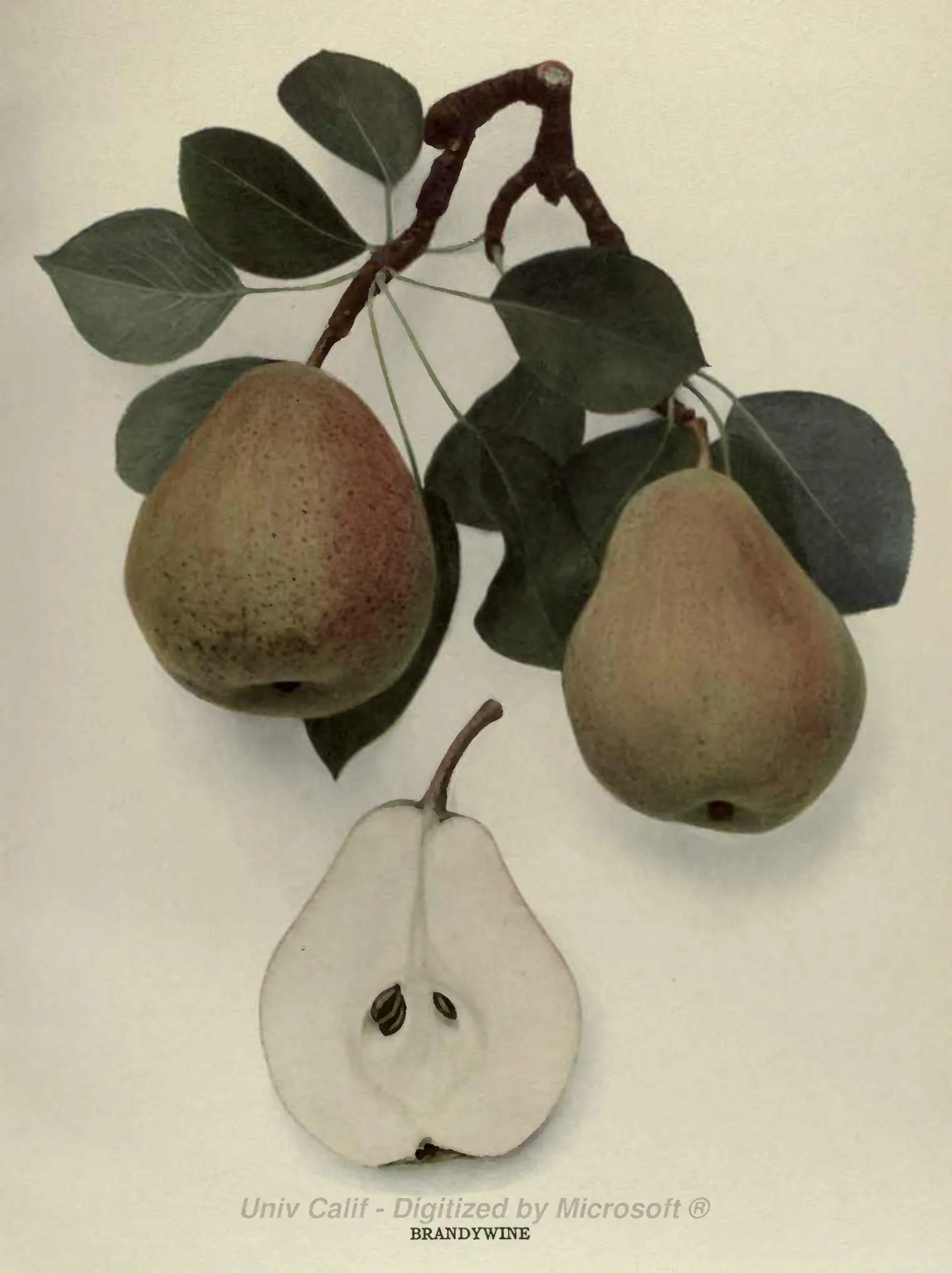
Brandywine
Origin / History
Brandywine is American, a chance seedling (Hedrick) and a native of Chaddsford, Delaware County, Pennsylvania. The original tree was found near a fence on the farm of the late Eli Harvey, on the banks of the Brandywine River. Hovey adds that it was transplanted into the garden of Mr. Geo. Brinton of that place. That garden lies on the banks of the Brandywine and is part of the grounds occupied by the American army "who defended our country in the battle of Brandywine." In Hovey's words: "It was, therefore, very appropriately named the Brandywine Pear."
The original tree began to bear about 1820. In 1835 the wind broke it down near the surface of the ground. A sucker from the original began bearing again and first fruited in 1844, which accounts for the variety not becoming known to cultivators sooner. Hovey observes that before 1835 very little interest was felt in native pears, but that by his day this interest was universal. He adds that "no sooner had the young tree, which sprang from the ruins of the old one, come into bearing, than its merits were made known to cultivators."
Dr. Brinckle of Philadelphia first brought the variety to the notice of pomologists. Fruit from him was first shown before the Massachusetts Horticultural Society in 1848, where it attracted much attention, was thought remarkably fine, and received high commendations. Hovey's account is headed with a reference to the Horticulturist, vol. iii, 1848, and calls Brandywine "one of the most recently introduced of our American pears." Hedrick's references run from Horticulturist 3:166 (1848–49) through the Magazine of Horticulture (1849 and 1853) and the American Pomological Society Report (1858) to Leroy's Dictionnaire de Pomologie and the Pomologie de la France, both 1867.
In 1853 Hovey presented the fruit from his own collection, and it was pronounced "by all who tried it, fully equal to any pear of its season." In 1858 the American Pomological Society added Brandywine to its list of recommended fruits. The Central Experimental Farm at Agassiz, British Columbia, planted it for trial in spring 1891.
Hedrick judges that, were it not that Tyson is better in both tree and fruit, Brandywine "could be put down as about the best pear of its season." He holds that Tyson is the better variety "in almost every soil and situation." In his view Brandywine keeps a place in American pear flora only because its distinct flavor gives the fruit "the charm of individuality."
Tree
Vigorous, thrifty, a rapid and strong grower. Hovey calls it a vigorous grower in his narrative but "moderately vigorous" in his technical description. Large, very erect and upright, with long upright shoots, forming a rather compact, dense-topped, handsome pyramidal head. Hovey finds the habit approaching that of Buffum, though with much more slender wood. Hedrick finds the tree "not remarkable otherwise."
Annual shoots rather slender, of medium length. The wood is light olive (Hovey) or pale olive (Thomas, of the shoots), and in Hovey's description is dotted with round grayish specks, rather slender and very short-jointed. Downing calls the young wood dull yellow brown. Old wood grayish olive (Hovey). Branches long, olive-gray, sprinkled with roundish lenticels. Hedrick describes the branchlets as slender, curved, with short internodes, brownish red overspread with scarf-skin, glabrous, with few small, obscure lenticels.
Leaf-buds medium in size and length, ovate, pointed, diverging or free. Hovey calls the flower-buds medium-sized. Hedrick calls them large, plump, conical, and free, and says they are borne singly on spurs and as terminal buds.
Leaves small to rather small, long-ovate, narrow, tapering to a long point, serrate or slightly serrated. Hovey adds smooth, dark green, glossy, much waved, and recurved a little on the midrib. Petioles long, about 1½ inches.
Hovey calls the flowers small, with round, cupped petals, in compact clusters. Hedrick gives them as ¾ inch across, in dense clusters averaging 9 buds; his Cyclopedia gives 7. Hedrick also gives pedicels ¾ inch long, slender, and pubescent.
The tree comes into bearing rather early (Hovey). It is regular, abundant, and uniformly productive. Thomas dissents, calling the tree "not very productive." Hedrick, while listing it productive, writes that "Sometimes it is unproductive."
It succeeds and grows well on the quince, and Budd and Hansen report it extensively grown on that stock. Hovey in 1852 held that whether it would succeed on the quince "remains yet to be tested."
Fruit
Size: Medium. Hovey gives about 2¾ inches long and 2½ in diameter. Hedrick gives 2½ inches long and 2¼ wide; his Cyclopedia gives 2¾ inches long.
Form: Variable, generally obovate-pyriform, running into the stem. The recorded shapes run from oblate depressed pyriform to elongated or long pyriform. Hovey describes it as pyramidal or somewhat bell-shaped, slightly irregular, and full at the crown, which is a little oblique. He adds that it is rather suddenly contracted near the stem, occasionally with an elongated neck. Thomas calls it conic-pyriform (Tyson-shaped), with the neck acute.
Stem: Three-fourths to one and a half inches long; Hovey and Hedrick give 1½ inches, Hovey calling it rather long. Moderately stout to stout. Slightly curved to curved, "often curved" (Budd and Hansen). Generally obliquely attached, at the top of the neck. Fleshy at its junction with the fruit, the base somewhat fleshy and wrinkled, generally surrounded by folds or rings (Downing).
Cavity: None. The stem is inserted without cavity, the flesh drawn up in a wrinkled fold about the base of the stem (Hedrick).
Calyx: Large and open. Segments few (Elliott), short, stiff, entire, and projecting (Hovey).
Basin: Small, roundish, shallow to moderately deep, the eye but little depressed in it (Hovey). Smooth or usually smooth, though Hovey calls it furrowed.
Skin: Slightly rough or roughish, though Thomas calls it smooth. Dull yellowish green to greenish yellow, yellowish green in the shade; Hedrick's Cyclopedia gives the color as yellow. The sunny side is blushed with red, which Budd and Hansen call usual. Hovey describes it as "boldly tinged with bright red," Elliott as reddish brown, and Downing as "a warm cheek."
The skin is marked with russet in dots, streaks, sprinklings, netting, and tracings. It is partly russeted, and thickly or much russeted about the crown and eye. Hedrick places the russet tracings especially near the cavity.
Dots: Numerous, large, conspicuous, russet. Downing calls the skin "considerably dotted," and Hovey "thickly covered with large russety specks."
Flesh and flavor: White to yellowish white, or whitish faintly tinged with yellow. Coarse or rather coarse, granular. Hovey calls it "slightly firm, yet perfectly melting." Melting, juicy to very juicy. Flavor vinous, rich or rather rich, brisk, delicious, of fine flavor; somewhat aromatic to aromatic, with a fine aroma.
Hovey finds the qualities "peculiarly its own." He writes that the flavor, "without being highly aromatized, appears to be a concentration of that of several sorts, being almost as sugary as the Seckel, yet relieved by the refreshing juice of the Marie Louise, and the 'champagne' smack of the Beurre d'Aremberg." Downing also calls it sugary. Hedrick finds the flesh "neither sweet nor perfumed, as is that of most pears at this season," but with "the piquant smack of some of the winter pears which makes the fruits particularly refreshing."
Quality good to very good; Budd and Hansen say "very good."
Core and seeds: Core small and compact; Hovey calls it medium. Seeds few, small, dark brown.
Season
Ripens in August, the last of August into the first of September, with Tyson (Hedrick). Hovey gives the last of August and says the fruit remains "in eating some time."
Uses
Hedrick considers it worth planting for the sake of diversity in home orchards.
Subtypes / Variants
Not described in source.
Other
Not described in source.
Book Sources
Described in 7 period pomological works
- Budd & Hansen, Systematic Pomology (1914)
- Elliott, The Western Fruit Book (1865)
- Hedrick, The Pears of New York (1921)
- Hedrick, Cyclopedia of Hardy Fruits (1922)
- Downing, Fruits and Fruit Trees of America (1900)
- Thomas, The American Fruit Culturist (1903)
- Hovey, The Fruits of America (1852) — listed as THE BRANDYWINE PEAR.
Nursery Catalog Sources
Found in 6 catalogs (1849–1901) from Illinois, Massachusetts, Virginia
- Hovey & Co. , Cambridge , Massachusetts — 1849
- Azell Bowditch (Nursery / Fruit Catalog) , Boston , Massachusetts — 1850
- The Vineland Nurseries (Kelsey & Co. , Proprietors), St. Joseph, Missouri (Office: 13th and Atchison Sts., 2 Blocks East of the Citizens St. Car Line) — 1894
- The Salem Nursery (John A. Francis , Proprietor), Salem , Virginia — 1897
- Central Experimental Farm , Dominion Department of Agriculture, Agassiz, British Columbia (under test; Bulletin No. 3, Second Series) — 1900
- Benjamin Buckman (personal inventory) , Farmingdale , Illinois — 1901
View original book sources (8)
— C.M. Hovey, The Fruits of America (1852)THE BRANDYWINE PEAR.
Brandywine. Horticulturist, vol. iii. 1848.
The Brandywine is one of the most recently introduced of our American pears, and was first brought to the notice of Pomologists by Dr. Brinckle, of Philadelphia. Specimens of the fruit received from him were first exhibited before the Massachusetts Horticultural Society in 1848, which attracted much attention, and were thought remarkably fine. In 1853, we had the gratification of presenting the fruit from our own collection, which was pronounced, by all who tried it, fully equal to any pear of its season.
The qualities of the Brandywine are peculiarly its own, and cannot well be compared with any other variety: its flesh is slightly firm, yet perfectly melting; and its flavor, without being highly aromatized, appears to be a concentration of that of several sorts, being almost as sugary as the Seckel, yet relieved by the refreshing juice of the Marie Louise, and the "champagne" smack of the Beurre d'Aremberg.
The Brandywine is a native of Chaddsford, Delaware County, Pennsylvania. The original tree was found near a fence on the farm of the late Eli Harvey, and was transplanted into the garden of Mr. Geo. Brinton, of that place. The garden is on the banks of the Brandywine River, and is a part of the grounds occupied by the American army, who defended our country in the battle of Brandywine. It was, therefore, very appropriately named the Brandywine Pear. The original tree began to bear fruit as long ago as 1820, but in 1835 it blew down near the surface of the ground. The present tree is a sucker from the original, and began to bear again in 1844. This fact accounts for its not sooner having become known to cultivators. Previous to 1835, when the old tree blew down, very little interest was felt in regard to our native pears; now, however, that interest is universal, and no sooner had the young tree, which sprang from the ruins of the old one, come into bearing, than its merits were made known to cultivators.
The tree is a vigorous grower, with a handsome pyramidal habit, approaching to the Buffum, though with much more slender wood. It seems to come into bearing rather early. Whether it will succeed on the quince remains yet to be tested.
Tree.— Moderately vigorous, and very erect in its growth, forming a rather compact pyramidal head; annual shoots rather slender, medium length.
Wood. — Light olive, dotted with round grayish specks, rather slender and very short-jointed; old wood, grayish olive; buds, medium size, ovate, diverging: Flower-buds, medium size.
Leaves. — Small, long ovate, narrow, tapering to a long point, smooth, dark green, glossy, much waved, recurved a little on the midrib, and slightly serrated; petioles, long, about one and a half inches in length.
Flowers. — Small; petals round, cupped; clusters compact.
Fruit. — Medium size, about two inches and three quarters long, and two and a half in diameter: Form, pyramidal, or somewhat bell-shaped, slightly irregular, full at the crown, which is little oblique, and rather suddenly contracted near the stem, occasionally with an elongated neck: Skin, slightly rough, yellowish green in the shade, russeted around the crown, boldly tinged with bright red in the sun, and thickly covered with large russety specks: Stem, rather long, about one and a half inches in length, moderately stout, slightly curved, and generally obliquely attached, without any cavity, by a somewhat fleshy and wrinkled base: Eye, large, open, and but little depressed in a small, roundish, furrowed basin; segments of the calyx, short, stiff, entire, projecting: Flesh, yellowish white, coarse, melting and very juicy: Flavor, rich, brisk, vinous and delicious, with a fine aroma: Core, medium size: Seeds, small, dark brown.
Ripe the last of August, and in eating some time.
— F.R. Elliott, The Western Fruit Book (1865)Brandywine.
American, from the banks of the Brandywine river. Tree, thrifty, rapid grower, long upright shoots, regular and abundant bearer. Fruit, medium, varying in form, generally obovate pyriform, running into the stem, which is fleshy, and rather obliquely set; color, dull yellowish green, reddish brown in sun, marked with russet dots and streaks, and much russeted about eye; calyx, open, segments few; basin, smooth, moderate depth; core, small, compact; seeds, few, dark brown; flesh, white, rather coarse, melting, juicy, vinous. Last of August, first of September. Succeeds on Quince.
— A.J. Downing, The Fruits and Fruit Trees of America (1900)Brandywine.
Found on the farm of Eli Harvey, on the banks of the Brandywine, Delaware Co., Pa. Tree vigorous, upright, uniformly productive. Young wood dull yellow brown.
Fruit medium, varying in form from oblate depressed pyriform to elongated pyriform. Skin dull yellowish green, considerably dotted and somewhat sprinkled with russet, having a warm cheek on the side of the sun. Stalk is fleshy at its junction with the fruit, and generally surrounded by folds or rings. Calyx open. Basin smooth and shallow. Flesh white, juicy, melting, sugary, and vinous, somewhat aromatic. Good to very good. Ripe last of August and first of September.
— John J. Thomas, The American Fruit Culturist (1903)Brandywine.* Size medium; conic-pyriform (Tyson-shaped), neck acute; smooth, dull yellowish-green, partly russeted, crown thickly russeted; stalk three-fourths to an inch and a half long, fleshy at insertion; flesh white, very juicy and melting, of fine flavor. Leaves rather small, shoots pale olive, vigorous, upright; tree not very productive. Ripens in August. A native of Delaware County, Pa. Grows well on the quince. Fig. 656.
— J.L. Budd & N.E. Hansen, American Horticultural Manual, Part II: Systematic Pomology (1914)Brandywine. — Medium in size; shape quite variable, ranging from oblate pyriform to long pyriform; skin greenish yellow, dotted and netted with russet, usually blushed on sunny side; stalk three-quarters to one and one-half inches long, stout, often curved, and inserted at top of neck without cavity. Flesh white, juicy, melting, rather rich, very good. Extensively grown on the quince. Pennsylvania.
— U.P. Hedrick, The Pears of New York (1921)BRANDYWINE
- Horticulturist 3:166, figs. 25 and 26. 1848-49. 2. Mag. Hort. 15:106. 1849. 3. Hovey Fr. Am. 2:51, Pl. 1851. 4. Mag. Hort. 19:450, fig. 30. 1853. 5. Am. Pom. Soc. Rpt. 231. 1858. 6. Leroy Dict. Pom. 1:496, fig. 1867. 7. Pom. France 4: No. 160, Pl. 160. 1867.
Were it not that Tyson is better in both tree and fruit, Brandywine, which ripens its crop with that of Tyson, could be put down as about the best pear of its season. Tyson is the better variety, however, in almost every soil and situation, and Brandywine has a place in American pear flora only because the pears have a distinct flavor which gives them the charm of individuality. The flesh is neither sweet nor perfumed, as is that of most pears at this season, but has the piquant smack of some of the winter pears which makes the fruits particularly refreshing. The tree is vigorous, with a handsome pyramidal top, but is not remarkable otherwise. Sometimes it is unproductive. The variety is worth planting for the sake of diversity in home orchards.
The original tree, a chance seedling, was found on the farm of Eli Harvey, Chaddsford, on the banks of the Brandywine River, Pennsylvania. This parent tree began to bear about 1820, but in 1835 wind broke it down near the surface of the ground. The present tree is a sucker from the original, and first fruited in 1844. This fact accounts for its not sooner having become known to cultivation. Dr. Brinckle of Philadelphia showed the fruits first at a meeting of the Massachusetts Horticultural Society in 1848 when it received high commendations. In 1858 the American Pomological Society added Brandywine to its list of recommended fruits.
Tree large, vigorous, very upright, dense-topped, productive; branches long, olive-gray, sprinkled with roundish lenticels; branchlets slender, curved, with short internodes, brownish-red overspread with scarf-skin, glabrous, with few small, obscure lenticels.
Leaf-buds medium in size and length, pointed, free. Leaves small, long-ovate; apex taper-pointed; margin serrate; petiole 1½ in. long. Flower-buds large, plump, conical, free, singly on spurs and as terminal buds; flowers ¾ in. across, in dense clusters, average 9 buds in a cluster; pedicels ¾ in. long, slender, pubescent.
Fruit ripens in late August and early September; medium in size, 2½ in. long, 2¼ in. wide, variable in shape but generally obovate-pyriform; stem 1½ in. long, fleshy, curved, obliquely attached; cavity lacking, the flesh drawn up in a wrinkled fold about the base of the stem; calyx large, open; lobes short, entire; basin small, shallow, usually smooth; skin roughish; color greenish-yellow, blushed with red on the sunny side, marked with tracings of russet especially near the cavity; dots numerous, large, conspicuous, russet; flesh whitish, or faintly tinged with yellow, granular, melting, juicy, aromatic, vinous; quality good to very good. Core small; seeds few, small, dark brown.
— U.P. Hedrick, Cyclopedia of Hardy Fruits (1922)BRANDYWINE. Fig. 78. Were it not that Tyson is better in tree and fruit, Brandywine, which ripens its crop with that of Tyson, could be put down as the best pear of its season. Tyson is the better variety, however, and Brandywine has a place in the American pear flora only because the pears have a distinct flavor which gives them the charm of individuality. The flesh is neither sweet nor perfumed as is that of most pears at this season, but has the piquant smack of some of the winter pears which makes the fruits particularly refreshing. The tree is vigorous, with a handsome pyramidal top. The variety is worth planting for the sake of diversity in home orchards. The original tree, a chance seedling, was found on the farm of Eli Harvey, Chadds Ford, Pennsylvania, on the banks of the Brandywine River.
Tree large, vigorous, very upright, dense-topped, productive; branches long, olive-gray, sprinkled with roundish lenticels. Leaves small, long-ovate; apex taper-pointed; margin serrate; petiole 1½ inches long. Flowers ¾ inch across, in dense clusters, average 7 buds in a cluster. Fruit ripens in late August and early September; 2¾ inches long, 2¼ inches wide, obovate-pyriform; stem 1½ inches long, fleshy, curved, obliquely attached; cavity lacking, the flesh drawn up in a wrinkled fold about the base of the stem; calyx large, open; lobes short, entire; basin small, shallow, usually smooth; skin roughish; color yellow, blushed with red on the sunny side, marked with tracings of russet especially near the cavity; dots numerous, large, conspicuous, russet; flesh whitish, or faintly tinged with yellow, granular, melting, juicy, aromatic, vinous; quality good to very good; core small; seeds few, small, dark brown.
— Central Experimental Farm, Central Experimental Farm, Agassiz BC — Catalogue of Fruit Trees under Test (Bulletin No. 3, 1900) (1900)Planted Spring 1891. Tree a strong grower. Fruit of medium size, pyriform. Skin yellowish green, sprinkled with russet. Flesh white, juicy, aromatic and of fine flavour. Season last of August.