Buffum
Pear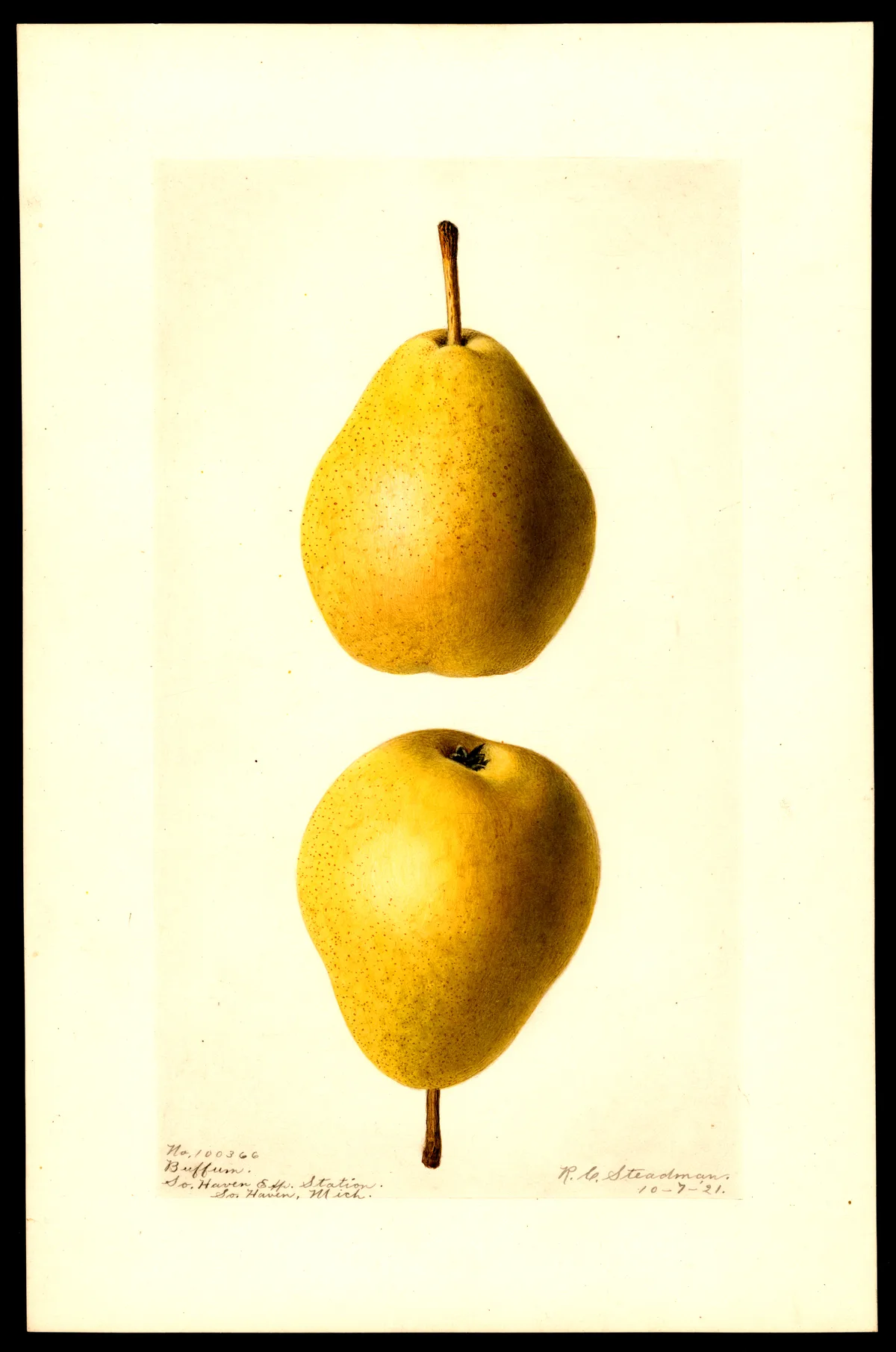
USDA Pomological Watercolor Collection
Buffum
Origin / History
Buffum is a pear and a native of Rhode Island. Hovey places its origin in the garden of David Buffum, of Warren, Rhode Island, and Hedrick gives the original tree there. Hedrick reports Hovey as dating it to shortly after the advent of the nineteenth century. He also records that some writers placed the original tree on the grounds of Prescott Hall, Newport, Rhode Island. Downing judged it, from its general resemblance to the Doyenne, "no doubt, a seedling of that fine sort," and Hedrick names that parent as White Doyenné. Hovey and Hedrick both cite the variety from Kenrick's American Orchardist, which Hedrick dates 1832. Downing described it under the spelling "Buffam," in an account Hedrick dates 1845.
Manning, "we believe" (Hovey), introduced it around Boston, fruited it in his Pomological Garden at Salem, and exhibited it before the Massachusetts Horticultural Society. Hedrick names him Robert Manning and places the exhibition soon after the Society's founding in 1828. Hovey says Manning gave a brief account of it in the Magazine of Horticulture in 1837 (vol. iii, p. 16). From the vicinity of Boston it was gradually disseminated throughout the country.
Hovey records that cultivators estimated it variously, some considering it nearly equal to a fine Doyenne and others placing it among pears of medium quality. "Two years since," its merits were "pretty fully discussed" at the meeting of the Pomological Congress in New York, on the question of adding it to the list of kinds worthy of general cultivation. The Congress placed it on the list by a large majority. Hedrick gives its addition to the fruit-list of the American Pomological Society as 1852.
Hovey held that, "without being ranked among the finest pears," it "possesses abundant merits, which entitle it to a place in the collection of every cultivator." He deemed these qualities sufficient to place it "among our most popular varieties." He complained that among the multitude of new pears ripening at the same time it had been overlooked, and that inferior sorts had been planted to the exclusion of "this much better fruit." Elliott calls it "very successful wherever grown." Budd and Hansen call it "popular in many States for culinary use and market."
Hedrick judged it "without deserving a high place among pears," yet possessed of "several meritorious characters which should keep it in the list of standard varieties." In his view it "must depend chiefly on its tree-characters for approbation," and in these it excels nearly all of its orchard associates. By his time its culture was on the wane, chiefly because its fruits ripen with those of Seckel and fail in that competition, the Seckels being nearly as large and much better in quality. He held that "because of its admirable tree-characters the variety should not be lost."
Tree
Tree remarkably vigorous, very strong and upright, very erect, dense, of great size, hardy. It is "as erect and straight as a poplar" (Hovey), with a stately habit and a spiry top. It forms a perfect, symmetrical pyramid even without the aid of the pruning knife. Hedrick says that in full leaf it might easily be taken for a Lombardy poplar. Nearly free from blight, almost immune (Hedrick).
Young shoots strong, reddish or reddish brown, very erect. Downing names the strong upright reddish-brown shoots as a distinguishing mark of the variety. Wood sturdy and ruddy in winter when stripped of foliage. Hovey describes the wood as reddish brown, sparsely dotted with small whitish specks, moderately stout and short-jointed, with the old wood dull brown. Hedrick describes the branches as shaggy, zigzag, reddish-brown, overspread with grayish scarf-skin, with numerous small lenticels. His branchlets are short, reddish-brown tinged with green, streaked with grayish scarf-skin, smooth, glabrous, with conspicuous, small, raised lenticels.
Leaf-buds small, short. Hovey calls them broad at the base, erect, flattened; Hedrick calls them conical, pointed, appressed, with prominent leaf-scars. Hovey gives the flower-buds as medium size, obtuse, dark brown. Hedrick gives them as large, conical, pointed, plump, free, arranged singly on short spurs and branchlets.
Foliage deep or dark green, glossy. Hovey gives the leaves as large, roundish-ovate, narrowing toward each end, thick, wavy, prominently nerved, coarsely and obtusely serrated. His petioles are of medium length, three-quarters to an inch long, stout, holding the leaves erect. Hedrick gives the leaves as 3½ in. long, 2 in. wide (3¼ by 1½ in. in his Cyclopedia), oval, thin, leathery. In his account the apex is abruptly pointed, the margin glandular, finely serrate, and the petiole 2½ in. long.
Flowers medium size, petals roundish, cupped (Hovey). Hedrick gives them as 1⅛ in. across (1¼ in. in his Cyclopedia), showy, in dense clusters of 6 to 8 buds (6 to 7 flowers in his Cyclopedia). His pedicels are ⅝ in. long, slender, pubescent, greenish.
Very productive: "an immense bearer," the fruit hanging in clusters from every branch (Hovey). Elliott calls it always productive of fair, even-sized fruit, and Downing says it bears large, regular crops. Hovey finds it rather late in coming into bearing. Hedrick notes a tendency to bear biennially. At the Central Experimental Farm, Agassiz, British Columbia, where it was planted in spring 1890, it proved a strong grower but a shy bearer.
Hovey says it does not succeed well on the quince. Elliott calls it admirably adapted to standard orcharding. Downing calls it "an orchard Pear of the first quality," as a very strong, upright grower bearing large, regular crops of very handsome and salable fruit.
Fruit
Size: Medium, uniform in size and shape, even-sized. Hedrick says the fruits are never large and often run small. Hovey gives about 2½ in. long and 2¼ in. in diameter. Hedrick gives 2⅝ in. long and 2 in. wide (2½ in. long, more than 2 in. wide in his Cyclopedia).
Form: Oblong obovate to obovate, with unequal sides, a little smaller on one side or with one side enlarged. Hedrick calls it oblong-obovate-pyriform. Hovey gives it as ovate inclining to obovate, largest around the crown, rounding off to the stem, where it ends obtusely.
Stem: Stout to very thick, half an inch to an inch long, most authors giving three-quarters of an inch to an inch. Hovey calls it short, about half an inch. Slightly sunk, in a slight depression.
Cavity: Very slight to shallow, narrow, moderate or small. Hedrick describes it as obtuse, very shallow, narrow, russeted, gently furrowed, often lipped or slightly lipped.
Calyx: Eye rather large (Hovey); calyx open (Hedrick). Segments short, small. Hovey calls the segments rounded, and Elliott calls them recurved. Hedrick gives the lobes as separated at the base, short, narrow, obtuse, and the calyx-tube as short, wide, conical.
Basin: Shallow, round, of moderate size or small, the eye little depressed. Hedrick calls it obtuse, gently furrowed.
Skin: Fair, smooth except for the russet markings. Hedrick gives it as thick, very tough and granular, dull. Brownish green at first, becoming yellow at maturity. The yellow is pale yellow (Hovey), golden or deep yellow, deep brownish-yellow (Hedrick), or greenish yellow (Agassiz). The sunny side is bright red, finely suffused over half the fruit (Downing) or deeply tinted (Hovey). Thomas calls it a broad reddish-brown cheek, Agassiz a reddish cheek, and Hovey's technical description brownish red. Hedrick places a bright reddish blush on the exposed cheek toward the basin. A little to somewhat russeted, often russeted (Hovey), interlaced with russet. Downing names the peculiar brownish green appearance of the pear before ripening as distinctive. Handsome and beautiful.
Dots: Small, brown, brownish or russet, quite numerous to many, conspicuous (Hedrick). Hovey alone gives a few greenish and russety specks.
Flesh and flavor: White to yellowish white, or white tinged with yellow. Most authors call it buttery. Hovey calls it fine, melting and juicy; Hedrick calls it firm, granular, stringy toward the center, juicy. Downing finds it not so juicy as the Doyenne, Budd and Hansen quite juicy, and Agassiz not juicy.
Flavor sweet. Hovey calls it rich, sweet and pleasantly perfumed, and Hedrick calls it aromatic. Downing calls it "of excellent flavor." Picked early and ripened indoors, Hovey says it becomes "almost as melting and delicious as the White Doyenne, which it resembles, when in its best condition."
Quality variable: "a little variable" (Downing), "slightly variable" (Thomas), "very variable" (Hedrick). Downing has frequently eaten it "so fine as scarcely to be distinguished from the Doyenne, and again when rather insipid." Hedrick writes that "at times the flesh is rich, aromatic, melting, and very good; again, the pears may be insipid or even illy flavored, devoid of perfume, coarse in texture, and poor." Verdicts run from "very good" (Downing, Thomas, Budd and Hansen) through "quality good" (Hedrick) and "quality medium" (Agassiz) to Elliott's "not, however, of more than second-rate quality." Downing also calls it "a beautiful and good, though not first-rate variety."
Core and seeds: Core rather small (Elliott) to medium (Hovey). Hedrick gives it as large, closed, with core-lines clasping. Seeds dark brown (Elliott), medium size (Hovey). Hedrick gives the seeds as large, wide, plump, acute.
Season
September, to the end of September (Thomas), or late September and October (Hedrick). The fruit should be picked early and ripened in the fruit room or house. Thomas says to pick it two weeks before ripening, "or it becomes mealy," and Hedrick specifies a moderately cool fruit-room for good quality. Hovey says it keeps two or three weeks.
Uses
Culinary use and market (Budd and Hansen). Downing calls it a very handsome and salable fruit, and Thomas values it for its fair fruit and fine bearing qualities. As an ornamental tree, Hovey calls it "one of the best sorts to introduce near the house, where its spiry top breaks up the formality of round-headed trees." Hedrick counts it among the most ornamental of all fruit trees by virtue of its great size, symmetrical pyramidal form, dark green glossy foliage, and ruddy winter wood.
Subtypes / Variants
Not described in source.
Other
Not described in source.
Book Sources
Described in 7 period pomological works
- Budd & Hansen, Systematic Pomology (1914)
- Hedrick, The Pears of New York (1921)
- Elliott, The Western Fruit Book (1865)
- Hedrick, Cyclopedia of Hardy Fruits (1922)
- Thomas, The American Fruit Culturist (1903)
- Downing, Fruits and Fruit Trees of America (1900) — listed as BUFFAM
- Hovey, The Fruits of America (1852) — listed as THE BUFFUM PEAR.
Nursery Catalog Sources
Found in 22 catalogs (1845–1917) from Alabama, Florida, Illinois, Massachusetts, Missouri, New Jersey, Oregon, Washington
- Winship's Nursery (Brighton Nurseries , operated by the Winship family), Brighton (Boston) , Massachusetts — 1845
- Hovey & Co. , Cambridge , Massachusetts — 1849
- Joseph Breck & Co. , Boston , Massachusetts — 1855
- Missouri Nursery Co. , Louisiana , Missouri — 1891
- Glen St. Mary Nurseries (G.L. Taber , Proprietor), Glen St. Mary , Florida — 1893
- The Vineland Nurseries (Kelsey & Co. , Proprietors), St. Joseph, Missouri (Office: 13th and Atchison Sts., 2 Blocks East of the Citizens St. Car Line) — 1894
- Woodburn Nurseries , Woodburn, Marion Co. , Oregon — 1894
- The Lovett Company , Little Silver , New Jersey — 1896
- J.V. Cotta (Cotta Nursery) , Carroll County , Illinois — 1898
- Alabama Nursery Co. , Huntsville , Alabama — 1900
- Central Experimental Farm , Dominion Department of Agriculture, Agassiz, British Columbia (under test; Bulletin No. 3, Second Series) — 1900
- Washington Nursery Co. , Toppenish , Washington — 1901
- Phoenix Nursery Company (W. E. Rossney , President; Sidney Tuttle, Vice-President), Bloomington , Illinois — 1904
- Washington Nursery Company , Toppenish , Washington — 1909
- Island Nurseries & Fruit Farm , Vashon (Vashon Island) , Washington — 1910
- Island Nurseries & Fruit Farm , Vashon (Vashon Island) , Washington — 1911
- Vineland Nurseries Company , Clarkston , Washington — 1912
- Washington Nursery Company , Toppenish , Washington — 1912
- Island Nurseries & Fruit Farm , Vashon (Vashon Island) , Washington — 1914
- Island Nurseries & Fruit Farm , Vashon (Vashon Island) , Washington — 1915
- Island Nurseries & Fruit Farm , Vashon (Vashon Island) , Washington — 1916
- Island Nurseries & Fruit Farm , Vashon (Vashon Island) , Washington — 1917
View original book sources (8)
— C.M. Hovey, The Fruits of America (1852)THE BUFFUM PEAR.
BUFFUM. Kenrick's American Orchardist.
BUFFAM, Downing's Fruits and Fruit Trees.
The Buffum pear has been variously estimated by different cultivators; some considering it nearly equal to a fine Doyenne, while others place it among those of medium quality. Two years since, at the meeting of the Pomological Congress in New York, the merits of the Buffum were pretty fully discussed, the question being upon adding it to the list of kinds worthy of general cultivation. The result of the discussion was, that it was placed upon the list by a large majority.
The Buffum, without being ranked among the finest pears, possesses abundant merits, which entitle it to a place in the collection of every cultivator. The tree is of remarkably vigorous growth, as erect and straight as a poplar, forming a perfect pyramid, even without the aid of the pruning knife. It is an immense bearer; and the fruit, which hangs in clusters from every branch, is fair and beautiful, with a golden yellow skin, often russeted and deeply tinted with bright red on the sunny side. Picked early, (as it should be,) and ripened in the fruit room or house, it becomes almost as melting and delicious as the White Doyenne, which it resembles, when in its best condition. A combination of such qualities we deem sufficient to place the Buffum among our most popular varieties.
The Buffum is a native of Rhode Island, originating in the garden of David Buffum, of Warren. Mr. Manning, we believe, introduced it around Boston, fruited it in his Pomological Garden at Salem, exhibited it before the Massachusetts Horticultural Society, and gave a brief account of it in the Magazine of Horticulture in 1837, (vol. iii. p. 16.) Since then, it has been gradually disseminated throughout the country, though among the multitude of new pears, which ripen about the same time, it has been overlooked, and inferior sorts have been planted, to the exclusion of this much better fruit.
As an ornamental tree, merely, the Buffum claims our regard. Its stately habit, symmetrical form, deep green foliage, and ruddy-colored wood when stripped of its foliage, render it one of the best sorts to introduce near the house, where its spiry top breaks up the formality of round-headed trees. It is rather late in coming into bearing, and it does not succeed well on the quince.
Wood. — Reddish brown, sparsely dotted with small whitish specks, moderately stout and short-jointed; old wood, dull brown; buds, small, short, broad at the base, erect, flattened: Flower-buds, medium size, obtuse, dark brown.
Leaves. — Large, roundish-ovate, narrowing towards each end, thick, deep green, glossy, wavy, prominently nerved, and coarsely and obtusely serrated; petioles, medium length, three quarters to an inch long, stout, holding the leaves erect.
Flowers. — Medium size: petals roundish, cupped.
Fruit. — Medium size, about two and a half inches long, and two and a quarter inches in diameter: Form, ovate, inclining to obovate, largest around the crown, rounding off the stem, where it ends obtusely: Skin, fair, smooth, pale yellow, interlaced with russet, brownish red on the sunny side, and dotted with a few greenish and russety specks: Stem, short, about half an inch long, stout and slightly sunk in a shallow cavity: Eye, rather large, and little depressed in a shallow basin; segments of the calyx short, rounded: Flesh, yellowish white, fine, melting and juicy: Flavor, rich, sweet, and pleasantly perfumed: Core, medium size: Seeds, medium size.
Ripe in September, and keeps two or three weeks.
— F.R. Elliott, The Western Fruit Book (1865)BUFFUM.
American. Native of Rhode Island. It is very successful wherever grown, admirably adapted to standard orcharding, an upright, strong grower, reddish brown shoots, always productive of fair, even-sized fruit; not, however, of more than second-rate quality.
Fruit, medium, oblong obovate; color, brownish green, becoming yellow, bright red, suffused in sun; brown dots and a little russet; stem, half to inch long, slight depression; calyx, with short recurved segments; basin, round; core, rather small; seeds, dark brown; flesh, white, buttery, sweet. September.
— A.J. Downing, The Fruits and Fruit Trees of America (1900)BUFFAM.
The Buffam is a native of Rhode Island, and from its general resemblance to the Doyenne, it is, no doubt, a seedling of that fine sort. It is an orchard Pear of the first quality, as it is a very strong, upright grower, with reddish or reddish brown young shoots, bears large, regular crops, and is a very handsome and salable fruit. It is a little variable in quality. We have frequently eaten them so fine as scarcely to be distinguished from the Doyenne, and again when rather insipid. It may be considered a beautiful and good, though not first-rate variety.
Fruit of medium size, oblong obovate, a little smaller on one side. Skin fair, deep yellow (brownish green at first), finely suffused over half the fruit, with bright red, sprinkled with small brown dots, or a little russet. Stalk an inch long, inserted in a very slight cavity. Calyx with small segments, and basin of moderate size. Flesh white, buttery, not so juicy as the Doyenne, but sweet, and of excellent flavor. The strong upright reddish brown shoots, and peculiar brownish green appearance of the pear before ripening, distinguish this fruit. Very good. September.
— John J. Thomas, The American Fruit Culturist (1903)Buffum.* Size medium, obovate; skin yellow, with a broad, reddish-brown cheek, somewhat russeted; stalk three-fourths of an inch long, stout; cavity and basin moderate or small; flesh buttery, sweet, very good, slightly variable. Shoots strong, reddish-brown, very erect; tree very productive. Valuable for its fair fruit, and fine bearing qualities. Ripens end of September, but should be picked two weeks before, or it becomes mealy. Origin, Rhode Island. Fig. 712.
— J.L. Budd & N.E. Hansen, American Horticultural Manual, Part II: Systematic Pomology (1914)Buffum.— Size medium, oblong, obovate, with one side enlarged; skin yellow when mature, with bright red on sunny side; dots quite numerous; stalk one inch long inserted in narrow, shallow cavity. Flesh white, buttery, quite juicy, sweet, very good. Season, September. Popular in many States for culinary use and market. Rhode Island.
— U.P. Hedrick, The Pears of New York (1921)BUFFUM
- Kenrick Am. Orch. 166. 1832. 2. Mag. Hort. 10:300, fig. 15. 1844. 3. Ibid. 16:297. 1850. 4. Hovey Fr. Am. 2:19, Pl. 1851. 5. Am. Pom. Soc. Rpt. 53. 1852. 6. Horticulturist N. S. 6:300, Pl. 1856. 7. Ibid. 25:104, fig. 1870. 8. Mas Le Verger 3: Pt. i, 81, fig. 39. 1866-73.
Buffam. 9. Downing Fr. Trees Am. 356, fig. 150. 1845.
Without deserving a high place among pears, Buffum has several meritorious characters which should keep it in the list of standard varieties. The variety must depend chiefly on its tree-characters for approbation, and in these it excels nearly all of its orchard associates. The trees are remarkably vigorous, nearly free from blight, very productive, although they have a tendency to bear biennially; and by virtue of great size, symmetrical, pyramidal form, dark green, glossy foliage, and sturdy, ruddy wood in winter, they are among the most ornamental of all fruit trees. In full leaf, a Buffum tree might easily be taken for a Lombardy poplar. The quality of the fruits is very variable. At times the flesh is rich, aromatic, melting, and very good; again, the pears may be insipid or even illy flavored, devoid of perfume, coarse in texture, and poor. The fruits are never large and often run small. To attain good quality, the pears must be picked early and ripened in a moderately cool fruit-room. The culture of Buffum is on the wane, chiefly for the reason that its fruits ripen with those of Seckel and fail in competition, as the Seckels are nearly as large and much better in quality. But because of its admirable tree-characters the variety should not be lost.
Some confusion exists as to the origin of Buffum. Some writers state that the original tree stood on the grounds of Prescott Hall, Newport, Rhode Island. Hovey, however, in his Fruits of America, 1851, says that the variety originated in the garden of David Buffum, Warren, Rhode Island, shortly after the advent of the nineteenth century. In the opinion of Downing the variety came from seed of White Doyenné. Soon after the founding of the Massachusetts Horticultural Society in 1828, Robert Manning exhibited specimens of the Buffum pear, and through him the variety became known in the vicinity of Boston from which place it was disseminated throughout the country. Buffum was added to the fruit-list of the American Pomological Society in 1852.
Tree vigorous, very upright, dense, hardy, almost immune to blight, very productive; branches shaggy, zigzag, reddish-brown, overspread with grayish scarf-skin, with numerous small lenticels; branchlets short, reddish-brown, tinged with green and streaked with grayish scarf-skin, smooth, glabrous, with conspicuous, small, raised lenticels.
Leaf-buds small, short, conical, pointed, appressed; leaf-scars prominent. Leaves 3½ in. long, 2 in. wide, oval, thin, leathery; apex abruptly pointed; margin glandular, finely serrate; petiole 2½ in. long. Flower-buds large, conical, pointed, plump, free, arranged singly on short spurs and branchlets; flowers 1⅛ in. across, showy, in dense clusters, 6 to 8 buds in a cluster; pedicels ⅝ in. long, slender, pubescent, greenish.
Fruit ripe in late September and October; medium in size, 2⅝ in. long, 2 in. wide, uniform in size and shape, oblong-obovate-pyriform, with unequal sides; stem ¾ in. long, very thick; cavity obtuse, very shallow, narrow, russeted, gently furrowed, often lipped; calyx open; lobes separated at the base, short, narrow, obtuse; basin shallow, obtuse, gently furrowed; skin thick, very tough and granular, smooth except for the russet markings, dull; color deep brownish-yellow, with a bright reddish blush on the exposed cheek toward the basin; dots many, small, brownish or russet, conspicuous; flesh white, tinged with yellow, firm, granular, stringy toward the center, juicy, sweet, aromatic; quality good. Core large, closed; core-lines clasping; calyx-tube short, wide, conical; seeds large, wide, plump, acute.
— U.P. Hedrick, Cyclopedia of Hardy Fruits (1922)BUFFUM. Buffum has meritorious characters of the tree which should keep it in the list of standard varieties. The trees are remarkably vigorous, nearly free from blight, very productive, although they have a tendency to bear biennially. The quality of the fruits is variable. At times the flesh is rich, aromatic, melting and very good; again, it may be insipid or even illy flavored, devoid of perfume, coarse in texture and poor. The fruits are never large and often run small. To attain good quality, the pears must be picked early and ripened in a moderately cool fruit-room. The culture of Buffum is on the wane, chiefly for the reason that its fruits ripen with those of Seckel and fail in competition, the Seckels being nearly as large and much better in quality. The original tree of Buffum grew in the garden of David Buffum, Warren, Rhode Island. Tree vigorous, very upright, dense, hardy, almost immune to blight, very productive; branches shaggy, zigzag, reddish-brown, with numerous small lenticels. Leaves 3¼ inches long, 1½ inches wide, oval, thin, leathery; apex abruptly pointed; margin glandular, finely serrate; petiole 2½ inches long. Flowers 1¼ inches across, showy, in dense clusters, 6 to 7 flowers in a cluster. Fruit ripe in late September and October; 2½ inches long, more than 2 inches wide, uniform in size and shape, oblong-obovate-pyriform, with unequal sides; stem ¾ inch long, very thick; cavity obtuse, shallow, narrow, russeted, gently furrowed, often slightly lipped; calyx open; lobes separated at the base, short, narrow, obtuse; basin shallow, obtuse, gently furrowed; skin thick, tough and granular, smooth except for the russet markings, dull; color deep brownish-yellow, with a bright reddish blush on the exposed cheek toward the basin; dots many, small, brownish or russet, conspicuous; flesh white, tinged with yellow, firm, granular, stringy toward the center, juicy, sweet, aromatic; quality good; core large, closed; core-lines clasping; calyx-tube short, wide, conical; seeds large, wide, plump, acute.
— Central Experimental Farm, Central Experimental Farm, Agassiz BC — Catalogue of Fruit Trees under Test (Bulletin No. 3, 1900) (1900)Planted Spring 1890. Tree a strong grower, but a shy bearer. Fruit of medium size, obovate. Skin greenish yellow, with a reddish cheek and sprinkled with brown dots. Flesh white, buttery, not juicy, quality medium. Season September.