Gansel's Bergamot
Pear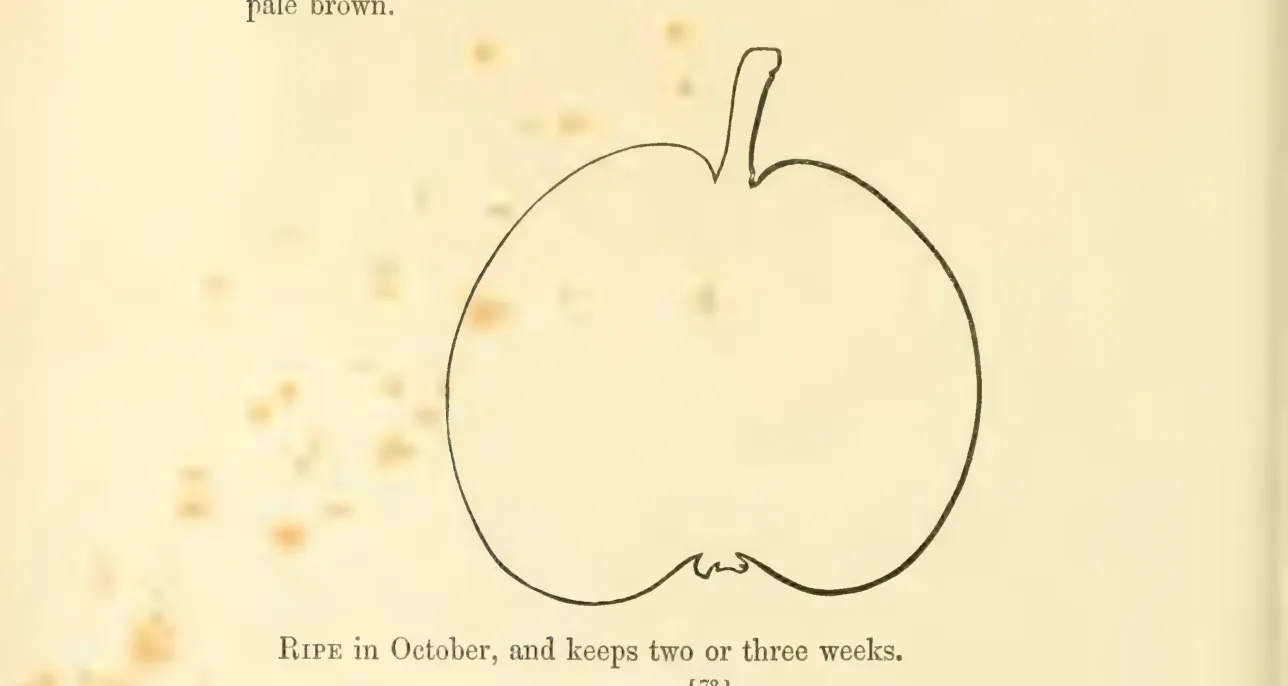
Gansel's Bergamot
Origin / History
English (Lindley, Hovey, Thomas, Hedrick); Elliott lists it as "Foreign." Raised by Lieutenant-General Gansel from seed of the Autumn Bergamot at Donneland Hall, near Colchester (Lindley). Hovey gives "Donellan Hall," the general's seat, and Bunyard "Donneland Hill, Colchester." Lindley places the raising "about the middle of the last century." Hovey and Hedrick give 1768, and Bunyard, citing Lindley, gives about 1768. Hovey reckoned it had consequently been in cultivation nearly a century.
Lindley ranks it among the native English autumnal pears as perhaps holding "the highest rank, whether we consider its beauty, its excellence, or its prolific nature." Hovey calls it "this fine old pear," holding "the highest rank in English collections," and "justly esteemed by British pomologists a superior fruit." Downing calls it an old pear. Elliott calls it "an old variety, with few superiors when well grown."
Hovey could not ascertain when it entered American collections. He thought it "probably… introduced many years previous, or about the commencement of the present century." He takes the Brockholst Bergamot, which Mr. Lowell names among the few sorts cultivated in Massachusetts in 1815, to be "undoubtedly this pear." According to Hovey, Coxe cultivated it in his collection in New Jersey and described it in his work (which Hovey dates 1818) as a "very fine pear." Coxe's text, dated 1817, carries it under the name "Broca's Bergamot." There he calls it "a very fine pear, superior to most of the Bergamot tribe." Lindley marks the identity of the Brocas Bergamot (Hort. Soc. Fruit Cat. no. 51) with a query.
In Hovey's day the variety was "greatly neglected in the rapid introduction of new varieties." It was "not uncommon to find large and choice collections without a single specimen," and some cultivators well acquainted with the principal pears scarcely knew it. He was "at a loss to imagine" why. He judged the main reason probably its age: it had been introduced along with the White Doyenne, Brown Beurré, and St. Germain, which had long ceased to be generally cultivated on account of the uncertainty of the crop. Planted for trial at the Central Experimental Farm, Agassiz, British Columbia, in spring 1893.
Tree
Vigor disputed. Coxe finds the tree "remarkably deficient in vigour of growth," Lindley calls the wood weak, and Bunyard calls it a weak, straggling grower that does best when double grafted. Elliott calls it vigorous, Downing moderately vigorous, and the Agassiz station a strong grower.
Habit spreading. Hovey gives it a "wild habit," rather irregular, the branches horizontal at first with the ends curved upward, but says judicious pruning makes a good head. Annual growth short and rather slender (Hovey). Shoots short, dark gray, spreading (Thomas).
Wood weak and flexuose, like that of the Brown Beurré. Lindley says it is covered with a kind of mealiness, as are the leaves, and by this it is particularly distinguished from all the Beurrés and Chaumontelles. Hovey gives the wood as grayish olive, dotted with whitish specks, rather slender, short-jointed, and the old wood as olive gray. Downing gives the young wood as dull grayish brown. Buds small, short, obtusely ovate, diverging, with rather prominent shoulders; flower buds small, obtusely pointed (Hovey).
Leaves small, thick, dark bluish green, obovate, cordate at the base, narrowing to the point, wavy or undulating. Lindley calls them shining, flat, rather mealy, and Thomas flat, mealy. Hovey says the young leaves are covered with a kind of mealiness. Margin very slightly serrated (Hovey); Bunyard calls the leaf round oval and entire. Petioles "stout, one inch long, and rather slender" (Hovey). Coxe says the tree loses its leaves very early in the season; "they fall sometimes as early as the fruit."
Flowers small; petals roundish obovate, crimped, much cupped; clusters compact (Hovey).
Productiveness disputed. Coxe calls it "a very uncertain and small bearer," and Bunyard gives fertility moderate. Lindley speaks of its "prolific nature," and Elliott and Downing call it productive. Hovey says the reputation of a small bearer "does not accord with our experience." In his account it is not as prolific as the Bartlett or Buffum, but produces "what may be termed a good crop," just enough to keep the tree in fine condition without the troublesome labor of thinning. Rather late in coming into bearing (Hovey).
Stock disputed. Hovey says it does not succeed very well on the quince; Elliott says it succeeds well on quince.
Lindley says it does not bear well as a standard but yields a tolerably certain crop on an east or south-east wall, where it ripens well. Bunyard says it requires a wall to bring its fruits to perfection. Elliott says it requires a warm, rich soil.
Fruit
Size: Medium to large, sometimes very large. Most authors call it large. Bunyard calls it fairly large. Thomas calls it rather large, sometimes only medium, and Hedrick medium. Coxe makes it rather larger than the Autumn Bergamot.
Lindley gives it as usually 7½ or 8 inches round, occasionally almost a foot in circumference. Hovey gives about three inches long by three and a half in diameter, and Bunyard 2½ by 2½ inches.
Form: Roundish, roundish obovate, or roundish-oblate, much flattened. Regular in figure; Lindley says it is "quite destitute of angles." Lindley calls it ovate, very much flattened at the crown. Thomas calls it roundish-oblate, more or less approaching obovate, flattened most at the crown. Hovey and Coxe give it as flattened at both ends and narrowing a little toward the stem; Coxe also finds it rounder than the Autumn Bergamot. Globular-oblate (Hedrick); flattened round (Bunyard).
Stem: Short, half to three-fourths of an inch long; Bunyard alone calls it medium. Fleshy, the ends often fleshy. Downing says it is fleshy at both ends. Moderately stout. Lindley says it is "thickening on the back of its bent part," while Hovey calls it straight and deeply inserted.
Cavity: Small, round, smooth, moderate to deep. Downing calls it moderate, Bunyard moderately deep, and Elliott deep.
Calyx: Open. Eye small (Lindley) to medium (Hovey). Calyx short and small (Downing); segments short and narrow (Hovey).
Basin: Smooth, round, open, shallow to deep. Hovey calls it large and Elliott deep. Downing calls it a moderate hollow, and Bunyard shallow.
Skin: Yellowish brown, brown before maturity (Downing), more or less russeted, with a cheek of russet red, faint russet brown, or red-brown on the sunny side. Elliott describes the color as yellowish brown russet, red in sun. Lindley calls it dull brown like the Brown Beurré, a little marked with dashes of deeper russet. Hovey says it is little russeted on the sunny side. A greener ground is reported in other sources. Bunyard gives pale yellowish green with red-brown flush. Hedrick gives greenish yellow on the shaded side and reddish brown on the side of the sun, marbled with russet, sometimes washed with red. Coxe gives dull light green.
Texture disputed. Hovey calls the skin fair and smooth. Coxe calls it rough, Downing roughish, and Bunyard a little rough.
Dots: Russet specks, spots, or flecks, with russet patches (Elliott). Hovey says the skin is regularly covered with green and russety specks.
Flesh and flavor: White to yellowish white, melting, juicy to very juicy, juice abundant. Coarse (Hovey, followed by Elliott); granular (Thomas). Bunyard says it is a little gritty, and Hedrick buttery, a little gritty around the core.
Flavor rich and sweet: "very sweet, rich and high-flavoured" (Lindley) and "remarkably sweet and richly flavoured" (Bunyard). Hovey calls it "rich, sugary, and delicious, with a fine bergamot perfume." Aromatic (Downing); perfumed (Thomas). Coxe calls it rich, juicy, melting, and sprightly. Hedrick gives the juice as sugary, vinous, slightly musky and acid. Elliott says that on cold clay it is almost tasteless.
Quality very good. Elliott rates it "'very good,' or 'best,'" and Hedrick "first."
Core and seeds: Lindley calls the core very small; Hovey, followed by Elliott, calls it large. Seeds small, roundish, pale brown (Hovey).
Season
The recorded season runs from the middle of September to about the middle of December. Most authors place it in early autumn, September or October; Hedrick gives October and November, and Hovey says it keeps two or three weeks. Lindley says it comes into eating in the middle of November and continues in perfection about a month. Bunyard gives November to December.
Uses
Dessert (Bunyard). Coxe says that if it ripened at another season it would be highly prized. Ripening with the Seckel, Beurré, and several other fine fruits, it is less esteemed.
Subtypes / Variants
Not described in source.
Other
Lindley cites Forsyth, Hooker's Pomona Lond. no. 17, and Hort. Soc. Fruit Cat. no. 53. Hovey cites the Pomological Magazine, vol. i, pl. 35. Hedrick cites Brookshaw Pomona 2: Pl. L, 1817; Pom. Mag. 1:35, Pl., 1828; Knoop Fructologie 1:92, 135, 1771; and Leroy Dict. Pom. 1:239, fig., 1867. Bunyard cites Her. Pom., II., 53. Thomas figures it (fig. 683).
Book Sources
Described in 8 period pomological works
- Hovey, The Fruits of America (1852)
- Elliott, The Western Fruit Book (1865)
- Bunyard, A Handbook of Hardy Fruits (1920) — listed as GANSELL'S BERGAMOTTE
- Coxe, A View of the Cultivation of Fruit Trees (1817) — listed as Broca's Bergamot
- Downing, Fruits and Fruit Trees of America (1900) — listed as Gansel's Bergamotte
- Hedrick, The Pears of New York (1921) — listed as Gansel Bergamot
- Thomas, The American Fruit Culturist (1903) — listed as Gansel Bergamot
- Lindley, Pomologia Britannica Vol. 1 (1841) — listed as THE GANSEL'S BERGAMOT PEAR.
Nursery Catalog Sources
Found in 5 catalogs (1849–1913) from England, Illinois, Massachusetts
- Hovey & Co. , Cambridge , Massachusetts — 1849 — listed as Gansell's Bergamot
- Central Experimental Farm , Dominion Department of Agriculture, Agassiz, British Columbia (under test; Bulletin No. 3, Second Series) — 1900
- Benjamin Buckman (personal inventory) , Farmingdale , Illinois — 1901
- James Veitch & Sons , Ltd., Royal Exotic Nursery, Chelsea, London (also Coombe Wood, Langley, and Feltham) , England — 1911
- Benjamin Buckman (personal inventory) , Farmingdale , Illinois — 1913
View original book sources (9)
— William Coxe, A View of the Cultivation of Fruit Trees (1817)
- BROCA'S BERGAMOT.
This is a very fine pear, superior to most of the Bergamot tribe, but a very uncertain and small bearer; the size is rather larger than the autumn Bergamot, the shape rounder; it is flat at both ends, diminishing a little towards the stem---the skin is rough, of a dull light green; the flesh rich, juicy, melting, and sprightly---the tree is remarkably deficient in vigour of growth, and loses its leaves very early in the season: they fall sometimes as early as the fruit---if this pear ripened at another season it would be highly prized, but ripening with the Seckle, Beurree', and several other fine fruits, it is less esteemed---it is in perfection about the middle of September.
— John Lindley, Pomologia Britannica, Vol. 1 (1841)THE GANSEL'S BERGAMOT PEAR.
Gansel's Bergamot. Forsyth. Hooker's Pomona Lond. no. 17. Hort. Soc. Fruit Cat. no. 53. ? Brocas Bergamot. Hort. Soc. Fruit Cat. no. 51.
Among our native English autumnal Pears, this, perhaps, holds the highest rank, whether we consider its beauty, its excellence, or its prolific nature. It was raised by a Lieut.-General Gansel, from seed of the Autumn Bergamot, at Donneland Hall, near Colchester, about the middle of the last century.
It does not bear well as a standard, but yields a tolerably certain crop on an east or south-east wall, in which situation it ripens well. In the middle of November it comes into eating, and continues in perfection about a month.
Sometimes it attains a very large size, having occasionally been seen almost a foot in circumference.
The Wood is weak and flexuose, like that of the Brown Beurré, but is covered with a kind of mealiness, as are also the leaves, by which it is particularly distinguished from all the Beurrés and Chaumontelles.
Leaves shining, flat, rather mealy.
Fruit ovate, very much flattened at the crown, usually 7½ or 8 inches round, of a very regular figure, quite destitute of angles. Stalk short and fleshy, thickening on the back of its bent part. Eye small. Skin dull brown, like that of the Brown Beurré, a little marked with dashes of deeper russet. Flesh white, melting, very sweet, rich and high-flavoured. Core very small.
— C.M. Hovey, The Fruits of America (1852)THE GANSELL'S BERGAMOT PEAR.
Gansell's Bergamot. Pomological Magazine, vol. i. pl. 35.
Brocas Bergamot, Ives's Bergamot, Staunton, Gurle's Beurré, Bonne Rouge, Diamant, } According to London Hort. Soc. Catalogue, 3d Ed.
This fine old pear has been greatly neglected in the rapid introduction of new varieties; and it is not uncommon to find large and choice collections without a single specimen of this kind: indeed, some cultivators, well acquainted with the principal pears that we now possess, scarcely know the Gansell's Bergamot. How it happens that a variety of such excellence, and holding the highest rank in English collections, should have been so much neglected, we are at a loss to imagine; but probably the fact that it is an old pear,—introduced along with the White Doyenne, Brown Beurré, St. Germain, &c., which have long ceased to be generally cultivated on account of the uncertainty of the crop,—is the main reason why its merits have been overlooked.
The Gansell's Bergamot is a pear of English origin, and was obtained from the seed of the Autumn Bergamot, by Lieut. Gen. Gansell, at his seat at Donellan Hall, near Colchester, in 1768. It has consequently been in cultivation nearly a century, and is justly esteemed by British pomologists a superior fruit. At what period it was introduced into American collections, we have been unable to ascertain. Mr. Lowell mentions, among the few sorts cultivated in Massachusetts in 1815, the Brockholst Bergamot, which was undoubtedly this pear. Coxe cultivated it in his collection in New Jersey, and described it in his work (1818) as a "very fine pear." Probably it was introduced many years previous, or about the commencement of the present century.
It has the reputation of being a small bearer, but this does not accord with our experience. True, it is not as prolific as the Bartlett or Buffum, but produces what may be termed a good crop, just enough to keep the tree in fine condition, without the troublesome labor of thinning. The tree has a wild habit, with small bluish green leaves, but by judicious pruning makes a good head. It is rather late in coming into bearing, and does not succeed very well on the quince.
Tree.—Rather irregular and spreading in its growth, the branches horizontal at first, with the ends curved upwards; annual growth, short and rather slender.
Wood.—Grayish olive, dotted with whitish specks, rather slender, and short-jointed; old wood, olive gray; buds, small, short, obtusely ovate, diverging, with rather prominent shoulders: Flower-buds, small, obtusely pointed.
Leaves.—Small, thick, dark bluish green, obovate, cordate at the base, narrowing to the point, wavy, and very slightly serrated; young leaves covered with a kind of mealiness; petioles, stout, one inch long, and rather slender.
Flowers.—Small; petals, roundish obovate, crimped, much cupped; clusters, compact.
Fruit.—Large, about three inches long, and three and a half in diameter: Form, regular, roundish, considerably flattened at each end, and narrowing little towards the stem: Skin, fair, smooth, yellowish brown, little russeted on the sunny side, and regularly covered with green and russety specks: Stem, short, about half an inch long, moderately stout, straight, and deeply inserted in a small round cavity: Eye, medium size, open, and sunk in a large, round, smooth, open basin; segments of the calyx, short and narrow: Flesh, yellowish white, coarse, melting, and very juicy: Flavor, rich, sugary, and delicious, with a fine bergamot perfume: Core, large: Seeds, small, roundish, pale brown.
Ripe in October, and keeps two or three weeks.
— F.R. Elliott, The Western Fruit Book (1865)Gansel's Bergamot. Broca's Bergamot, | Staunton, | Gurle's Bergère, Ives' Bergamot, | Bonne Rouge, | Diamant. Foreign. An old variety, with few superiors when well grown. It requires a warm, rich soil ; on cold clay it is almost tasteless. Tree, vigorous, spreading, succeeds well on Quince, productive. Fruit, large, roundish obovate, yellowish brown russet, red in sun, russet dots and patches ; stem, short ; cavity, deep ; calyx, open ; basin, deep ; core, large ; flesh, yellowish white, coarse, melting, juicy ; 'very good,' or 'best.' October.
— A.J. Downing, The Fruits and Fruit Trees of America (1900)Gansel's Bergamotte.
Brocas Bergamot. Ives's Bergamot. Staunton. Bonne Rouge. Gurle's Beurre. Diamant.
Gansel's Bergamotte is an old Pear, raised from seed of the Autumn Bergamotte, by the English Lieutenant-General Gansel, of Donneland Hall. Tree moderately vigorous, spreading in habit, and productive. Young wood dull grayish brown.
Fruit large, roundish obovate, but much flattened. Skin roughish brown, becoming yellowish brown at maturity, tinged sometimes with a russet red cheek, and sprinkled with spots of russet. Stalk short, fleshy at both ends. Cavity moderate. Calyx short and small, placed in a smooth, moderate hollow. Flesh white, melting, very juicy, rich, sweet, and aromatic. Very good. Ripens during all September.
— John J. Thomas, The American Fruit Culturist (1903)Gansel Bergamot. (Brocas Bergamot.) Rather large, sometimes only medium; roundish-oblate, more or less approaching obovate, flattened most at crown; skin yellowish-brown, with a faint russet brown blush; stalk short, half or three-fourths of an inch long, ends often fleshy; cavity and basin smooth; flesh granular, melting, juicy, rich, sweet, perfumed, with a very good flavor. Ripens through several of the early weeks of autumn. Shoots short, dark gray, spreading; leaves flat, mealy. English. Fig. 683.
[Additional entry in this volume: "Bergamot, Gansel's", pp. 784–784]
Bergamot, Gansel's, p. 535.
— E.A. Bunyard, A Handbook of Hardy Fruits (1920)GANSELL'S BERGAMOTTE. Her. Pom., II., 53. G. Rote Dechantsbirne. (Brocas Bergamotte, Bonne Rouge.) Dessert, November to December, fairly large, 2½ by 2½, flattened round. Skin, a little rough. Colour, pale yellowish-green with red-brown flush and russet flecks. Flesh, white, melting, remarkably sweet and richly flavoured; a little gritty. Eye, open in a shallow basin. Stem, medium, fleshy in a moderate deep cavity. Growth, weak, straggling; fertility moderate. Leaf, round oval, entire, undulating. Origin, according to Lindley this was raised by Lt.-Gen. Gansel at Donneland Hill, Colchester, from a seed of Autumn Bergamotte, about 1768. A weak grower, doing best when double grafted. It requires a wall to bring its fruits to perfection.
— U.P. Hedrick, The Pears of New York (1921)Gansel Bergamot.
- Brookshaw Pomona 2: Pl. L. 1817. 2. Pom. Mag. 1:35, Pl. 1828. Diamant-peer. 3. Knoop Fructologie 1:92, 135. 1771. Bergamote Gansel. 4. Leroy Dict. Pom. 1:239, fig. 1867.
Raised from seed of Autumn Bergamot by Lieutenant-General Gansel near Colchester, Eng., in 1768.
Fruit medium, globular-oblate, greenish-yellow on the shaded side, reddish-brown on the side of the sun, dotted and marbled with russet, sometimes washed with red; flesh white, buttery, melting, a little gritty around the core; juice abundant, sugary, vinous, slightly musky and acid; first; Oct. and Nov.
— Central Experimental Farm, Central Experimental Farm, Agassiz BC — Catalogue of Fruit Trees under Test (Bulletin No. 3, 1900) (1900)Planted Spring 1893. Tree a strong grower. Fruit large, roundish, obovate, flattened. Skin yellowish brown and sprinkled with russet. Flesh white, melting, juicy, sweet and rich. Season September.