Gansell's Bergamot Pear
Pear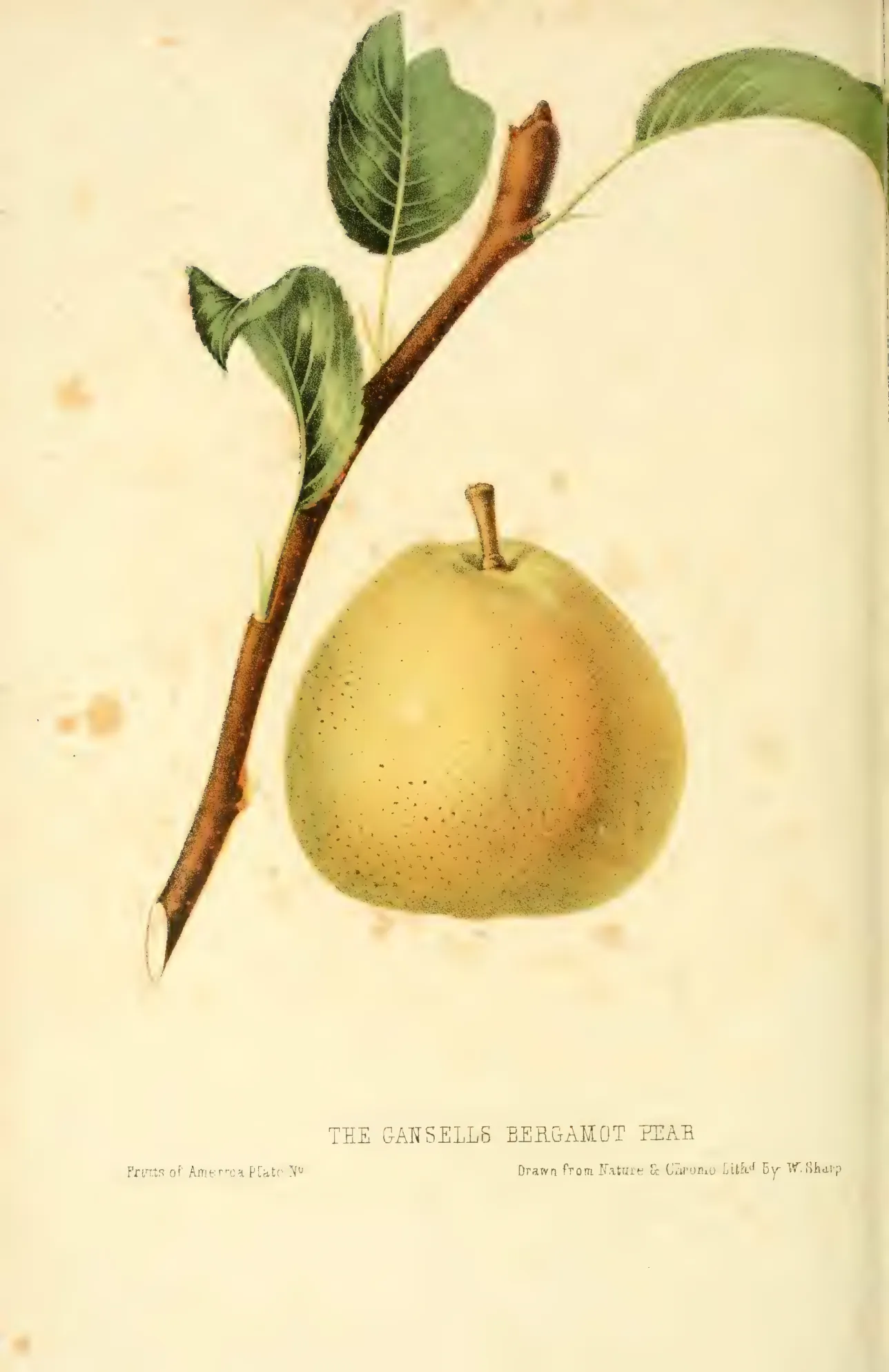
Gansell's Bergamot Pear
Origin and History
The Gansell's Bergamot is a pear of English origin, obtained from the seed of the Autumn Bergamot by Lieut. Gen. Gansell at his seat at Donellan Hall, near Colchester, in 1768. It has consequently been in cultivation nearly a century and is justly esteemed by British pomologists a superior fruit.
The variety was introduced to American collections in the early nineteenth century. Mr. Lowell mentions among the few sorts cultivated in Massachusetts in 1815 the Brockholst Bergamot, which was undoubtedly this pear. Coxe cultivated it in his collection in New Jersey and described it in his work (1818) as a "very fine pear." Probably the variety was introduced many years previous, or about the commencement of the present century.
The Gansell's Bergamot has been greatly neglected in the rapid introduction of new varieties, despite its excellence and high rank in English collections. This neglect has been attributed to the fact that it is an old pear, introduced along with the White Doyenne, Brown Beurré, St. Germain, and similar varieties, which have long ceased to be generally cultivated on account of the uncertainty of the crop.
Tree
The tree has a rather irregular and spreading growth, with branches horizontal at first and the ends curved upwards. Annual growth is short and rather slender. It has a wild habit with small bluish green leaves, but by judicious pruning makes a good head. The tree is rather late in coming into bearing and does not succeed very well on the quince.
Wood: Grayish olive, dotted with whitish specks, rather slender, and short-jointed; old wood olive gray.
Buds: Small, short, obtusely ovate, diverging, with rather prominent shoulders; flower-buds small and obtusely pointed.
Leaves: Small, thick, dark bluish green, obovate, cordate at the base, narrowing to the point, wavy, and very slightly serrated. Young leaves are covered with a kind of mealiness. Petioles are stout, one inch long, and rather slender.
Flowers: Small, with roundish obovate, crimped petals that are much cupped; clusters compact.
Bearing Habit: Has the reputation of being a small bearer, though this does not accord with the author's experience. It produces what may be termed a good crop, just enough to keep the tree in fine condition without the troublesome labor of thinning. It is not as prolific as the Bartlett or Buffum.
Fruit
Size and Form: Large, about three inches long and three and a half inches in diameter. Form is regular and roundish, considerably flattened at each end, narrowing little towards the stem.
Stem and Cavity: Stem short, about half an inch long, moderately stout, straight, and deeply inserted in a small round cavity.
Eye and Basin: Eye medium size, open, and sunk in a large, round, smooth, open basin.
Calyx: Segments short and narrow.
Skin: Fair and smooth, yellowish brown, little russeted on the sunny side, and regularly covered with green and russety specks.
Flesh: Yellowish white, coarse, melting, and very juicy.
Flavor: Rich, sugary, and delicious, with a fine bergamot perfume.
Core and Seeds: Core large; seeds small, roundish, and pale brown.
Season and Storage
Ripe in October and keeps two or three weeks.
Book Sources
Described in 1 period pomological work
View original book sources (1)
— C.M. Hovey, The Fruits of America (1852)THE GANSELL'S BERGAMOT PEAR.
Gansell's Bergamot. Pomological Magazine, vol. i. pl. 35.
Brocas Bergamot, Ives's Bergamot, Staunton, Gurle's Beurré, Bonne Rouge, Diamant, } According to London Hort. Soc. Catalogue, 3d Ed.
This fine old pear has been greatly neglected in the rapid introduction of new varieties; and it is not uncommon to find large and choice collections without a single specimen of this kind: indeed, some cultivators, well acquainted with the principal pears that we now possess, scarcely know the Gansell's Bergamot. How it happens that a variety of such excellence, and holding the highest rank in English collections, should have been so much neglected, we are at a loss to imagine; but probably the fact that it is an old pear,—introduced along with the White Doyenne, Brown Beurré, St. Germain, &c., which have long ceased to be generally cultivated on account of the uncertainty of the crop,—is the main reason why its merits have been overlooked.
The Gansell's Bergamot is a pear of English origin, and was obtained from the seed of the Autumn Bergamot, by Lieut. Gen. Gansell, at his seat at Donellan Hall, near Colchester, in 1768. It has consequently been in cultivation nearly a century, and is justly esteemed by British pomologists a superior fruit. At what period it was introduced into American collections, we have been unable to ascertain. Mr. Lowell mentions, among the few sorts cultivated in Massachusetts in 1815, the Brockholst Bergamot, which was undoubtedly this pear. Coxe cultivated it in his collection in New Jersey, and described it in his work (1818) as a "very fine pear." Probably it was introduced many years previous, or about the commencement of the present century.
It has the reputation of being a small bearer, but this does not accord with our experience. True, it is not as prolific as the Bartlett or Buffum, but produces what may be termed a good crop, just enough to keep the tree in fine condition, without the troublesome labor of thinning. The tree has a wild habit, with small bluish green leaves, but by judicious pruning makes a good head. It is rather late in coming into bearing, and does not succeed very well on the quince.
Tree.—Rather irregular and spreading in its growth, the branches horizontal at first, with the ends curved upwards; annual growth, short and rather slender.
Wood.—Grayish olive, dotted with whitish specks, rather slender, and short-jointed; old wood, olive gray; buds, small, short, obtusely ovate, diverging, with rather prominent shoulders: Flower-buds, small, obtusely pointed.
Leaves.—Small, thick, dark bluish green, obovate, cordate at the base, narrowing to the point, wavy, and very slightly serrated; young leaves covered with a kind of mealiness; petioles, stout, one inch long, and rather slender.
Flowers.—Small; petals, roundish obovate, crimped, much cupped; clusters, compact.
Fruit.—Large, about three inches long, and three and a half in diameter: Form, regular, roundish, considerably flattened at each end, and narrowing little towards the stem: Skin, fair, smooth, yellowish brown, little russeted on the sunny side, and regularly covered with green and russety specks: Stem, short, about half an inch long, moderately stout, straight, and deeply inserted in a small round cavity: Eye, medium size, open, and sunk in a large, round, smooth, open basin; segments of the calyx, short and narrow: Flesh, yellowish white, coarse, melting, and very juicy: Flavor, rich, sugary, and delicious, with a fine bergamot perfume: Core, large: Seeds, small, roundish, pale brown.
Ripe in October, and keeps two or three weeks.