Dearborn
Pear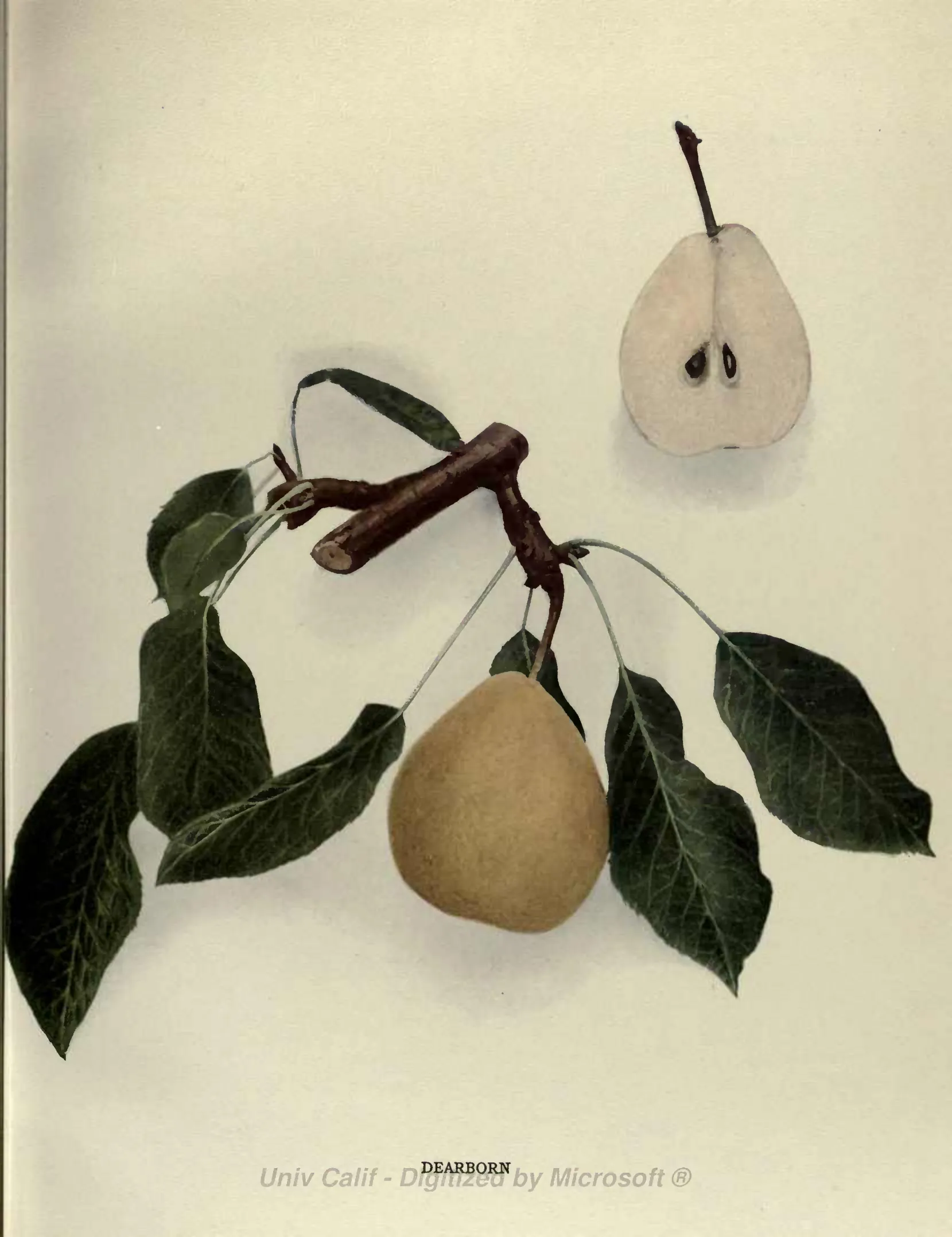
Dearborn
Origin / History
Dearborn was found growing in a border of shrubs in 1818 at Brinley Place, Roxbury, Massachusetts, the home of General Henry Alexander Scammell Dearborn (1783–1851), first president of the Massachusetts Horticultural Society. (Elliott gives the date as "about 1819"; Downing gives 1818.) In 1831, General Dearborn first exhibited fruit of the variety at the Massachusetts Horticultural Society, where it was named Dearborn's Seedling in honor of the originator. The variety was included in the American Pomological Society's first fruit-catalog in 1848 under the name Dearborn's Seedling; in 1883 the Society shortened the name to Dearborn. Since 1891, the name has failed to appear in the catalogs of the Society. Once a favorite, Dearborn is now nearly lost to cultivation, and few or no nurserymen grow the trees. Hedrick judges it "too good a variety to be lost," because of its splendid fruit- and tree-characters.
Hedrick warns that this variety should not be confused with a pear raised by Van Mons of Belgium and also named by him Dearborn: the Van Mons Dearborn is larger and ripens later than the American Dearborn, and was long since taken from lists of pears recommended for cultivation in America. (Elliott's brief first entry — "Foreign. Large, pyriform, russeted. November, December." — describes the Van Mons pear, not the American Dearborn covered by his fuller second entry.)
General Dearborn was an ardent pear-grower who helped to test the hundreds of seedlings then being brought from Belgium and France and grew considerable numbers from his own seed-beds; of all his seedlings, only Dearborn survives.
Tree
Tree large, vigorous, spreading, tall, rapid-growing, very productive; trunk stocky. Erect, yet spreading in habit (Elliott); requires little pruning; productive on the pear root, with quality variable (Elliott). The trees are almost flawless, hardy, vigorous, very productive, and almost free from blight, well adapted to home orchards where fruits cannot receive the care of skilled hands. Bears when young (Thomas).
Branches thick, zigzag, reddish-brown partly covered with a heavy, gray scarf-skin, marked by many reddish-brown lenticels. Young shoots long, reddish brown (Downing); straight, long, dark brown (Thomas). Branchlets slender, very long, with long internodes; older wood brown, new growth greenish, nearly covered with reddish-brown mottled with ash-gray scarf-skin, smooth, glabrous becoming pubescent near the tips of the new growth, with numerous small, brownish, round, raised, conspicuous lenticels.
Leaf-buds very small, short, pointed, plump, free. Leaves 3 in. long; 1¼ in. wide (Hedrick 1921) / 1¾ in. wide (Hedrick 1922), thin; apex obtusely-pointed; margin with very fine dark tips, finely and shallowly serrate; petiole tinged red, 1½ in. long (Hedrick 1921) / 1¾ in. long (Hedrick 1922), glabrous.
Flower-buds small, short, conical, plump, free, arranged singly on short spurs. Flowers showy, 1¼ in. across, in dense clusters, 9 or 10 buds in a cluster; pedicels ¾ in. long, pubescent.
Fruit
Size: Scarcely of medium size (Downing, Thomas); small to medium (Budd & Hansen); small (Hedrick), with the pears running small enough to be a real drawback. Hedrick 1921: 2½ in. long, 2¼ in. wide. Hedrick 1922: 2¼ in. long, 2¾ in. wide. Elliott (Dearborn's Seedling entry): "rather small."
Form: Roundish pyriform, with a slight neck, very regularly formed, symmetrical, uniform (Downing, Hedrick). Roundish, inclining to obovate, narrowing a little to the stem (Elliott). Obovate or Buffum-shaped, regular (Thomas). Attractive in shape and color.
Stem / Stalk: Slender, an inch long (Thomas); rather more than an inch long (Downing); 1 in. long (Hedrick 1921); ¾ in. long (Hedrick 1922); one to one-quarter inches long, curved (Budd & Hansen); long, slender, curved (Elliott).
Cavity: Set with very little depression (Downing); sunk little or none (Thomas); inserted in a slight cavity (Budd & Hansen); obtuse, shallow, narrow, thinly russeted, often slightly lipped (Hedrick).
Calyx: Open, large; lobes separated at the base, narrow, acuminate (Hedrick). Delicate, spreading segments (Downing); short, thick segments (Elliott).
Basin: Very shallow (Downing, Thomas, Budd & Hansen); very shallow, obtuse, gently furrowed and wrinkled, symmetrical (Hedrick).
Skin: Thick, very tough, smooth, dull (Hedrick); very smooth (Downing). Color clear/pale yellow, with russet specks and a few minute dots (Downing: "clear light yellow, with a few minute dots"; Thomas: "clear yellow, with minute specks"; Budd & Hansen: "light yellow with small dots"; Hedrick: "pale yellow"/"clear pale yellow, with russet specks"). Elliott describes the skin as "pale yellow, little russet at base of stem, and surface dotted with small russet dots." Dots numerous, small, russet, conspicuous (Hedrick).
Flesh / Flavor: Flesh white (Downing, Budd & Hansen, Hedrick) / yellowish white (Elliott); very fine grained (Thomas, Elliott), slightly granular at the center (Hedrick); tender and melting, very juicy, sweet, sprightly in flavor (Downing); juicy, melting, sweet, sprightly, very good (Budd & Hansen); juicy, melting, and of fine flavor (Thomas); sweet but spicy, aromatic (Hedrick); delicately perfumed (Elliott). Quality good (Hedrick); "very good" (Downing); a choice amateur variety (Budd & Hansen). Hedrick notes the fruit is "hardly as richly flavored as those of Elizabeth which ripen at the same time."
Core / Seeds: Core medium (Elliott); core large for the size of the fruit, closed, with clasping core-lines (Hedrick); calyx-tube short, wide, conical. Seeds large, wide, long, plump, acute (Hedrick); dark brown, long, pointed (Elliott).
Season
Ripens in late August — about the middle of August (Downing, Thomas), early (Budd & Hansen, Hedrick), late August (Hedrick). Elliott (Dearborn's Seedling entry) gives August. In season, the crop succeeds that of Bloodgood and precedes that of Bartlett.
Uses
A summer pear with many valuable qualities for home orchards; "a choice amateur variety" (Budd & Hansen). Particularly well suited to home orchards where fruits cannot receive the care of skilled hands, owing to the trees' hardiness, vigor, productivity, and near freedom from blight. One of the most desirable early varieties.
Subtypes / Variants
Not described in source.
Other
Hedrick references illustrations in Downing (1845, fig. 135), Hovey (1851, Pl.), Mas Le Verger (1866–73, fig. 7), and Leroy Dict. Pom. (1869, fig.); Thomas references Fig. 674. Geographic origin attribution: Massachusetts (Thomas, Budd & Hansen).
Book Sources
Described in 6 period pomological works
- Hedrick, The Pears of New York (1921)
- Budd & Hansen, Systematic Pomology (1914)
- Elliott, The Western Fruit Book (1865)
- Hedrick, Cyclopedia of Hardy Fruits (1922)
- Downing, Fruits and Fruit Trees of America (1900) — listed as Dearborn's Seedling
- Thomas, The American Fruit Culturist (1903) — listed as Dearborn's Seedling
View original book sources (6)
— F.R. Elliott, The Western Fruit Book (1865)Dearborn. Foreign. Large, pyriform, russeted. November, December.
[Additional entry in this volume: "Dearborn's Seedling", pp. 341–341]
Dearborn's Seedling. Done's. | Wheeler's New St. Michael. Raised by General H. A. S. Dearborn, about 1819, at Roxbury, Mass. Tree, vigorous, erect, yet spreading; requires little pruning; productive on the pear root; quality variable. Fruit, rather small, roundish, inclining to obovate, narrowing a little to the stem; color, pale yellow, little russet at base of stem, and surface dotted with small russet dots; calyx, with short thick segments; stem, long, slender, curved; core, medium; seeds, dark brown, long, pointed; flesh, yellowish white, fine-grained, melting, juicy, sweet, delicately perfumed. August.
— A.J. Downing, The Fruits and Fruit Trees of America (1900)Dearborn's Seedling.
A very admirable early Pear; of first quality, raised in 1818, by the Hon. H. A. S. Dearborn, of Boston. It bears most abundant crops, and is one of the most desirable early varieties, succeeding the Bloodgood, and preceding the Bartlett. Young shoots long, reddish brown.
Fruit scarcely of medium size, roundish pyriform, and very regularly formed. Skin very smooth, clear light yellow, with a few minute dots. Stalk slender, rather more than an inch long, set with very little depression. Calyx with delicate spreading segments, set in a very shallow basin. Flesh white, very juicy and melting, sweet and sprightly in flavor. Very good. Ripens about the middle of August.
— John J. Thomas, The American Fruit Culturist (1903)Dearborn's Seedling.* Scarcely medium in size, obovate or Buffum-shaped, regular, smooth; surface clear yellow, with minute specks; stalk an inch long, sunk little or none; basin very shallow; flesh very fine grained, juicy, melting, and of fine flavor. Ripens nearly with the Bloodgood, or middle of August. Shoots straight, long, dark brown. Tree bears when young. Fig. 674. Massachusetts.
— J.L. Budd & N.E. Hansen, American Horticultural Manual, Part II: Systematic Pomology (1914)Dearborn (Dearborn Seedling).—Small to medium; roundish pyriform, regular; color light yellow with small dots; stem one to one-quarter inches long, curved, and inserted in slight cavity; basin very shallow. Flesh white, juicy, melting, sweet, sprightly, very good. Season early. A choice amateur variety. Massachusetts.
— U.P. Hedrick, The Pears of New York (1921)DEARBORN
- Am. Pom. Soc. Cat. 36. 1883. 2. Ont. Dept. Agr. Fr. Ont. 155. 1914.
Dearborn's Seedling. 3. Kenrick Am. Orch. 154. 1832. 4. Downing Fr. Trees Am. 336, fig. 135. 1845. 5. Proc. Nat. Con. Fr. Gr. 51. 1848. 6. Hovey Fr. Am. 1:63, Pl. 1851. 7. Elliott Fr. Book 336. 1859. 8. Mas Le Verger 2:17, fig. 7. 1866-73. 9. Leroy Dict. Pom. 2:7, fig. 1869.
Once a favorite, Dearborn is now nearly lost to cultivation, and few or no nurserymen grow the trees. It is too good a variety to be lost, however, because of splendid fruit- and tree-characters. The fruits ripen early and are of good quality, though hardly as richly flavored as those of Elizabeth which ripen at the same time. Unfortunately the pears run small, but they are attractive in shape and color. In season, the crop succeeds that of Bloodgood and precedes that of Bartlett. The trees are almost flawless, and therefore are well adapted to home orchards where fruits cannot receive the care of skilled hands. Besides being almost free from blight, the trees are hardy, vigorous, and very productive. The variety has many valuable qualities for a summer pear in home orchards.
This pear was found growing in a border of shrubs in 1818 at Brinley Place, Roxbury, Massachusetts, the home of General H. A. S. Dearborn,¹ first president of the Massachusetts Horticultural Society. In 1831, General Dearborn first exhibited fruit of the variety at the Massachusetts Horticultural Society where it was named Dearborn's Seedling in honor of the originator. This variety should not be confused with a pear raised by Van Mons of Belgium and named by him Dearborn. The Dearborn of Van Mons is larger and ripens later than the American Dearborn, and was long since taken from lists of pears recommended for cultivation in America. Dearborn was included in the American Pomological Society's first fruit-catalog in 1848, where it was called Dearborn's Seedling. In 1883, the Society shortened the name to Dearborn. Since 1891, the name has failed to appear in the catalogs of this Society.
¹ General Henry Alexander Scammell Dearborn, who followed the vocation of a soldier, statesman, and author, chose as his avocation horticulture and in several of its fields became eminent. A native of New England (1783-1851), son of General Henry Dearborn of Revolutionary fame, he was early educated to the profession of law and pursued that vocation until the war with Great Britain in 1812. Services in this war brought him the rank and title of general. After the war he served as Collector of the Port of Boston, in Congress, and as Mayor of Roxbury, Massachusetts, which office he held at the time of his death. But it is as a patron, friend, and lover of horticulture that the life and work of General Dearborn interest pomologists. He was one of the charter members in the Massachusetts Horticultural Society and a prime mover in its organization. He was elected its first president March 17, 1829. In the history of the Society published in 1880, of all the famous members of this truly remarkable organization, General Dearborn's portrait was chosen for the frontispiece. He was early interested in experimental gardens and rural cemeteries. The plans for experimental gardens advocated by him were never fully carried out, but no doubt his enthusiasm for such gardens, with his own garden as a model, did much to stimulate the planting in America in the early half of the nineteenth century of the many famous gardens which adorned and enriched every center of culture along the Atlantic seaboard. He helped to establish the Mount Auburn and Forest Hills cemeteries, famous among Boston cemeteries, and the first of rural cemeteries in this country. His life-long devotion to rural art as exemplified in gardens and cemeteries knew no bounds. On these subjects and on pomology he contributed many articles to the agricultural and horticultural papers of his time. Few men, it can be said, could better concentrate their thoughts and feelings on paper than he seems to have done. Besides the many papers from his own pen he published several translated treatises from the French, chief of which was a monograph on the Camellia in 1838 and another on Morus multicaulis in 1839, the "Mulberry Craze" being in full swing at this time. General Dearborn was an ardent pear-grower and helped to test the hundreds of seedlings then being brought from Belgium and France and grew as well considerable numbers from his own seed-beds. Of all his seedlings, however, only Dearborn survives.
Tree large, vigorous, spreading, tall, very productive; trunk stocky; branches thick, zigzag, reddish-brown partly covered with a heavy, gray scarf-skin, marked by many reddish-brown lenticels; branchlets slender, very long, with long internodes, older wood brown, new growth greenish, nearly covered with reddish-brown, mottled with ash-gray scarf-skin, smooth, glabrous becoming pubescent near the tips of the new growth, with numerous small, brownish, round, raised, conspicuous lenticels.
Leaf-buds very small, short, pointed, plump, free. Leaves 3 in. long, 1¼ in. wide, thin; apex obtusely-pointed; margin with very fine dark tips, finely and shallowly serrate; petiole tinged red, 1½ in. long, glabrous. Flower-buds small, short, conical, plump, free, arranged singly on short spurs; flowers showy, 1¼ in. across, in dense clusters, 9 or 10 buds in a cluster; pedicels ¾ in. long, pubescent.
Fruit ripe in late August; small, 2½ in. long, 2¼ in. wide, uniform, roundish-pyriform, with a slight neck, symmetrical, uniform; stem 1 in. long, slender; cavity obtuse, shallow, narrow, thinly russeted, often slightly lipped; calyx open, large; lobes separated at the base, narrow, acuminate; basin very shallow, obtuse, gently furrowed and wrinkled, symmetrical; skin thick, very tough, smooth, dull; color pale yellow, with russet specks; dots numerous, small, russet, conspicuous; flesh white, slightly granular at the center, tender and melting, very juicy, sweet but spicy, aromatic; quality good. Core large for the size of the fruit, closed, with clasping core-lines; calyx-tube short, wide, conical; seeds large, wide, long, plump, acute.
— U.P. Hedrick, Cyclopedia of Hardy Fruits (1922)DEARBORN.
Dearborn's Seedling.
Once a favorite, Dearborn is now nearly lost to cultivation. It is too good a variety to be lost, however. The fruits ripen early and are of good quality, though hardly as richly flavored as those of Elizabeth which ripen at the same time. Unfortunately the pears run small, but they are attractive in shape and color. In season, the crop succeeds that of Bloodgood, and precedes that of Bartlett. The trees are almost flawless, and are as well adapted to home orchards where fruits cannot receive the care of skilled hands, as any other pear. Besides being almost free from blight, the trees are hardy, vigorous, and very productive. The variety has many valuable qualities for a summer pear in home orchards.
This pear was found in 1818 at Roxbury, Massachusetts, near the home of General H. A. S. Dearborn.
Tree large, vigorous, spreading, tall, rapid-growing, very productive; branches thick, zigzag, reddish-brown, marked by many reddish-brown lenticels. Leaves 3 inches long, 1¾ inches wide, thin; apex obtusely pointed; margin with very fine dark tips, finely and shallowly serrate; petiole tinged red, 1¾ inches long, glabrous. Flowers showy, 1¼ inches across, in dense clusters, 9 or 10 buds in a cluster.
Fruit ripe in late August; small, 2¼ inches long, 2¾ inches wide, uniform, roundish-pyriform, with a slight neck, symmetrical, uniform; stem ¾ inch long, slender; cavity obtuse, shallow, narrow, thinly russeted, often lipped; calyx open, large; lobes separated at the base, narrow, acuminate; basin very shallow, obtuse, gently furrowed and wrinkled, symmetrical; skin thick, very tough, smooth, dull; color clear pale yellow, with russet specks; dots numerous, small, russet, conspicuous; flesh white, slightly granular at the center, tender and melting, very juicy, sweet but spicy, aromatic; quality good; core large, closed, with clasping core-lines; calyx-tube short, wide, conical; seeds large, wide, long, plump, acute.