Elizabeth
Pear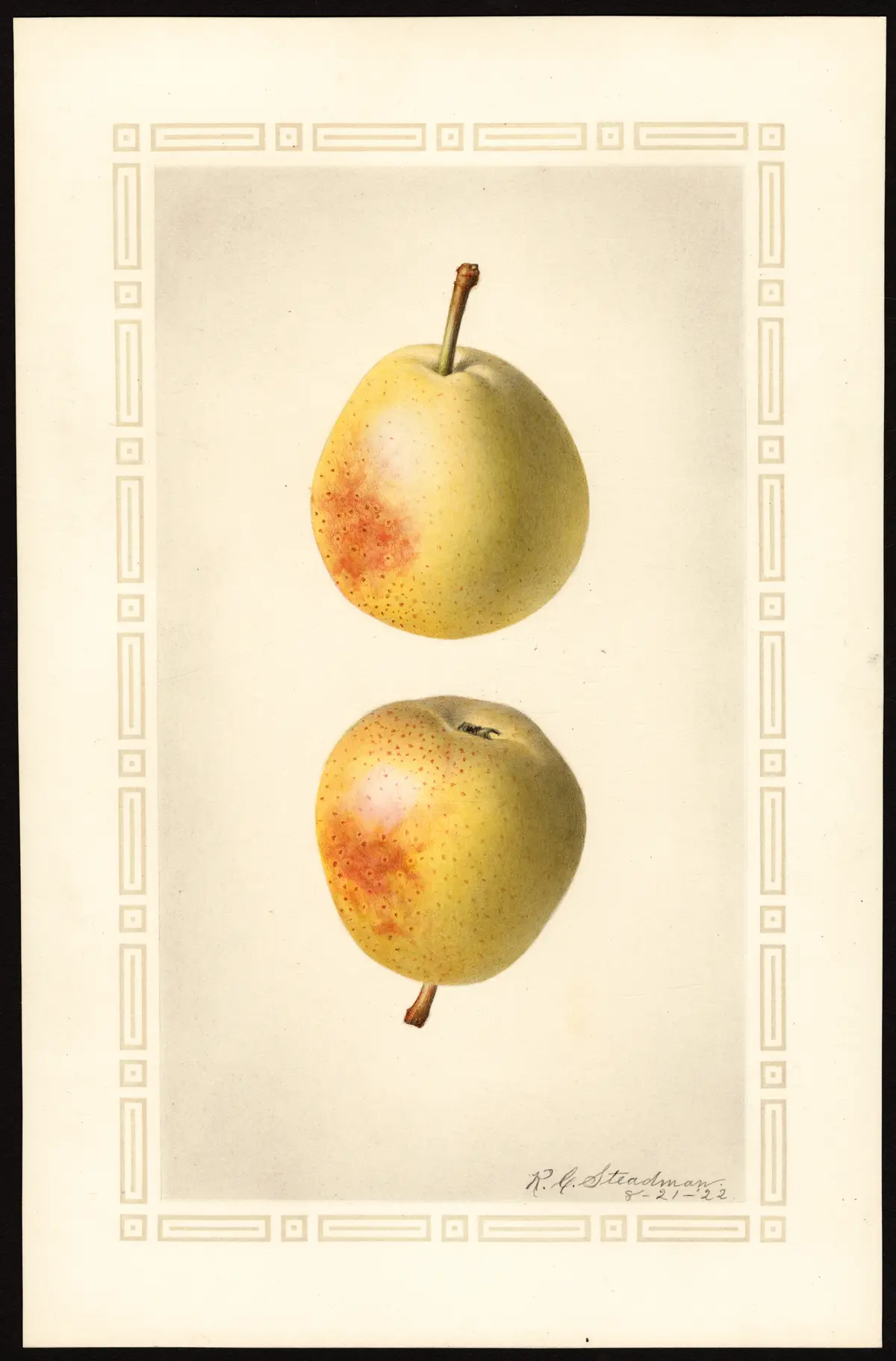
USDA Pomological Watercolor Collection
Elizabeth
Origin / History
Belgian pear, raised by Van Mons early in the nineteenth century. Van Mons established his nursery at Louvain in 1819. In 1830 and 1831 he sent two consignments of pear cions to the Massachusetts Horticultural Society; both were lost on the way. Three years later Kenrick, Manning, and Dearborn, Massachusetts horticulturists, asked him to forward another collection. In the successive springs of 1835 and 1836 he sent two more collections, which arrived safely, though a large proportion of the cions died. They comprised about 150 named and 100 unnamed seedling varieties, and Van Mons gave Manning permission to name any seedling that might prove worthy of cultivation. Manning named No. 154 of these Elizabeth (Van Mons). It was later disseminated as Manning's Elizabeth, and soon after the name was shortened to Elizabeth. Elliott (1865) calls it foreign, received under number and named by the elder Manning. It was placed on the fruit list of the American Pomological Society in 1854.
Robert Manning, born at Salem, Mass., July 18, 1784, died October 10, 1842. He established his "Pomological Garden" at Salem in 1823 to introduce and test new fruits; at its fullest it held about 2000 fruits, of which 1000 kinds were pears. He was one of the founders of the Massachusetts Horticultural Society, and his "Book of Fruits" (1838) was the first American pomology in which the descriptions were all made with fruit in hand. Most of Van Mons's pears reached American orchards through the Salem garden. Hedrick places him among the most notable American pomologists.
Hedrick rates Elizabeth "among the best summer pears for eastern America, either for home consumption or for the markets." Commended for handsome, well-flavored fruits and for trees vigorous, hardy, productive, resistant to blight, early and annual bearing. Faults: fruits small, flesh a little coarse and a little too gritty, flavor good for an early pear but "not as sweet and rich as might be desired." The trees are nearly flawless, failing, if at all, in not attaining as great size as some other inhabitants of pear orchards.
Tree
Small, upright, dense-topped, hardy, very productive. Vigorous; as resistant to blight as any other European pear. Comes into bearing early and bears annually. The crop is often borne in clusters, a defect by reason of which the fruits are so often small. Trunk slender. Branches brownish-green, partly overspread with thin gray scarf-skin, marked by conspicuous, oval lenticels. Branchlets slender, long, reddish-brown mingled with green, the new growth exceptionally red, dull, smooth, glabrous except on the younger wood, with obscure, raised lenticels. Young wood reddish brown (Elliott).
Leaf-buds small, short, pointed, plump, free. Flower-buds small, short, conical, plump, free, borne singly on short spurs. Leaves 3 in. long, 1½ in. wide, stiff; apex variable; margin almost entire; petiole 2 in. long, slender, reddish-green; stipules very small and slender when present. Flowers early, showy, 1¼ in. across, in dense clusters averaging 8 buds to a cluster; pedicels 1 in. long, lightly pubescent. The Cyclopedia's condensed text gives leaves 1¾ in. wide and flowers 1¾ in. across.
Fruit
Size: Small; the smallness can be overcome somewhat by thinning. 2½ in. long, 2¼ in. wide (Hedrick, Pears of New York). The Cyclopedia text calls it inferior in size, 2¾ in. long, 2¾ in. wide.
Form: Obovate-obtuse-pyriform, symmetrical, uniform; obovate rounded (Elliott).
Stem: 1 in. long, thick, curved.
Cavity: Acuminate, shallow, narrow, symmetrical, often lipped.
Calyx: Large, almost closed; lobes separated at the base, short, narrow, acuminate; calyx-tube short, wide, conical. Elliott alone describes the calyx as small, open.
Basin: Shallow, obtuse, gently furrowed and wrinkled.
Skin: Tough, characteristically rough, glossy. Handsome. Ground bright yellow, lemon yellow (Elliott), with a lively red cheek, described in the Cyclopedia as a beautiful, lively, pinkish-red cheek; red in the sun (Elliott). Mottled with brownish, minute specks; slight traces of russet (Elliott).
Dots: Numerous, very small, conspicuous, russet or brown.
Flesh and flavor: Yellowish white (Elliott), tinged with yellow; slightly granular under the skin, strongly granular at the center; a little coarse and a little too gritty (Hedrick); tender and melting, very juicy. Sweet, vinous, aromatic; "sugary" (Elliott). Hedrick calls the flavor "good for an early pear," not as sweet and rich as might be desired. Quality "very good" (Elliott and Hedrick).
Core and seeds: Core large, closed, with clasping core-lines. Seeds wide, plump, acute.
Season
Ripe in late August ("Last August," Elliott).
Uses
Among the best summer pears for home consumption or for the markets (Hedrick).
Subtypes / Variants
Not described in source.
Other
Not described in source.
Book Sources
Described in 3 period pomological works
- Hedrick, The Pears of New York (1921)
- Elliott, The Western Fruit Book (1865) — listed as Elizabeth. (Manning's.)
- Hedrick, Cyclopedia of Hardy Fruits (1922)
Nursery Catalog Sources
Found in 1 catalog (1849) from Massachusetts
- Hovey & Co. , Cambridge , Massachusetts — 1849
View original book sources (3)
— F.R. Elliott, The Western Fruit Book (1865)Elizabeth. (Manning's.)
Elizabeth Van Lions, | Van Mons No. 154.
Foreign. Received under number, and named by the elder Manning: young wood, reddish brown. Fruit, small, obovate rounded, lemon yellow, red in sun. slight traces of russet ; calyx, small, open ; core, large; flesh, yellowish white, melting, sugary, juicy ; "very good." Last August.
— U.P. Hedrick, The Pears of New York (1921)ELIZABETH
- Mag. Hort. 8:57. 1842. 2. Ibid. 13:63, fig. 6. 1847. 3. Leroy Dict. Pom. 3:126, fig. 1869. 4. Am. Pom. Soc. Cat. 23. 1897. Manning's Elizabeth. 5. Downing Fr. Trees Am. 385. 1845. 6. Hovey Fr. Am. 2:41, Pl. 1851. 7. Am. Pom. Soc. Rpt. 231. 1854. 8. Downing Fr. Trees Am. 810, fig. 1869. Elizabeth de Manning. 9. Mas Le Verger 2:105, fig. 51. 1866-73. 10. Guide Prat. 93, 269. 1876. Nina. 11. Hogg Fruit Man. 623. 1884. 12. Mathieu Nom. Pom. 258. 1889.
Elizabeth is among the best summer pears for eastern America, either for home consumption or for the markets. The characters which commend it are: handsome, well-flavored fruits; and vigorous, hardy, productive trees, which are as resistant to blight as those of any other European pear, and which come in bearing early and bear annually. Faults are: the fruits are small, a fault that can be overcome somewhat by thinning; they are a little coarse in texture of flesh, which is a little too gritty; and the flavor, while good for an early pear, is not as sweet and rich as might be desired. The trees are nearly flawless, failing, if at all, in not attaining as great size as some other inhabitants of pear orchards. The crop is often borne in clusters — a defect by reason of which the fruits are so often small. But even with these defects, we must end as we began with the statement that this is one of the best summer pears.
In the year 1819, Van Mons established his famous nursery at Louvain, Belgium, and in the years 1830 and 1831 he sent from there two consignments of pear cions to the Massachusetts Horticultural Society, both of which were unfortunately lost in turn on the way. Three years later, Kenrick, Manning, and Dearborn, Massachusetts horticulturists, requested him to forward another collection. In the successive springs of 1835 and 1836, he sent two more collections which safely arrived in due course, though a large proportion of the cions died. These collections comprised originally about 150 named and 100 seedling unnamed varieties, and Van Mons granted Manning permission to name any of the latter that might prove worthy of cultivation. No. 154 of these, Mr. Manning¹ named Elizabeth (Van Mons). Later on it was disseminated as Manning's Elizabeth, and soon after the name was shortened to Elizabeth. The variety was placed in the fruit-list of the American Pomological Society in 1854.
Tree small, upright, dense-topped, hardy, very productive; trunk slender; branches brownish-green, partly overspread with thin, gray scarf-skin, marked by conspicuous, oval lenticels; branchlets slender, long, reddish-brown mingled with green, new growth exceptionally red, dull, smooth, glabrous except on the younger wood, with obscure, raised lenticels.
Leaf-buds small, short, pointed, plump, free. Leaves 3 in. long, 1½ in. wide, stiff; apex variable; margin almost entire; petiole 2 in. long, slender, reddish-green; stipules very small and slender when present. Flower-buds small, short, conical, plump, free, singly on short spurs; flowers early, showy, 1¼ in. across, in dense clusters, average 8 buds in a cluster; pedicels 1 in. long, lightly pubescent.
Fruit ripe in late August; small, 2½ in. long, 2¼ in. wide, obovate-obtuse-pyriform, symmetrical, uniform; stem 1 in. long, thick, curved; cavity acuminate, shallow, narrow, symmetrical, often lipped; calyx large, almost closed; lobes separated at the base, short, narrow, acuminate; basin shallow, obtuse, gently furrowed and wrinkled; skin tough, characteristically rough, glossy; color bright yellow, with a lively, red cheek, mottled with brownish, minute specks; dots numerous, very small, conspicuous, russet or brown; flesh tinged with yellow, slightly granular under the skin, strongly granular at the center, tender and melting, very juicy, sweet, vinous, aromatic; quality very good. Core large, closed, with clasping core-lines; calyx-tube short, wide, conical; seeds wide, plump, acute.
¹ The fame of Robert Manning as an accurate and discriminating American pomologist will long endure. Few Americans, one conceives, as his life is reviewed, have rendered greater service in any field of the nation's agriculture. The quantity of his work was not remarkably large, but the quality was superfine. Systematic pomology in particular owes him much for his painstaking descriptions of fruits, and his corrections in nomenclature. Born in Salem, Mass., July 18, 1784, he made the town of his birth famous as a pomological center in America, where, at the time of his death, October 10, 1842, his garden probably contained a larger collection of fruits than had ever before been brought together in America. Manning began collecting fruits in 1823 when he established his "Pomological Garden" at Salem for the purpose of introducing and testing new varieties of fruits. He attempted to bring together all of the varieties of fruits that would thrive in eastern Massachusetts, and when his garden was fullest had about 2000 fruits, of which 1000 kinds were pears, to which fruit he gave most attention. He had many English, French, and Belgian correspondents from whom he received the most notable fruits grown in their countries. He is said to have had a most remarkable memory and could carry in mind the names, tree-habits, and qualities of any fruit he had ever seen and could identify it at sight. In whatever group of pomologists he chanced to be, his identifications and decisions on nomenclature were accepted as correct. Small wonder, therefore, that the Book of Fruits, published by Manning in 1838, at once took the place of authority for descriptions of tree-fruits and for such small-fruits, trees, and shrubs as the author described. It was the first, and is almost the only, American pomology in which the descriptions were all made with fruit in hand. The author intended this book to be the first of a series, but the books to follow never appeared. He was one of the founders of the Massachusetts Horticultural Society. Pear-growers are indebted to Manning for the work he did in testing the seedlings sent out by Van Mons, the famous Belgian breeder, most of whose pears came to American orchards through the agency of the Salem Pomological Garden. He also received and introduced valuable pears from the London Horticultural Society. His achievements mark Manning among the most notable American pomologists, of whom no other labored as devotedly for the attainment of better pears.
— U.P. Hedrick, Cyclopedia of Hardy Fruits (1922)ELIZABETH. Manning's Elizabeth.
Elizabeth is among the best summer pears for eastern America, either for home consumption or for the markets. The characters which commend it are: handsome, well-flavored fruits; and vigorous, hardy, productive trees, which are as resistant to blight as those of any other European pear, and which come in bearing early and bear annually. Faults are: the fruits are small; they are a little coarse in texture of flesh, which is a little too gritty; and the flavor, while good for an early pear, is not sweet and rich. The trees are nearly flawless, failing, if at all, in not attaining sufficient size. The crop is often borne in clusters—a defect by reason of which the fruits are often small. But even with these faults, this is one of the best of summer pears. Elizabeth is a Belgian pear which originated with Van Mons early in the nineteenth century.
Tree small, upright, dense-topped, hardy, very productive; trunk slender; branches brownish-green, marked by conspicuous, oval lenticels. Leaves inches long, 1¾ inches wide, stiff; apex variable; margin almost entire; petiole inches long, slender, reddish-green; stipules very small and slender when present. Flowers early, showy, 1¾ inches across, in dense clusters, average 8 buds in a cluster. Fruit ripe in late August; inferior in size, 2¾ inches long, 2¾ inches wide, obovate-obtusepyriform, symmetrical, uniform; stem 1 inch long, thick, curved; cavity acuminate, shallow, narrow, symmetrical, often lipped; calyx large, almost closed; lobes separated at the base, short, narrow, acuminate; basin shallow, obtuse, gently furrowed and wrinkled; skin tough, characteristically rough, glossy; color bright yellow with a beautiful, lively, pinkish-red cheek, mottled, mingled with brownish, minute specks; dots numerous, very small, conspicuous, russet or brown; flesh tinged with yellow, slightly granular under the skin, strongly granular at the center, tender and melting, very juicy, sweet, vinous, aromatic; quality very good; core large, closed, with clasping core-lines; calyx-tube short, wide, conical; seeds wide, plump, acute.