Manning's Elizabeth
Pear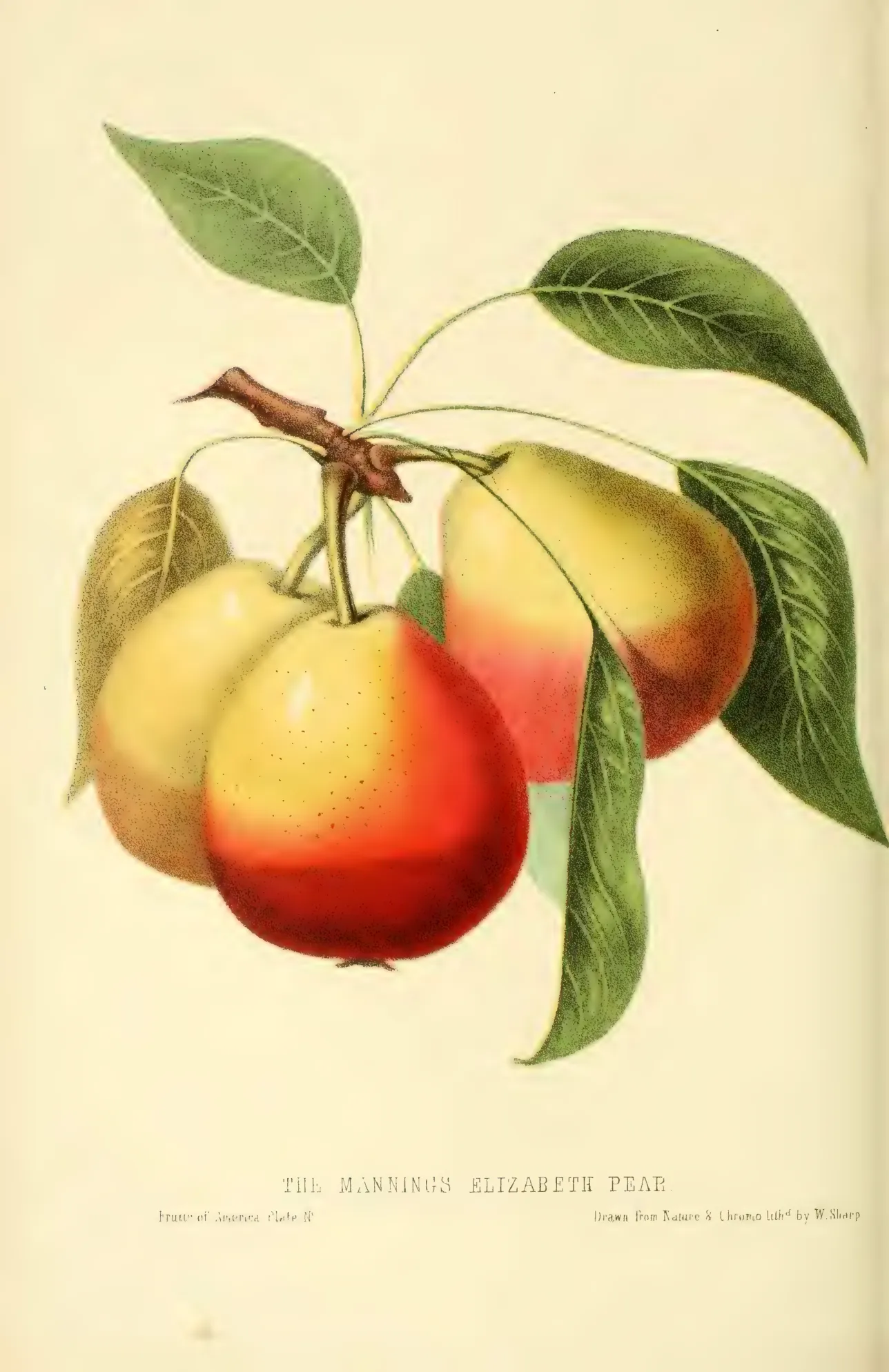
Manning's Elizabeth
[NOTE: Source text may be incorrect — the Stark Bros. Year Book (1910) entry is garbled ("A dark-fleshed, fine grained pear, South, in the fruit is of medium size, a most tender juicy, core with a very handsome fruit yellow with a slight blush. Rich, juicy and delicious flavor. CS"). Its "dark-fleshed" contradicts the white or yellowish flesh given by the other sources that name a flesh color. The words "South" and "core," and the closing "CS," cannot be placed with confidence. Only its clearly legible details are used below.]
Origin / History
Manning's Elizabeth is a pear, a Belgian seedling of Dr. Van Mons, raised in his nursery at Louvain.
Nearly twenty-five years before Hovey wrote in 1852, Van Mons sent two collections of pear scions to the Massachusetts Horticultural Society. Both were lost on the way in successive years, and with them his choice seedlings, "the fruits of his labors for many years." In 1834 Messrs. Kenrick, Manning, and Dearborn asked Van Mons for another collection, hoping for better success in transport. It arrived in the spring of 1835 in such good order that more than half was saved. A further package reached them in the spring of 1836. It was delayed on the way, but many additional sorts were secured from it.
The two collections held nearly one hundred and fifty named varieties and upwards of one hundred unnamed seedlings. The seedlings were designated by the numbers under which they were known in the Louvain nursery. The original trees there were soon after removed or destroyed, which left the numbered kinds wholly in the hands of Kenrick and Manning. Hovey records this variety as No. 158 of these seedlings. Downing gives No. 154.
Van Mons gave Mr. Manning permission to name any of the seedlings that proved worthy of cultivation. Manning described and named this one in the Magazine of Horticulture (vol. viii, p. 57) as the "Elizabeth, Van Mons." Hovey afterward described it more fully under the same name, with an outline of the fruit. It was more recently called Manning's Elizabeth in recognition of Manning's zeal in introducing and disseminating pears. Hovey calls it "a name well deserved, and one which we are happy to aid in disseminating."
Hovey calls it "a very fine early pear; remarkably beautiful." Downing calls it "one of the most desirable Pears of its season, for amateur growing." Budd & Hansen call it productive and "popular in the eastern and southeastern States." It was planted for trial at the Central Experimental Farm, Agassiz, British Columbia, in the spring of 1893.
Tree
Growth vigorous (Hovey) to moderate (Downing; Agassiz). Upright, with rather spreading branches, horizontal at first, then turning upward in a gentle curve. Annual shoots long and moderately stout. Shoots diverging, dull reddish to dark reddish brown.
Wood deep reddish brown, dotted with a few grayish specks, moderately stout, rather short-jointed; old wood light brown. Buds medium in size, ovate, bluntly pointed, diverging; flower buds medium in size.
Leaves medium in size, ovate, tapering to the point, yellowish green, wavy, entire at the edge. Petioles of medium length, about one and a half inches long, moderately stout. Flowers medium in size; petals roundish; clusters compact (Hovey).
Comes into bearing early. Productive. Hovey calls it "a most profuse bearer, being literally loaded with pears." It succeeds well on the quince (Hovey), and Thomas says it does best on dwarf stock.
Fruit
Size: Small to medium; about two inches long and two in diameter (Hovey).
Form: Obovate to roundish obovate, sometimes given as obovate obtuse pyriform. Very full around the crown, tapering to the stem and ending obtusely there. Thomas calls it Seckel-form.
Stem: One-half to one inch long, inclined (Budd & Hansen). Downing and Thomas give one inch. Hovey gives it as medium length, about three-quarters of an inch, and rather slender.
Cavity: Shallow, small, round; stem slightly inserted.
Calyx: Open. Eye small and little sunk; segments of the calyx short (Hovey).
Basin: Shallow, open, broad.
Skin: Fair, a little rough (Hovey) or smooth (Thomas). Ground color deep yellow, rich lemon yellow, bright yellow, or pale yellow, and greenish yellow at Agassiz. Cheek bright, lively red, brilliantly suffused with crimson on the sunny side and becoming paler in the shade; Stark gives only a slight blush.
Russet often flecked or in patches. Hovey says the fruit is often peculiarly marked. When about two-thirds grown, the blossom-end half of most specimens assumes a thick russet covering. This usually terminates in a complete circle around the middle of the fruit and is generally retained at maturity, so that the end next the crown is often covered with thick russet. A beautiful, handsome fruit.
Dots: Many, small, brown and red or dark. Deeper-colored specks show through the crimson.
Flesh and flavor: White, or yellowish (Hovey). Fine-grained, though Hovey calls it coarse. Juicy, melting to very melting, buttery, "most tender." Flavor very sweet, saccharine or sugary, sprightly to very sprightly, rich, aromatic, "pleasantly perfumed," "with a peculiar flavor" (Downing). Quality "very good or best" (Downing), "very good" (Budd & Hansen), "excellent" (Thomas), and "delicious" (Stark).
Core and seeds: Core large. Seeds rather large, brown (Hovey).
Season
Early. Ripe at the last of August, Hovey giving the middle to the last of August. At Agassiz, British Columbia, the season is September.
Uses
Dessert; Downing calls it "a beautiful dessert fruit."
Subtypes / Variants
Not described in source.
Other
Not described in source.
Book Sources
Described in 4 period pomological works
Nursery Catalog Sources
Found in 16 catalogs (1850–1912) from Alabama, Illinois, Maryland, Massachusetts, Missouri, New Jersey, Pennsylvania
- Azell Bowditch (Nursery / Fruit Catalog) , Boston , Massachusetts — 1850
- William H. Moon Co. , Morrisville, Bucks County , Pennsylvania — 1890
- Rogers Nursery Co. , Moorestown , New Jersey — 1893
- The Vineland Nurseries (Kelsey & Co. , Proprietors), St. Joseph, Missouri (Office: 13th and Atchison Sts., 2 Blocks East of the Citizens St. Car Line) — 1894
- The Lovett Company , Little Silver , New Jersey — 1896
- Reading Nursery , Jacob W. Manning, Proprietor, Reading , Massachusetts — 1898
- Brown Brothers Co. , Continental Nurseries, Rochester, NY (also operated from Toronto, Canada) — 1899
- Alabama Nursery Co. , Huntsville , Alabama — 1900
- Central Experimental Farm , Dominion Department of Agriculture, Agassiz, British Columbia (under test; Bulletin No. 3, Second Series) — 1900
- Benjamin Buckman (personal inventory) , Farmingdale , Illinois — 1901
- Brown Brothers Co. , Continental Nurseries, Rochester, NY (also operated from Toronto, Canada) — 1901
- Stark Bros. Nurseries & Orchards Co. , Louisiana , Missouri — 1906
- Wm. J. Corse (successor to Robert Sinclair / Sinclair Nurseries) , Baltimore , Maryland — 1909
- Stark Bros. Nurseries & Orchards Co. , Louisiana , Missouri — 1910
- Stark Bros. Nurseries & Orchards Co. , Louisiana , Missouri — 1911
- Stark Bros. Nurseries & Orchards Co. , Louisiana , Missouri — 1912
View original book sources (6)
— C.M. Hovey, The Fruits of America (1852)THE MANNING'S ELIZABETH PEAR.
Manning's Elizabeth. Magazine of Horticulture, vol. viii. p. 57. 158 Van Mons, Magazine of Horticulture, vol. viii. Elizabeth, Van Mons, Magazine of Horticulture, vol. xiii.
Nearly twenty-five years have elapsed since Dr. Van Mons sent to the Massachusetts Horticultural Society two collections of pear scions, both of which, in successive years, were unfortunately lost on the way. Deprived thus of securing the choice seedlings, the fruits of his labors for many years, Messrs. Kenrick, Manning and Dearborn, in 1834, solicited Van Mons to send another collection, with the hope of better success in their transportation. Fortunately, in the spring of 1835, these arrived safely at their destination, and in such good order that more than half of them were saved. In the spring of 1836 another package came to hand, and, though delayed on its way, many additional sorts were secured. These two collections embraced nearly one hundred and fifty named varieties, and upwards of one hundred unnamed or numbered kinds, the latter wholly seedlings, and designated under the numbers by which they were known in Dr. Van Mons's nursery at Louvain, the original trees of which were soon after removed or destroyed, leaving their entire possession in the hands of Messrs. Kenrick and Manning.
The Elizabeth was one of these numbered varieties, (No. 158.) Dr. Van Mons kindly gave Mr. Manning permission to name any of them which might prove worthy of cultivation; and in accordance with his wishes Mr. Manning described and named it in the Magazine of Horticulture, (vol. viii. p. 57,) as the Elizabeth, Van Mons. Subsequently we described it more fully under the same name, accompanied with an outline of the fruit; but as commendatory of the zealous labors of Mr. Manning in the introduction and dissemination of various pears, it has more recently been called Manning's Elizabeth, a name well deserved, and one which we are happy to aid in disseminating.
The Elizabeth is a very fine early pear; remarkably beautiful, with a deep yellow skin and a bright red cheek. Often it is peculiarly marked; when about two-thirds of its size, one half of the pear,—the blossom end,—in most of the specimens, assumes a thick russet covering, which usually terminates in a complete circle around the middle of the fruit, and it generally retains this color, even at maturity. It is a most profuse bearer, being literally loaded with pears: it succeeds well upon the quince, and comes into bearing early.
Tree.—Vigorous, upright, with rather spreading branches, horizontal at first, but which turn upward with a gentle curve; annual shoots, long and moderately stout.
Wood.—Deep reddish brown, dotted with a few grayish specks, moderately stout, and rather short-jointed; old wood, light brown; buds, medium size, ovate, bluntly pointed, diverging: Flower-buds, medium size.
Leaves.—Medium size, ovate, tapering to the point, yellowish green, wavy, and entire at the edge; petioles, medium length, about one and a half inches long, moderately stout.
Flowers.—Medium size; petals, roundish; clusters, compact.
Fruit.—Small, about two inches long, and two in diameter: Form, obovate, very full around the crown, tapering to, and ending obtusely at, the stem: Skin, fair, little rough, rich lemon yellow, brilliantly suffused with crimson on the sunny side, through which appears deeper colored specks, becoming paler in the shade, the end next the crown often covered with thick russet: Stem, medium length, about three quarters of an inch long, rather slender, and slightly inserted in a shallow cavity: Eye, small, open, and little sunk in an open, shallow basin; segments of the calyx, short: Flesh, yellowish, coarse, melting and juicy: Flavor, sugary, rich, and pleasantly perfumed: Core, large: Seeds, rather large, brown.
Ripe from the middle to the last of August.
— A.J. Downing, The Fruits and Fruit Trees of America (1900)Manning's Elizabeth.
Van Mons. No. 154. Elizabeth Van Mons.
Manning's Elizabeth, a seedling of Dr. Van Mons', named by Mr. Manning, is a very sweet and sprightly Pear, with a peculiar flavor. A beautiful dessert fruit, productive, growth moderate, shoots dull reddish. One of the most desirable Pears of its season, for amateur growing.
Fruit below medium, obovate obtuse pyriform, bright yellow, with a lively red cheek, dotted with brown and red dots. Stalk one inch long, set in a shallow, round cavity. Calyx open, set in a broad shallow basin. Flesh white, juicy, and very melting, with a saccharine but very sprightly aromatic character. Very good or best. Last of August.
— John J. Thomas, The American Fruit Culturist (1903)Manning's Elizabeth.* Small, obovate, Seckel-form, smooth; surface yellow, with a lively blush; stalk one inch long, cavity round, shallow; flesh very melting, saccharine, sprightly, perfumed, excellent. Early. Shoots diverging, dark reddish-brown. Does best on dwarf stock. Belgian.
— J.L. Budd & N.E. Hansen, American Horticultural Manual, Part II: Systematic Pomology (1914)Elizabeth, Manning's, — Medium, roundish obovate; color pale yellow with red cheek and often flecked with russet and numerous dark spots; stalk one-half to one inch long, inclined, inserted in small round cavity. Flesh white, juicy, fine-grained, buttery, sweet, very good. Productive and popular in the eastern and southeastern States. Belgium.
— Central Experimental Farm, Central Experimental Farm, Agassiz BC — Catalogue of Fruit Trees under Test (Bulletin No. 3, 1900) (1900)Planted Spring 1893. Tree a moderate grower. Fruit of medium size, obovate, pyriform. Skin greenish yellow, with patches of russet and many small dots. Flesh white, juicy, sweet and fine grained. Season September.
— Stark Bros. Nurseries & Orchards Co., Stark Bros. Year Book (1910) (1910)A dark-fleshed, fine grained pear, South, in the fruit is of medium size, a most tender juicy, core with a very handsome fruit yellow with a slight blush. Rich, juicy and delicious flavor. CS