Seckel
Pear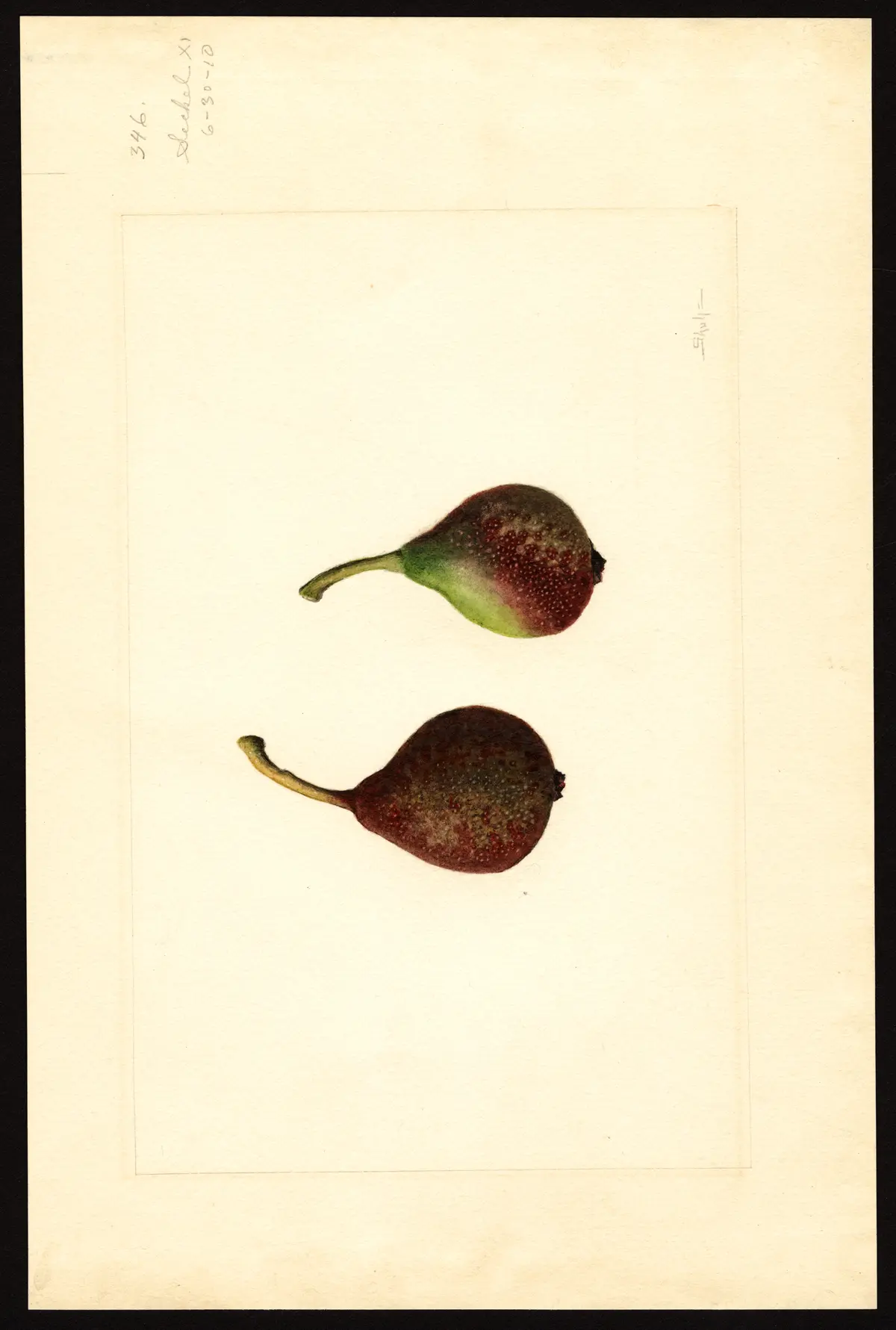
USDA Pomological Watercolor Collection
Seckel
Origin / History
An American pear, in Hedrick's words "distinct in type from any European variety." Downing reports that the first pomologists of Europe pronounced it entirely distinct from any European sort. Coxe (1817) found no such pear described by L'abbé Rozier or de La Quintinye among the French, or by Miller or Forsyth among the English. Nor did he find any of the intelligent French gentlemen in America who knew it in his own country. He judged that it possessed "all the characteristicks of a new variety." Its precise origin is unknown (Downing, followed by the Herefordshire Pomona). Coxe names it for Mr. Seckle of Philadelphia, proprietor of the original tree, then growing on his estate near that city. He believed it a native fruit, produced from the seed of a fine pear accidentally dropped where the tree grew; the proprietor owned many varieties. Hovey calls it undoubtedly an accidental seedling, believed to have sprung from a kernel of the Rousselet de Rheims, which it resembles in high aroma and greatly in wood, leaves, and habit. Downing names the Rousselet, "a well-known German Pear," and supposes its seeds were brought by Germans settling near Philadelphia. Hedrick's Cyclopedia (1922) says Seckel is supposed to have originated as a chance seedling soon after the Revolutionary War near Philadelphia, Pennsylvania.
According to Dr. Brinckle (cited by Elliott), the original tree stood in Passyunk township, on the Delaware river, about three and a half miles from Philadelphia. Downing puts the farm about four miles from the city. The Herefordshire Pomona (1885) places the tree in a meadow in Passyunk township, about a quarter of a mile from the Delaware, opposite League Island, about three and a half miles from Philadelphia.
By the Pomona's account the tree was then over a hundred years old and about thirty feet high. The trunk measured six feet in diameter at a foot from the ground and four feet nine inches at five feet. It was hollow and very much decayed, and the bark was entirely gone halfway round to a height of six feet. The tree was expected to die within a few years, though young suckers growing from the root would preserve the original stock. The Pomona regrets that the decayed portion was never plastered up. Downing reports the original tree, "a few years ago," still vigorous and fruitful, with specimens lately exhibited at the annual show of the Pennsylvania Horticultural Society. Hedrick says it long remained vigorous and fruitful.
The account of "Dutch Jacob," related by the late Bishop White, appears in Downing's text (1900 edition) dated "about the beginning of the last century." In that version Dutch Jacob was a well-known Philadelphia sportsman and cattle-dealer. Early in autumn, returning from his shooting excursions, he was often seen coming into the city eating pears of an unusually delicious flavor, whose source he would not reveal. At length he was tracked to the spot, and the original tree was found growing in a retired place near the Delaware. The property afterward passed to the Holland Land Company, which disposed of it in parcels. The ground on which the tree stood, a fine strip of woodland, became the farm of Mr. Seckel. The fruit was soon brought into notice, and the land was added to the vast estate of the late S. W. Roberts, Esq.
The Herefordshire Pomona, quoting Downing, dates the story "about 1765," when the Bishop was a lad. In this version Dutch Jacob each season regaled his neighbors with the pears. When the Holland Land Company, owning a considerable tract south of the city, disposed of it in parcels, Jacob secured the ground on which his favorite tree stood, "a fine strip of land near the Delaware." Not long afterward it became the farm of Mr. Seckel, "who introduced this remarkable fruit to public notice, and it received his name."
Hedrick (1921) places the story "toward the close of the eighteenth century." He calls the ground a neck of land near the Delaware river and says Mr. Seckel gave the pear his name and introduced it. In his account the property was later added to the estate of Stephen Girard, not S. W. Roberts. Bunyard calls the finder "a trapper called Dutch Jacob," who found the tree in a wood near Philadelphia; in his account Mr. Seckle was a later cultivator of the land.
Coxe first described the variety in 1817 under the spelling "Seckle." The Herefordshire Pomona insists the owner was "Mr. Seckle (not Seckel)." Hedrick notes that Coxe lived in Philadelphia and probably knew the introducer, and that English pomologists followed Coxe's spelling. Nearly all of Coxe's contemporaries, however, spelled it Seckel, the spelling now in common use.
In 1819 Dr. Hosack sent trees to the London Horticultural Society; Hovey and Hedrick call him "of New York," the Herefordshire Pomona "of Philadelphia." The Pomona adds that they were sent with several other fruits. Hovey says that in 1820 the fruit was exhibited from the garden of Mr. Braddick and "highly extolled for its exquisitely perfumed and luscious qualities," and "at once became a most popular and extensively cultivated variety." Downing reports that the Society pronounced it "exceeding in flavor the richest of their autumn Pears." Hedrick says it was later distributed in England from the Society, and that the new variety was soon widely disseminated and everywhere became popular. Bunyard gives 1819 as the date of its introduction to England. At its first meeting, in 1848, the American Pomological Society recommended Seckel for general cultivation. Hedrick says it has ever held its place among the pears the Society recommends.
Its reputation has been of the highest from the first. Coxe calls it, "in the general estimation of amateurs of fine fruit, both natives and foreigners, the finest pear of this or any other country." Hovey calls it "undoubtedly as regards richness of flavor — best of all pears." Downing calls it "the richest and most exquisitely flavored variety known," not surpassed nor indeed equalled by any European variety. Hedrick says it is equalled by no other variety in high quality of fruit, its high standing resting on its flesh-characters.
Thomas regards it as the standard of excellence, as the Green Gage is among plums. Hedrick says it is everywhere used as the standard for excellence. Budd and Hansen call it widely grown on account of its unexcelled quality. Bunyard records it as "the favourite pear of Walt Whitman."
Downing considers no garden complete without it and calls it indispensable in the smallest garden. The Herefordshire Pomona says no garden, however small, should be without it. Hovey found it one of the sorts planted in the very smallest collection.
Hovey reports that for many years it was the only American variety considered worth growing. With the White Doyenne or Butter pear of Philadelphia, it was until recently the only sort cultivated to any extent for the Philadelphia market, and well-grown specimens still commanded as high a price as any other variety of its season. In his day it was more sought after than any other pear except perhaps the Bartlett. "If it had the size of the Bartlett, or, indeed, was a moderately large pear, it would challenge — as it does now in the estimation of many — the world for a rival." Hedrick (1921) likewise writes that if the fruits were larger, Seckel would challenge the world as a market pear, as it already does as a pear for the home orchard. After Bartlett and "the disreputable Kieffer," he says, it is more grown than any other variety in America. For the home orchard it has no rival in any part of North America where European varieties are grown.
Elliott (1865) writes that no variety had become so generally known in this country, and that in the Southern and Middle States no variety deserves so extended culture. Thomas finds that it succeeds well throughout the Northern, Middle, and Western States.
Tree
Very hardy. Downing calls it the healthiest and hardiest of all pear trees; Hedrick calls it almost as hardy as any other pear. Remarkably free from blight. Hedrick calls it "nearly iron-clad" in resistance to blight. He says it stands almost alone among the several hundred pears grown on this side of the Atlantic in vigor of tree, productiveness, and immunity to blight. Fruit and foliage are susceptible to scab (Hedrick).
Vigor is in conflict. Coxe calls the tree "singularly vigorous and beautiful," of great regularity of growth and richness of foliage. The Herefordshire Pomona calls it vigorous. Hedrick calls it large and very vigorous, long-lived, with a very stocky trunk. Hovey, Elliott, and Thomas call it of slow growth, and Bunyard calls its growth "rather weak." Hovey gives both characters: a very slow grower, making short stocky wood and forming at mature age only a low, compact, broadly pyramidal tree, yet vigorous, upright, erect, and compact in habit. Elliott finds it of only medium size on the pear stock and well suited to garden planting.
Head fine, compact, regular-shaped, symmetrical, round, dense-topped. Habit upright to upright-spreading. Hedrick finds the tops large, low, compact, and broadly pyramidal. At Agassiz, British Columbia, where it was planted in spring 1890, the tree was a compact and upright grower.
Wood stout, short-jointed, olive-brown or olive-colored; Downing and Hedrick both name this wood as a distinguishing mark of the variety. Hovey gives the wood as dark brownish olive, dotted with minute grayish specks, and the old wood as grayish olive. His annual shoots are very short, stout, and blunt at the ends; Thomas's are stout, short, and ascending. Hedrick describes the branches as thick and reddish brown, mingled with dull gray scarf-skin and covered with small lenticels. His branchlets are thick, dark reddish brown, dull, smooth, and glabrous, with small, slightly raised lenticels. He calls the branchlets long, against Hovey's very short shoots.
Leaf buds small and short. Hovey calls them broad, erect, and flattened; Hedrick calls them obtuse or pointed and appressed, with prominent leaf scars. Flower buds of medium size and bluntly ovate (Hovey), or small, short, conical, and free (Hedrick).
Leaves medium, ovate to oval or round oval. Hovey calls them thick, smooth, nearly flat, dark green, and finely and rather sharply serrated, on rather short, moderately stout petioles about one inch long. Hedrick calls them leathery, taper-pointed, and finely serrate, 2½ inches long and 1⅝ inches wide, on a petiole ½ inch long, with stipules very long when present. His Cyclopedia prints 1½ inches for both width and petiole. Bunyard's leaf is sharply pointed and boldly curved-serrate, turning crimson brown.
Flowers small, in compact or dense clusters, seven or eight buds to a cluster (Hedrick). Petals tinged with rose, obovate, cupped (Hovey). Hedrick gives the flowers 1⅛ inches across (1¼ in his Cyclopedia), on pedicels ¾ inch long, slender, lightly pubescent, light green, slightly streaked with red. Blossoms markedly self-fertile (Hedrick).
Fruit borne in clusters at the ends of the branches (Downing, Hedrick). Crops regular and abundant (Downing); the tree is very productive, an abundant to good bearer, of good fertility. Very tardy, or late, in coming into bearing (Hovey, Hedrick).
Does not succeed very well upon the quince (Hovey); Bunyard finds it a little too dwarfed on quince and best on pear stock. The Herefordshire Pomona finds it succeeds well as a standard and is admirably adapted for dwarf pyramids on the pear stock, kept well root-pruned.
Needs rich cultivation (Thomas). Downing advises a frequent top-dressing of manure when the size of the pear is an object. Hedrick says it does best in fertile soils, which must not be a heavy clay. In the North, Elliott advises planting it, when possible, in warm, rich, sandy loam and in sheltered situations.
Fruit
Size: Generally small, "small to medium" in Hovey; uniform in size and shape (Hedrick). Hovey gives about 2½ inches long and 2¼ inches in diameter. Hedrick gives 2⅝ inches long and 2 inches wide; his Cyclopedia prints 2 inches long and 1¾ inches wide. Elliott notes that his drawing is too small for a fair average. Coxe says form and appearance vary with aspect, age, and cultivation.
Form: Obovate, regular, symmetrical, handsomely shaped, attractive because clean and trim in contour (Hedrick). Round at the blossom end, diminishing with a gentle swell toward the stem (Coxe). Hovey calls it roundish obovate, largest in the middle, narrowing to each end, with a small crown, somewhat obtuse at the stem. Elliott calls it rounded, obtuse pyriform, and Thomas sometimes obscurely conic-pyriform. Bunyard calls it round oval, even.
Stem: Short, ½ to ¾ inch long, moderately stout to thick, slightly to often curved.
Cavity: Small to very small, a very slight or trifling, narrow depression. Hovey calls it contracted and highest on one side. Hedrick calls it obtuse, very shallow, narrow, and symmetrical.
Calyx: Small. Open, partly open, or partially closed (Hovey). Set nearly even with the surface, on a level, not at all depressed. Segments short to very short. Hovey calls them stiff, incurved, and projecting. Hedrick describes the lobes as separated at the base, variable in width, and acute, with the calyx tube short and conical.
Basin: Small, shallow, scarcely at all sunk. Hedrick describes it as very shallow and narrow, strongly obtuse, and symmetrical.
Skin: Dull brownish green at first, becoming yellowish brown when ripe; dull yellowish brown in Downing, rich yellowish brown in Thomas. Lightly marked with pale russet (Hedrick), with a lively russet-red or russety red cheek, bright red on the side exposed to the sun. Thomas calls the cheek deep brownish red, and Hovey a ruddy cheek on the sunny side. Hovey gives the mature color as a clear light golden russet, Bunyard as dark brown red. The Agassiz station records the skin simply as brownish green. Coxe reports two forms: sometimes yellow with a bright red cheek, and smooth; at other times "a perfect russet, without any blush." The peculiar reddish-brown color distinguishes the variety (Downing, Hedrick).
Smooth or nearly smooth, dull (Hedrick); Bunyard alone calls it rough. Hedrick calls the fruit "not highly colored." The Herefordshire Pomona finds the color beautiful enough to make it an ornament to the dessert table.
Dots: Numerous, rather thickly set, small to very small, grayish or russet. Bunyard calls them conspicuous and white.
Flesh and flavor: White to yellowish white; whitish, white with a faint tinge of yellow (Hedrick), yellow in Bunyard. Melting, buttery, juicy to very and exceedingly juicy. Fine or very fine-grained (Hovey, Thomas); Hedrick calls it slightly granular, and Bunyard tender.
Sweet, sugary, luscious, rich to exceedingly and peculiarly rich, perfumed, with a peculiar spicy, aromatic perfume. Downing calls the flavor "highly concentrated, spicy, and honeyed." Elsewhere it is "most exquisitely and delicately flavoured," with a "rich and unusually powerful aromatic flavour," "remarkably sweet," and "of the sweetmeat order" (Bunyard). Much of the spicy, aromatic flavor lies in the skin, which Hedrick says should never be discarded in eating. Thomas finds its "high musky perfume" "not, however, agreeable to all."
Quality "best" (Budd and Hansen), "very good to best" (Hedrick). Thomas calls it "the richest and highest flavored pear known." Veitch calls it "very fine," "extremely rich, very delicious," and Bunyard "a most delicious fruit."
Core and seeds: Core small, closed, with clasping core lines (Hedrick); medium in Hovey. Seeds small, broad or broadly ovate; Hedrick calls them short, not very plump, obtuse.
Season
The recorded season runs from the end of August into November. Most authors place it in October. The earliest writers begin at the end of August or in September and run to the middle or last of October; Downing has the fruit ripening gradually in the house through that period. Thomas calls it early mid-autumn, and Bunyard alone carries it to November. Hovey says the fruit, ripe in September, keeps three or four weeks. Hedrick says the fruits do not keep after maturity. He counts it another distinctive character that they lose little in quality by ripening on the tree.
Uses
Dessert. The Herefordshire Pomona calls it one of the most valuable dessert pears, surpassing in richness any other pear in cultivation, and Veitch "one of the best pears." Hedrick finds it excellent for culinary purposes, unlike most other dessert pears, but too small for commercial canning. He notes that it costs twice as much to pick as the large-fruited Bartlett. Even so, it is usually a profitable commercial variety, since a well-grown crop almost always commands a fancy price.
Subtypes / Variants
Not described in source.
Other
Coxe figures the variety (p. 189, pl. 25). The Herefordshire Pomona cites further figures in the Transactions of the London Horticultural Society, Vol. III, plate ix, and the Pomological Magazine, plate 72; Bunyard (1920) cites the Herefordshire Pomona, I, 28. Hedrick's references run from Coxe (1817), the Transactions of the London Horticultural Society (1820), and the Pomological Magazine (1829) through Prince (1831), Kenrick (1832), and the English Horticultural Register (1833). They continue with the Gardeners' Chronicle (1842), Downing (1845), the Proceedings of the National Convention of Fruit Growers (1848), Hovey (1851), and the Magazine of Horticulture (1853). The later entries are Pomologie de la France (1864), Mas, Le Verger (1866–73), Leroy (1869), the Guide Pratique (1876), the Journal of Horticulture (1882), Hogg (1884), and Bunyard (1920).
[NOTE: Source text may be incorrect — the George Bunyard & Co. catalog entry (1914) is garbled and self-contradictory ("large; small"; "Fairly medium"; "Found in a good tree University"; "Found in a good tree of Boston").] Salvageable from it: season "Oct."; "very rich"; "not any color"; "The perfect Seckel"; "very good flavor"; "the best little known of all pears; perfection itself."
Book Sources
Described in 10 period pomological works
- Budd & Hansen, Systematic Pomology (1914)
- Hedrick, The Pears of New York (1921)
- Elliott, The Western Fruit Book (1865)
- Hedrick, Cyclopedia of Hardy Fruits (1922)
- The Herefordshire Pomona (1876–1885) — listed as SECKLE
- Bunyard, A Handbook of Hardy Fruits (1920) — listed as SECKLE
- Coxe, A View of the Cultivation of Fruit Trees (1817) — listed as Seckle Pear
- Downing, Fruits and Fruit Trees of America (1900) — listed as Seukel
- Thomas, The American Fruit Culturist (1903)
- Hovey, The Fruits of America (1852) — listed as THE SECKEL PEAR.
Nursery Catalog Sources
Found in 94 catalogs (1845–1947) from Alabama, Arkansas, California, England, Florida, Illinois, Kansas, Maryland, Massachusetts, Missouri, Nebraska, New Jersey, New York, Oregon, Pennsylvania, Virginia, Washington
- Winship's Nursery (Brighton Nurseries , operated by the Winship family), Brighton (Boston) , Massachusetts — 1845
- Hovey & Co. , Cambridge , Massachusetts — 1849
- Azell Bowditch (Nursery / Fruit Catalog) , Boston , Massachusetts — 1850
- Joseph Breck & Co. , Boston , Massachusetts — 1855
- St. Helena Nursery , Howell Prairie, Marion County, OR (Marion Co., Ogn.) — 1864
- Hutchison Nursery , James Hutchison, Oakland , California — 1881
- Felix Gillet , Barren Hill Nursery, Nevada City , California — 1884
- Fancher Creek Nursery , Fresno , California — 1886
- Huntsville Wholesale Nurseries (Jessie S. Moss , Proprietor; W.F. Heikes, Manager), Huntsville , Alabama — 1886
- W.R. Strong & Co. , Capital and Orange Hill Nurseries (Robert Williamson, prop.), Sacramento , California — 1886
- Felix Gillet , Barren Hill Nursery, Nevada City , California — 1888
- California Nursery Co. , Niles , California — 1889
- Felix Gillet , Barren Hill Nursery, Nevada City , California — 1889
- Felix Gillet , Barren Hill Nursery, Nevada City , California — 1890
- William H. Moon Co. , Morrisville, Bucks County , Pennsylvania — 1890
- Felix Gillet , Barren Hill Nursery, Nevada City , California — 1891
- Missouri Nursery Co. , Louisiana , Missouri — 1891
- Puyallup & Yakima Nurseries , Puyallup, Washington (Lock Box 191) and North Yakima , Washington — 1892
- Glen St. Mary Nurseries (G.L. Taber , Proprietor), Glen St. Mary , Florida — 1893
- Milwaukie-Canby Nurseries , Canby, OR (and Milwaukie, OR) — 1893
- Oregon Wholesale Nurseries , Salem , Oregon — 1893
- Rogers Nursery Co. , Moorestown , New Jersey — 1893
- Sherwood Hall Nursery Co. , Timothy Hopkins (Menlo Park Nurseries), San Francisco / Menlo Park , California — 1893
- Green's Nursery Co. (Charles A. Green) , Rochester , New York — 1894
- Multnomah Nurseries , Russellville , Oregon — 1894
- The Vineland Nurseries (Kelsey & Co. , Proprietors), St. Joseph, Missouri (Office: 13th and Atchison Sts., 2 Blocks East of the Citizens St. Car Line) — 1894
- Woodburn Nurseries , Woodburn, Marion Co. , Oregon — 1894
- Felix Gillet , Barren Hill Nursery, Nevada City , California — 1895
- The Lovett Company , Little Silver , New Jersey — 1896
- Stark Bros. Nurseries & Orchards Co. , Louisiana , Missouri — 1896
- Felix Gillet , Barren Hill Nursery, Nevada City , California — 1897
- Kelway & Son , Langport, Somerset , England — 1897
- The Salem Nursery (John A. Francis , Proprietor), Salem , Virginia — 1897
- Arthur J. Collins & Sons , Moorestown , New Jersey — 1898
- J.V. Cotta (Cotta Nursery) , Carroll County , Illinois — 1898
- Reading Nursery , Jacob W. Manning, Proprietor, Reading , Massachusetts — 1898
- Stark Bros. Nurseries & Orchards Co. , Louisiana , Missouri — 1898
- Brown Brothers Co. , Continental Nurseries, Rochester, NY (also operated from Toronto, Canada) — 1899
- Alabama Nursery Co. , Huntsville , Alabama — 1900
- George Bunyard & Co. , Royal Nurseries, Maidstone, Kent , England — 1900
- Central Experimental Farm , Dominion Department of Agriculture, Agassiz, British Columbia (under test; Bulletin No. 3, Second Series) — 1900
- The Dalles Nurseries , The Dalles , Oregon — 1901
- Washington Nursery Co. , Toppenish , Washington — 1901
- Benjamin Buckman (personal inventory) , Farmingdale , Illinois — 1901
- Brown Brothers Co. , Continental Nurseries, Rochester, NY (also operated from Toronto, Canada) — 1901
- Mountain Grove Nurseries (Tippin & Moore , Proprietors; Geo. T. Tippin, J. W. Tippin, J. C. Moore), Mountain Grove , Missouri — 1901
- S.L. Watkins , Grizzly Flats, El Dorado County , California — 1901
- Yarbrough Bros. , Stephens , Arkansas — 1901
- Forestville Nurseries , T.J. True, Forestville , California — 1902
- Pacific Nursery Company (W. O. Hudson & A. D. Hudson) , Tangent , Oregon — 1903
- Russellville Nursery Co. , Russellville, OR (three miles east of Portland, one mile from Montavilla car line) — 1903 — listed as Seckle
- Henderson Luelling / Traveling Nursery (historical recall) , Oregon — 1904
- Phoenix Nursery Company (W. E. Rossney , President; Sidney Tuttle, Vice-President), Bloomington , Illinois — 1904
- Stark Bros. Nurseries & Orchards Co. , Louisiana , Missouri — 1906
- J.B. Pilkington , Portland , Oregon — 1907
- Russellville Nursery Co. , Montavilla Station, Portland, OR (three miles east of Portland, one mile from Montavilla car line) — 1907
- Carlton Nursery Co. , Carlton , Oregon — 1909
- Milton Nursery Co. (A. Miller & Sons , Proprietors), Milton , Oregon — 1909
- Wm. J. Corse (successor to Robert Sinclair / Sinclair Nurseries) , Baltimore , Maryland — 1909
- Washington Nursery Company , Toppenish , Washington — 1909
- C.F. Lansing , Salem , Oregon — 1910
- Island Nurseries & Fruit Farm , Vashon (Vashon Island) , Washington — 1910
- Galbraith Nursery Co. (DeWitt Hansen , Pres.-Mgr.), Fairbury , Nebraska — 1911
- Island Nurseries & Fruit Farm , Vashon (Vashon Island) , Washington — 1911
- Stark Bros. Nurseries & Orchards Co. , Louisiana , Missouri — 1911
- James Veitch & Sons , Ltd., Royal Exotic Nursery, Chelsea, London (also Coombe Wood, Langley, and Feltham) , England — 1911
- Ballygreen Nurseries , Hanford , Washington — 1912
- Pacific Nursery Company , Portland , Oregon — 1912
- Vineland Nurseries Company , Clarkston , Washington — 1912
- Washington Nursery Company , Toppenish , Washington — 1912
- Stark Bros. Nurseries & Orchards Co. , Louisiana , Missouri — 1912
- J. B. Pilkington , Nurseryman, Portland, OR (nurseries near Newberg, forty miles from Portland) — 1913
- Samuel Fraser , Geneseo , New York — 1913
- Thomas Rivers & Son , Sawbridgeworth, Hertfordshire , England — 1913
- Van Holderbeke Nursery Co. , Incorporated, Spokane, Washington (nurseries at Otis Orchards WA, Pasadena WA, Kennewick WA) — 1913
- Benjamin Buckman (personal inventory) , Farmingdale , Illinois — 1913
- George Bunyard & Co. , Royal Nurseries, Maidstone, Kent , England — 1914
- Island Nurseries & Fruit Farm , Vashon (Vashon Island) , Washington — 1914
- Island Nurseries & Fruit Farm , Vashon (Vashon Island) , Washington — 1915
- Union Nurseries , J.B. Weaver & Sons, Union , Oregon — 1915
- Island Nurseries & Fruit Farm , Vashon (Vashon Island) , Washington — 1916
- Holsinger Bros. Nurseries (Holsinger Brothers Nursery) , Rosedale , Kansas — 1916
- George Bunyard & Co. , Royal Nurseries, Maidstone, Kent , England — 1917
- Island Nurseries & Fruit Farm , Vashon (Vashon Island) , Washington — 1917
- Fancher Creek Nurseries , George C. Roeding, Fresno , California — 1918
- Oregon Nursery Co. , Orenco , Oregon — 1920
- Christopher Nurseries / John Stewart & Sons , Christopher , Washington — 1920
- Benedict Nursery Co. , Portland , Oregon — 1921
- Island Nurseries & Fruit Farm , Vashon , Washington — 1921
- Columbia & Okanogan Nursery Co. , Wenatchee , Washington — 1925
- Hudson's Wholesale Nurseries , Tangent , Oregon — 1926
- Stark Bro's Nurseries , Louisiana , Missouri — 1932
- Milton Nursery Co. , Milton-Freewater , Oregon — 1947
- North-Western Nurseries , Walla Walla , Washington
View original book sources (13)
— William Coxe, A View of the Cultivation of Fruit Trees (1817)
- SECKLE PEAR.
So called from Mr. Seckle of Philadelphia, the proprietor of the original tree now growing on his estate near that city—it is in the general estimation of amateurs of fine fruit, both natives and foreigners, the finest pear of this or any other country—it is believed to be a native fruit, produced from the seed of a fine pear (of which the original proprietor owned many varieties) accidentally dropped where this tree now grows. The form and appearance, vary with aspect, age, and cultivation—the size generally is small, the form regular, round at the blossom end, diminishing with a gentle swell towards the stem, which is rather short and thick; the skin is sometimes yellow, with a bright red cheek, and smooth; at other times a perfect russet, without any blush—the flesh is melting, juicy, and most exquisitely and delicately flavoured; the time of ripening is from the end of August, to the middle of October. The tree is singularly vigorous and beautiful, of great regularity of growth and richness of foliage—very hardy, and possessing all the characteristicks of a new variety—neither L'abbé Rozier or de La Quintinye among the French, nor Miller or Forsyth among the English writers, describe such a pear as the Seckle—nor have I found one among the intelligent French gentlemen in our country, who has any knowledge of the pear in his own country.
— C.M. Hovey, The Fruits of America (1852)THE SECKEL PEAR. Seckel. Coxe's View of the Cultivation of Fruit Trees, p. 189, pl. 25.
Sycle, Red Cheeked Seckle, } According to Pomological Magazine. New York Red Cheek, } Seckle, of many authors and writers. Shakspeare, of some French Collections.
The encomiums bestowed upon this — undoubtedly as regards richness of flavor — best of all pears, have been so numerous and so universal, both at home and abroad, that it would be quite superfluous to recapitulate them. The late Dr. Hossack, of New York, sent trees of the Seckel to the London Horticultural Society in 1819, and, in 1820, the fruit was exhibited from the garden of Mr. Braddick, which was highly extolled for its exquisitely perfumed and luscious qualities, and it at once became a most popular and extensively cultivated variety. To our own cultivators it has been a familiar pear since first described by Mr. Coxe, in his valuable work published in 1817, and though comparatively so old a variety, it is to this day more sought after than any other pear, unless we except the Bartlett, and is always one of the sorts planted in the very smallest collection. If it had the size of the Bartlett, or, indeed, was a moderately large pear, it would challenge — as it does now in the estimation of many — the world for a rival.
The Seckel is so named after the late Mr. Seckel, of Philadelphia, on whose estate, near that city, the original tree was growing when Mr. Coxe wrote his account of it. It is undoubtedly an accidental seedling, believed to have sprung from a kernel of the Rousselet de Rheims, partaking, as it does, of the high aroma of that variety, and greatly resembling it in the wood, leaves, habit, &c. Its great excellence soon became known to cultivators of the pear, and for many years it was the only American variety considered worth growing. With the White Doyenne or Butter pear of Philadelphia, it was, until recently, the only sort cultivated, to any extent, for the supply of the market of that city : and notwithstanding the introduction of so many fine pears, well grown specimens still command as high a price as any other variety of its season. The Seckel is a very slow grower, making short stocky wood, and forming, at mature age, only a low, compact, and broadly-pyramidal tree. It is very tardy in coming into bearing, and does not succeed very well upon the quince.
SECKEL PEAR. Tree. — Vigorous, upright, erect, compact in its habit, and forming a regular-shaped and fine head ; annual shoots very short, stout, and blunt at the ends. Wood. — Dark brownish olive, dotted with minute grayish specks, short-jointed ; old wood, grayish olive ; buds, small, short, broad, erect, and flattened : Flower-buds, medium size, bluntly ovate. Leaves. — Medium size, ovate, nearly flat, smooth, thick, dark green, finely and rather sharply serrated ; petioles, rather short, about one inch in length, moderately stout. Flowers. — Small, disposed in compact clusters; petals, tinged with rose, obovate, cupped. Fruit. — Small to medium, about two and a half inches long, and two and a quarter in diameter : Form, roundish obovate, largest in the middle, narrowing to each end, with a small crown, and somewhat obtuse at the stem : Skin, nearly smooth, of a clear light golden russet when mature, with a ruddy cheek on the sunny side, and rather thickly dotted with small grayish specks : Stem, short, about half an inch long, moderately stout, and inserted in a very small contracted cavity, highest on one side : Eye, partially closed, and set nearly even with the surface ; segments of the calyx, short, stiff, incurved, projecting: Flesh, yellowish white, fine, melting, and exceedingly juicy : Flavor, sugary, rich, and luscious, with a peculiar, spicy, aromatic perfume : Core, medium size : Seeds, small, broadly ovate.
Ripe in September, and keeps three or four weeks.
— F.R. Elliott, The Western Fruit Book (1865)Seckel. Sickle, New York Red Cheek, Sycle. Red-cheeked Seckel,
The original tree of this variety, according to Dr. Brinckle, stands in Passyunk township, on the Delaware river, about three and a half miles from Philadelphia. No one variety has become so generally known in this country as the Seckel, and in our Southern and Middle States, no one variety deserves so extended culture. North, it should, when possible, be planted in warm, rich, sandy loam, and sheltered situations. The tree is of slow growth; wood, short-jointed, stout, forming a round head, and of only medium size on the pear stock, and well suited to garden planting.
Fruit, small, (our drawing too small for a fair average), rounded, obtuse pyriform; color, brownish green at first, becoming yellowish brown, with a lively red russet cheek; stem, short, slightly curved, set in a very slight depression; calyx, small, open; basin, shallow; core, small; seeds, broad, ovate; flesh, yellowish white, juicy, buttery, spicy, aromatic, sweet. September and October.
— Woolhope Naturalists Field Club, The Herefordshire Pomona (1885)PLATE XXVIII.
- SECKLE.
[Syn : Seckel; Sicker; New York Red Cheek; Shakespear; Lammas, of the Americans.]
The Seckle Pear is an American production. Its precise origin is unknown. Downing, in his "Fruits and Fruit Trees of America," says, " Its affinity to the Rotisselet, a well-known German Pear, leads to the supposition that the seeds of the latter Pear, having been brought by some of the Germans settling near Philadelphia, by chance produced this superior variety." It is first noticed by Coxe, an American pomologist, in his work " View of the Cultivation of Fruit Trees." It was sent to the London Horticultural Society in 1819, by Dr. Hosack, of Philadelphia, with several other fruits.
The original tree is still in existence, and is over a hundred years old. It grows in a meadow in Passyunk township, about a quarter of a mile from the Delaware, opposite League Island, and about three miles and a half from Philadelphia. It is about thirty feet high ; the diameter of the trunk at a foot from the ground, is six feet ; and at five feet from the ground, it is four feet nine inches. The trunk is hollow and very much decayed ; the bark, half way round to the height of six feet, is entirely gone ; and the progress of decay has advanced so far, that it is feared in a few more years the tree will have ceased to exist. There are, however, young suckers growing from the root, by which the original stock will be preserved ; but it is to be regretted that means were not taken to preserve the original tree, by the very simple process of plaistering up the decayed portion. The property on which the tree stands belonged in 1817, according to Coxe, to Mr. Seckle (not Seckel), of Philadelphia, and hence the origin of the name.
" The following morceau of its history may be relied on," Downing adds, " it having been related by the late venerable Bishop White, whose tenacity of memory is well known. About 1765, when the Bishop was a lad, there was a well-known sportsman and cattle dealer in Philadelphia, who was familiarly known as ' Dutch Jacob.' Every season, early in the autumn, on returning from his shooting excursion, Dutch Jacob regaled his neighbours with pears of an unusually delicious flavour ; the secret of whose place of growth, however, he would never satisfy their curiosity by divulging. At length the Holland Land Company, owning a considerable tract south of the city, disposed of it in parcels, and Dutch Jacob then secured the ground on which his favourite pear tree stood—a fine strip of land near the Delaware. Not long afterwards it became the farm of Mr. Seckel, who introduced this remarkable fruit to public notice, and it received his name." The Seckle Pear has been figured in the Transactions of The London Horticultural Society, Vol. III., Pl. ix., and also in the Pomological Magazine, Pl. 72.
Description.—Fruit : small ; obovate, regularly and handsomely shaped. Skin : at first dull brownish green, changing, as it ripens, to yellowish brown, with bright red on the side exposed to the sun. Eye : small and open, with very short segments, and not at all depressed. Stalk : half an inch long, inserted in a small, narrow depression. Flesh : buttery, melting and very juicy, with a rich and unusually powerful aromatic flavour.
One of the most valuable dessert Pears, surpassing in richness any other pear in cultivation. It is ripe in October, and from the beauty of its colour is as desirable as an ornament to the dessert table, as it is welcome there, for its delicious flavour.
The tree is very hardy, vigorous, and an abundant bearer. It succeeds well as a standard, and is admirably adapted for dwarf pyramids on the Pear stock, kept well root pruned. No garden, however small, should be without this excellent fruit.
— A.J. Downing, The Fruits and Fruit Trees of America (1900)Seukel.
Seckle. Syckle. New York Red Cheek. Sickel. Red-Cheeked Seckel. Shakespeare.
We do not hesitate to pronounce this American Pear the richest and most exquisitely flavored variety known. In its highly concentrated, spicy, and honeyed flavor it is not surpassed, nor indeed equalled, by any European variety. When we add to this, that the tree is the healthiest and hardiest of all pear-trees, forming a fine, compact, symmetrical head, and bearing regular and abundant crops in clusters at the ends of the branches, it is easy to see that we consider no garden complete without it. Indeed we think it indispensable in the smallest garden.
The stout, short-jointed, olive-brown colored wood distinguishes this variety, as well as the peculiar reddish brown color of the fruit. The soil should receive a top-dressing of manure frequently, when the size of the Pear is an object. The Seckel Pear originated on the farm of Mr. Seckel, about four miles from Philadelphia.* It was sent to Europe by the late Dr. Hosack, in 1819, and the fruit was pronounced by the London Horticultural Society exceeding in flavor the richest of their autumn Pears.
Fruit small, regularly formed, obovate. Skin brownish green at first, becoming dull yellowish brown, with a lively russet red cheek. Stalk half to three-fourths of an inch long, slightly curved, and set in a trifling depression. Calyx small, and placed in a basin scarcely at all sunk. Flesh whitish, buttery, very juicy and melting, with a peculiarly rich spicy flavor and aroma. It ripens gradually in the house from the end of August to the last of October.
- The precise origin of the Seckel Pear is unknown. The first pomologists of Europe have pronounced that it is entirely distinct from any European variety, and its affinity to the Rousselet, a well-known German Pear, leads to the supposition that the seeds of the latter Pear, having been brought here by some of the Germans settling near Philadelphia, by chance produced this superb seedling. However this may be, the following account may be relied on as authentic, it having been related by the late venerable Bishop White, whose tenacity of memory is well known. About the beginning of the last century, there was a well-known sportsman and cattle-dealer in Philadelphia, who was familiarly known as "Dutch Jacob." Dutch Jacob, early in the autumn, on returning from his shooting excursions, was often noticed coming into the city eating pears of an unusually delicious flavor, the secret of which, however, he would never reveal. At length he was tracked to the spot, and the original tree was discovered growing in a retired spot near the Delaware. The property afterwards passed into the hands of the Holland Land Company, who disposed of it in parcels, and the ground upon which the pear-tree stood, a fine strip of woodland, became the farm of Mr. Seckel. The fruit was soon brought into notice, and is added to the vast estate of the late S. W. Roberts, Esq. The original tree (a few years ago), vigorous and fruitful. Specimens were lately exhibited at the annual show of the Pennsylvania Horticultural Society.
— John J. Thomas, The American Fruit Culturist (1903)Seckel.* Small, obovate, sometimes obscurely conic-pyriform, regular; skin brownish green, becoming rich yellowish brown, with a deep brownish-red cheek; stalk one-half to three-fourths of an inch long, cavity and basin small; flesh very fine-grained, sweet, very juicy, melting, buttery, the richest and highest flavored pear known. Although of slow growth and small size, like the Green Gage among plums, it is regarded as the standard of excellence. Its high musky perfume is not, however, agreeable to all. Early mid-autumn. Shoots stout, short, ascending; tree very hardy. Needs rich cultivation. Origin, near Philadelphia, Pa., and succeeds well throughout the Northern, Middle, and Western States, and is remarkably free from the blight.
— J.L. Budd & N.E. Hansen, American Horticultural Manual, Part II: Systematic Pomology (1914)Seckel. — Small, obovate, regular; color when ripe yellowish brown, with russety red cheek; stalk half an inch or more in length, inserted in slight cavity. Flesh whitish, buttery, melting, very juicy, with rich spicy flavor; quality best. Widely grown on account of its unexcelled quality. Pennsylvania.
— E.A. Bunyard, A Handbook of Hardy Fruits (1920)SECKLE. Her. Pom., I., 28. G. Seckle's Birne. Dessert, October to November, small, round oval, even. Skin, rough. Colour, dark brown red with conspicuous white dots. Flesh, yellow, tender, remarkably sweet and rich. Eye, open on a level. Stem, short and stout. Growth, rather upright, rather weak; fertility good. Leaf, medium, round, oval, sharply pointed, boldly curved serrate, turns crimson brown. Origin, found in a wood near Philadelphia by a trapper called Dutch Jacob, and named after Mr. Seckle, a later cultivator of the land on which it stood. Introduced to England in 1819. A most delicious fruit of the sweetmeat order and the favourite pear of Walt Whitman. It does best on Pear stock as it is a little too dwarfed on Quince.
— U.P. Hedrick, The Pears of New York (1921)SECKEL
- Prince Pom. Man. 1:139. 1831. 2. Kenrick Am. Orch. 183. 1832. 3. Gard. Chron. 708, fig. 1842. 4. Downing Fr. Trees Am. 415, fig. 188. 1845. 5. Proc. Nat. Con. Fr. Gr. 51. 1848. 6. Hovey Fr. Am. 2:33, Pl. 1851. 7. Mag. Hort. 19:457, fig. 94. 1853. 8. Mas Le Verger 3: Pt. 1, 29, fig. 13. 1866-73. 9. Leroy Dict. Pom. 2:656, figs. 1869. 10. Guide Prat. 63, 303. 1876.
Seckle. 11. Coxe Cult. Fr. Trees 189, fig. 25. 1817. 12. Trans. Lond. Hort. Soc. 3:256, Pl. 9. 1820. 13. Pom. Mag. 2:72, Pl. 1829. 14. Hort. Reg. (Eng.) 1:488. 1833. 15. Pom. France 2: No. 64, Pl. 64. 1864. 16. Jour. Hort. 3rd Ser. 4:128. 1882. 17. Hogg Fruit Man. 644. 1884. 18. Bunyard Handb. Hardy Fr. 197. 1920.
Seckel is an American pear distinct in type from any European variety. Among the several hundred pears that are grown on this side of the Atlantic, Seckel stands almost alone in vigor of tree, productiveness, and immunity to blight, and is equalled by no other variety in high quality of fruit. If the fruits were larger, Seckel would challenge the world as a pear for the markets as it now does as a pear for the home orchard. After Bartlett and the disreputable Kieffer, it is now more grown than any other variety in America, everywhere being used as the standard for excellence. The fruits are small, not highly colored, but attractive because clean and trim in contour. But it is the flesh-characters that give the fruits their high standing. The flesh is melting, juicy, perfumed and most exquisitely and delicately flavored, with the curious character of having much of its spicy, aromatic flavor in the skin, which should never be discarded in eating. The reddish-brown color of the fruit is another distinguishing character of Seckel. Unlike most other dessert pears, the fruits of this one are excellent for culinary purposes. Still another distinctive character is that the fruits do not lose much in quality by ripening on the tree. Besides being nearly iron-clad in resistance to blight and very productive, the trees are almost as hardy as those of any other pear, and are remarkable for their large, low, compact, broadly pyramidal tops. The tree is further distinguished by its short-jointed, stout, olive-colored wood, and its habit of bearing fruits in clusters on the ends of the branches. The trees do best in fertile soils which must not be a heavy clay. Its blossoms are markedly self-fertile. There are several faults of fruit and tree. The fruits are small and do not keep after maturity; it costs twice as much to pick them as it does the large-fruited Bartlett; fruit and foliage are susceptible to scab; the pears are too small for commercial canning; and the trees are late in coming in bearing. With these several faults, however, Seckel is usually a profitable commercial variety as a well-grown crop almost always commands a fancy price. For the home orchard, Seckel has no rival in any part of North America where European varieties are grown.
Toward the close of the eighteenth century, there lived in Philadelphia a well-known sportsman and cattle dealer known as "Dutch Jacob." Every autumn, upon returning from shooting excursions, Dutch Jacob distributed among his neighbors pears of exceedingly delicious flavor. The place of their growth he kept secret. In time, a tract of land south of Philadelphia was disposed of in parcels, and Dutch Jacob secured the ground on which his favorite pear tree stood, a neck of land near the Delaware river. Shortly afterwards this land became the property of a Mr. Seckel, who gave the pear his name and introduced it. Later, the property was added to the estate of Stephen Girard, and the original tree long remained vigorous and fruitful. The new variety was soon widely disseminated and everywhere became popular. As early as 1819, Dr. Hossack of New York sent trees of the variety to the London Horticultural Society, whence it was later distributed in England. There is much difference of opinion as to the spelling of the name of this pear. Coxe, who lived in Philadelphia and probably knew the introducer of the pear, writing in 1817, spelled the name Seckle. English pomologists have followed Coxe. Nearly all of Coxe's contemporaries, however, spelled it Seckel, the spelling now in common use. At the first meeting of the American Pomological Society, held in 1848, Seckel was recommended for general cultivation and the variety has ever held its place among the pears recommended by the Society.
Tree large and very vigorous, upright-spreading, dense-topped, hardy, very productive, long-lived; trunk very stocky; branches thick, reddish-brown mingled with dull gray scarf-skin, covered with small lenticels; branchlets thick, long, dark reddish-brown, dull, smooth, glabrous, with small, slightly raised lenticels.
Leaf-buds small, short, obtuse or pointed, appressed; leaf-scars prominent. Leaves 2½ in. long, 1⅝ in. wide, oval, leathery; apex taper-pointed; margin finely serrate; petiole ½ in. long; stipules very long when present. Flower-buds small, short, conical, free; flowers 1⅛ in. across, in dense clusters, 7 or 8 buds in a cluster; pedicels ¾ in. long, slender, lightly pubescent, light green, slightly streaked with red.
Fruit ripe in October; small, 2⅝ in. long, 2 in. wide, uniform in size and shape, obovate, symmetrical; stem ¾ in. long, short, thick, often curved; cavity obtuse, with a very shallow, narrow depression, symmetrical; calyx small, partly open; lobes separated at the base, short, variable in width, acute; basin very shallow and narrow, strongly obtuse, symmetrical; skin smooth, dull; color yellowish-brown, lightly marked with pale russet and often with a lively russet-red cheek; dots numerous, very small, russet or grayish; flesh white, with a faint tinge of yellow, slightly granular, melting, buttery, very juicy; sweet, with an exceedingly rich, aromatic, spicy flavor; quality very good to best. Core small, closed, with clasping core-lines; calyx-tube short, conical; seeds small, short, not very plump, obtuse.
— U.P. Hedrick, Cyclopedia of Hardy Fruits (1922)SECKEL. Fig. 94. Among the several hundred pears that are or have been grown on this side of the Atlantic, Seckel stands almost alone in vigor of tree, productiveness, and immunity to blight, and is equalled by no other variety in high quality of fruit. If the fruits were larger, Seckel would challenge the world as a pear for the markets as it now does as a pear for the home orchard. After Bartlett and the disreputable Kieffer, it is now more grown than any other variety in America. The fruits are small, not highly colored, but attractive because clean and trim in contour. The flesh is melting, juicy, perfumed and most exquisitely and delicately flavored, with the curious character of having much of its spicy, aromatic flavor in the skin which should never be discarded in eating. The reddish-brown color of the fruit is another distinguishing character of Seckel. Another distinctive character is that the fruits do not lose much if any by ripening on the tree. Besides being nearly iron-clad in resistance to blight and very productive, the trees are as hardy as those of any other pear, and are remarkable for their large, compact, broadly pyramidal tops. The tree is further distinguished by its short-jointed, stout, olive-colored wood, and its habit of bearing fruits in clusters on the ends of the branches. Its blossoms are markedly self-fertile. There are several faults of fruit and tree: thus, the fruits are small and do not keep after maturity; fruit and foliage are susceptible to scab; the pears are too small for commercial canning; and the trees are late in coming in bearing. Notwithstanding these several faults, Seckel is usually a profitable commercial variety, as a well-grown crop almost always commands a fancy price. For the home orchard, it has no rival in any part of North America where European varieties are grown. Seckel is supposed to have originated as a chance seedling soon after the Revolutionary War near Philadelphia, Pennsylvania.
Tree very large, very vigorous, upright-spreading, dense-topped, hardy, very productive, long-lived; trunk stocky; branches thick, reddish-brown, covered with small lenticels. Leaves 2½ inches long, 1½ inches wide, oval, leathery; apex taper-pointed; margin finely serrate; petiole 1½ inches long; stipules very long when present. Flowers 1¼ inches across, in dense clusters, 7 or 8 buds in a cluster. Fruit ripe in October; small, 2 inches long, 1¾ inches wide, uniform in size and shape, obovate, symmetrical; stem ¾ inch long, short, thick, often curved; cavity obtuse, with a shallow, narrow depression, symmetrical; calyx small, partly open; lobes separated at the base, short, variable in width, acute; basin shallow, narrow, strongly obtuse, symmetrical; skin smooth, dull; color yellowish-brown, lightly marked with pale russet and often with a russet-red cheek; dots numerous, very small, russet or grayish; flesh white, with a faint tinge of yellow, slightly granular, melting, buttery, very juicy, sweet, with an exceedingly rich, aromatic, spicy flavor; quality very good to best; core small, closed, with clasping core-lines; calyx-tube short, conical; seeds small, short, not very plump, obtuse.
— Central Experimental Farm, Central Experimental Farm, Agassiz BC — Catalogue of Fruit Trees under Test (Bulletin No. 3, 1900) (1900)Planted Spring 1890. Tree a compact and upright grower. Fruit small, obovate. Skin brownish green. Flesh white, buttery, juicy, with a rich sugary aromatic flavour. Season October.
— James Veitch & Sons, Veitch's Fruit Trees (1911) (1911)small and very fine; does a good bearer; extremely rich, very delicious fruit; one of the best pears.
— George Bunyard & Co., George Bunyard Catalog of Fruit Trees (1914) (1914)Oct.; large; small; very rich; not any color. The perfect Seckel. Fairly medium; very good flavor. Found in a good tree University, so complete the best little known of all pears; perfection itself. Found in a good tree of Boston.