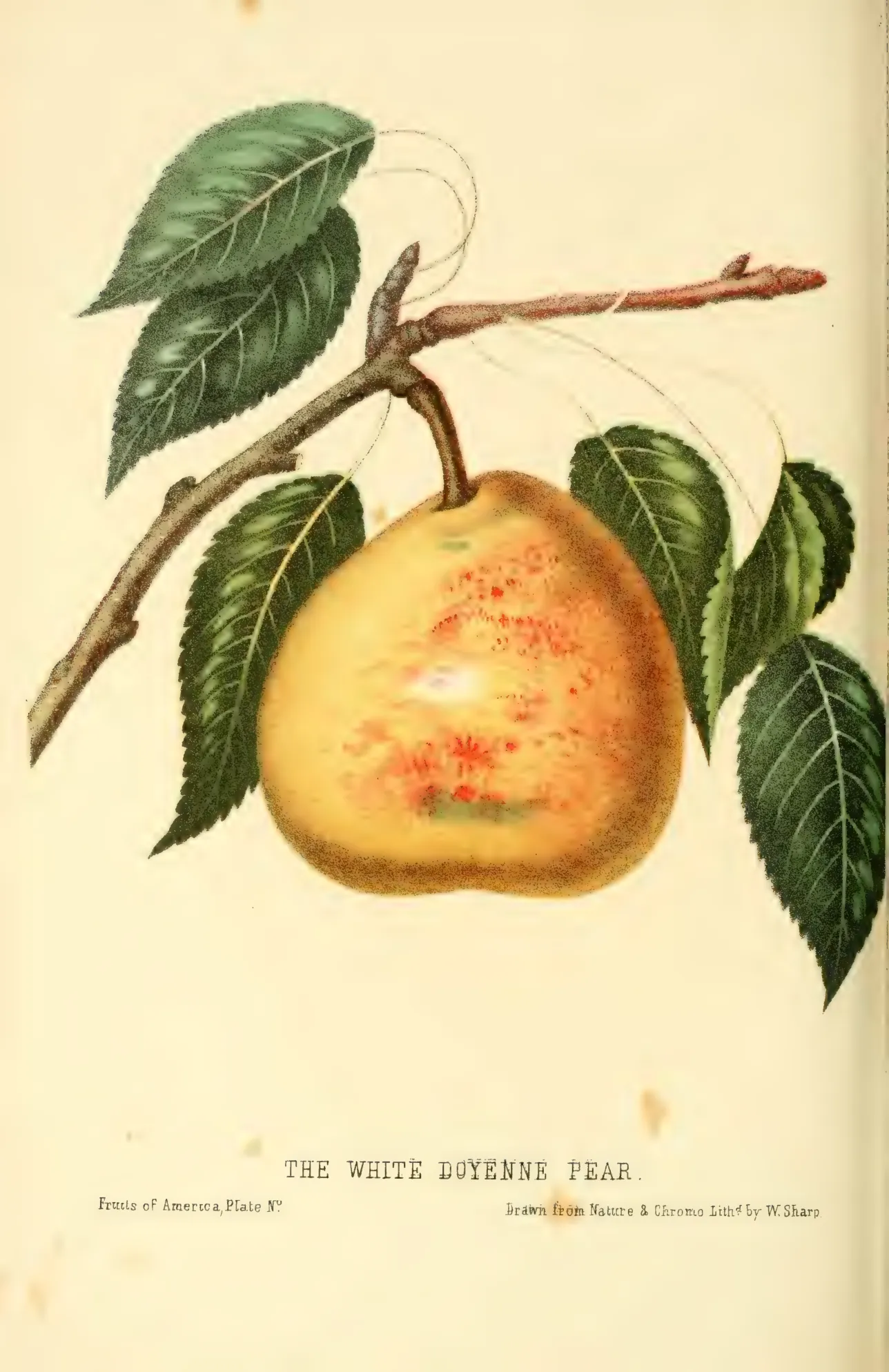
White Doyenné
PearOrigin & History
The White Doyenné is one of the oldest known pear varieties. According to Hedrick, the German pomologist Henri Manger, in his Systematische Pomologie (1780), considered it to have originated with the Romans and identified it as their Sementinum. The Italian writer Agostino Gallo called the variety Pera Ghiacciuola in 1559, and in 1660 Claude Saint-Etienne described a Poire de Neige — both descriptions representing the White Doyenné. In the sixteenth century and for part of the seventeenth, the name Ghiacciuola was accepted for the variety in France with the synonym Saint-Michel. Hedrick notes that Leroy states Le Lectier, in his catalog of the fruit trees he grew at Orléans in 1628, changed the name to Giaccole de Rome, and Nicholas de Bonnefonds modified it in the first edition of his Jardinier Français (1652) to Giacciola di Roma. English pomologists have mentioned this pear under a variety of names since early in the seventeenth century, with Poire Doyenné and White Doyenné being the most generally applied.
It is an old French variety, having been in cultivation over two hundred years at the time of Downing's writing. Hovey describes it as "one of the first good dessert pears brought to this country nearly a century ago" (writing in 1852). The date of its introduction to America is not precisely known, but Hedrick states it was probably brought to this country by the earliest French settlers. The first American catalogs mentioned the variety, and it was extensively grown in the vicinity of New York and Long Island where it was commonly called the Virgalieu pear. In the neighborhood of Boston, the name Saint-Michael was applied to it; while around Philadelphia it was called the Butter Pear. The name Doyenné (pronounced dwoy-annay), literally "deanship," is probably an allusion to the Dean by whom it was first brought into notice, according to Downing. At the Convention of Fruit-Growers held in New York in 1848, White Doyenné was included in a short list of pears recommended for general cultivation, and the American Pomological Society subsequently gave the variety a place in its fruit-catalog (Hedrick).
Its universal popularity is attested by the great number of names by which it is known in various parts of the world. All sources describe it as one of the most perfect and celebrated autumn pears. Downing calls it "unquestionably, one of the most perfect of autumn Pears." Hovey writes that it was, if not at his present time, "more extensively cultivated than any other," adding: "nor were the older pomologists mistaken in their estimate of the White Doyenné; for it still is, when ripened in perfection, unrivalled by few, and surpassed by none, of more recent introduction." By 1921, however, Hedrick notes that this "ancient and world-renowned pear, its fruits the most delectable of any that come from a pear orchard, is now rarely planted in America," being discarded because the small and comparatively unattractive fruits fail to satisfy commercial demands.
Tree
The tree is large, vigorous, and upright. Hedrick describes it as vasiform, hardy, and very productive, with a stocky, somewhat smooth trunk; branches thick, dark gray, with many large lenticels; branchlets thick, reddish-brown, smooth, glabrous, with small, very slightly raised lenticels. Hovey describes a vigorous tree with an upright, regular habit and erect branches forming a fine pyramidal head, with annual shoots long, straight, and erect. Downing notes the branches are strong, upright, yellowish gray or light brown. Thomas describes the shoots as ascending, grayish-yellow.
Wood (Hovey): Yellowish brown, dotted with roundish gray specks, moderately stout, and short-jointed; old wood yellowish olive.
Buds: Hedrick describes leaf-buds as obtuse, pointed, appressed. Hovey describes buds as small, short, ovate, diverging, with small shoulders; flower-buds medium size, dark brown, with grayish scales. Hedrick describes flower-buds as large, long, conical or pointed, free.
Leaves: Hedrick gives dimensions of 2⅜ inches long and 1⅝ inches wide, flattened, leathery, with taper-pointed apex, finely serrate margin, and a slender petiole 1¼ inches long. Hovey describes them as medium size, rather narrow, tapering to each end, light green, folded inwards, recurved on the midrib, with fine regular serratures; petioles medium length, about an inch long, rather slender. Thomas notes leaves folded, recurved.
Flowers: Hedrick describes flowers as early, 1⅜ inches across, in dense clusters of 7 or 8 buds; pedicels ⅝ inch long, slender, pubescent, light green. Hovey describes flowers as small, with ovate, neatly cupped petals in compact clusters.
The tree prefers a rich, deep soil — Hedrick specifies a rich clay, heavy rather than light, on which tree and fruit attain perfection. Hovey recommends a rich, deep, warm soil, noting that with such a location it will rarely fail to mature the finest fruit. Hovey adds that it flourishes admirably as a pyramid on the quince and is one of the few sorts that make large vigorous trees on that stock, bearing at an early age even upon the pear. Thomas notes that in portions of the Western States it is unsurpassed in its excellent qualities of hardy growth, fair fruit, delicious flavor, and great productiveness.
The fruits and foliage are inviting prey to the scab-fungus, which often cracks and scabs the pears and defoliates the trees (Hedrick). The trees are also ravaged by blight when that disease is epidemic (Hedrick). Multiple sources note that the variety fails by cracking in many localities, particularly in New England (Hovey, Thomas). Hovey found that it produced the finest specimens upon the quince stock, when other trees upon the pear, growing side by side, bore nothing but spotted, cracked, and worthless fruit. Hedrick notes that grown in a light soil and when scab is unchecked, the fruits are small, green, cracked, and cankered — intolerable to sight and taste.
Fruit
Size: Medium to large (Downing, Thomas); medium, 2⅝ inches long and 2⅜ inches wide (Hedrick); medium, about three inches long and two and three-quarters inches in diameter (Hovey). The fruit varies considerably in different soils and is often shorter or longer on the same tree (Downing).
Form: Regularly formed, obovate (Downing). Uniform, obovate-obtuse-pyriform, symmetrical (Hedrick). Obovate, regular, full at the crown, tapering to the stem, where it ends obtusely (Hovey). Regular obovate, obtuse, sometimes remotely pyriform (Thomas).
Stem: Brown, from three-fourths to an inch and a fourth long, a little curved, planted in a small, round cavity (Downing). ⅞ inch long, thick, slightly curved (Hedrick). Medium length, about three-quarters of an inch long, moderately stout, curved, inserted in a very small rounded cavity (Hovey). About an inch long, scarcely sunk (Thomas).
Cavity: Small, round (Downing). Obtuse, shallow, narrow, russeted, usually symmetrical (Hedrick). Very small, rounded (Hovey).
Calyx: Always very small, closed, set in a shallow basin, smooth or delicately plaited (Downing). Small, open or closed; lobes short, narrow, obtuse (Hedrick). Small, closed; segments of the calyx small and short (Hovey). Small (Thomas).
Basin: Shallow, smooth or delicately plaited (Downing). Shallow, obtuse, nearly smooth, symmetrical (Hedrick). Very shallow, open (Hovey). Shallow (Thomas).
Skin: Smooth, clear pale yellow, regularly sprinkled with small dots, and often with a fine red cheek (Downing). Thick, tough, smooth, dull; color clear pale yellow, with a small, bright red blush on the exposed cheek; dots numerous, small, russet, conspicuous (Hedrick). Fair, smooth, clear pale yellow when mature, tinged with a beautiful red on the sunny side, and regularly sprinkled with small russet specks (Hovey). Pale yellow, often a faint blush (Thomas).
Flesh & Flavor: White, fine-grained, very buttery, melting, rich, high-flavored and delicious; rated "Best" (Downing). Yellowish-white, granular, firm at first but becoming melting when fully ripe, juicy, sweet, with a rich, aromatic flavor; quality very good (Hedrick). White, fine, melting, very buttery and juicy; rich, sugary, sprightly, delicately perfumed, and delicious (Hovey). Very fine texture, white, buttery, melting, rich, and excellent (Thomas).
Core & Seeds: Core closed, with clasping core-lines; calyx-tube short, wide, conical; seeds wide, plump, obtuse (Hedrick). Core medium size; seeds medium size (Hovey).
Season
September, and if picked early from the tree will often ripen gradually till December (Downing). Matures in early October (Hedrick). Ripe in October and keeps three or four weeks (Hovey). Middle to late autumn; north of forty-two degrees of latitude it becomes a late autumn fruit and may be kept into winter (Thomas).
Uses
All sources treat the White Doyenné as a premier dessert pear. Hovey notes it was the standard by which pomologists compared every new pear. Hedrick describes it as having "fruits the most delectable of any that come from a pear orchard" but notes that by the early twentieth century the small and comparatively unattractive fruits failed to satisfy commercial demands.
Subtypes & Variants
Doyenné Panaché (Striped Dean): A variety rather more narrowing to the stalk, the skin prettily striped with yellow, green, and red, and dotted with brown. Flesh juicy, melting, but not high-flavored. October. (Downing)
Thorp: Listed by Hedrick among the references (Downing 1857, Magazine of Horticulture 1858), suggesting it was at one time considered a distinct form or synonym.
Book Sources
Described in 4 period pomological works
View original book sources (4)
— A.J. Downing, The Fruits and Fruit Trees of America (1900)White Doyenné.
Doyenné White. Virgalieu, of New York. St. Michael, of Boston. Butter Pear, of Philadelphia, Virgaloo. Bergoloo. Yellow Butter. White Beurré. White Autumn Beurré. Dean's. Warwick Bergamot. Pine Pear. St. Michel. Reigner. Doyenné. Doyenné blanc. Beurré blanc. Poire de Limon. Valencia. Citron de Septembre. Bonne-ente. A courte queue. Kaiserbirne. Kaiser d'Automne. Weisse Herbst Butterbirne. Dechantsbirne. Nouvelle d'Ouef. Edwige. Carlisle. White or Autumn Butter. Valentia or Valencia. Poire du Doyen. Garner or Gardner. Sublime Garnotte.
The White Doyenné is, unquestionably, one of the most perfect of autumn Pears. Its universal popularity is attested by the great number of names by which it is known in various parts of the world. As the Virgalieu in New York, Butter Pear in Philadelphia, and St. Michael's in Boston, it is most commonly known; but all these names, so likely to create confusion, should be laid aside for the true one, White Doyenné.* It is an old French variety, having been in cultivation over two hundred years. The branches are strong, upright, yellowish gray or light brown.
Fruit of medium or large size, regularly formed, obovate. It varies considerably in different soils, and is often shorter or longer on the same tree. Skin smooth, clear pale yellow, regularly sprinkled with small dots, and often with a fine red cheek. Stalk brown, from three-fourths to an inch and a fourth long, a little curved, and planted in a small, round cavity. Calyx always very small, closed, set in a shallow basin, smooth or delicately plaited. Flesh white, fine-grained, very buttery, melting, rich, high-flavored and delicious. Best. September — and, if picked early from the tree, will often ripen gradually till December.
The Doyenné Panaché, or Striped Dean, is a variety rather more narrowing to the stalk, the skin prettily striped with yellow, green, and red, and dotted with brown. Flesh juicy, melting, but not high-flavored. October.
- Virgalieu seems an American name, and is always liable to be confounded with the Virgouleuse, a very different fruit. The Doyenné (pronounced dwoy-annay), literally deanship, is probably an allusion to the Dean by whom it was first brought into notice.
— U.P. Hedrick, The Pears of New York (1921)WHITE DOYENNÉ
- Pom. Mag. 2:60, Pl. 1829. 2. Lindley Guide Orch. Gard. 385. 1831. 3. Prince Pom. Man. 2:43. 1831. 4. Downing Fr. Trees Am. 378, fig. 162. 1845. 5. Proc. Nat. Con. Fr. Gr. 51. 1848. 6. Hovey Fr. Am. 2:85, Pl. 1851. 7. Horticulturist N. S. 4:158, Pl. 1854. 8. Ibid. N. S. 6:406. 1856. 9. Downing Fr. Trees Am. 880, fig. 1869. 10. Hogg Fruit Man. 663. 1884.
Warwicke. 11. Parkinson Par. Ter. 592. 1629.
Doyenné. 12. Langley Pomona 132. 1729. 13. Duhamel Trait. Arb. Fr. 2:205, Pl. XLIII. 1768. 14. Miller Gard. Dict. 2: Pt. 1. 1807. 15. Brookshaw Pom. Brit. 2: Pl. 49. 1817. 16. Brookshaw Hort. Reposit. 2:175, Pl. 92. 1823. 17. Leroy Dict. Pom. 2:52, fig. 1869. 18. Rev. Hort. 51. 1898.
Virgalieu. 19. Prince Cat. 1771.
White Beurré. 20. Mawe-Abercrombie Univ. Gard. Bot. 1778.
Weisse Herbst Butterbirne. 21. Christ Handb. 511. 1817. 22. Liegel Syst. Anleit. 100. 1825. 23. Dochnahl Führ. Obstkunde 2:84. 1856. 24. Lauche Deut. Pom. II: No. 16, Pl. 16. 1882. 25. Mathieu Nom. Pom. 296. 1889.
Saint-Michael. 26. Coxe Cult. Fr. Trees 191, fig. 38. 1817.
Doyenné Blanc. 27. Trans. Lond. Hort. Soc. 5:135. 1824. 28. Kenrick Am. Orch. 121. 1841. 29. Pom. France 1: No. 74, Pl. 74. 1863. 30. Mas Le Verger 3: Pt. 2, 19, fig. 106. 1866-73. 31. Guide Prat. 63, 264. 1876. 32. Cat. Cong. Pom. France 236, fig. 1906.
Thorp. 33. Downing Fr. Trees Am. 553. 1857. 34. Mag. Hort. 24:516. 1858.
Bonne-Ente. 35. Noisette Man. Comp. Jard. 2:532. 1860.
This ancient and world-renowned pear, its fruits the most delectable of any that come from a pear orchard, is now rarely planted in America. It is being discarded because the small and comparatively unattractive fruits fail to satisfy commercial demands. In the middle of the last century, when there was almost a mania for the best of the European pears, when fruits were judged by the palate rather than the eye as now, White Doyenné was one of the most commonly planted varieties. Proof of its popularity at home and abroad is found in the great number of names under which it has been grown. A more serious fault than small and unattractive pears is that the fruits and foliage are inviting prey to the scab-fungus, which often cracks and scabs the pears and defoliates the trees. Except in susceptibility to scab, the trees are nearly perfect when grown in the soil which they prefer — a rich clay, heavy rather than light. On such a soil, tree and fruit attain perfection. The accompanying illustration shows this pear at its best in color and size — a handsome fruit rather than the unattractive product so often seen. Grown in a light soil, and when scab is unchecked, the fruits are small, green, cracked, and cankered — intolerable to sight and taste. Unfortunately, also, the trees are ravaged by blight when that disease is epidemic. The faults named have made the variety an outcast, but it should still receive attention for the superb quality of its fruits where scab and blight can be controlled.
This pear is one of the oldest of all varieties. It is impossible to state whether it originated in France or was brought to that country from Italy. A German, Henri Manger, who studied the origin of fruits, states in his Systematische Pomologie, 1780, that the White Doyenné originated with the Romans; he considered it to be their Sementinum. Agostino Gallo, 1559, called the variety Pera Ghiacciuola. In 1660, Claude Saint-Etienne described a Poire de Neige. Both of these descriptions represent White Doyenné. In the sixteenth century and for part of the seventeenth, the name Ghiacciuola was accepted for the variety in France with the synonym Saint-Michel. Leroy states that Le Lectier, in his catalog of the fruit trees which he grew at Orléans in 1628, changed the name to Giaccole de Rome, and Nicholas de Bonnefonds modified it in the first edition of his Jardinier Français, 1652, to Giacciola di Roma. English pomologists have mentioned this pear under a variety of names since early in the seventeenth century. The names Poire Doyenné and White Doyenné have been most generally applied to it. The date of its introduction to America is not known, but it was probably brought to this country by the earliest French settlers. The first American catalogs mentioned the variety, and it was extensively grown in the vicinity of New York and Long Island where it was commonly called the Virgalieu pear. In the neighborhood of Boston, the name Saint-Michael was applied to it; while around Philadelphia it was called the Butter Pear. For nearly a century, however, the variety has been most generally known in this country as White Doyenné. At the Convention of Fruit-Growers held in New York, in 1848, White Doyenné was included in a short list of pears recommended for general cultivation. Since that date, the American Pomological Society has given the variety a place in its fruit-catalog.
Tree large, vigorous, upright, vasiform, hardy, very productive; trunk stocky, somewhat smooth; branches thick, dark gray, with many large lenticels; branchlets thick, reddish-brown, smooth, glabrous, with small, very slightly raised lenticels.
Leaf-buds obtuse, pointed, appressed. Leaves 2⅜ in. long, 1⅝ in. wide, flattened, leathery; apex taper-pointed; margin finely serrate; petiole 1¼ in. long, slender. Flower-buds large, long, conical or pointed, free; flowers early, 1⅜ in. across, in dense clusters, 7 or 8 buds in a cluster; pedicels ⅝ in. long, slender, pubescent, light green.
Fruit matures in early October; medium in size, 2⅝ in. long, 2⅜ in. wide, uniform, obovate-obtuse-pyriform, symmetrical; stem ⅞ in. long, thick, slightly curved; cavity obtuse, shallow, narrow, russeted, usually symmetrical; calyx small, open or closed; lobes short, narrow, obtuse; basin shallow, obtuse, nearly smooth, symmetrical; skin thick, tough, smooth, dull; color clear pale yellow, with a small, bright red blush on the exposed cheek; dots numerous, small, russet, conspicuous; flesh yellowish-white, granular, firm at first but becoming melting when fully ripe, juicy, sweet, with a rich, aromatic flavor; quality very good. Core closed, with clasping core-lines; calyx-tube short, wide, conical; seeds wide, plump, obtuse.
— C.M. Hovey, The Fruits of America (1852)THE WHITE DOYENNE' PEAR.
White Doyenne'. Pomological Magazine, vol. ii. pl. 60. St. Michael, of Boston. Virgalieu, of New York. Butter Pear, of Philadelphia. Doyenne' Blanc, of French authors White Beurre', Snow Pear, Poire de Limon, According to Cat. of Lon. Hort. Soc. Poire Niege, Poire de Seigneur, Bonne Ente, Beurre' Blanc, Pine Pear, A Courte Queue, Dean's, &c., &c., According to Cat. of Lon. Hort. Soc.
The White Doyenne is the world-renowned pear, and one that has been— if it is not at the present time — more extensively cultivated than any other. The proof of its popularity is the great number of names that have been given to it, both in Europe and this country. As the St. Michael, Virgalieu or Butter pear, it is familiar to all who know anything of a pear in the Eastern or Middle States. So strong are our early associations connected with it, that we form our opinion of every new pear by a comparison with this; nor were the older pomologists mistaken in their estimate of the White Doyenne; for it still is, when ripened in perfection, unrivalled by few, and surpassed by none, of more recent introduction.
Unfortunately, the White Doyenne for a long time has failed to perfect its fruit in many parts of the country, more particularly in New England, and its cultivation has been neglected for other and more certain sorts; but in New York and the Western States it still matures its superb fruit in abundance and perfection. Whether it will ever be restored to its original excellence in localities heretofore affected remains to be seen; but luckily we have it in our means to obviate its defects in some degree; after an experience of several years we have found it to produce the finest specimens upon the quince stock, when other trees upon the pear, growing side by side, have borne nothing but spotted, cracked, and worthless fruit.
The White Doyenne is of French origin, and was one of the first good dessert pears brought to this country nearly a century ago. Under favorable conditions it grows freely, and produces immense crops. It prefers a rich, deep, warm soil, and if it can always have such a location it will rarely fail to mature the finest fruit. It flourishes admirably as a pyramid on the quince, and is one of the few sorts that make large vigorous trees on that stock. It bears at an early age, even upon the pear.
Tree. — Vigorous, with an upright regular habit, and erect branches, forming a fine pyramidal head; annual shoots long, straight, erect.
Wood. — Yellowish brown, dotted with roundish gray specks, moderately stout, and short-jointed; old wood, yellowish olive; buds, small, short, ovate, diverging, with small shoulders: Flower-buds, medium size, dark brown, with grayish scales.
Leaves. — Medium size, rather narrow, tapering to each end, light green, folded inwards, recurved on the midrib, with fine, regular serratures; petioles, medium length, about an inch long, rather slender.
Flowers. — Small; petals ovate, neatly cupped; clusters compact.
Fruit. — Medium size, about three inches long, and two and three quarters in diameter: Form, obovate, regular, full at the crown, tapering to the stem, where it ends obtusely: Skin, fair, smooth, clear pale yellow when mature, tinged with a beautiful red on the sunny side, and regularly sprinkled with small russet specks: Stem, medium length, about three quarters of an inch long, moderately stout, curved, and inserted in a very small rounded cavity: Eye, small, closed, and sunk in a very shallow, open basin; segments of the calyx, small and short: Flesh, white, fine, melting, very buttery, and juicy: Flavor, rich, sugary, sprightly, delicately perfumed, and delicious: Core, medium size: Seeds, medium size.
Ripe in October, and keeps three or four weeks.
— John J. Thomas, The American Fruit Culturist (1903)White Doyenné.* (Butter Pear of Pennsylvania, Virgalieu of New York, St. Michael of Boston, Yellow Butter, white Beurré, Doyenné, Doyenné Blanc.) Medium or rather large, regular obovate, obtuse, sometimes remotely pyriform; surface pale yellow, often a faint blush, stalk about an inch long, scarcely sunk; calyx small, basin shallow; flesh of very fine texture, white, buttery, melting, rich, and excellent. Middle to late autumn. Shoots ascending, grayish-yellow; leaves folded, recurved. It fails by cracking in many localities, but in portions of the Western States it is unsurpassed in its excellent qualities of hardy growth, fair fruit, delicious flavor, and great productiveness. France. North of forty-two degrees of latitude, it becomes a late autumn fruit, and may be kept into winter. Fig. 719.