Surpasse Virgalieu
Pear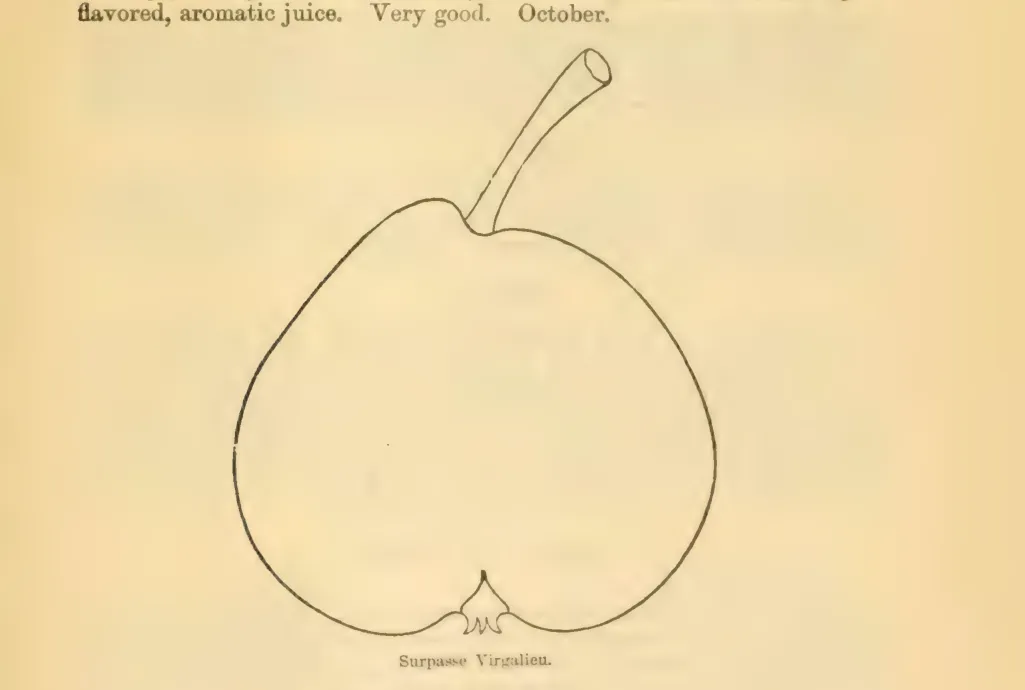
Surpasse Virgalieu
Origin / History
Origin unknown. First sent out under this name from the nursery of the late Andrew Parmentier of Brooklyn, N. Y. Hedrick places the introduction about 1800. Elliott calls it "probably an American seedling." Downing calls it "perhaps, an unrecognized foreign Pear." Downing says Parmentier named it in allusion to its surpassing the favorite Virgalieu (White Doyenne) of New York, and calls Surpasse Virgalieu a "very delicious fruit." Hedrick cites Downing, Fr. Trees Am. 416, fig. 189, 1845, and Leroy, Dict. Pom. 2:868, fig., 1869.
Tree
Vigorous, healthy, of upright growth, with yellowish brown wood. A regular, abundant bearer on either Pear or Quince (Elliott).
Fruit
Size: Medium to rather large; Downing gives rather large.
Form: Obovate to roundish, sometimes roundish obovate, and varying in form. Elliott illustrates the variation with drawings made from specimens he pulled himself from the same branch.
Stem: Varying, medium to rather more than an inch long (Downing).
Cavity: Moderate, oblique, rather higher on one side; the stalk not deeply planted.
Calyx: Generally small to rather small. Erect and open (Elliott); pretty firm (Downing).
Basin: Slight, small, smooth.
Skin: Smooth, pale lemon yellow to yellowish, sometimes or rarely with a little faint red on the sunny side. Elliott gives brownish red in the sun, often with sprinklings of russet.
Dots: Few to very few, minute.
Flesh and flavor: White, exceedingly fine-grained, buttery, melting (Thomas), juicy. The juice is abundant, delicious, high-flavored and aromatic; Hedrick says it differs from that of the Doyenné. Downing rates it "Very good," Thomas "excellent," and Hedrick "first."
Core and seeds: Core medium. Seeds broad, ovate (Elliott).
Season
October.
Uses
Not described in source.
Subtypes / Variants
Not described in source.
Other
Not described in source.
Book Sources
Described in 4 period pomological works
Nursery Catalog Sources
Found in 1 catalog (1845) from Massachusetts
- Winship's Nursery (Brighton Nurseries , operated by the Winship family), Brighton (Boston) , Massachusetts — 1845 — listed as Surpasse Virgouleuse
View original book sources (4)
— F.R. Elliott, The Western Fruit Book (1865)Surpasse Virgalieu.
Beurre Van Mons, | Surpasse Vigilouse, | Colmar Van Mons, of some.
Origin uncertain, probably an American seedling, first disseminated by the late Andrew Parmentier, Brooklyn, N. Y. It is a regular abundant bearer on Pear or Quince, a vigorous, healthy tree, with yellowish brown wood, upright growth.
Fruit, medium, varying in form; (see our drawings, the specimens from which they were made all being pulled by ourself from the same branch;) color, yellowish, with brownish red in sun, minute dots, and often sprinklings of russet; calyx, generally small, erect, open; basin, slight; stem, varying; core, medium; seeds, broad, ovate; flesh, white, fine-grained, juicy, aromatic. October.
— A.J. Downing, The Fruits and Fruit Trees of America (1900)Surpasse Virgalieu.
Surpasse Virgouleuse. Colmar Van Mons, erroneously.
The precise origin of this very delicious fruit is not known. It was first sent out from the nursery of the late Mr. Andrew Parmentier, of Brooklyn, under this name, and is, perhaps, an unrecognized foreign Pear, so named by him in allusion to its surpassing the favorite Virgalieu (White Doyenne) of New York.
Fruit rather large, roundish, sometimes roundish obovate. Skin smooth, pale lemon yellow, with a very few minute dots, and rarely a little faint red on the sunny side. Stalk rather more than an inch long, not deeply planted in a cavity rather higher on one side. Calyx rather small, and pretty firm, set in a slight, smooth basin. Flesh white, exceedingly fine-grained and buttery, abounding with delicious, high-flavored, aromatic juice. Very good. October.
— John J. Thomas, The American Fruit Culturist (1903)Surpasse Virgalieu. Medium obovate, sometimes roundish-obovate; pale yellow, dots few, minute; sometimes faintly reddened to the sun; stalk medium; cavity moderate, oblique; basin small; flesh white, fine-grained, buttery, melting, high-flavored, excellent.
— U.P. Hedrick, The Pears of New York (1921)Surpasse Virgalieu.
- Downing Fr. Trees Am. 416, fig. 189. 1845.
- Leroy Diet. Pom. 2:868, fig. 1869.
The origin of this variety is unknown. Andrew Parmentier introduced it from his nursery at Brooklyn under this name about 1800. Fruit rather large, obovate; skin smooth, pale lemon-yellow with a very few minute dots and rarely a little faint red on the sunny side; flesh white, exceedingly fine-grained and buttery, abounding with delicious highly flavored, aromatic juice, differing from that of the Doyenné; first; Oct.