Léon Leclerc (Van Mons)
Pear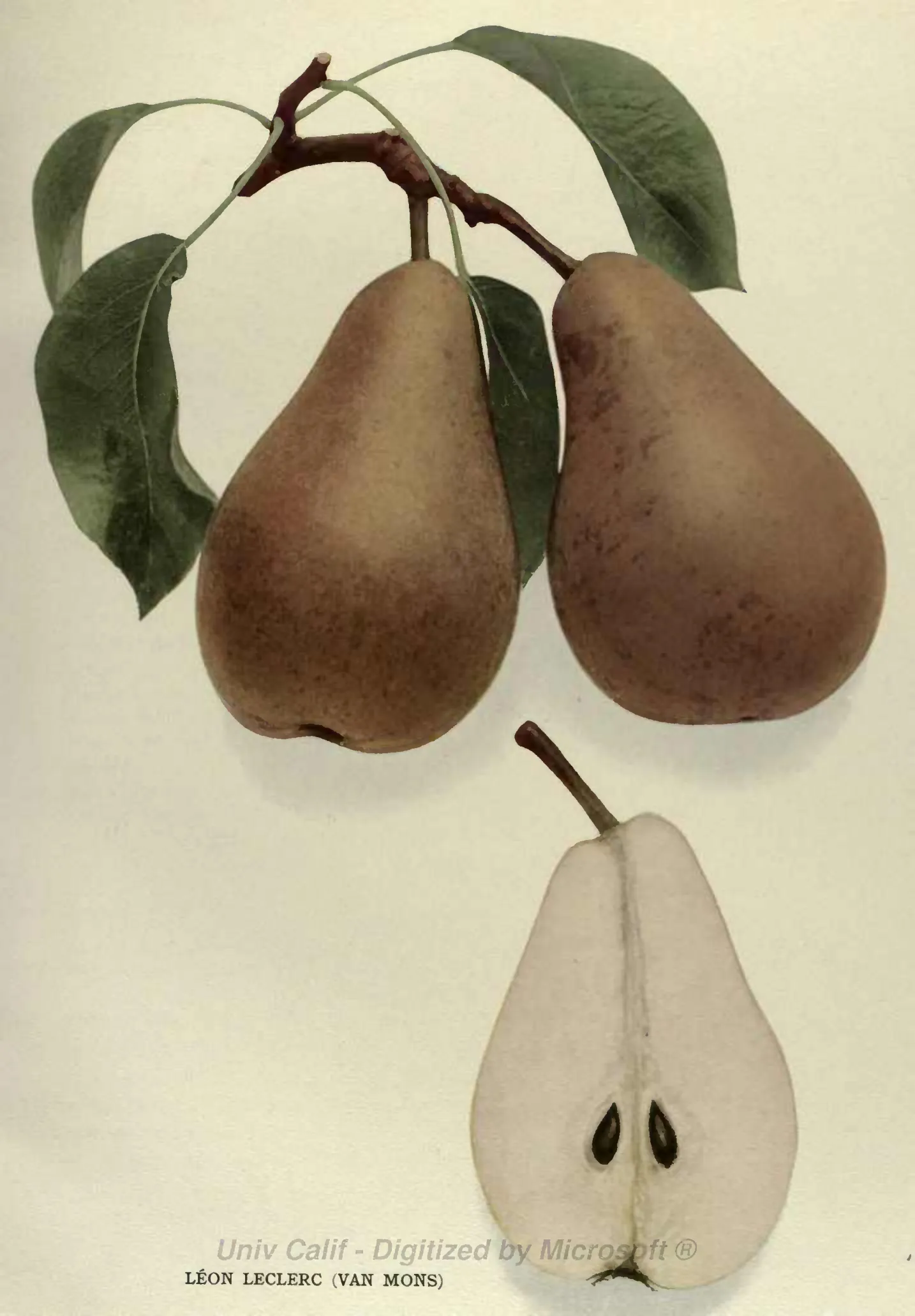
Léon Leclerc (Van Mons)
Origin / History
Obtained by M. Léon Leclerc, a distinguished pomologist living at Laval, France, about 1825; first fruited in 1828. He dedicated it to his friend Van Mons and, desiring to couple his own name with his friend's, called it Van Mons Léon Leclerc, the name by which most authors have known it. Identity has been much confused, because Van Mons raised a pear in 1816 which he dedicated to Léon Leclerc. The proper name of that pear is Léon Leclerc de Laval. There is also a Léon Leclerc de Louvain. Léon Leclerc (Van Mons) was fruited in America before 1843 by Marshall P. Wilder. The American Pomological Society added it to its fruit catalog in 1862 and dropped it in 1869.
A century ago this pear was heralded in Europe as the best of all pears, and shortly afterward was introduced into the United States with highest praise. Hedrick writes that it is still popular in Europe but that its reputation there is not sustained in America. It deserves a place among major varieties only because it fills a niche in the pear season, the crop coming between late fall and early winter at a time when there are few other good varieties. Hedrick holds that, were it not for one serious fault, it might take high rank in America. The fault is great susceptibility to the scab fungus; after Flemish Beauty, no other variety suffers as much both in fruit and foliage.
Tree
Tree medium in size, vigorous, spreading, open-topped, productive; slow-growing (Cyclopedia of Hardy Fruits). Trunk shaggy. Branches roughish, reddish-brown, overspread with heavy, dull scarf-skin, with conspicuous, numerous, large lenticels. Branchlets very slender and curved, short, with short internodes, light brown streaked with gray and tinged with green, dull, smooth, glabrous, with numerous small, conspicuous, raised lenticels.
Leaf-buds very small, short, pointed, appressed. Leaves leathery; apex taper-pointed; margin glandless, entire; petiole glabrous, reddish-green. Leaves 1⅜ in. long, ¾ in. wide, petiole 1½ in. long (Pears of New York); leaves 3¼ in. long, 1½ in. wide, petiole 1¾ in. long (Cyclopedia). Flower-buds small, short, conical, plump, free, borne singly on short spurs. Flowers showy, 1¼ in. across, in dense racemes (Cyclopedia: dense clusters, nearly a raceme), 7 or 8 buds in a cluster; pedicels ⅞ in. long, pubescent.
No remarkable characters in the trees to recommend them, although quite up to the average in all characters on either pear or quince stock. Said to prefer a rich, deep soil. Very susceptible to scab in fruit and foliage.
Fruit
Size: Large; 3⅛ in. long, 2½ in. wide (Pears of New York); 2¾ in. long, 3½ in. wide (Cyclopedia). Well grown in a congenial environment, on standard or quince stock, often as large as Duchesse d'Angoulême.
Form: Oblong-pyriform, tapering to a very long, narrow neck; compares rather closely in shape with Duchesse d'Angoulême.
Stem: Thick, curved; 1 in. long (Pears of New York), ¾ in. long (Cyclopedia).
Cavity: Very small, compressed, usually lipped.
Calyx: Large, open; lobes separated at the base, broad, acute; calyx-tube short, narrow, conical.
Basin: Shallow, narrow, obtuse, symmetrical.
Skin: Thick, tough, roughened by russet specks. Color dull yellow, covered with dots and tracings of russet and occasionally with a faint russet-red blush. On well-grown specimens the color is rich and beautiful.
Dots: Numerous, small, russet, conspicuous.
Flesh and flavor: Granular under the skin, nearly melting, juicy; subacid or with a peculiar sprightliness. Flavor sprightly and refreshing, which, with good flesh characters, gives the variety high rank for quality (Hedrick). Quality "good."
Core and seeds: Core large, closed, with clasping core-lines. Seeds large, wide, long, acute.
Season
Ripe in late September and October; the crop comes in season between late fall and early winter.
Uses
Suitable only for collections (Hedrick).
Subtypes / Variants
Not described in source.
Other
Not described in source.
Book Sources
Described in 2 period pomological works
- Hedrick, The Pears of New York (1921)
- Hedrick, Cyclopedia of Hardy Fruits (1922) — listed as LÉON LECLERC
Nursery Catalog Sources
Found in 1 catalog (1900)
- Central Experimental Farm , Dominion Department of Agriculture, Agassiz, British Columbia (under test; Bulletin No. 3, Second Series) — 1900 — listed as Léon Leclerc
View original book sources (2)
— U.P. Hedrick, The Pears of New York (1921)LÉON LECLERC (VAN MONS)
- Mass. Hort. Soc. Rpt. 3. 1843. 2. Downing Fr. Trees Am. 419, fig. 192. 1845. 3. Hovey Fr. Am. 1:9, Pl. 1851. 4. Ann. Pom. Belge 5:51, Pl. 1857. 5. Am. Pom. Soc. Rpt. 70. 1862. 6. Pom. France 1: No. 29, Pl. 29. 1863. 7. Jour. Hort. N. S. 10:366. 1866. 8. Mas Le Verger 3: Pt. 1, 127, fig. 62. 1866-73. 9. Leroy Dict. Pom. 2:722, fig. 1869. 10. Jour. Hort. 3rd Ser. 1:573, fig. 103. 1880. 11. Cat. Cong. Pom. France 361, fig. 1906.
Van Mons Butterbirne. 12. Lauche Deut. Pom. II: No. 65, Pl. 65. 1883. 13. Mathieu Nom. Pom. 292. 1889.
A century ago this pear was being heralded in Europe as the best of all pears, and shortly afterward was introduced into the United States with highest praise. The variety is still popular in Europe, but its reputation there is not sustained here. The pear deserves a place among major varieties only because it fills a particular niche in the pear season, the crop coming in season between late fall and early winter at a time when there are few other good varieties. Were it not for one serious fault, however, the variety might take high rank in America. The fault is great susceptibility to the scab fungus. After Flemish Beauty, no other variety suffers as much both in fruit and foliage. Well grown in a congenial environment, on standard or quince stock, the pears are often as large as those of Duchesse d'Angoulême, with which they compare rather closely in shape. On well-grown specimens, also, the color is rich and beautiful. The flavor is sprightly and refreshing, which, with good flesh-characters, give the variety high rank for quality. There are no remarkable characters in the trees to recommend them, although they are quite up to the average in all characters either on pear or quince stocks. They are said to prefer a rich, deep soil. The variety is suitable only for collections.
This pear was obtained by M. Léon Leclerc, a distinguished pomologist living at Laval, France, who dedicated it to his friend Van Mons. Desiring to couple his own name with that of his friend, he gave it the name of Van Mons Léon Leclerc, by which appellation it has been known by most authors. The variety first fruited in 1828. There has been a good deal of confusion as to the identity of this pear, owing to the fact that Van Mons raised a pear in 1816 which he dedicated to Léon Leclerc. The proper name of the latter pear is Léon Leclerc de Laval. There is also a Léon Leclerc de Louvain. The variety under discussion was fruited in this country previous to 1843 by Marshall P. Wilder. The American Pomological Society added the variety to its fruit-catalog in 1862 but dropped it in 1869.
Tree medium in size, vigorous, spreading, open-topped, productive; trunk shaggy; branches roughish, reddish-brown, overspread with heavy, dull scarf-skin, with conspicuous, numerous, large lenticels; branchlets very slender and curved, short, with short internodes, light brown streaked with gray and tinged with green, dull, smooth, glabrous, with numerous small, conspicuous, raised lenticels.
Leaf-buds very small, short, pointed, appressed. Leaves 1⅜ in. long, ¾ in. wide, leathery; apex taper-pointed; margin glandless, entire; petiole 1½ in. long, glabrous, reddish-green. Flower-buds small, short, conical, plump, free, singly on short spurs; flowers showy, 1¼ in. across, in dense racemes, 7 or 8 buds in a cluster; pedicels ⅞ in. long, pubescent.
Fruit ripe in late September and October; large, 3⅛ in. long, 2½ in. wide, oblong-pyriform, tapering to a very long, narrow neck; stem 1 in. long, thick, curved; cavity very small, compressed, usually lipped; calyx large, open; lobes separated at the base, broad, acute; basin shallow, narrow, obtuse, symmetrical; skin thick, tough, roughened by russet specks; color dull yellow, covered with dots and tracings of russet and occasionally with a faint russet-red blush; dots numerous, small, russet, conspicuous; flesh granular under the skin, nearly melting, juicy, subacid or with a peculiar sprightliness; quality good. Core large, closed, with clasping core-lines; calyx-tube short, narrow, conical; seeds large, wide, long, acute.
— U.P. Hedrick, Cyclopedia of Hardy Fruits (1922)LÉON LECLERC. This variety is popular in Europe, but its reputation there is not sustained here, although it fills a particular niche in the pear season, the crop coming in season between late fall and early winter at a time when there are few other good varieties. Were it not for a serious fault, the variety might take high rank in America. After Flemish Beauty, no other variety suffers as much in fruit and foliage from scab. Well grown in a congenial environment, the pears are often as large as those of Duchesse d'Angouleme, with which they compare closely in shape. On well-grown specimens, also, the color is rich and beautiful. The flavor is sprightly and refreshing, which, with good flesh characters, give the variety high rank for quality. There are no remarkable characters in the trees to recommend them. The variety is suitable only for collections. This pear originated with Léon Leclerc, Laval, France, about 1825.
Tree medium in size, vigorous, spreading, open-topped, slow-growing, productive; trunk shaggy; branches roughish, reddish-brown, with numerous large lenticels. Leaves 3¼ inches long, 1½ inches wide, leathery; apex taper-pointed; margin glandless, entire; petiole 1¾ inches long, glabrous, reddish-green. Flowers showy, 1¼ inches across, in dense clusters, nearly a raceme, 7 or 8 buds in a cluster. Fruit ripens in late September and October; large, 2¾ inches long, 3½ inches wide, oblong-pyriform, tapering to a very long, narrow neck; stem ¾ inch long, thick, curved; cavity very small, compressed, usually lipped; calyx large, open; lobes separated at the base, broad, acute; basin shallow, narrow, obtuse, symmetrical; skin thick, tough, roughened by russet specks; color dull yellow, covered with dots and tracings of russet and occasionally with a faint russet-red blush; dots numerous, small, russet, conspicuous; flesh granular under the skin, nearly melting, juicy, subacid or with a peculiar sprightliness; quality good; core large, closed, with clasping core-lines; calyx-tube short, narrow, conical; seeds large, wide, long, acute.