Doyenne D'Ete
Pear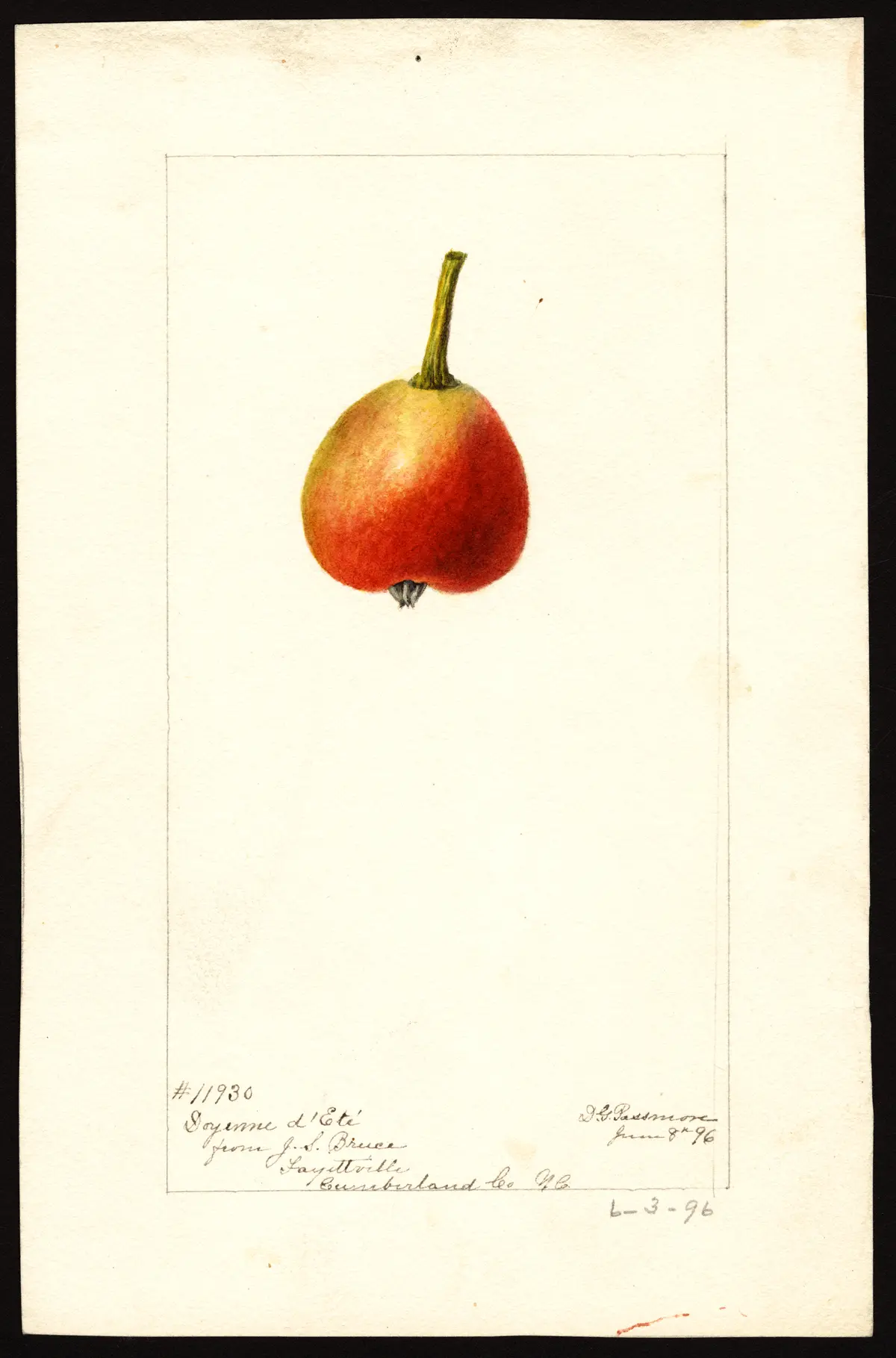
USDA Pomological Watercolor Collection
Doyenne D'Ete
Origin / History
Doyenne D'Ete is a French pear of relatively recent introduction to American collections at the time of Hovey's writing (1852). Its cultivation in France was largely confined to the vicinity of Nantes, where it was raised abundantly and esteemed as one of the best early pears. According to the Bon Jardinier, it was first introduced to Paris by M. Noisette in 1830, but it does not appear in the latest Catalogue of the London Horticultural Society (1842), suggesting it had not yet become generally known to cultivators at that date. It was first brought to the notice of American pomologists by Mr. Kenrick, who published a description from M. Poiteau's work (Théorie Van Mons, noted in the Magazine of Horticulture, vol. xiii, p. 66) as early as 1836. The variety does not appear to have been practically introduced to American collections until 1843, when Hovey received trees from Paris; these grew rapidly and came into bearing in 1845. After three years of bearing, Hovey judged Doyenne D'Ete deserving a rank among the best early varieties.
Tree
Vigorous, with an erect and upright habit, branching regularly. Annual shoots moderately stout and slightly curved at the ends.
Wood: Clear olive yellow, with pale brown specks, and rather short-jointed. Old wood grayish olive. Buds medium size, shortly pointed, and slightly diverging. Flower-buds medium size, ovate.
Leaves: Medium size, oblong-ovate, narrow, tapering much to the point, little recurved on the midrib, partially drooping, and regularly but not very deeply serrated. Petioles long, about one and a half inches in length, and rather slender.
Flowers: Medium size; petals thick, obovate, and cupped.
Bearing habit: Hovey describes the tree as a most abundant as well as an early bearer, succeeding finely upon the quince and coming into fruit on young trees only two years from the bud. The Central Experimental Farm (Agassiz, BC, planted spring 1890) records it as a strong grower but only moderately productive. Veitch (1911) calls it very productive.
Fruit
Size: Hovey describes the fruit as medium size, about two inches long and two inches in diameter. The Central Experimental Farm describes it as small. Veitch describes it as medium.
Form: Roundish-turbinate, largest in the middle, tapering roundly to the stem where it is obtuse (Hovey). The Central Experimental Farm describes it as roundish, pyriform.
Stem: Rather long, about one and a quarter inches, moderately stout, yellowish brown, slightly fleshy at the base, and obliquely inserted without any cavity, under a slight projection.
Cavity: None; stem inserted under a slight projection without a cavity.
Calyx / Eye: Eye small, closed, and inserted in a very shallow basin. Segments of the calyx short, stiff, and projecting.
Basin: Very shallow.
Skin: Hovey describes the skin as fair, smooth, pale yellowish green, becoming nearly yellow when mature, broadly shaded and marbled with brilliant red on the sunny side, and dotted with greenish russet specks. The Central Experimental Farm describes it as smooth, pale yellowish white, and sprinkled with gray dots — no red cheek is mentioned. The brilliant red cheek is cited by Hovey as one of the variety's distinguishing merits over other early pears: "the fruit… has the merit of being far more beautiful, having a fair yellow skin, with a brilliant red cheek."
Flesh: Yellowish white, a little coarse, melting, buttery, and juicy (Hovey). The Central Experimental Farm describes the flesh as white, melting, juicy, sweet, and of pleasant flavour. Hovey adds that fruit taken from the tree at the proper time will ripen off in the house and possess a flesh as melting as the White Doyenné.
Flavor: Rich, sugary, sprightly, pleasantly perfumed, and excellent (Hovey). Sweet and of pleasant flavour (Central Experimental Farm). Excellent in flavour (Veitch).
Core: Medium size.
Seeds: Small, flattened, dark brown.
Season
Hovey gives the ripening season as the end of July and the beginning of August. The Central Experimental Farm records it as ripening in July. Veitch gives September — a notable conflict with the other two sources, which agree on a July to early-August season.
Hovey notes that care is necessary in gathering the fruit: to have it in the best condition, it should be picked just as it changes from green to yellow. If gathered too soon, it will not have attained its rich flavor; if gathered too late, the flavor will have been lost. Properly timed, the fruit will ripen off satisfactorily in the house.
Uses
Dessert. Hovey judges it deserving a place in every good collection, rating it equal in quality to the Madeleine and superior in appearance. The specimens were described as uniformly fair.
Subtypes / Variants
Not described in source.
Book Sources
Described in 1 period pomological work
Nursery Catalog Sources
Found in 1 catalog (1900)
- Central Experimental Farm , Dominion Department of Agriculture, Agassiz, British Columbia (under test; Bulletin No. 3, Second Series) — 1900
View original book sources (3)
— C.M. Hovey, The Fruits of America (1852)THE DOYENNÉ D'ÉTÉ PEAR.
Doyenné d'Été. Théorie Van Mons, (Mag. of Hort., vol. xiii. p. 66.) Doyenné de Juillet, Thompson, in Gard. Chronicle, 1847. Summer Doyenné, Fruits and Fruit Trees of America.
The number of really good early pears is so exceedingly limited, that every addition to the list is viewed with great interest by the zealous cultivator. The early pears generally cultivated, with few exceptions, are small and inferior-flavored, and, indeed, scarcely worth growing, — certainly not by amateur cultivators for their own use. It is, therefore, with no little gratification that we introduce to greater notice the Doyenné d'Été, a variety of recent introduction to American collections, and, as yet, but little disseminated. In France, it is a tolerably well-known pear, but its cultivation seems to have been confined to the vicinity of Nantes, where it is raised abundantly, and is esteemed as one of the best early pears. It ripens fully as early as the Madeleine; and the fruit, which is equal in quality to that old variety, has the merit of being far more beautiful, having a fair yellow skin, with a brilliant red cheek. All its qualities considered, it must claim a place in every good collection.
The Doyenné d'Été was first brought to the notice of American pomologists by Mr. Kenrick, who published a description of the pear from M. Poiteau's work, entitled Théorie Van Mons, as long ago as 1836. It does not, however, appear to have been introduced until 1843, at which period we received trees from Paris, which grew rapidly, and, in 1845, came into bearing. It is stated, in the Bon Jardinier, that it was first introduced to Paris by M. Noisette, in 1830; but, as it is not enumerated in the latest Catalogue of the London Horticultural Society, (1842,) we apprehend it had not become generally known to cultivators.
After the experience of three years, we consider the Doyenné d'Été as deserving a rank among the best early varieties. The tree is a vigorous and healthy grower, a most abundant as well as an early bearer, and it succeeds finely upon the quince, coming into fruit, on young trees, only two years from the bud. The specimens have also been uniformly fair. Like most summer pears, some care is necessary in gathering the fruit; to have it in the best condition, it should be picked just as it changes from green to yellow; if gathered too soon, it will not have attained its rich flavor, — and, if too late, it will have lost it. But if taken from the tree at the proper time, it will ripen off in the house, and possess a flesh as melting as the White Doyenné.
Tree. — Vigorous, with an erect and upright habit, branching regularly; annual shoots moderately stout, and slightly curved at the ends.
Wood. — Clear olive yellow, with pale brown specks, and rather short-jointed; old wood grayish olive; buds medium size, shortly pointed, and slightly diverging: Flower-buds medium size, ovate.
Leaves. — Medium size, oblong-ovate, narrow, tapering much to the point, little recurved on the midrib, partially drooping, and regularly but not very deeply serrated; petioles long, about one and a half inches in length, and rather slender.
Flowers. — Medium size; petals thick, obovate, and cupped.
Fruit. — Medium size, about two inches long, and two inches in diameter: Form, roundish-turbinate, largest in the middle, tapering roundly to the stem, where it is obtuse: Skin, fair, smooth, pale yellowish green, becoming nearly yellow when mature, broadly shaded and marbled with brilliant red on the sunny side, and dotted with greenish russet specks: Stem, rather long, about one and a quarter inches, moderately stout, yellowish brown, slightly fleshy at the base, and obliquely inserted, without any cavity, under a slight projection: Eye, small, closed, and inserted in a very shallow basin; segments of the calyx short, stiff, projecting: Flesh, yellowish white, little coarse, melting, buttery and juicy: Flavor, rich, sugary, sprightly, pleasantly perfumed, and excellent: Core, medium size: Seeds, small, flattened, dark brown.
Ripe the end of July and beginning of August.
[Additional entry in this volume: "THE DOYENNE D'ETE PEAR", pp. 141–142]
THE DOYENNE D'ETE PEAR.
Doyenné d'Eté. Théorie Van Mons, (Mag. of Hort., vol. xiii. p. 66.) Doyenné de Juillet, Thompson, in Gard. Chronicle, 1847. Summer Doyenné, Fruits and Fruit Trees of America,
The number of really good early pears is so exceedingly limited, that every addition to the list is viewed with great interest by the zealous cultivator. The early pears generally cultivated, with few exceptions, are small and inferior-flavored, and, indeed, scarcely worth growing,—certainly not by amateur cultivators for their own use. It is, therefore, with no little gratification that we introduce to greater notice the Doyenné d'Eté, a variety of recent introduction to American collections, and, as yet, but little disseminated. In France, it is a tolerably well-known pear, but its cultivation seems to have been confined to the vicinity of Nantes, where it is raised abundantly, and is esteemed as one of the best early pears. It ripens fully as early as the Madeleine; and the fruit, which is equal in quality to that old variety, has the merit of being far more beautiful, having a fair yellow skin, with a brilliant red cheek. All its qualities considered, it must claim a place in every good collection.
The Doyenné d'Eté was first brought to the notice of American pomologists by Mr. Kenrick, who published a description of the pear from M. Poiteau's work, entitled Théorie Van Mons, as long ago as 1836. It does not, however, appear to have been introduced until 1843, at which period we received trees from Paris, which grew rapidly, and, in 1845, came into bearing. It is stated, in the Bon Jardinier, that it was first introduced to Paris by M. Noisette, in 1830; but, as it is not enumerated in the latest Catalogue of the London Horticultural Society, (1842,) we apprehend it had not become generally known to cultivators.
After the experience of three years, we consider the Doyenné d'Eté as deserving a rank among the best early varieties. The tree is a vigorous and healthy grower, a most abundant as well as an early bearer, and it succeeds finely upon the quince, coming into fruit, on young trees, only two years from the bud. The specimens have also been uniformly fair. Like most summer pears, some care is necessary in gathering the fruit; to have it in the best condition, it should be picked just as it changes from green to yellow; if gathered too soon, it will not have attained its rich flavor,—and, if too late, it will have lost it. But if taken from the tree at the proper time, it will ripen off in the house, and possess a flesh as melting as the White Doyenné.
Tree.—Vigorous, with an erect and upright habit, branching regularly; annual shoots moderately stout, and slightly curved at the ends.
Wood.—Clear olive yellow, with pale brown specks, and rather short-jointed; old wood grayish olive; buds medium size, shortly pointed, and slightly diverging: Flower-buds medium size, ovate.
Leaves.—Medium size, oblong-ovate, narrow, tapering much to the point, little recurved on the midrib, partially drooping, and regularly but not very deeply serrated; petioles long, about one and a half inches in length, and rather slender.
Flowers.—Medium size; petals thick, obovate, and cupped.
Fruit.—Medium size, about two inches long, and two inches in diameter: Form, roundish-turbinate, largest in the middle, tapering roundly to the stem, where it is obtuse: Skin, fair, smooth, pale yellowish green, becoming nearly yellow when mature, broadly shaded and marbled with brilliant red on the sunny side, and dotted with greenish russet specks: Stem, rather long, about one and a quarter inches, moderately stout, yellowish brown, slightly fleshy at the base, and obliquely inserted, without any cavity, under a slight projection: Eye, small, closed, and inserted in a very shallow basin; segments of the calyx short, stiff, projecting: Flesh, yellowish white, little coarse, melting, buttery and juicy: Flavor, rich, sugary, sprightly, pleasantly perfumed, and excellent: Core, medium size: Seeds, small, flattened, dark brown.
Ripe the end of July and beginning of August.
— Central Experimental Farm, Central Experimental Farm, Agassiz BC — Catalogue of Fruit Trees under Test (Bulletin No. 3, 1900) (1900)Planted Spring 1890. Tree a strong grower but only moderately productive. Fruit small, roundish, pyriform. Skin smooth pale yellowish white, and sprinkled with gray dots. Flesh white, melting, juicy, sweet and of pleasant flavour. Season July.
— James Veitch & Sons, Veitch's Fruit Trees (1911) (1911)medium, melting, juicy, sweet pear. Excellent in flavour. Very productive Sept.