Madeleine
Pear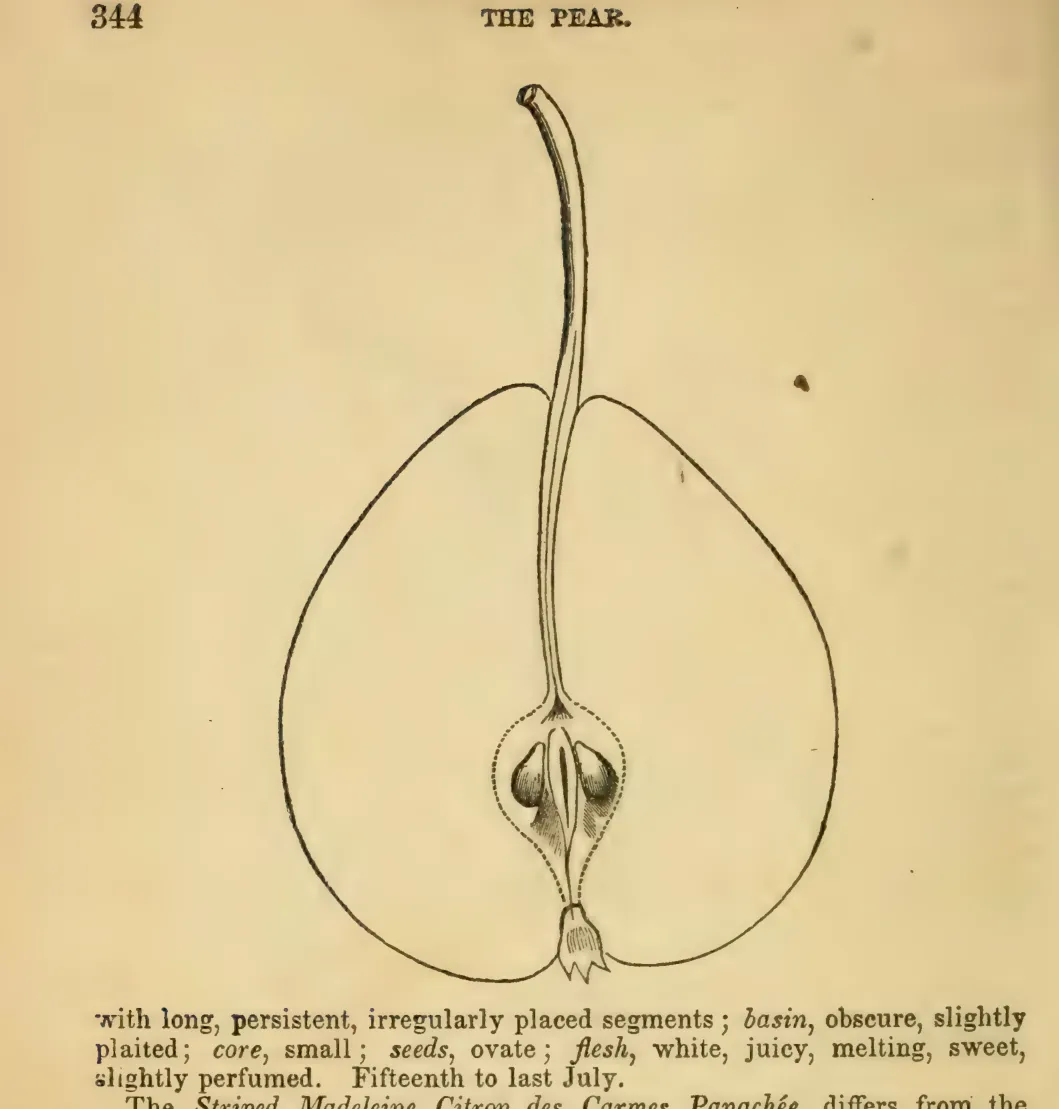
Madeleine
Origin / History
Of ancient and somewhat uncertain origin. Hedrick records that it was cultivated by M. Le Lectier in his garden at Orleans in 1628, and that previously no other author had made mention of it. He adds that M. Leroy, writing in 1867, deemed it presumable that it had originated in France. Elliott calls it "Foreign"; Thomas gives France. Hedrick's earliest bibliographic citation is Duhamel, Trait. Arb. Fr., 1768.
Downing explains both principal names. Madeleine comes from its being in perfection, in France, at the feast of Ste. Madeleine. Citron des Carmes comes from its being first cultivated by the Carmelite monks. Hedrick records that besides its original names the pear has been known by some fifty others in different localities and at different times. He says Madeleine is now its recognized name in America, while in England it is known as the Citron des Carmes; Bunyard describes it under that name. Coxe (1817) writes that "this pear Mr. Prince calls the early Chaumontel."
Hedrick says it is not clear when or by whom it was introduced to America. It was a standard variety as early as 1831, when Prince first described it. At the national convention of fruit-growers in 1848 it was recommended for general cultivation, and it has appeared in the fruit-catalog of the American Pomological Society ever since.
Coxe calls it "a very fine early fruit" and "one of the finest fruits of the season." Downing calls it "one of the most refreshing and excellent of the early Pears." Hedrick says Madeleine "has long been a dependable summer variety," and that many consider it the best very early summer pear. He adds: "if the product alone were to be considered it might well be called the best, but, unfortunately, the faults of the trees more than offset the virtues of the fruits." He judges the pears "attractive in appearance, and very good in quality." He nonetheless considers the variety worth planting only for the sake of succession in crop, and in large collections of pears. Bunyard says it is often met with in old orchards, where it makes a good standard.
Tree
Tree large, vigorous to very vigorous, a strong grower, upright, open-topped, productive (Hedrick, Elliott). Bunyard alone gives growth as rather small.
Trunk shaggy. Branches zigzag, light greenish-brown, covered with gray scarf-skin (Hedrick). Downing gives the branches as long, erect, and olive-colored; Thomas gives the shoots as straight, erect, and greenish. Branchlets slender, long, reddish-brown mingled with green, mottled with ash-gray near the tips, smooth, glabrous, with small, raised, conspicuous lenticels. Leaf-buds small, very short, pointed, appressed (Hedrick).
Leaves 3 in. long, 1½ in. wide, thin; apex taper-pointed; margin glandless, finely serrate; petiole 1⅝ in. long, glabrous, reddish-green (Hedrick). Thomas and Bunyard both give the leaves as flat. Bunyard also calls them oval pointed and down held, and coarsely serrate, against Hedrick's finely serrate.
Flower-buds small, thick, short, conical, plump, free, distributed as lateral buds or on very short spurs. Flowers showy, 1⅛ in. across, in dense clusters, averaging 11 buds to a cluster; pedicels 1¼ in. long, slightly pubescent (Hedrick).
Fruitful, with fertility good, and very productive on pear or quince root (Elliott). Hedrick says the trees do not hold their crop well, are tender to cold, and are short-lived.
Not resistant to blight (Hedrick); rather liable to blight (Thomas). Elliott says it is a little liable to frozen sap-blight on the rich Western soils until it has acquired the age of ten or more years.
Fruit
Size: Small to medium. Most authors place it at below medium to medium. Hedrick calls it "inferior in size," 2½ in. long by 2 in. wide. Bunyard gives small, 2 by 1⅞ in. Coxe says it is small, "not much larger than the Hativean." Budd and Hansen give medium to small.
Form: Obovate pyriform, slightly pyriform; oblong pyriform (Elliott), conic-obovate (Thomas), roundish-obtuse-pyriform (Hedrick). Bunyard alone calls it round conical, even.
Stem: Long, 1⅛ in. to nearly 2 in., most authors giving about an inch and a half. Downing says it is often nearly two inches. Hedrick gives 1⅛ in. and Bunyard 1¼ in. The stem is set on the side of a small swelling, the fruit a little enlarged on one side at its base (Downing, Elliott). Most authors call it slender; Hedrick calls it thick and curved, and Bunyard stout, obliquely inserted level.
Cavity: Very narrow and small (Thomas); very shallow and narrow, or lacking, with the flesh folded in a lip on one side of the stem (Hedrick).
Calyx: Small (Downing). Elliott gives long, persistent, irregularly placed segments; Hedrick gives the lobes as short, narrow, acuminate, separated at the base. Hedrick calls the calyx partly open; Bunyard calls the eye wide open, on the level. Calyx-tube short, wide, conical (Hedrick).
Basin: Shallow to very shallow, or obscure (Elliott), narrow, obtuse, gently furrowed or slightly plaited, symmetrical.
Skin: Thin, smooth, very tender. Green, from pale yellowish green to dull green (Hedrick) or pea green (Bunyard).
A faint or little brownish blush appears rarely or occasionally, chiefly on fruits most exposed to the sun. Hedrick calls the blush dotted, and Bunyard calls it a slight brown-red flush. Against Thomas's "rarely," Budd and Hansen say the fruit is often brownish where exposed. Russet specks occur around the stalk (Downing, very rarely) or on fruits most exposed to the sun (Elliott). Attractive in appearance (Hedrick).
Dots: Numerous, greenish, obscure (Hedrick).
Flesh and flavor: White, greenish white (Bunyard), or slightly tinged yellow (Hedrick). Juicy to very juicy, tender and melting; buttery (Coxe); granular at the center (Hedrick).
Flavor sweet, delicate, slightly perfumed; vinous (Hedrick). Coxe calls it "highly flavoured," the taste, "when not too ripe, sugary." Thomas gives the flesh as usually faintly acid, with "an agreeable, delicate, fine, refreshing flavor"; Budd and Hansen call it slightly acid, with "delicate rich flavor." Bunyard alone dissents: "a little sweet, no flavour."
Quality "good to very good" (Downing, Hedrick); "very good" (Budd and Hansen).
Core and seeds: Core small (Elliott), closed, with clasping core-lines (Hedrick). Seeds ovate (Elliott); wide, short, plump, acuminate (Hedrick).
Season
Very early summer, from the middle of July into early August. Most authors give the middle to the end of July, Elliott from the fifteenth. Thomas places it about midsummer, at the time of wheat harvest. Hedrick gives early August, the crop ripening just before that of Bloodgood.
The season is short, the skins are tender, and the flesh quickly softens at the core (Hedrick). Thomas says it needs house-ripening. Bunyard says it should be eaten before the green color changes.
Uses
Dessert (Bunyard). Hedrick records it as recommended on the Pacific slope for local markets.
Subtypes / Variants
Elliott describes the Striped Madeleine, Citron des Carmes Panachée. Its fruit is striped with light yellow, and its flesh is sweeter and less juicy than that of Madeleine. The tree is not as vigorous in growth. The wood is shorter jointed and striped red and yellow, and the tree is said to be less liable to blight.
Other
Bunyard calls it "rather similar to, but quite distinct from, the Chalk or Crawford Pear of Kent."
[NOTE: Source text may be incorrect — the Veitch (1911) catalog entry is telegraphic and partly garbled. "small, pale" agrees with the book sources, but "golden" and the season "to Feb." are incompatible with a July–August summer pear and may belong to a different variety.] The Veitch entry reads, verbatim:
small, pale, with a hint of red on stalk in golden, Fine fine Ult. to Feb.
Book Sources
Described in 8 period pomological works
- Elliott, The Western Fruit Book (1865)
- Hedrick, The Pears of New York (1921)
- Downing, Fruits and Fruit Trees of America (1900) — listed as Madeleine, or Citron des Carmes
- Budd & Hansen, Systematic Pomology (1914)
- Bunyard, A Handbook of Hardy Fruits (1920)
- Hedrick, Cyclopedia of Hardy Fruits (1922)
- Thomas, The American Fruit Culturist (1903)
- Coxe, A View of the Cultivation of Fruit Trees (1817) — listed as Madeleine, Citron de Carmes, Or Green Chissel
Nursery Catalog Sources
Found in 35 catalogs (1845–1917) from Alabama, California, England, Illinois, Massachusetts, Oregon, Washington
- Winship's Nursery (Brighton Nurseries , operated by the Winship family), Brighton (Boston) , Massachusetts — 1845 — listed as Citron de Carmes
- Hovey & Co. , Cambridge , Massachusetts — 1849 — listed as Citron des Carmes
- Azell Bowditch (Nursery / Fruit Catalog) , Boston , Massachusetts — 1850
- Joseph Breck & Co. , Boston , Massachusetts — 1855 — listed as Green Chissel
- Joseph Breck & Co. , Boston , Massachusetts — 1855 — listed as Madeline
- St. Helena Nursery , Howell Prairie, Marion County, OR (Marion Co., Ogn.) — 1864
- Felix Gillet , Barren Hill Nursery, Nevada City , California — 1884
- Fancher Creek Nursery , Fresno , California — 1886
- W.R. Strong & Co. , Capital and Orange Hill Nurseries (Robert Williamson, prop.), Sacramento , California — 1886
- Felix Gillet , Barren Hill Nursery, Nevada City , California — 1888
- Felix Gillet , Barren Hill Nursery, Nevada City , California — 1889
- Felix Gillet , Barren Hill Nursery, Nevada City , California — 1890
- Felix Gillet , Barren Hill Nursery, Nevada City , California — 1891
- The Vineland Nurseries (Kelsey & Co. , Proprietors), St. Joseph, Missouri (Office: 13th and Atchison Sts., 2 Blocks East of the Citizens St. Car Line) — 1894
- Multnomah Nurseries , Russellville , Oregon — 1894
- Woodburn Nurseries , Woodburn, Marion Co. , Oregon — 1894
- Felix Gillet , Barren Hill Nursery, Nevada City , California — 1895
- Felix Gillet , Barren Hill Nursery, Nevada City , California — 1897
- Central Experimental Farm , Dominion Department of Agriculture, Agassiz, British Columbia (under test; Bulletin No. 3, Second Series) — 1900
- Alabama Nursery Co. , Huntsville , Alabama — 1900
- Washington Nursery Co. , Toppenish , Washington — 1901
- Benjamin Buckman (personal inventory) , Farmingdale , Illinois — 1901
- Russellville Nursery Co. , Russellville, OR (three miles east of Portland, one mile from Montavilla car line) — 1903 — listed as Madeline
- Russellville Nursery Co. , Montavilla Station, Portland, OR (three miles east of Portland, one mile from Montavilla car line) — 1907
- Carlton Nursery Co. , Carlton , Oregon — 1909
- Washington Nursery Company , Toppenish , Washington — 1909
- Island Nurseries & Fruit Farm , Vashon (Vashon Island) , Washington — 1910
- James Veitch & Sons , Ltd., Royal Exotic Nursery, Chelsea, London (also Coombe Wood, Langley, and Feltham) , England — 1911
- Island Nurseries & Fruit Farm , Vashon (Vashon Island) , Washington — 1911
- Pacific Nursery Company , Portland , Oregon — 1912
- Washington Nursery Company , Toppenish , Washington — 1912
- Island Nurseries & Fruit Farm , Vashon (Vashon Island) , Washington — 1914
- Island Nurseries & Fruit Farm , Vashon (Vashon Island) , Washington — 1915
- Island Nurseries & Fruit Farm , Vashon (Vashon Island) , Washington — 1916
- Island Nurseries & Fruit Farm , Vashon (Vashon Island) , Washington — 1917
View original book sources (9)
— William Coxe, A View of the Cultivation of Fruit Trees (1817)
- MADELEINE, CITRON DE CARMES, OR GREEN CHISSEL.
This is a very fine early fruit—the size is small, not much larger than the Hativean—the skin green, the flesh juicy, buttery, and highly flavoured—the taste, when not too ripe, sugary. This pear Mr. Prince calls the early Chaumontel; it is one of the finest fruits of the season.
— F.R. Elliott, The Western Fruit Book (1865)MADELEINE.
Citron des Carmes, | Magdalen.
Foreign. Tree, very vigorous, strong grower, a little liable to frozen sap-blight on the rich Western soils, until it has acquired the age of ten or more years; very productive on pear or quince root.
Fruit, below medium, obovate, oblong pyriform: stem, long, slender, at base one side of fruit a little enlarged; color, pale yellowish green, a little brownish blush, and russet specks on those exposed most to sun; calyx, with long, persistent, irregularly placed segments; basin, obscure, slightly plaited; core, small; seeds, ovate; flesh, white, juicy, melting, sweet, slightly perfumed. Fifteenth to last July.
The Striped Madeleine Citron des Carmes Panachée, differs from the former in being striped with light yellow, flesh more sweet and less juicy. It is not as vigorous in growth, the wood shorter jointed, striped red and yellow, and said to be less liable to blight.
— A.J. Downing, The Fruits and Fruit Trees of America (1900)Madeleine, or Citron des Carmes.
Madeleine. Sainte-Madelaine. Citron des Carmes. Grüne Sommer Magdalena. Early Chaumontelle. Grüne Magdalena. Magdelen.
The Madeleine is one of the most refreshing and excellent of the early Pears. It takes its name from its being in perfection, in France, at the feast of Ste. Madeleine. Citron des Carmes comes from its being first cultivated by the Carmelite monks. The tree is fruitful and vigorous, with long, erect, olive-colored branches.
Fruit of medium size, obovate pyriform. Stalk long and slender, often nearly two inches, set on the side of a small swelling. Pale yellowish green (very rarely with a little brownish blush and russet specks around the stalk). Calyx small, in a very shallow furrowed basin. Flesh white, juicy, melting, with a sweet and delicate flavor, slightly perfumed. Good to very good. Middle and last of July.
— John J. Thomas, The American Fruit Culturist (1903)Madeleine.* (Citron des Carmes, Magdelen, Green Chisel, incorrectly.) Medium in size, slightly pyriform, conic-obovate; skin smooth, pale yellowish-green, rarely a faint brownish blush; stalk slender, an inch and a half long; cavity very narrow and small; basin shallow; flesh juicy and melting, usually faintly acid, with an agreeable, delicate, fine, refreshing flavor. Matures about midsummer, or at the time of wheat harvest. Needs house-ripening. Shoots straight, erect, greenish, growth vigorous; tree rather liable to blight. Leaves quite flat. Fig. 685. France.
— J.L. Budd & N.E. Hansen, American Horticultural Manual, Part II: Systematic Pomology (1914)Madeleine (Magdeleri). — Medium to small, obovate, slightly pyriform; color yellowish green, often with brownish shade where exposed; stalk one and one-half inches long, slender, inserted in very narrow small cavity; basin shallow. Flesh juicy, melting, slightly acid, with delicate rich flavor, very good. France.
— E.A. Bunyard, A Handbook of Hardy Fruits (1920)CITRON DES CARMES. Her. Pom. II., 44. (Madeleine.) Dessert, end July, small, 2 by 1⅞, round conical, even. Skin, smooth, thin. Colour, pea green with occasional slight brown red flush. Flesh, tender, greenish white, a little sweet, no flavour. Eye, wide open on level. Stem, stout, 1¼ inches, obliquely inserted level. Growth, rather small; fertility good. Leaf, oval pointed, flat, down held, coarsely serrate. This is often met with in old orchards where it makes a good standard. Rather similar to, but quite distinct from, the Chalk or Crawford Pear of Kent. It should be eaten before the green colour changes.
— U.P. Hedrick, The Pears of New York (1921)MADELEINE
- Duhamel Trait. Arb. Fr. 2:124, Pl. IV. 1768. 2. Pom. Mag. 2:51, Pl. 1829. 3. Prince Pom. Man. 1:13. 1831. 4. Downing Fr. Trees Am. 341, fig. 138. 1845. 5. Proc. Nat. Con. Fr. Gr. 51. 1848. 6. Elliott Fr. Book 331, fig. 1854. 7. Mas Le Verger 2:59, fig. 28. 1866-73. 8. Guide Prat. 62, 287. 1876.
Sainte Madelaine. 9. Knoop Pomologie 76, Tab. I, fig. 1771.
Grüne Sommer-Magdalene. 10. Dochnahl Führ. Obstkunde 2:150. 1856. 11. Lucas Tafelbirnen 47, fig. 1894.
Citron des Carmes. 12. Pom. France 3: No. 101, Pl. 101. 1865. 13. Leroy Dict. Pom. 1:563, fig. 1867. 14. Hogg Fruit Man. 548. 1884. 15. Cat. Cong. Pom. France 212, fig. 1906.
Grüne Magdalene. 16. Mathieu Nom. Pom. 228. 1889.
Madeleine has long been a dependable summer variety, the crop of which ripens just before that of Bloodgood. Many consider it the best very early summer pear, and if the product alone were to be considered it might well be called the best, but, unfortunately, the faults of the trees more than offset the virtues of the fruits. The pears are attractive in appearance, and very good in quality; but their season is short, their skins are tender, and the flesh quickly softens at the core. While the trees are productive, they are not resistant to blight, do not hold their crop well, are tender to cold, and are short-lived. The variety is worth planting only for the sake of succession in crop, and in large collections of pears. The variety is recommended on the Pacific slope for local markets.
The Madeleine pear is of ancient and somewhat uncertain origin. It was cultivated by M. Le Lectier in his garden at Orleans in 1628, but previously no other author had made mention of it, though M. Leroy, writing in 1867, deemed it presumable that it had originated in France. Besides its original names this pear has been known by some fifty others in different localities and at different times, but Madeleine is now its recognized name in this country. In England, it is known as the Citron des Carmes. When and by whom it was introduced to America is not clear, but it was a standard variety as early as 1831 when Prince first described it. At the national convention of fruit-growers held in 1848, Madeleine was recommended for general cultivation, and ever since this time the variety has appeared in the fruit-catalog of the American Pomological Society.
Tree large, vigorous, upright, open-topped, tender, productive; trunk shaggy; branches zigzag, light greenish-brown covered with gray scarf-skin; branchlets slender, long, reddish-brown mingled with green, mottled with ash-gray near the tips, smooth, glabrous, with small, raised, conspicuous lenticels.
Leaf-buds small, very short, pointed, appressed. Leaves 3 in. long, 1½ in. wide, thin; apex taper-pointed; margin glandless, finely serrate; petiole 1⅝ in. long, glabrous, reddish-green. Flower-buds small, thick, short, conical, plump, free, distributed as lateral buds or on very short spurs; flowers showy, 1⅛ in. across, in dense clusters, average 11 buds in a cluster; pedicels 1¼ in. long, slightly pubescent.
Fruit ripens in early August; inferior in size, 2½ in. long, 2 in. wide, roundish-obtuse-pyriform; stem 1⅛ in. long, thick, curved; cavity very shallow and narrow, or lacking, the flesh folded in a lip on one side of the stem; calyx partly open; lobes separated at the base, short, narrow, acuminate; basin shallow, narrow, obtuse, gently furrowed, symmetrical; skin thin, smooth, very tender; color dull green, occasionally with a faint, dotted, brownish blush; dots numerous, greenish, obscure; flesh slightly tinged yellow, granular at the center, tender and melting, very juicy, sweet, vinous; quality good to very good. Core closed, with clasping core-lines; calyx-tube short, wide, conical; seeds wide, short, plump, acuminate.
— U.P. Hedrick, Cyclopedia of Hardy Fruits (1922)MADELEINE. Madeleine has long been a dependable summer variety, the crop of which ripens just before that of Bloodgood. Many consider it the best very early summer pear. The fruits are attractive in appearance, and very good in quality; but their season is short, their skins are tender, and the flesh quickly softens at the core. While the trees are productive, they are not resistant to blight, do not hold their crop well, are tender to cold, and are short-lived. The variety is worth planting only for the sake of succession in crop, and in large collections of pears.
Madeleine was cultivated by Le Lectier in his garden at Orleans in 1628; no other author had made previous mention of it.
Tree large, vigorous, upright, open-topped, hardy, productive; trunk shaggy; branches zigzag, light greenish-brown. Leaves 3 inches long, 1¾ inches wide, thin; apex taper-pointed, margin glandless, finely serrate; petiole 1¾ inches long, glabrous, reddish-green. Flowers showy, 1¾ inches across, in dense clusters, average 5 buds in a cluster. Fruit ripens in early August; 2¾ inches long, 2¼ inches wide, roundish-obtuse-pyriform; stem 1¼ inches long, thick, curved; cavity very shallow and narrow or lacking, the flesh folded in a lip on one side of the stem; calyx partly open; lobes separated at the base, short, narrow, acuminate; basin shallow, narrow, obtuse, gently furrowed, symmetrical; skin thin, smooth, very tender; color dull green, occasionally with faint dotted brownish blush; dots numerous, greenish, obscure; flesh slightly tinged yellow, granular at the center, tender and melting, very juicy, sweet, vinous; quality good to very good; core closed, with clasping core-lines; calyx-tube short, wide, conical; seeds wide, short, plump, acuminate.
MALINES: See Josephine de Malines.
— James Veitch & Sons, Veitch's Fruit Trees (1911) (1911)small, pale, with a hint of red on stalk in golden, Fine fine Ult. to Feb.