Long Green
Pear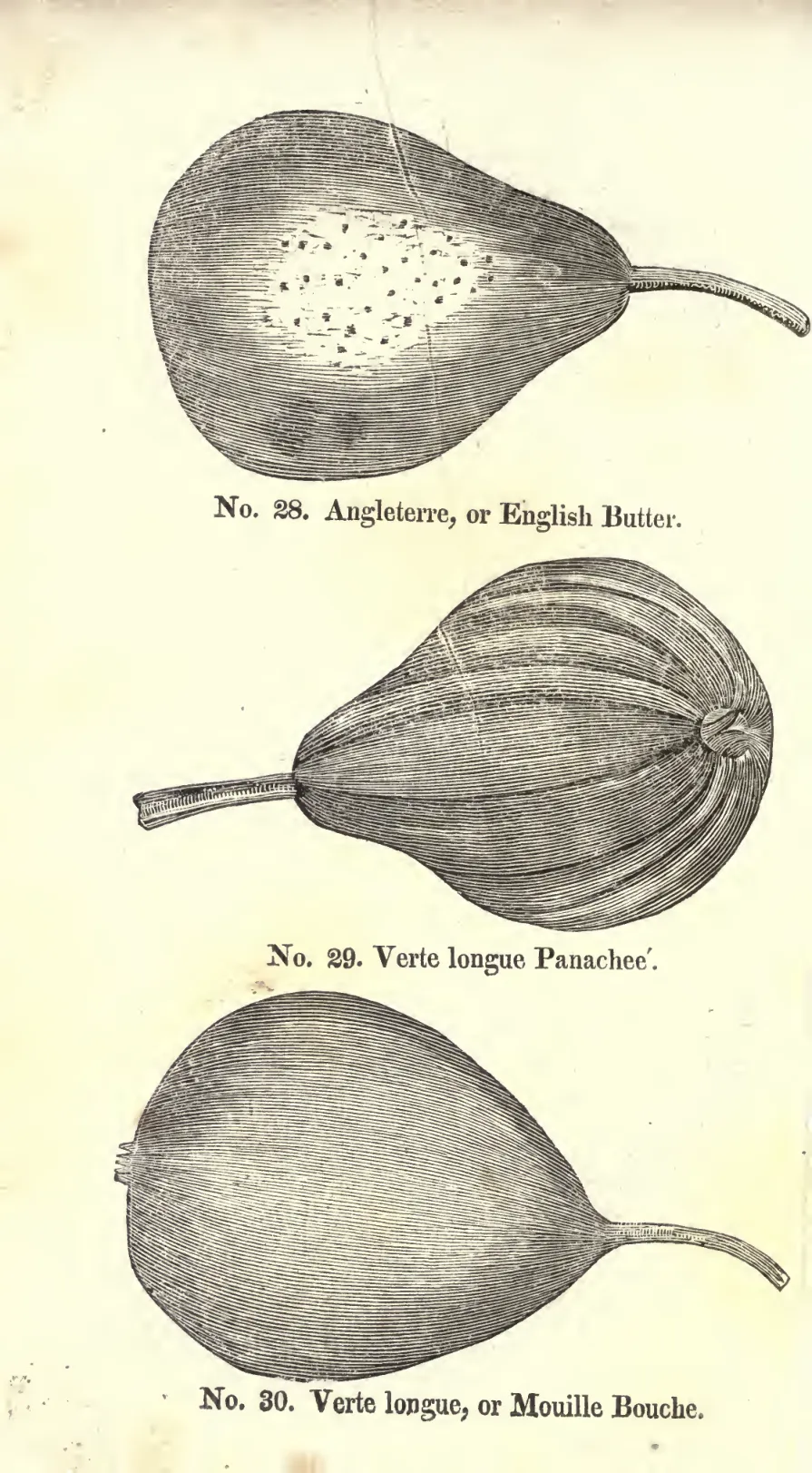
Long Green
Origin / History
An old variety, described by Duhamel (Downing). Coxe described it in 1817 as Verte Longue, Mouille Bouche, or Long Green. Downing and Thomas also give Verte Longue as the name of their pear. Hedrick (1921) cites Downing (1869), Dochnahl (1856), Leroy (1869), and Mathieu (1889). He calls Long Green a French pear, cultivated in France for the last 100 years, with ten French synonyms.
Hedrick holds that his Long Green is distinct from the Verte Longue, which he makes synonymous with Verte Longue d'Automne, though "these two pears have been confused and have various names in common." Thomas treats Long Green (Verte Longue) and Long Green of Autumn (Verte Longue d'Automne) as two pears, the latter "quite distinct." Downing heads his Long Green with the name Mouthwater, which Thomas gives to Long Green of Autumn.
Tree
Very vigorous and productive (Downing). Coxe, in his second entry, says its character changes with the season. When the year is unfavorable the fruit cracks and the trees lose all their leaves prematurely.
Fruit
Size: Small to rather large. Coxe and Downing call it small; Thomas calls it rather large and Hedrick above medium. Coxe's second entry calls it, when in perfection, "a fine plump fruit."
Form: Long-pyriform to obovate acute pyriform, the ends acute to rather acute. Very long, fig-like in form, narrowed from the middle to the stalk (Hedrick). Coxe's second entry gives instead "almost elliptical form, very little diminished towards the stem," resembling the yellow Beurré in shape.
Stem: Of medium length (Downing). Nearly perpendicularly inserted (Downing); oblique (Thomas).
Cavity: Not described in source.
Calyx: Small (Downing).
Basin: Almost none; the calyx set almost without basin (Downing).
Skin: Green, remaining green when fully ripe, the surface wholly green. Hedrick gives grass-green passing to brownish-green on the face exposed to the sun. Coxe's second entry gives green "with clouds of black."
Dots: Gray-russet, uniformly sprinkled (Hedrick).
Flesh and flavor: Flesh white (Coxe, second entry) to greenish-white (Hedrick), fine or semi-fine, melting, rather granular around the seeds (Hedrick). Juicy to very juicy; juice abundant, saccharine, sweet, "with a characteristic perfume, often very slight" (Hedrick). Flavor pleasant, spicy, agreeable.
Coxe calls the spicy taste "not universally admired, very similar to that of the Verte Longue Panachee." His second entry calls it a fruit of "varying excellence," "too often acid in the extreme with little flavour."
Downing and Thomas rate it good ("Good"; "a good and agreeable flavor"); Hedrick ranks it "second."
Core and seeds: Not described in source.
Season
September into the beginning of October. Most give September; Coxe gives the end of September and beginning of October. Coxe's second entry says it "lasts a long time in favourable seasons."
Uses
Not described in source.
Subtypes / Variants
Thomas names the Striped Long Green as a sub-variety.
Other
[NOTE: Source text may be incorrect — Coxe's second entry under "No. 30. Verte longue, or Mouille Bouche" begins mid-sentence ("varying excellence—…") and conflicts with his main entry. Hedrick declares his Long Green distinct from the Verte Longue, the name under which Coxe, Downing, and Thomas describe theirs, so his description may concern a different pear.]
Long Green of Autumn (Verte Longue d'Automne, or Mouthwater), which Thomas calls "quite distinct," is smaller and much more rounded than Long Green, with a long stem and a brown cheek. Very juicy and pleasant; ripens late in autumn, a month after Long Green. Thomas follows this description with "Profusely productive, and valuable."
Book Sources
Described in 4 period pomological works
- Thomas, The American Fruit Culturist (1903)
- Downing, Fruits and Fruit Trees of America (1900)
- Hedrick, The Pears of New York (1921)
- Coxe, A View of the Cultivation of Fruit Trees (1817) — listed as Verte Longue, Mouille Bouche, Or Long Green
View original book sources (4)
— William Coxe, A View of the Cultivation of Fruit Trees (1817)
- VERTE LONGUE, MOUILLE BOUCHE, OR LONG GREEN.
This is a small pear, the skin green when fully ripe; the flesh melting and juicy, with a spicy taste, not universally admired, very similar to that of the Verte Longue Panachee. It ripens in the end of September, and beginning of October.
[Additional entry in this volume: "Verte longue, or Mouille Bouche"]
No. 30. Verte longue, or Mouille Bouche.
varying excellence—it is too often acid in the extreme with little flavour; its character changes with the season—when the year is unfavourable the fruit cracks, and the trees lose all their leaves prematurely; when in perfection it is a fine plump fruit, of almost elliptical form, very little diminished towards the stem—resembling the yellow Beurree' in shape; the skin is green with clouds of black, the flesh white—it ripens in September, and lasts a long time in favourable seasons.
— A.J. Downing, The Fruits and Fruit Trees of America (1900)Long Green.
Verte Longue. Mouille Bouche. Mouthwater.
An old variety, described by Duhamel. Tree very vigorous and productive.
Fruit small, obovate acute pyriform. Stalk of medium length, nearly perpendicularly inserted. Calyx small, almost without basin. Skin remains green when fully ripe. Flesh melting, juicy, with a pleasant spicy flavor. Good. September.
— John J. Thomas, The American Fruit Culturist (1903)Long Green. (Verte Longue.) Rather large, long-pyriform, the ends rather acute, stem oblique; surface wholly green; flesh very juicy, with a good and agreeable flavor. The Striped Long Green is a sub-variety. Long Green of Autumn (Verte Longue d'Automne, or Mouthwater) is quite distinct, being smaller, much more rounded, stem long, and with a brown cheek; very juicy and pleasant; ripens late in autumn, a month after the preceding. Profusely productive, and valuable.
— U.P. Hedrick, The Pears of New York (1921)Long Green,
- Downing Fr. Trees Am. 803. 1869. Belgische Zapfenbirne.
- Dochnahl Führ. Obstkunde 2:139. 1856. Longue-Verte.
- Leroy Diet. Pom. 2:349, fig. 1869. Grune Lange Herbstbirne.
- Mathieu Nom. Pom. 228. 1889.
This French pear is distinct from the Verte Longue which is synonymous with Verte Longue d'Automne, though these two pears have been confused and have various names in common. It has been cultivated in France for the last 100 years. Longue Verte has ten French synonyms. Fruit above medium, very long, fig-like in form, narrowed from middle to stalk, acute, grass-green passing to brownish-green on the face exposed to the sun, uniformly sprinkled with dots of gray-russet; flesh greenish-white, fine or semi-fine, melting, rather granular around the seeds; juice abundant, saccharine, sweet, with a characteristic perfume, often very slight; second; Sept.