Early Summer Bergamot
Pear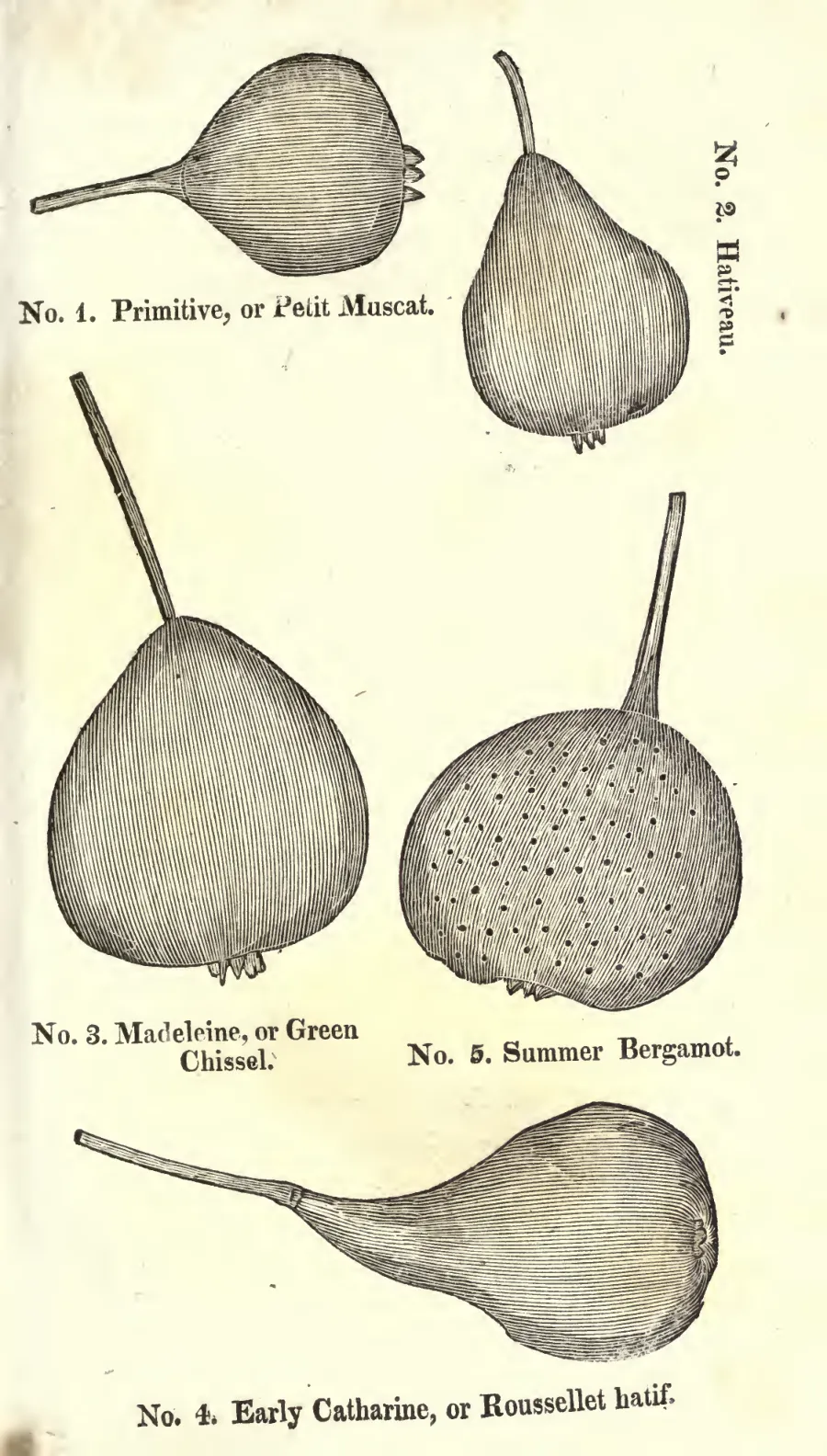
Early Summer Bergamot
Origin / History
An old foreign variety (Downing).
Tree
Feeble in growth (Downing). Coxe calls it "the least vigorous pear tree in our country," of moderate size and great hardiness, free from blight.
Fruit
Size: Small (Coxe, Thomas); quite small (Downing).
Form: Round.
Stem: Not described in source.
Cavity: Not described in source.
Calyx: Not described in source.
Basin: Not described in source.
Skin: Green, becoming yellow when fully ripe (Coxe); yellowish green (Downing); greenish yellow (Thomas).
Dots: Small, russet; the skin is "full of small russet spots" (Coxe).
Flesh and flavor: Juicy; rich and sprightly (Coxe); "pretty rich in flavor" (Downing); rich (Thomas). Coxe calls it a highly flavored juicy fruit if gathered from the tree, but when too ripe it becomes dry and loses its flavor. Downing says it quickly becomes mealy and dry, and Thomas says becoming dry. Coxe: "one of the finest pears of the season, when eaten before it is too ripe." Downing: "small size and second quality."
Core and seeds: Not described in source.
Season
Middle to end of July (Coxe); last of July (Downing); early August (Thomas). Best gathered from the tree and eaten before it is too ripe (Coxe).
Uses
Not described in source.
Subtypes / Variants
Not described in source.
Other
Downing describes a Large Summer Bergamot, "quite distinct" from this variety: flesh breaking and half buttery, not rich; ripe in September; tree grows and bears finely.
Book Sources
Described in 3 period pomological works
- Coxe, A View of the Cultivation of Fruit Trees (1817)
- Downing, Fruits and Fruit Trees of America (1900) — listed as Summer Bergamot
- Thomas, The American Fruit Culturist (1903) — listed as Summer Bergamot
View original book sources (3)
— William Coxe, A View of the Cultivation of Fruit Trees (1817)
- EARLY SUMMER BERGAMOT.
This is one of the finest pears of the season, when eaten before it is too ripe. The skin is green, full of small russet spots, but when fully ripe it becomes yellow—it is a highly flavoured juicy fruit if gathered from the tree, but when too ripe it becomes dry, and loses its flavour—the size is small, of a round form, the flesh rich and sprightly—it is the least vigorous pear tree in our country—of moderate size and great hardiness; free from blight—the fruit in perfection from the middle to the end of July.
[Additional entry in this volume: "Summer Bergamot", pp. 270–270]
No. 5. Summer Bergamot.
— A.J. Downing, The Fruits and Fruit Trees of America (1900)Summer Bergamot.
Bergamotte d'Été.
The Summer Bergamot is an old foreign variety, of small size and second quality. The tree is of feeble growth.
Fruit, quite small, round. Skin yellowish green. Flesh juicy, and pretty rich in flavor, but quickly becomes mealy and dry. Last of July.
There is a Large Summer Bergamot, quite distinct from the above. Flesh breaking and half buttery, not rich. September. The tree grows and bears finely.
— John J. Thomas, The American Fruit Culturist (1903)Summer Bergamot. Small, round, greenish-yellow; juicy, rich, becoming dry. Early August.