Verte longue
Pear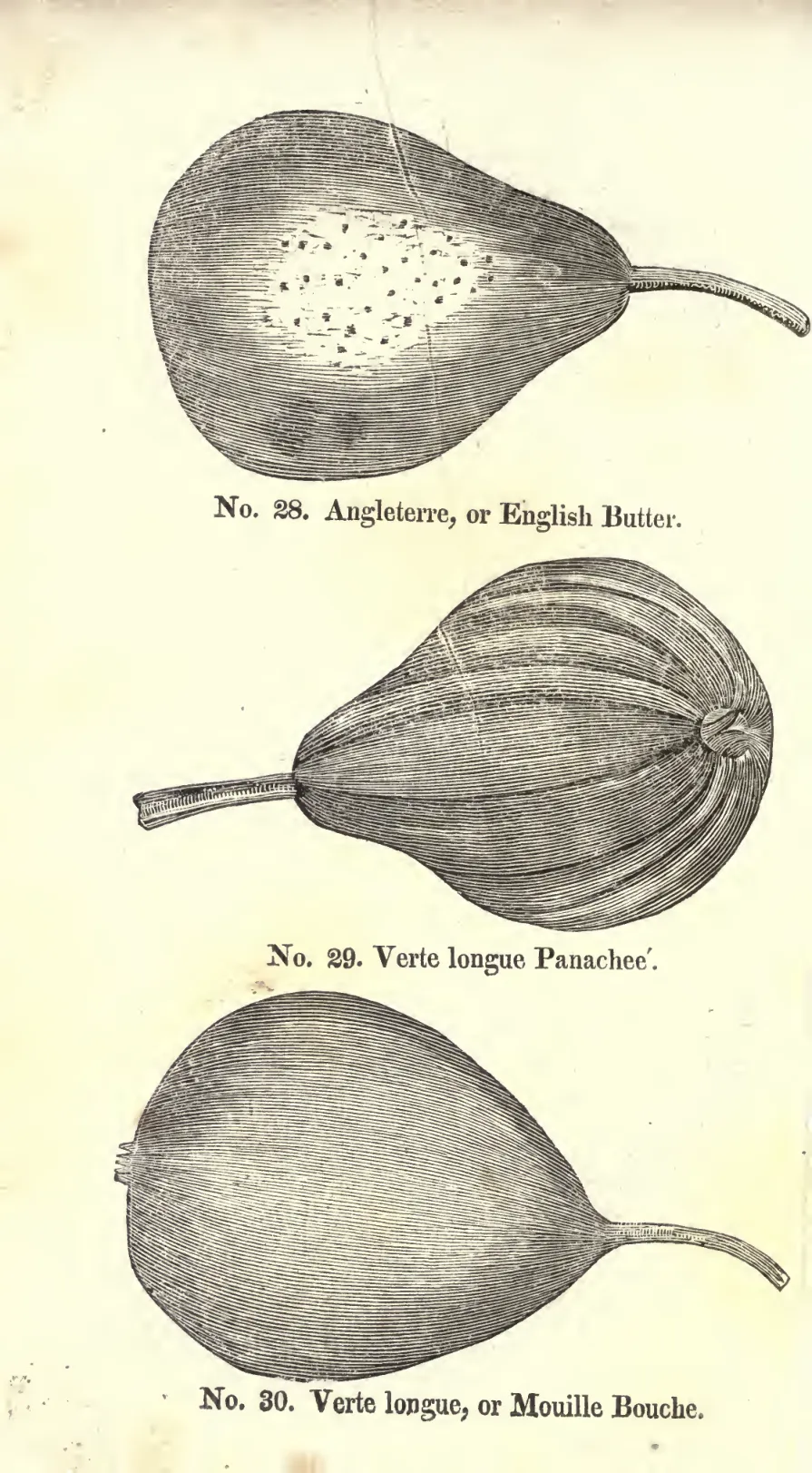
Verte longue
Origin / History
Described by William Coxe in A View of the Cultivation of Fruit Trees (1817) as No. 30, under the heading "Verte longue, or Mouille Bouche." Coxe lists Mouille Bouche as the other name under which the variety appears.
Tree
In unfavorable seasons the trees lose all their leaves prematurely.
Fruit
Size: Not described in source.
Form: When in perfection, the fruit is fine and plump, of almost elliptical form, very little diminished towards the stem, resembling the yellow Beurré in shape.
Stem: Not described in source.
Cavity: Not described in source.
Calyx: Not described in source.
Basin: Not described in source.
Skin: Green, with clouds of black.
Dots: Not described in source.
Flesh and flavor: The flesh is white. Excellence varies with the season. The fruit is too often acid in the extreme, with little flavor. When in perfection, it is a fine plump fruit.
Core and seeds: Not described in source.
Season
Ripens in September. When the year is unfavorable, the fruit cracks and the trees lose all their leaves prematurely. In favorable seasons the fruit lasts a long time.
Uses
Not described in source.
Subtypes / Variants
Not described in source.
Other
Not described in source.
Book Sources
Described in 1 period pomological work
- Coxe, A View of the Cultivation of Fruit Trees (1817) — listed as No. 30. Verte longue, or Mouille Bouche
Nursery Catalog Sources
Found in 3 catalogs (1845–1855) from Massachusetts
- Winship's Nursery (Brighton Nurseries , operated by the Winship family), Brighton (Boston) , Massachusetts — 1845
- Hovey & Co. , Cambridge , Massachusetts — 1849
- Joseph Breck & Co. , Boston , Massachusetts — 1855
View original book sources (1)
— William Coxe, A View of the Cultivation of Fruit Trees (1817)No. 30. Verte longue, or Mouille Bouche.
varying excellence—it is too often acid in the extreme with little flavour; its character changes with the season—when the year is unfavourable the fruit cracks, and the trees lose all their leaves prematurely; when in perfection it is a fine plump fruit, of almost elliptical form, very little diminished towards the stem—resembling the yellow Beurree' in shape; the skin is green with clouds of black, the flesh white—it ripens in September, and lasts a long time in favourable seasons.