Stevens Genesee
Pear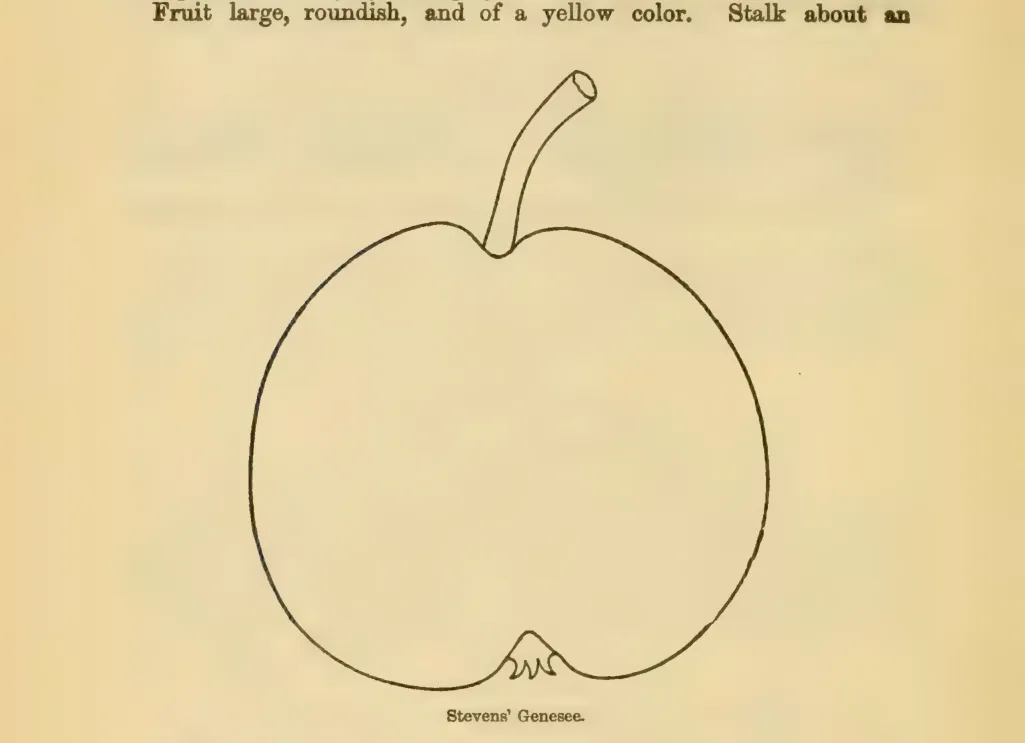
Stevens Genesee
Origin / History
A pear of western New York. Downing says it "is reputed to be a seedling of Western New York." He places its origin on the farm of Mr. F. Stevens, of Lima, Livingston County, N. Y. Hedrick gives the farm of M. F. Stevens, Lima, N. Y. Elliott gives it as a native of Rochester, N. Y. Hedrick's earliest cited reference is Cole's American Fruit Book, page 157, 1849.
Downing calls it "this admirable Pear, combining in some degree the excellence of the Doyenné and Bergamotte." Elliott calls it "one of the most desirable of pears for all collections." Budd and Hansen report it "quite extensively grown east of the Great Lakes."
Tree
Young shoots diverging, dark gray. Elliott calls it a fine grower and productive, and recommends it on either Pear or Quince stock.
Fruit
Size: Large.
Form: Roundish to nearly round. Elliott calls it roundish obovate, and Hedrick globular-obovate.
Stem: Stout, about an inch long, thicker at the base (Downing). Elliott calls it rather stout.
Cavity: Slight, small, narrow; set rather one-sided (Downing).
Calyx: Segments short and stiff. Elliott describes them as connected and half reflexed.
Basin: Medium, regular (Elliott); smooth, of only moderate depth (Downing).
Skin: Yellow to bright yellow. Elliott describes it as greenish yellow, becoming yellow.
Dots: Not described in source.
Flesh and flavor: Flesh white, tender, half buttery to nearly or rather buttery, juicy. Flavor sweet, rich, aromatic. Hedrick calls the flavor "excellent." Elliott says "even windfalls of this variety are extremely fine." Downing and Hedrick rate it "good to very good"; Budd and Hansen rate it "very good."
Core and seeds: Core medium. Seeds ovate pyriform, blackish (Elliott).
Season
The recorded season runs from the end of August into October, with September or early fall the common date. Hedrick extends it through October. Downing gives the first of September, but says that, "although placed among autumn pears, it frequently ripens here at the end of August, among the late summer varieties." Hedrick says it ripens as early as August in some districts.
Uses
Not described in source.
Subtypes / Variants
Not described in source.
Other
Not described in source.
Book Sources
Described in 5 period pomological works
- Downing, Fruits and Fruit Trees of America (1900) — listed as Stevens' Genesee
- Budd & Hansen, Systematic Pomology (1914)
- Elliott, The Western Fruit Book (1865) — listed as Stevens' Genesee
- Hedrick, The Pears of New York (1921)
- Thomas, The American Fruit Culturist (1903) — listed as Stevens' Genesee
Nursery Catalog Sources
Found in 3 catalogs (1845–1900) from Massachusetts
- Winship's Nursery (Brighton Nurseries , operated by the Winship family), Brighton (Boston) , Massachusetts — 1845
- Hovey & Co. , Cambridge , Massachusetts — 1849
- Central Experimental Farm , Dominion Department of Agriculture, Agassiz, British Columbia (under test; Bulletin No. 3, Second Series) — 1900
View original book sources (5)
— F.R. Elliott, The Western Fruit Book (1865)Stevens' Genesee.
Louise de Prusse. | Guernsey. | Stephens' Genesee.
Native of Rochester, N. Y. It is one of the most desirable of pears for all collections, either on Pear or Quince ; a fine grower, with diverging, dark gray shoots ; productive.
Fruit, large, roundish obovate ; color, greenish yellow, becoming yellow ; stem, rather stout ; cavity, narrow ; calyx with short, stiff, connected segments, half reflexed ; basin, medium, regular ; core, medium ; seeds, ovate pyriform, blackish ; flesh, white, half buttery, juicy, sweet, aromatic. September. Even windfalls of this variety are extremely fine.
— A.J. Downing, The Fruits and Fruit Trees of America (1900)Stevens' Genesee.
Guernsey. Louise de Prusse. Crottée. Doyenné Galeux. Saint Michel Crotté. Philippe Strié. Doyenné Crotté. Passa-tutti. Stephen's Genesee. Genesee. Beurré des Belges.
This admirable Pear, combining in some degree the excellence of the Doyenné and Bergamotte, is reputed to be a seedling of Western New York. It originated on the farm of Mr. F. Stevens, of Lima, Livingston Co., N. Y. Although placed among autumn pears, it frequently ripens here at the end of August, among the late summer varieties. Young shoots diverging, dark gray. Fruit large, roundish, and of a yellow color. Stalk about an inch long, stout, thicker at the base, and set in a slight, rather one-sided depression. Calyx with short, stiff divisions, placed in a smooth basin of only moderate depth. Flesh white, half buttery, with a rich aromatic flavor. Good to very good. First of September.
— John J. Thomas, The American Fruit Culturist (1903)Guernsey. See Stevens' Genesee.
— J.L. Budd & N.E. Hansen, American Horticultural Manual, Part II: Systematic Pomology (1914)Stevens Genesee. — Large, nearly round; color bright yellow; stalk one inch long, stout, thicker at base, and inserted in a small cavity. Flesh white, nearly buttery, rich, aromatic, very good. Season, early fall. Quite extensively grown east of the Great Lakes. New York.
— U.P. Hedrick, The Pears of New York (1921)Stevens Genesee. i. Cole Am. Fr. Bk. 157. 1849. Originated on the farm of M. F. Stevens, Lima, N. Y. Fruit large, globular-obovate, yellow; flesh white, tender, rather buttery, of a rich, excellent, aromatic flavor; good to very good; Sept. and Oct. but in some districts as early as Aug.