Collins
Pear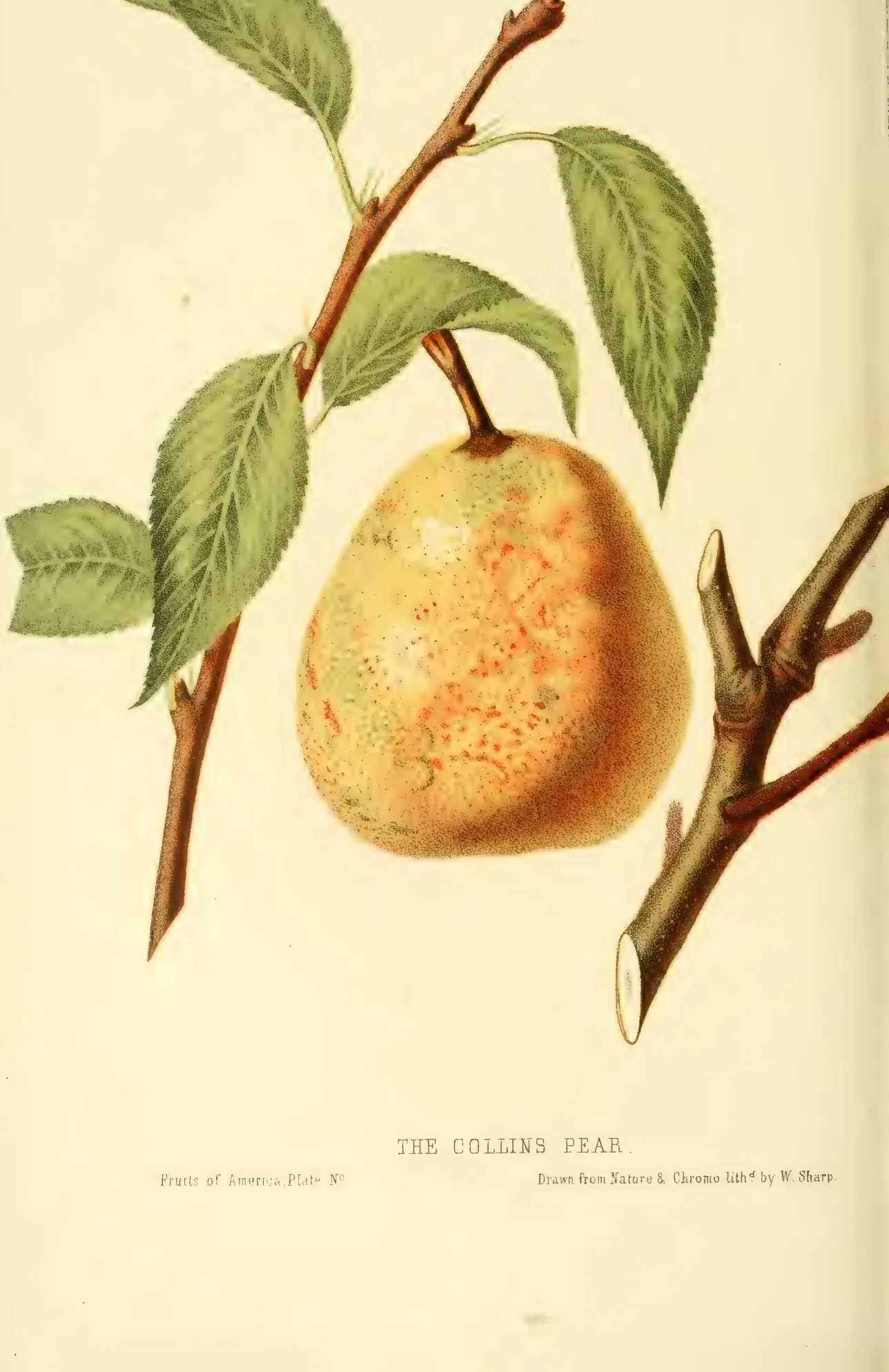
Collins
Origin / History
Collins is an American pear from Watertown, Massachusetts, supposed to be a seedling of the White Doyenne. Hovey says it originated in the garden then owned by Mr. Norris Collins. It "sprung up accidentally" where the tree was still growing, with no other variety in the immediate vicinity. Downing gives the originator as A. Collins of Watertown. Hedrick says it was raised from seed of the White Doyenne on the farm of a Mr. Collins, and he cites the Magazine of Horticulture (vol. 17, 1851, and vol. 18, 1852).
The original tree first bore in 1839 or 1840 and fruited every year afterward. Mr. A. Pike, nurseryman, was the first to discover its merits. He exhibited the first specimens before the Massachusetts Horticultural Society in 1848, where, Hovey says, they "attracted, and deservedly, much attention from the fruit committee." Hedrick gives 1848 as the date of introduction.
Hovey called Collins "one of the most recent additions to our list of American pears." He believed it had not yet fruited anywhere except on the original tree, and that it was "only proved from one locality." Even so, he wrote that "there can be but little doubt it will take its rank among the very best of our native varieties." Pike presented him with pears which "had the promise of great excellence," and Hovey said yearly trials since had "more than confirmed our first impressions of it." Taking all its qualities into account, he judged it "a great acquisition to our list of fine autumn pears."
Tree
Tree of moderate growth. Hovey describes it as moderately vigorous, upright, and of tolerably regular form, with rather slender annual shoots.
Wood reddish brown, dotted with grayish specks, rather slender and short-jointed; old wood grayish brown. Buds medium size, ovate, diverging; flower-buds medium size.
Leaves medium size, roundish-ovate, narrowing most to the point, light green, slightly folded inwards, a little recurved on the midrib, obtusely serrated. Petioles of medium length, about one inch long, moderately stout. Flowers medium size; petals roundish, cupped.
A regular, constant and abundant bearer, which Hovey calls "a most productive variety." At Hovey's writing the original tree appeared about twenty-five years old. It stood about thirty feet high and was pyramidally formed, its branches weighed down by the mass of fruit it had repeatedly produced. Its success on the quince stock had not then been fully tested.
Fruit
Size: Medium to large; most authors call it large or above medium. Downing and Thomas call it medium. Hovey measures it at about two and three-quarters inches long and two and three-quarters inches in diameter, larger than the White Doyenne.
Form: Obovate to roundish obovate, rather flattened (Hedrick), approaching turbinate (Thomas). Regular, full and broad at the crown, tapering roundly to an obtuse stem end. Hovey says it is generally like the White Doyenne in form. Downing describes it as roundish, slightly acute pyriform.
Stem: Short, thick or stout, curved, inserted obliquely or at an inclination. Hovey alone gives it as medium length, about one inch long, a little swollen at the base.
Cavity: None; the stem is inserted without any cavity, not sunk.
Calyx: Large and open (Hovey, Elliott), against small (Downing, Thomas). Hovey gives the segments of the calyx as short, stiff, and slightly reflexed.
Basin: The eye is a little sunk, very little or scarcely sunk. Hovey describes a broad, open, somewhat funnel-shaped basin.
Skin: Fair, nearly smooth. Yellowish green, greenish yellow when ripe; like the White Doyenne in color. Mottled with dull red on the sunny side, or frequently with a blush there (Downing), which Hedrick calls a fine blush. Somewhat clouded with grayish spots and a little traced with russet.
Dots: Regularly dotted or speckled with russet specks, spots, or dots.
Flesh and flavor: Flesh white, fine, buttery, melting, juicy; like the White Doyenne in texture. Flavor brisk, sprightly, vinous, sweet. Hovey calls it rich, with a slight perfume. He also calls it "a much more vinous pear" than the White Doyenne, its flavor, "though not perhaps quite so rich and sugary, is brisk and more refreshing, somewhat like the Marie Louise." Downing calls the flavor brisk and sugary, resembling the White Doyenné, and rates it "Very good." Hedrick rates it "good," and Thomas "of medium quality."
Core and seeds: Core large. Seeds small, roundish-obovate, broad.
Season
Ripe in September or by the first of October; Hedrick gives September and October. Hovey says it keeps well for three or four weeks.
Uses
Not described in source.
Subtypes / Variants
Not described in source.
Other
Not described in source.
Book Sources
Described in 5 period pomological works
Nursery Catalog Sources
Found in 2 catalogs (1849) from Massachusetts
- Hovey & Co. , Cambridge , Massachusetts — 1849 — listed as Charbonniere
- Hovey & Co. , Cambridge , Massachusetts — 1849 — listed as Mal Connaitre
View original book sources (5)
— C.M. Hovey, The Fruits of America (1852)THE COLLINS PEAR.
Collins. Magazine of Horticulture, vol. xvii. p. 256. Watertown, of some Collections.
The Collins is one of the most recent additions to our list of American pears; and has not, we believe, yet fruited anywhere except upon the original tree: but though so entirely new, and only proved from one locality, we think there can be but little doubt it will take its rank among the very best of our native varieties. In size, it is larger than the White Doyenne, (or St. Michael,) which it otherwise greatly resembles, being generally like it in form, the color of its skin, and texture of the flesh; but is a much more vinous pear, and its flavor, though not perhaps quite so rich and sugary, is brisk and more refreshing, somewhat like the Marie Louise.
The Collins pear originated in Watertown, Mass., in the garden now owned by Mr. Norris Collins, and specimens were first exhibited before the Massachusetts Horticultural Society in 1848. They attracted, and deservedly, much attention from the fruit committee. Mr. A. Pike, nurseryman, was the first to discover the merits of this variety, and he exhibited the first specimens: he also presented us with a number of the pears, which we thought had the promise of great excellence; and subsequent trials of the fruit every year up to this time have more than confirmed our first impressions of it. Taking into consideration all its qualities, it is a great acquisition to our list of fine autumn pears.
It is supposed to be a seedling of the White Doyenne, which sprung up accidentally where the tree is now growing, there being no other variety in the immediate vicinity. It first began to bear in 1839 or 40; since then it has fruited every year, proving it to be a constant bearer, as well as a most productive variety. The original tree appears about twenty-five years old, is about thirty feet high, and pyramidally formed, the branches being weighed down by the mass of fruit which it has repeatedly produced. The tree is a moderate grower. Whether it will succeed on the quince stock has not yet been fully tested.
Tree. — Moderately vigorous, upright, of tolerably regular form, with rather slender annual shoots.
Wood. — Reddish brown, dotted with grayish specks, rather slender and short-jointed; old wood, grayish brown; buds, medium size, ovate, diverging: Flower-buds, medium size.
Leaves. — Medium size, roundish-ovate, narrowing most to the point, light green, slightly folded inwards, little recurved on the midrib, and obtusely serrated; petioles, medium length, about one inch long, and moderately stout.
Flowers. — Medium size; petals, roundish, cupped.
Fruit. — Large, about two and three quarters of an inch long, and two and three quarters of an inch in diameter: Form, obovate, regular, full and broad at the crown, tapering roundly to the stem end, which is obtuse: Skin, fair, nearly smooth, yellowish green, mottled with dull red on the sunny side, somewhat clouded with grayish spots, little traced with russet, and regularly dotted with russet specks: Stem, medium length, about one inch long, stout, curved, little swollen at the base, and obliquely inserted without any cavity: Eye, large, open, and a little sunk in a broad, open, somewhat funnel-shaped basin; segments of the calyx, short, stiff, and slightly reflexed: Flesh, white, fine, buttery, melting and juicy: Flavor, sprightly, vinous, and rich, with a slight perfume: Core, large: Seeds, small, roundish-obovate, broad.
Ripe in September, and keeps well for three or four weeks.
— F.R. Elliott, The Western Fruit Book (1865)Collins. Watertown. American. From Watertown, Massachusetts ; supposed a seedling of white Doyenne ; a regular, abundant bearer. Fruit, large or above medium, roundish obovate, yellowish green, mottled with dull red in sun, some russet ; stem, short, curved ; calyx, large, open ; core, large ; flesh, white, vinous, juicy, sweet, melting. September.
— A.J. Downing, The Fruits and Fruit Trees of America (1900)Collins.
Watertown. Colin Noir. Meconnaitre. Charbonniere. Malconnaitre.
Raised by A. Collins, of Watertown, Mass., and first exhibited before the Massachusetts Horticultural Society in 1848. Tree of moderate growth, with reddish brown shoots.
Fruit medium, roundish, slightly acute pyriform. Skin greenish yellow, with russet spots, and frequently a blush on the sunny side. Stalk short, thick, inserted at an inclination without cavity. Calyx small, and very little sunk. Flesh fine, melting, juicy, with a brisk, sugary flavor, resembling white Doyenné. Very good. Ripens first of October.
— John J. Thomas, The American Fruit Culturist (1903)Collins. Size medium, obovate, approaching turbinate; greenish-yellow; stalk short, thick, oblique, not sunk; calyx small, scarcely sunk; flesh juicy and melting; of medium quality. First of October. Massachusetts.
— U.P. Hedrick, The Pears of New York (1921)Collins.
- Mag. Hort. 17:255, fig. 261. 1851.
- Ibid. 18:149. 1852.
Raised from seed of the White Doyenne on the farm of a Mr. Collins in Watertown, Mass., and introduced in 1848. Fruit large, obovate, rather flattened, when ripe greenish yellow, with a fine blush in the sun and speckled with russet dots; flesh white, fine, brisk, melting, juicy, vinous, sweet; good; Sept. and Oct.