Marie Louise
Pear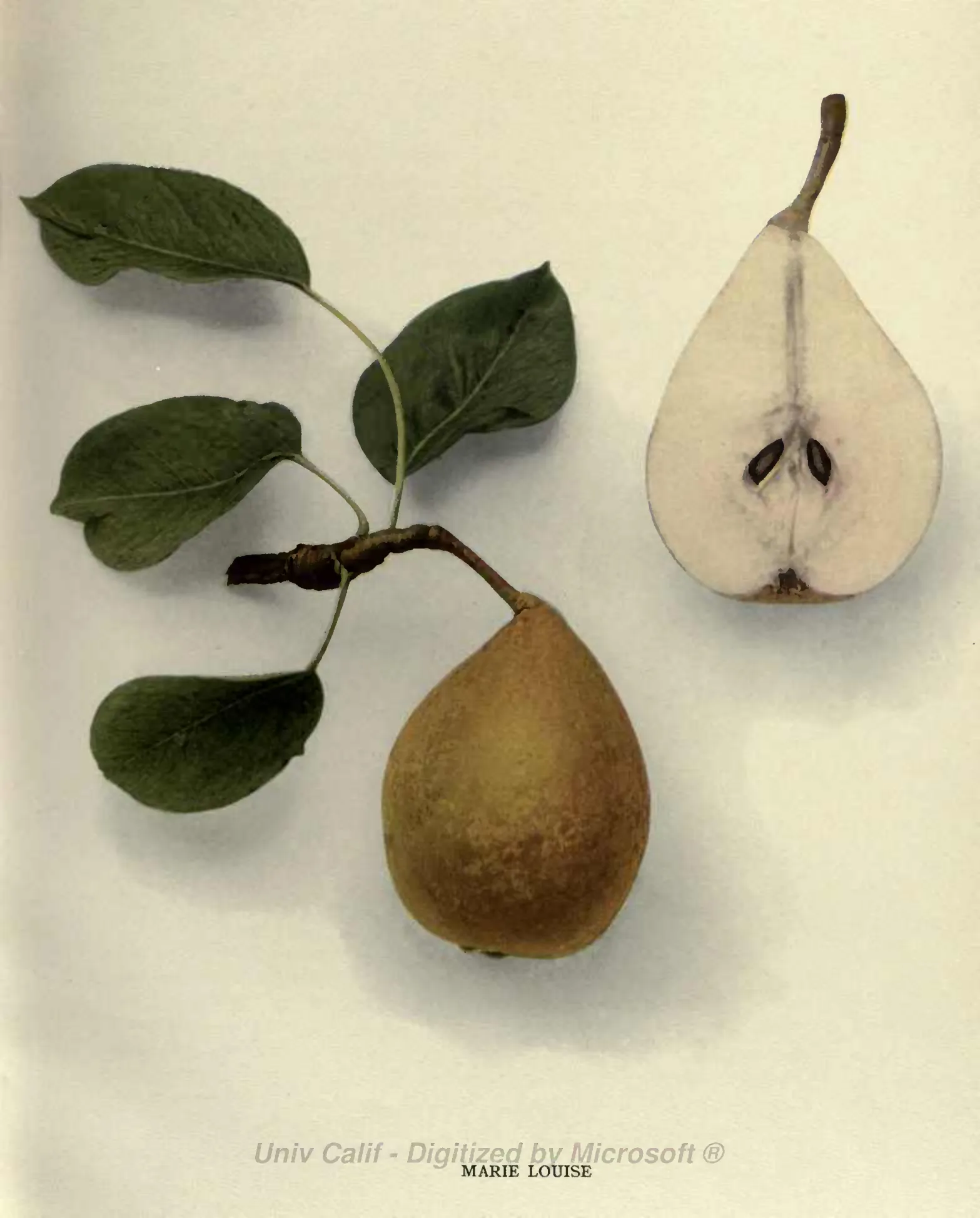
Marie Louise
Origin / History
A Belgian variety (Downing, Thomas); Elliott lists it as "Foreign." It was raised from seed in 1809 by the Abbé Duquesne and dedicated to Marie Louise, second consort of Napoleon the First, the Archduchess of Austria (Bunyard). Bunyard and Hedrick place the Abbé at Mons, Belgium. Hovey places him at Brussels and notes that the origin "is often attributed to Van Mons."
The Abbé passed the pear on to Van Mons. In 1816 Van Mons sent it without a name to a Mr. Braddick of Thames Ditton, England (Hedrick). Hovey records that in 1816 Van Mons sent specimens to the London Horticultural Society along with other Belgian kinds. These attracted great attention and so established the reputation of the continental pears that enthusiastic cultivators made special visits to Van Mons and other amateurs to procure the identical varieties. The late Mr. Braddick, near London, obtained a great number of sorts on three visits and liberally distributed scions among the London nurserymen, who propagated them and offered them for sale.
In 1820 the Marie Louise first fruited in England. An account of it, with a beautiful drawing of the fruit, appeared in the Transactions of the London Horticultural Society (Hovey). It was figured in the Pomological Magazine (vol. iii, pl. 122; dated 1830 by Hedrick), and in England it in time became one of the best-known pears. In 1823 Thomas Andrew Knight sent scions from England to John Lowell of Roxbury, Massachusetts, and through Lowell it was widely disseminated in America. The American Pomological Society placed Marie Louise in its list of fruits in 1862.
Hovey calls it "long been known as one of our very finest autumn pears" and "undoubtedly one of the choicest sorts we possess." He credits its large size, good season, good keeping, unusually melting flesh, and "most refreshing, delicious flavor." Downing finds it of first quality in its native country, and "here, in some seasons, fully sustains that character," but "so uncertain, so variable in seasons, as greatly to detract from its value." Bunyard calls it "now one of the best known of the pears." For Hedrick its fruits "are among the perfections of Nature," and pomologists generally agree they are the finest flavored of their season. He adds that were the tree more certain in bearing and less fastidious as to environment and care, the variety would rank as one of the best of all pears.
Tree
Hardy, vigorous, straggling. Hovey calls it very hardy, vigorous, and rapid growing, making a large, spreading head, with long, stout annual shoots. It is exceedingly ill-shaped while young and brought into good form only by careful pruning and training. The annual shoots are often twisted and contorted, growing sideways, downward, curved, and in all directions. Hovey finds this character so constant that the variety can always be detected among all the trees in the nursery. Once the tree reaches a bearing state the crooked growth is checked and it assumes a better form.
The habit is otherwise described as rather straggling, or diverging and drooping (Elliott), very flexuous and straggling (Thomas), and spreading and straggling. Hedrick gives the tree as medium in size, vigorous, spreading, open-topped, hardy, and productive, with a slender trunk. In his general remarks he calls it "only moderately vigorous," and his Cyclopedia adds "slow-growing."
Young wood olive in tone: olive-gray (Elliott, Thomas), clear deep olive (Hovey), or reddish olive brown (Downing). Hovey describes it as stout and rather short-jointed, thickly dotted with very large, conspicuous grayish specks, with old wood very dark gray olive. Hedrick gives branches dark reddish-brown mingled with thin gray scarf-skin and marked with many large lenticels, which his Cyclopedia calls very conspicuous. His branchlets are very slender and very short, with short internodes, light brown tinged with brownish-red, glossy, smooth, and glabrous, with very small, slightly raised lenticels.
Buds sharply pointed. Leaf buds are large, diverging, and with very prominent shoulders (Hovey), or small, short, plump, and free (Hedrick). Flower buds are small, conical, and free, borne singly as lateral buds or on short spurs (Hedrick).
Leaves narrow (Thomas, Bunyard, Hedrick): narrow oval, held open, turning black (Bunyard); short, oval or somewhat elongated, and leathery (Hedrick). Hedrick gives them 2½ in. long and 1½ in. wide (1¼ in. wide in his Cyclopedia), with the apex obtusely or slightly taper-pointed. Hovey describes them as medium in size, ovate, acuminate, nearly flat, thick, deep green, and wavy. Hovey also calls the margin sharply but not deeply serrated, while Bunyard calls it nearly entire and Hedrick glandless and entire. Petioles very long (Hovey, Thomas) and slender: about 1½ in. and rather slender (Hovey); 2 in., greenish, and glabrous (Hedrick, whose Cyclopedia prints ¾ in.).
Flowers large and very showy, 1½ in. across (1⅜ in. in Hedrick's Cyclopedia). Petals obovate, with a long claw (Hovey). The flowers are borne in dense clusters of 7 to 9 buds, on pedicels often 1½ in. long, slender, slightly pubescent, and greenish (Hedrick).
Productive; fertility good (Bunyard). Hedrick finds it rather uncertain in bearing, varying much from season to season in abundance and quality of product. He also finds it somewhat susceptible to blight.
Wants rich, warm, sandy soil, without which it is only a "good" pear (Elliott), and rich cultivation, without which the fruit will be poor (Thomas). It does well as a standard on suitable soils (Bunyard) but does not succeed well upon the quince (Hovey).
Fruit
Size: Large to medium, variable in size. Most authors call it large or pretty large; Hedrick calls it above medium, and Bunyard and Veitch medium. Hovey gives about 4 in. long and 3 in. in diameter, often reaching 5 in. in length. Bunyard gives 3 by 4, and Hedrick 3½ in. long and 2⅝ in. wide (3¼ by 2⅜ in. in his Cyclopedia).
Form: Oblong-pyriform, irregular, a little one-sided, with sides unequal. Hovey describes it as largest about the middle, narrowing to each end, swollen on one side, and oblique at the crown. Thomas notes a curved axis and a somewhat conical body, and Bunyard calls it long oval, a little uneven. In shape it resembles Beurré Bosc, with the same trim contour (Hedrick; "a short Beurre Bosc" in his Cyclopedia).
Stem: About 1½ in. long, called long (Hovey), rather long (Bunyard), or medium (Elliott). Moderately stout to thick, woody (Bunyard), curved or a little curved. Obliquely inserted, "often oblique" in Thomas's words.
Cavity: Slight or very small and one-sided, russeted, often lipped. The stem is sometimes set under a slightly raised or swollen lip, with russet at the base of the stem (Elliott). Hovey gives no cavity at all, the stem inserted under a swollen lip.
Calyx: Small (Thomas), medium (Hovey), or large (Bunyard, Hedrick). Open (Elliott, Bunyard, Hedrick), irregularly formed (Elliott), or partially closed (Hovey). Segments long, stiff, and diverging (Hovey). Elliott calls the segments connected, while Hedrick has the lobes separated at the base, narrow, and acuminate. Calyx tube short, narrow, conical (Hedrick).
Basin: Small or narrow, obtuse, considerably to much furrowed, plaited. The eye is moderately sunk (Hovey), or nearly on the surface of the fruit (Bunyard). Russet at the crown (Elliott), in thin patches of fine russet especially around the eye (Bunyard).
Skin: Thin, smooth, fair, tender, and dull. Pale green or dull green (Elliott), becoming yellowish, pale, fine, or rich yellow at maturity. Occasionally marbled with red in the sun (Hovey), or sun-flecked with red on the sunny side (Hedrick). Partly (Thomas) to often much (Hovey) russeted: netted, sprinkled, and mottled with light russet, especially on the exposed side or cheek, in marblings, dots, and thin patches of fine russet. On dry soils it comes rather more russeted (Bunyard). Of fine or refined appearance (Veitch, Rivers).
Dots: Numerous, small, russet, somewhat obscure (Hedrick); russet dots (Elliott); green and russet specks (Hovey).
Flesh and flavor: White to yellowish-white, very pale (Bunyard). Fine (Hovey), granular (Hedrick), a little gritty (Bunyard). Tender, buttery, melting, exceedingly or very juicy. Flavor rich, saccharine, and vinous; also perfumed, most refreshing, and delicious (Hovey), aromatic (Hedrick), very sweet (Veitch), and "of a distinct and refined flavour" (Bunyard). Hedrick: "a most delectable commingling of refreshing piquancy and scented sweetness."
Quality "very good" (Elliott, Downing, Hedrick) or "excellent" (Veitch, Rivers, who also gives "very good flavour"). Elliott holds it only "good" off rich, warm, sandy soil. Thomas: "when well grown rich and fine—often second or third rate—variable."
Core and seeds: Core medium (Hovey) to small (Elliott); closed, with clasping core lines (Hedrick). Seeds medium-sized, long, pointed, and dark brown (Hovey); broad and ovate (Elliott); wide and acute (Hedrick).
Season
The recorded season runs from late September through November; mid-autumn. Most authors give the last of September and October, closing as early as early or middle October (Downing, Hedrick). Hovey gives ripe in October and keeping well through November, and Bunyard gives October to November. Bunyard adds that on dry soils the fruit keeps rather longer.
Uses
Dessert (Bunyard). Hedrick calls it "Not at all suited for a commercial plantation," but one of the choicest sorts for a home collection or in the hands of a pear fancier. Hedrick also finds the fruit somewhat susceptible to the scab fungus, so that even the most careful spraying fails to give it a fair cheek in some seasons. Rivers' catalog marks it "F.C."
Subtypes / Variants
Not described in source.
Other
Not described in source.
Book Sources
Described in 7 period pomological works
- Hedrick, The Pears of New York (1921)
- Hedrick, Cyclopedia of Hardy Fruits (1922)
- Bunyard, A Handbook of Hardy Fruits (1920)
- Downing, Fruits and Fruit Trees of America (1900)
- Elliott, The Western Fruit Book (1865)
- Thomas, The American Fruit Culturist (1903)
- Hovey, The Fruits of America (1852) — listed as THE MARIE LOUISE PEAR
Nursery Catalog Sources
Found in 10 catalogs (1845–1917) from England, Massachusetts
- Winship's Nursery (Brighton Nurseries , operated by the Winship family), Brighton (Boston) , Massachusetts — 1845
- Hovey & Co. , Cambridge , Massachusetts — 1849 — listed as Marie Louise le Delcourt
- Hovey & Co. , Cambridge , Massachusetts — 1849
- Joseph Breck & Co. , Boston , Massachusetts — 1855
- Kelway & Son , Langport, Somerset , England — 1897
- George Bunyard & Co. , Royal Nurseries, Maidstone, Kent , England — 1900
- James Veitch & Sons , Ltd., Royal Exotic Nursery, Chelsea, London (also Coombe Wood, Langley, and Feltham) , England — 1911
- Thomas Rivers & Son , Sawbridgeworth, Hertfordshire , England — 1913
- George Bunyard & Co. , Royal Nurseries, Maidstone, Kent , England — 1914
- George Bunyard & Co. , Royal Nurseries, Maidstone, Kent , England — 1917
View original book sources (9)
— C.M. Hovey, The Fruits of America (1852)THE MARIE LOUISE PEAR.
Marie Louise. Pomological Magazine, vol. iii. pl. 122. Forme de Marie Louise, } Marie Chretienne, } According to the Pomological Magazine. Princess de Parme', } Braddick's Field Marshal, } Maria, Thompson, in Gard. Chronicle, 1846.
The Marie Louise has long been known as one of our very finest autumn pears. As long ago as 1816, Dr. Van Mons sent specimens to the London Horticultural Society, with other Belgian kinds, which attracted great attention, and so highly established the reputation of the continental pears, that some enthusiastic cultivators made especial visits to Dr. Van Mons, and other amateurs, to procure the identical varieties. The late Mr. Braddick, near London, obtained a great number of sorts at three several visits, and liberally distributed scions among the London nurserymen, who soon propagated them, and offered them for sale. In 1820, the Marie Louise first fruited in England, and an account of it, with a beautiful drawing of the fruit, appeared in the Transactions of the London Horticultural Society. It is undoubtedly one of the choicest sorts we possess, being of large size, often measuring five inches in length, maturing at a good season, keeping well, with an unusually melting flesh, and of the most refreshing, delicious flavor.
The Marie Louise was raised by the Abbe Duquesne, of Brussels, in 1809, though its origin is often attributed to Van Mons. Mr. Knight first sent scions of it to this country in 1823, and, through Mr. Lowell, it was disseminated among our cultivators. It is a very hardy, vigorous, and rapid growing tree, though exceedingly ill-shaped while young, and only brought into good form by careful pruning and training. The annual shoots are often twisted and contorted, growing sideways, downwards, curved, and, indeed, in all directions, — a character so constant that it can always be detected among all the trees in the nursery. When once it arrives at a bearing state, its disposition to make crooked shoots is checked, and it assumes a better form. It does not succeed well upon the quince.
Tree. — Vigorous, with curved and twisted branches when young, but making a large and spreading head; annual shoots, long and stout.
Wood. — Clear deep olive, thickly dotted with very large, conspicuous grayish specks, stout, and rather short-jointed; old wood, very dark gray olive; buds, large, sharply pointed, diverging, with very prominent shoulders.
Leaves. — Medium size, ovate, acuminate, nearly flat, thick, deep green, wavy, and sharply but not deeply serrated: petioles, very long, about one and a half inches in length, rather slender.
Flowers. — Large; petals, obovate; claw, long.
Fruit. — Large, about four inches long, and three in diameter: Form, oblong, largest about the middle, narrowing to each end, swollen on one side, and oblique at the crown: Skin, fair, smooth, thin, pale green, becoming of a fine yellow when mature, occasionally marbled with red in the sun, often much russeted, and sprinkled with green and russet specks: Stem, long, about one and a half inches in length, moderately stout, curved, and obliquely inserted, without any cavity, under a swollen lip: Eye, medium size, partially closed, and moderately sunk in a small and much furrowed basin; segments of the calyx, long, stiff, diverging: Flesh, yellowish white, fine, melting, buttery, and exceedingly juicy: Flavor, rich, saccharine, vinous, perfumed, and delicious: Core, medium size: Seeds, medium size, long, pointed, dark brown.
RIPE in October, and keeps well through November.
— F.R. Elliott, The Western Fruit Book (1865)Marie Louise. Forme de Marie Louise, | Princes de Parme, | Maria. Marie Chretienne, | Braddick's Field Marshal, | Foreign. Tree, vigorous, rather straggling, or diverging and drooping, with olive gray colored shoots; requires rich, warm, sandy soil, otherwise it is only a "good" pear. It is hardy and productive. Fruit, large, oblong pyriform, dull green, becoming pale yellow, with marblings, dots and patches of russet, and russet at crown and base of stem; stem, medium, obliquely set in a slight cavity, or with a raised lip on one side; calyx, open, irregularly formed: segments, connected; core, small; seeds, broad, ovate; flesh, white, buttery, melting, juicy, vinous; "very good." Last of September and October.
— A.J. Downing, The Fruits and Fruit Trees of America (1900)Marie Louise.
Forme de Marie Louise. Marie Louise Donkelar. Marie Chretienne. Marie Louise Nouvelle. Princesse de Parme. Marie Louise de Jersey. Braddick's Field Standard. Corchorus. Marie Louise d'Elcourt. Marie Louise Delacourt. Van Donkelear. Van Donckelaer.
A Belgian variety, of first quality in its native country, and here, in some seasons, fully sustains that character; but it is so uncertain, so variable in seasons, as greatly to detract from its value. Tree a vigorous but straggling grower. Young wood reddish olive brown.
Fruit pretty large, oblong pyriform, rather irregular or one-sided in figure, pale green, but at maturity rich yellow, a good deal sprinkled and mottled with light russet on the exposed side. Stalk an inch and a half long, obliquely planted, sometimes under a slightly raised lip, sometimes in a very small one-sided cavity. Flesh white, exceedingly buttery and melting, with a rich, saccharine, and vinous flavor. Very good. Last of September and middle of October.
— John J. Thomas, The American Fruit Culturist (1903)Marie Louise. Large pyriform, a little one-sided, or with a curved axis; body somewhat conical; surface pale green, becoming yellowish, partly russeted; stalk an inch and a half long, rather stout, often oblique; calyx small, basin narrow, plaited; flesh buttery, melting, vinous, when well grown rich and fine—often second or third rate—variable. Needs rich cultivation or else the fruit will be poor. Mid-autumn. Growth very flexuous and straggling; shoots olive-gray, petioles very long, leaves narrow. Belgian. Fig. 701.
— E.A. Bunyard, A Handbook of Hardy Fruits (1920)MARIE LOUISE. Her. Pom., II., 55. (Marie Louise Delcourt, Princess de Parme.) Dessert, October to November, medium, 3 by 4, long oval, a little uneven. Skin, smooth. Colour, pale green to yellow, with thin patches of fine russet, especially around the eye. Flesh, very pale, juicy, a little gritty, of a distinct and refined flavour. Eye, large, open, nearly on the surface of the fruit. Stem, rather long, woody, generally a little curved, often in a slight cavity. Growth, makes a spreading, straggling tree; fertility good. Leaf, narrow oval, held open, nearly entire, turns black. Origin, raised by the Abbe Duquesne of Mons in 1809, and named after Napoleon's second wife, the Archduchess of Austria. This is now one of the best known of the pears. It does well as a standard on suitable soils. On dry soils it comes rather more russeted and keeps rather longer.
— U.P. Hedrick, The Pears of New York (1921)MARIE LOUISE
- Pom. Mag. 3:122, Pl. 1830. 2. Prince Pom. Man. 1:131. 1831. 3. Kenrick Am. Orch. 179. 1832. 4. Downing Fr. Trees Am. 399. 1845. 5. Hovey Fr. Am. 2:37, Pl. 1851. 6. Dochnahl Fuhr. Obstkunde 3:59. 1856. 7. Am. Pom. Soc. Rpt. 70. 1862. 8. Leroy Dict. Pom. 2:399, fig. 1869. 9. Guide Prat. 59, 287. 1876. 10. Lauche Deut. Pom. II: No. 38, Pl. 38. 1882. 11. Hogg Fruit Man. 613. 1884. 12. Mathieu Nom. Pom. 251. 1889.
Marie-Louise Delcourt. 13. Pom. France 1: No. 19, Pl. 19. 1863. 14. Mas Le Verger 3: Pt. I, 163, fig. 80. 1866-73.
The fruits of Marie Louise are among the perfections of Nature, and were the tree more certain in bearing and less fastidious as to environment and care, the variety would rank as one of the best of all pears. Pomologists generally agree that its fruits are the finest flavored of their season. The flesh is tender and melting, very juicy, and the flavor is a most delectable commingling of refreshing piquancy and scented sweetness. In shape, the pears resemble those of Beurré Bosc, having the same trim contour, but the color is very different — rich yellow, netted and sprinkled with russet, and sun-flecked with red on the sunny side. The fruit is somewhat susceptible to the scab fungus, and even the most careful spraying fails to give it a fair cheek in some seasons. The trees are hardy but only moderately vigorous, somewhat susceptible to blight, rather uncertain in bearing, and vary much from season to season in abundance and quality of product. Not at all suited for a commercial plantation, Marie Louise is one of the choicest sorts for a home collection or in the hands of a pear fancier.
The Abbé Duquesne, Mons, Belgium, raised this pear from seed in 1809 and dedicated it to Marie Louise, the second consort of Napoleon the First. The Abbé passed the pear on to Van Mons, who in 1816 sent it without a name to a Mr. Braddick of Thames Ditton, England, where in time it became one of the best-known pears. Thomas Andrew Knight sent cions of the variety from England to John Lowell, Roxbury, Massachusetts, in 1823, whence it became widely disseminated in America. The American Pomological Society placed Marie Louise in its list of fruits in 1862.
Tree medium in size, vigorous, spreading, open-topped, hardy, productive; trunk slender; branches dark reddish-brown mingled with thin gray scarf-skin, marked with many large lenticels; branchlets very slender and very short, with short internodes, light brown, tinged with brownish-red, glossy, smooth, glabrous, with very small, slightly raised lenticels.
Leaf-buds small, short, sharply pointed, plump, free. Leaves 2½ in. long, 1½ in. wide, narrow, short, oval or somewhat elongated, leathery; apex obtusely or slightly taper-pointed; margin glandless, entire; petiole 2 in. long, greenish, glabrous, slender. Flower-buds small, conical, free, arranged singly as lateral buds or on short spurs; flowers very showy, 1½ in. across, in dense clusters, 7 to 9 buds in a cluster; pedicels often 1½ in. long, slender, slightly pubescent, greenish.
Fruit ripe in late September and early October; above medium in size, 3½ in. long, 2⅝ in. wide, variable in size, oblong-pyriform, irregular, usually with sides unequal; stem 1½ in. long, thick, curved; cavity very small and one-sided, russeted, often lipped; calyx large, open; lobes separated at the base, narrow, acuminate; basin obtuse, considerably furrowed; skin thin, tender, smooth, dull; color yellow, netted and sprinkled with russet especially on the exposed cheek; dots numerous, small, russet, somewhat obscure; flesh yellowish-white, granular, tender, buttery, very juicy, aromatic, with a rich, vinous flavor; quality very good. Core closed, with clasping core-lines; calyx-tube short, narrow, conical; seeds wide, acute.
— U.P. Hedrick, Cyclopedia of Hardy Fruits (1922)MARIE LOUISE. Fig. 89. The fruits of Marie Louise are among the perfections of Nature, and were the tree more certain in bearing and less fastidious as to environment, the variety would rank as one of the best of all pears. The flesh is tender and melting, very juicy, and the flavor is a most delectable commingling of refreshing piquancy and scented sweetness. In shape, the pears resemble a short Beurre Bosc, having the same trim contour, but the color is very different — rich yellow, netted and sprinkled with russet, and sunflecked with red on the sunny side. The fruits are somewhat susceptible to the scab fungus, and even the most careful spraying fails to give them a fair cheek some seasons. The trees are hardy but only moderately vigorous, somewhat susceptible to blight, rather uncertain in bearing, and vary much from season to season in abundance and quality of product. Not at all suited for a commercial plantation, Marie Louise is one of the choicest sorts for a home collection. The Abbe Duquesne, Mons, Belgium, raised this pear from seed in 1809. Tree medium in size, vigorous, spreading, open-topped, slow-growing; hardy, productive; trunk slender; branches dark reddish-brown, marked with many large, very conspicuous lenticels. Leaves 2½ inches long, 1¼ inches wide, narrow, short, oval or somewhat elongated, leathery; apex obtusely or slightly taper-pointed; margin glandless, entire; petiole ¾ inches long, greenish, glabrous, slender. Flowers very showy, 1⅜ inches across, in dense clusters, 7 to 9 buds in a cluster. Fruit ripe in late September and early October; above medium in size, 3¼ inches long, 2⅜ inches wide, variable in size, oblong-pyriform, irregular; stem 1½ inches long, thick, curved; cavity small and one-sided, russeted, often lipped; calyx large, open; lobes separated at the base, narrow, acuminate; basin obtuse, furrowed; skin thin, tender, smooth, dull; color rich yellow, netted and sprinkled with russet on the exposed cheek; dots numerous, small, russet, obscure; flesh yellowish-white, granular, tender, buttery, very juicy, aromatic, with a rich, vinous flavor; quality very good; core closed, with clasping core-lines; calyx-tube short, narrow, conical; seeds wide, acute.
— James Veitch & Sons, Veitch's Fruit Trees (1911) (1911)medium, melting, juicy, very sweet. Excellent pear Fine appearance Sept. & Oct.
— Thomas Rivers & Son, Thomas Rivers Catalogue of Fruits (1914) (1914)...large, excellent fruit, of a refined appearance; very good flavour. F.C.