Beurré Bosc
Pear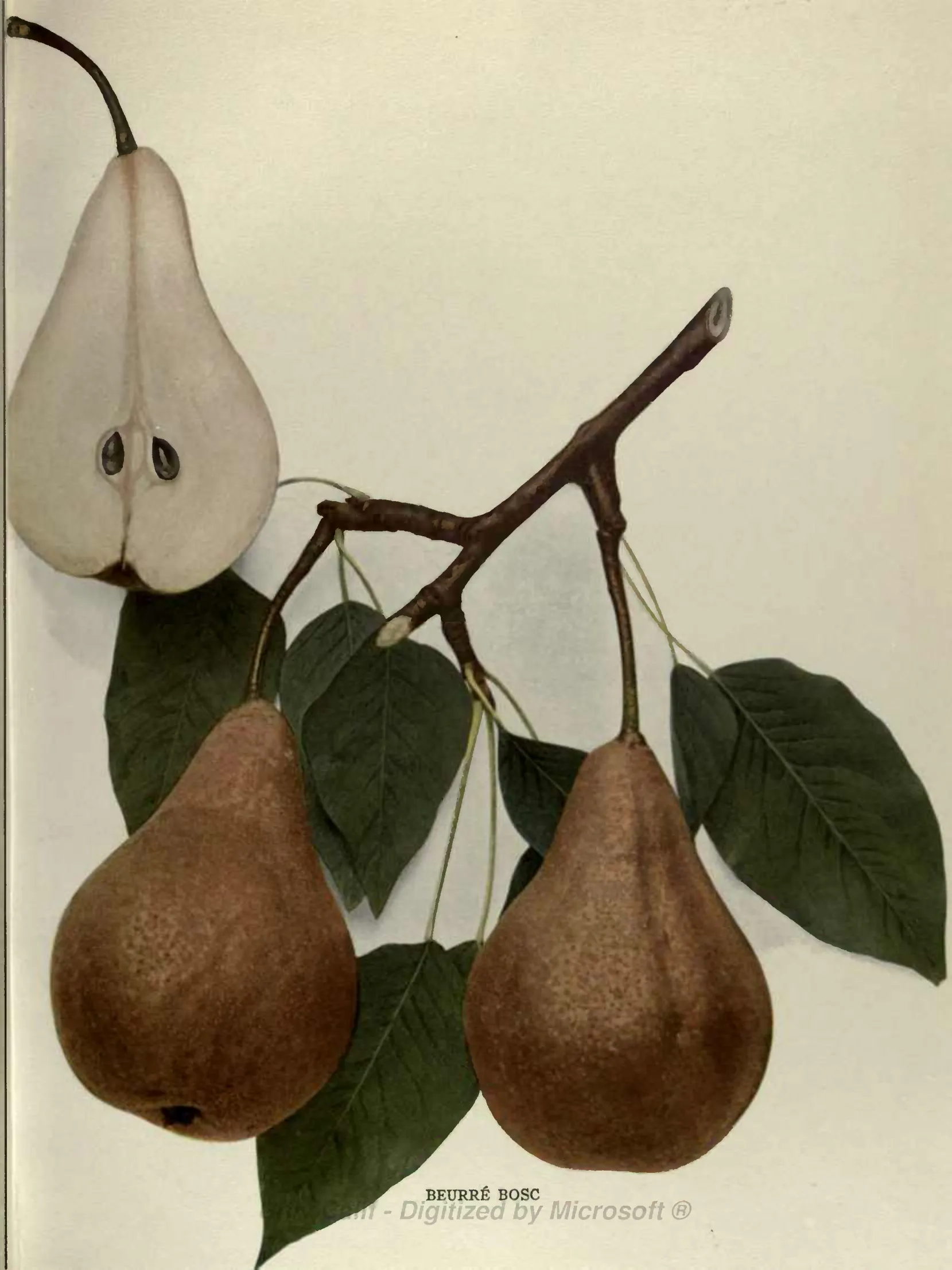
Origin & History
The Beurré Bosc was raised from seed in 1807 by Dr. Van Mons, the renowned pomologist of Louvain, Belgium. It was named by him Calebasse Bosc in honor of M. Bosc — described as "a distinguished Belgian cultivator" by Downing (1900), "a distinguished French naturalist" by Hedrick (1921), and "a distinguished Belgian pomologist" by Hovey (1852). About 1820, it was received at the garden of the Horticultural Society of London under the name Beurré Bosc, and Robert Thompson, then Director of the gardens, thought it best to retain this name as less likely to lead to confusion with the Calebasse, a distinct fruit. The variety was early introduced into France. About 1832 or 1833, Robert Manning and William Kenrick received scions in the United States from Van Mons and from the London Horticultural Society. It first fruited in Manning's collection in 1836, and he gave a brief account of it in the Magazine of Horticulture (vol. iii, p. 47) for 1837 (Hovey). The variety was cataloged by the American Pomological Society at its first meeting in 1848 (Hedrick).
Tree
The tree is medium in size, vigorous, upright-spreading, hardy, and productive, but not an early bearer. The trunk is stocky. Branches are smooth, brownish, covered with ash-gray scarf-skin, with large lenticels. Branchlets are brownish, tinged with gray, glossy, smooth, nearly glabrous, with slightly raised, conspicuous lenticels. Shoots are long, brownish olive, straggling or diverging when young.
In the nursery and while young, the tree is a rather moderate grower, and the shoots bend and incline downwards. Nurserymen complain that it is difficult to propagate, as the trees make a poor growth in the nursery and come to transplanting age with a root system of two or three prongs almost devoid of fibrous roots (Hedrick). The trees must be humored in soil and climate, and under favorable conditions make but moderate growth as young plants. However, when established, the tree thrives well and makes long and vigorous branches. Established trees surpass most of their neighbors in size and luxuriance of foliage, with large, glossy, and ample foliage quite conspicuous among other pear trees (Hovey). Very old trees have a nobility of aspect possessed by few other pears (Hedrick).
The tree is rather late in coming into bearing, generally the fifth or sixth year (Hovey). While slow in coming in bearing, after fruiting begins the trees bear regularly and abundantly. Elliott describes it as an early, annual, and productive bearer on pear roots, in contrast to the other sources' emphasis on slow initial bearing. The pears are borne singly — not in clusters as with most kinds — and on this account the trees have the appearance of having been thinned. The variety does not succeed well on the quince unless double-worked. The trees are tender to cold and somewhat susceptible to blight (Hedrick).
Wood: Brown, dotted with large pale gray specks, long-jointed, and moderately stout. Old wood dull gray brown. Annual shoots rather long. Buds medium size, pointed, little diverging, with prominent shoulders. Flower-buds medium size (Hovey). Leaf-buds obtuse, pointed, appressed; leaf-scars prominent (Hedrick).
Leaves: Hovey describes them as large, broad, and rounded at the base, tapering considerably to the point, thick, dark green, glossy on the upper side, with prominent nerves, slightly undulated and without serratures on the edge; petioles long, about two inches in length, and moderately stout. Hedrick gives measurements of 3 inches long, 1¼ inches wide, ovate, thick, leathery; apex taper-pointed; margin finely crenate; petiole 1¼ inches long. Note: Hovey describes the leaf margin as "without serratures" while Hedrick describes it as "finely crenate" — a direct conflict.
Flowers: Large. Petals narrow, with a long claw and little cupped (Hovey). Flowers open early, 1¼ inches across, showy, in dense clusters, from 10 to 20 buds in a cluster; pedicels 1 inch long, slightly pubescent, light green (Hedrick).
Fruit
Size: Large. Hedrick gives dimensions of 3½ inches long by 2½ inches wide. Hovey gives about 4 inches long by 3 inches in diameter. Uniform in size (Hedrick). The fruit bears singly and not in clusters, whence it is always of fine size (Downing). Elliott notes the fruit varies some in size and form but is always fair and smooth.
Form: Pyriform, with a very long, tapering neck — a shape wholly unlike any other pear (Hedrick). Downing describes it as pyriform, a little uneven, often tapering long and gradually into the stalk. Hedrick terms it acute-obovate-pyriform, with a very long tapering neck, uniform in shape and very symmetrical, perfectly symmetrical and unequalled in trimness of contour. Hovey describes it as pyramidal, a little uneven on the surface, large, full, and round at the base, contracted near the middle, and from thence gradually tapering to the stem. Elliott calls it obovate acute pyriform.
Stem: One to two inches long (Downing), or about one and a half inches (Hedrick, Hovey); curved, rather slender. Light brown (Hovey). Elliott describes it as usually long and slender.
Cavity: Very obtuse or lacking, occasionally very shallow and narrow, wrinkled, russeted, with a fleshy ring folded up around the stem, slightly lipped (Hedrick).
Calyx: Downing describes it as short, set in a very shallow basin. Hedrick describes the calyx as open, small, with lobes short, broad, and obtuse. Hovey describes the eye as small and closed, with segments of the calyx short. Elliott describes it as medium, with segments partially erect. Note: Hovey says "closed" while Hedrick says "open" — a direct conflict.
Basin: Very shallow, narrow, obtuse, smooth, and symmetrical (Hedrick). Round and shallow, sometimes a little uneven (Elliott).
Skin: Pretty smooth (Downing) to slightly granular, tender, and roughened by russet (Hedrick). The color is dark yellow, a good deal covered with streaks and dots of cinnamon russet. Hedrick describes the color as dark yellow overspread with thick, dark russet laid on in streaks and patches, with a cheek of solid russet, and the overall appearance as dull. Hovey describes the skin as nearly smooth, bright cinnamon russet all over, with occasional rough patches of a darker shade, and a few scattered blackish dots. Elliott gives dark yellow, nearly covered, dotted and marbled with cinnamon russet, with slight brownish red in the sun. Downing notes it is slightly touched with red on one side. Dots are small, light russet, and obscure (Hedrick).
Flesh & Flavor: The flesh is white (Downing, Elliott) to yellowish-white (Hedrick, Hovey), melting, very buttery, and very juicy. Downing describes a "rich, delicious, and slightly perfumed flavor." Hedrick describes the flesh as slightly granular, tender and melting, buttery, very juicy, "with a rich, delicious, aromatic flavor; quality very good to best." Hovey describes it as "fine, buttery, melting, and juicy" with a "rich, sugary, perfumed, and delicious" flavor. Elliott describes it as "melting, juicy, sweet, perfumed." The Seckel alone surpasses it as a dessert fruit in the estimation of most pear fanciers (Hedrick). The fruits seldom crack, scab, or mildew (Hedrick). Downing rates it "Best."
Core & Seeds: Core size is described variously: large, closed, with clasping core-lines; calyx-tube short, wide, conical (Hedrick); medium size (Hovey); small (Elliott). Seeds are wide, short, plump, and obtuse (Hedrick); medium size, dark brown (Hovey); blackish (Elliott).
Season
Ripens gradually. Downing gives the last of September to the last of October. Hedrick gives late October and November. Hovey gives September and October. Elliott gives October, or last of September.
Uses
Recommended for the home, for local and general markets, and for exportation (Hedrick). Elliott states it should have a place in the smallest collection. Hovey concurs that it cannot be omitted from the smallest collection of pears.
Subtypes & Variants
Not described in sources.
Book Sources
Described in 4 period pomological works
Nursery Catalog Sources
Found in 68 catalogs (1845–1947) from Alabama, California, England, Illinois, Maryland, Massachusetts, Missouri, New Jersey, New York, Oregon, Pennsylvania, Washington
- Winship's Nursery (Brighton Nurseries , operated by the Winship family), Brighton (Boston) , Massachusetts — 1845
- Hovey & Co. , Cambridge , Massachusetts — 1849
- Azell Bowditch (Nursery / Fruit Catalog) , Boston , Massachusetts — 1850
- Joseph Breck & Co. , Boston , Massachusetts — 1855
- Hutchison Nursery , James Hutchison, Oakland , California — 1881
- Felix Gillet , Barren Hill Nursery, Nevada City , California — 1884
- Huntsville Wholesale Nurseries (Jessie S. Moss , Proprietor; W.F. Heikes, Manager), Huntsville , Alabama — 1886
- W.R. Strong & Co. , Capital and Orange Hill Nurseries (Robert Williamson, prop.), Sacramento , California — 1886
- Felix Gillet , Barren Hill Nursery, Nevada City , California — 1888
- Felix Gillet , Barren Hill Nursery, Nevada City , California — 1889
- Felix Gillet , Barren Hill Nursery, Nevada City , California — 1890
- William H. Moon Co. , Morrisville, Bucks County , Pennsylvania — 1890
- Felix Gillet , Barren Hill Nursery, Nevada City , California — 1891
- Milwaukie-Canby Nurseries , Canby, OR (and Milwaukie, OR) — 1893
- Rogers Nursery Co. , Moorestown , New Jersey — 1893
- Green's Nursery Co. (Charles A. Green) , Rochester , New York — 1894
- Multnomah Nurseries , Russellville , Oregon — 1894
- The Vineland Nurseries (Kelsey & Co. , Proprietors), St. Joseph, Missouri (Office: 13th and Atchison Sts., 2 Blocks East of the Citizens St. Car Line) — 1894
- Felix Gillet , Barren Hill Nursery, Nevada City , California — 1895
- Felix Gillet , Barren Hill Nursery, Nevada City , California — 1897
- Kelway & Son , Langport, Somerset , England — 1897
- Arthur J. Collins & Sons , Moorestown , New Jersey — 1898
- Reading Nursery , Jacob W. Manning, Proprietor, Reading , Massachusetts — 1898
- Brown Brothers Co. , Continental Nurseries, Rochester, NY (also operated from Toronto, Canada) — 1899
- George Bunyard & Co. , Royal Nurseries, Maidstone, Kent , England — 1900
- Washington Nursery Co. , Toppenish , Washington — 1901
- Brown Brothers Co. , Continental Nurseries, Rochester, NY (also operated from Toronto, Canada) — 1901
- S.L. Watkins , Grizzly Flats, El Dorado County , California — 1901
- Forestville Nurseries , T.J. True, Forestville , California — 1902
- Phoenix Nursery Company (W. E. Rossney , President; Sidney Tuttle, Vice-President), Bloomington , Illinois — 1904
- The Dalles Nurseries , The Dalles , Oregon — 1906
- Stark Bros. Nurseries & Orchards Co. , Louisiana , Missouri — 1906
- J.B. Pilkington , Portland , Oregon — 1907
- Russellville Nursery Co. , Montavilla Station, Portland, OR (three miles east of Portland, one mile from Montavilla car line) — 1907
- Carlton Nursery Co. , Carlton , Oregon — 1909
- Wm. J. Corse (successor to Robert Sinclair / Sinclair Nurseries) , Baltimore , Maryland — 1909
- Washington Nursery Company , Toppenish , Washington — 1909
- C.F. Lansing , Salem , Oregon — 1910
- Island Nurseries & Fruit Farm , Vashon (Vashon Island) , Washington — 1910
- Stark Bros. Nurseries & Orchards Co. , Louisiana , Missouri — 1910
- Island Nurseries & Fruit Farm , Vashon (Vashon Island) , Washington — 1911
- Stark Bros. Nurseries & Orchards Co. , Louisiana , Missouri — 1911
- James Veitch & Sons , Ltd., Royal Exotic Nursery, Chelsea, London (also Coombe Wood, Langley, and Feltham) , England — 1911
- Ballygreen Nurseries , Hanford , Washington — 1912
- Pacific Nursery Company , Portland , Oregon — 1912
- Stark Bros. Nurseries & Orchards Co. , Louisiana , Missouri — 1912
- Washington Nursery Company , Toppenish , Washington — 1912
- J. B. Pilkington , Nurseryman, Portland, OR (nurseries near Newberg, forty miles from Portland) — 1913
- Samuel Fraser , Geneseo , New York — 1913
- Thomas Rivers & Son , Sawbridgeworth, Hertfordshire , England — 1913
- Island Nurseries & Fruit Farm , Vashon (Vashon Island) , Washington — 1914
- George Bunyard & Co. , Royal Nurseries, Maidstone, Kent , England — 1914
- Island Nurseries & Fruit Farm , Vashon (Vashon Island) , Washington — 1915
- Union Nurseries , J.B. Weaver & Sons, Union , Oregon — 1915
- Island Nurseries & Fruit Farm , Vashon (Vashon Island) , Washington — 1916
- Manalapan Nurseries , Englishtown , New Jersey — 1916
- Island Nurseries & Fruit Farm , Vashon (Vashon Island) , Washington — 1917
- George Bunyard & Co. , Royal Nurseries, Maidstone, Kent , England — 1917
- Fancher Creek Nurseries , George C. Roeding, Fresno , California — 1918
- Oregon Nursery Co. , Orenco , Oregon — 1920
- Benedict Nursery Co. , Portland , Oregon — 1921
- Island Nurseries & Fruit Farm , Vashon , Washington — 1921
- Columbia & Okanogan Nursery Co. , Wenatchee , Washington — 1925
- OSU Bulletin 216 — 1925
- Hudson's Wholesale Nurseries , Tangent , Oregon — 1926
- Stark Bro's Nurseries , Louisiana , Missouri — 1932
- Milton Nursery Co. , Milton-Freewater , Oregon — 1947
- Rich & Sons Nursery , Hillsboro , Oregon
View original book sources (4)
— A.J. Downing, The Fruits and Fruit Trees of America (1900)BEURRÉ BOSC.
Bosc's Flaschenbirne. Calebasse Bosc. Cannelle.
The Beurré Bosc is a Pear to which we give our unqualified praise. It is large, handsome, a regular bearer, always perfect, and of the highest flavor. It bears singly, and not in clusters, looking as if thinned on the tree, whence it is always of fine size. It was raised in 1807, by Van Mons, and named Calebasse Bosc in honor of M. Bosc, a distinguished Belgian cultivator. Having also been received at the garden of the Horticultural Society of London under the name of Beurré Bosc, Mr. Thompson thought it best to retain this name, as less likely to lead to a confusion with the Calebasse, a distinct fruit. The tree grows vigorously. Shoots long, brownish olive.
Fruit large, pyriform, a little uneven, often tapering long and gradually into the stalk. Skin pretty smooth, dark yellow, a good deal covered with streaks and dots of cinnamon russet, and slightly touched with red on one side. Stalk one to two inches long, rather slender, curved. Calyx short, set in a very shallow basin. Flesh white, melting, very buttery, with a rich, delicious, and slightly perfumed flavor. Best. Ripens gradually from the last of September to the last of October.
— U.P. Hedrick, The Pears of New York (1921)BEURRÉ BOSC
- Kenrick Am. Orch. 161. 1832. 2. Downing Fr. Trees Am. 358, fig. 152. 1845. 3. Proc. Nat. Cong. Fr. Gr. 29, 51. 1848. 4. Hovey Fr. Am. 1:65, Pl. 1851. 5. Ann. Pom. Belge 5:79, Pl. 1857. 6. Leroy Dict. Pom. 1:320, fig. 1867. 7. Hogg Fruit Man. 514. 1884. Bosc's Butterbirne. 8. Dochnahl Führ. Obstkunde 2:100. 1856. Beurré d'Apremont. 9. Pom. France 1: No. 26, Pl. 26. 1863. 10. Mas Le Verger 3: Pt. 2, 65, fig. 129. 1866-73. 11. Guide Prat. 48, 230. 1895. Bosc. 12. Am. Pom. Soc. Cat. 36. 1883. Bosc's Flaschenbirne. 13. Lauche Deut. Pom. II: No. 75, Pl. 75. 1883. 14. Mathieu Nom. Pom. 188. 1889. 15. Deut. Obstsorten 2: Pt. 5, Pl. 1906.
The fruits of Beurré Bosc merit unqualified praise. They are nearly flawless in every character. The pears at once receive approbation from all who see them by virtue of their uniquely beautiful color and shape, in which characters they are wholly unlike any other pear. The shape is pyriform, with a very long, tapering neck, perfectly symmetrical and unequalled in trimness of contour. The color is a dark rich yellow overspread with cinnamon-russet, with here and there a spot of the yellow ground color visible. The quality is rated by all as "very good" or "best;" the Seckel alone surpasses it as a dessert fruit in the estimation of most pear fanciers. The flesh, while slightly granular, is tender and melting or almost buttery, very juicy, with a rich piquant flavor and a pleasing aroma. The fruits seldom crack, scab, or mildew. The characters of the tree fall far short of those of the fruits. Nurserymen complain that it is difficult to propagate the trees as they make a poor growth in the nursery and come to transplanting age with a root system of two or three prongs almost devoid of fibrous roots. The trees must be humored in soil and climate, and under favorable conditions make but moderate growth as young plants. Established trees in suitable soils, however, surpass most of their neighbors in size and luxuriance of foliage. Very old trees have a nobility of aspect possessed by few other pears. While slow in coming in bearing, after fruiting begins the trees bear regularly and abundantly. The variety does not succeed well on the quince unless double-worked. Unfortunately, the trees are tender to cold and somewhat too susceptible to blight. Beurré Bosc has long been a favorite in the pear regions of Europe and America, and its culture in this country may be recommended for the home, for local and general markets, and for exportation.
This pear is a native of Belgium, having been raised from seed in 1807 by Dr. Van Mons, the renowned pomologist of Louvain, and was in the first instance named by him Calebasse Bosc in honor of M. Bosc, a distinguished French naturalist. In 1820, it was received at the garden of the Horticultural Society of London under the name Beurré Bosc, and Robert Thompson, at that time Director of the gardens, thought it best to retain this name. The variety was early introduced into France. About 1832 or 1833, Robert Manning and William Kenrick received cions in the United States from Van Mons and from the London Horticultural Society. The variety was cataloged by the American Pomological Society at its first meeting in 1848.
Tree medium in size, vigorous, upright-spreading, hardy, productive, not an early bearer; trunk stocky; branches smooth, brownish, covered with ash-gray scarf-skin, with large lenticels; branchlets brownish, tinged with gray, glossy, smooth, nearly glabrous, with slightly raised, conspicuous lenticels.
Leaf-buds obtuse, pointed, appressed; leaf-scars prominent. Leaves 3 in. long, 1¼ in. wide, ovate, thick, leathery; apex taper-pointed; margin finely crenate; petiole 1¼ in. long. Flower-buds large, conical, pointed, free; flowers open early, 1¼ in. across, showy, in dense clusters, from 10 to 20 buds in a cluster; pedicels 1 in. long, slightly pubescent, light green.
Fruit ripe in late October and November; large, 3½ in. long, 2½ in. wide, uniform in size, acute-obovate-pyriform, with a very long, tapering neck, uniform in shape and very symmetrical; stem 1½ in. long, curved; cavity very obtuse or lacking, occasionally very shallow and narrow, wrinkled, russeted, with a fleshy ring folded up around the stem, slightly lipped; calyx open, small; lobes short, broad, obtuse; basin very shallow, narrow, obtuse, smooth, symmetrical; skin slightly granular, tender, roughened by russet, dull; color dark yellow, overspread with thick, dark russet, laid on in streaks and patches, with a cheek of solid russet; dots small, light russet, obscure; flesh yellowish-white, slightly granular, tender and melting, buttery, very juicy, with a rich, delicious, aromatic flavor; quality very good to best. Core large, closed, with clasping core-lines; calyx-tube short, wide, conical; seeds wide, short, plump, obtuse.
— C.M. Hovey, The Fruits of America (1852)THE BEURRÉ BOSC PEAR.
Beurre Bosc. Lon. Hort. Soc. Catalogue, 2d Ed. 1831.
Calebasse Bosc, Beurré d'Yelle, of some, } Lon. Hort. Soc. Cat., 3d Ed. 1842. Marianne Nouvelle, Bosc's Flaschenbirne,
The Beurré Bosc has such a high and well known reputation, that it would seem almost superfluous to recapitulate its merits. Since its introduction to our gardens it has continued to be a general favorite, and it has been set down as a variety which cannot be omitted from the smallest collection of pears. It is a moderately vigorous and healthy growing tree, with large, glossy, and ample foliage, — quite conspicuous, in this respect, among other pear trees, — and, when loaded with its large, bell-shaped, rich-looking russety fruit, distributed evenly, but not thickly, over the branches, no pear has a more noble and attractive aspect.
The Beurré Bosc was raised as long ago as 1807. It was one of the early acquisitions of Van Mons, when his system of producing seedlings first began to attract attention ; and was named by him in honor of his friend, M. Bosc, a distinguished Belgian pomologist. It was sent to the London Horticultural Society about 1820, and was introduced into American collections in 1832 or 1833, when scions were received, by Messrs. Manning and Kenrick, from Dr. Van Mons and the London Horticultural Society about the same time. It first fruited in Mr. Manning's collection in 1836, and he gave a brief account of it in the Magazine of Horticulture, (vol. iii. p. 47,) for 1837.
The Beurré Bosc, in the nursery and while young, is a rather moderate grower, and the shoots bend and incline downwards ; but when it gets established it thrives well, and makes long and vigorous branches. It does not succeed very well upon the quince unless double worked. It is rather late in coming into bearing, generally the fifth or sixth year ; but when it begins to fruit it produces regular crops, the pears being borne singly — not in clusters as with most kinds — and, on this account, the trees have the appearance of having been thinned.
Tree. — Vigorous, somewhat irregular and diverging while young, but, with age, attaining an upright and spreading habit.
Wood. — Brown, dotted with large pale gray specks, long-jointed, and moderately stout ; old wood, dull gray brown ; annual shoots rather long ; buds, medium size, pointed, little diverging, with prominent shoulders : Flower-buds medium size.
Leaves. — Large, broad, and rounded at the base, tapering considerably to the point, thick, dark green, glossy on the upper side, with prominent nerves, slightly undulated and without serratures on the edge ; petioles long, about two inches in length, and moderately stout.
Flowers. — Large ; petals narrow, with a long claw and little cupped.
Fruit. — Large, about four inches long, and three in diameter : Form, pyramidal, little uneven on the surface, large full and round at the base, contracted near the middle, and from thence gradually tapering to the stem : Skin, nearly smooth, bright cinnamon russet all over, with occasional rough patches of a darker shade, and a few scattered blackish dots : Stem, long, about one and a half inches in length, curved, rather slender, light brown ; Eye, small, closed, and but slightly depressed in a shallow basin ; segments of the calyx short : Flesh, yellowish white, fine, buttery, melting, and juicy : Flavor, rich, sugary, perfumed, and delicious : Core, medium size : Seeds, medium size, dark brown.
Ripe in September and October, and matures gradually.
— F.R. Elliott, The Western Fruit Book (1865)Beurre Bosc.
Calebasse Bosc, | Marianne Nouvelle, | Bosc's Flaschenbirne.
A foreign variety, raised in 1807, by Van Mons. It is an early, annual, and productive bearer on the pear roots, and should have a place in the smallest collection. Tree, vigorous, with long brownish olive shoots straggling or diverging. The fruit varies some in size and form, as see our checked outline in engraving, but it is always fair and smooth.
Fruit, large, obovate acute pyriform ; color, dark yellow, nearly covered, dotted and marbled with cinnamon russet, slight brownish red in sun ; stem, usually long, slender ; calyx, medium, segments partially erect ; basin, round, shallow, sometimes a little uneven : core, small ; seeds, blackish; flesh, white, melting, juicy, sweet, perfumed. October, or last of September.