Rousselet Hatif
Pear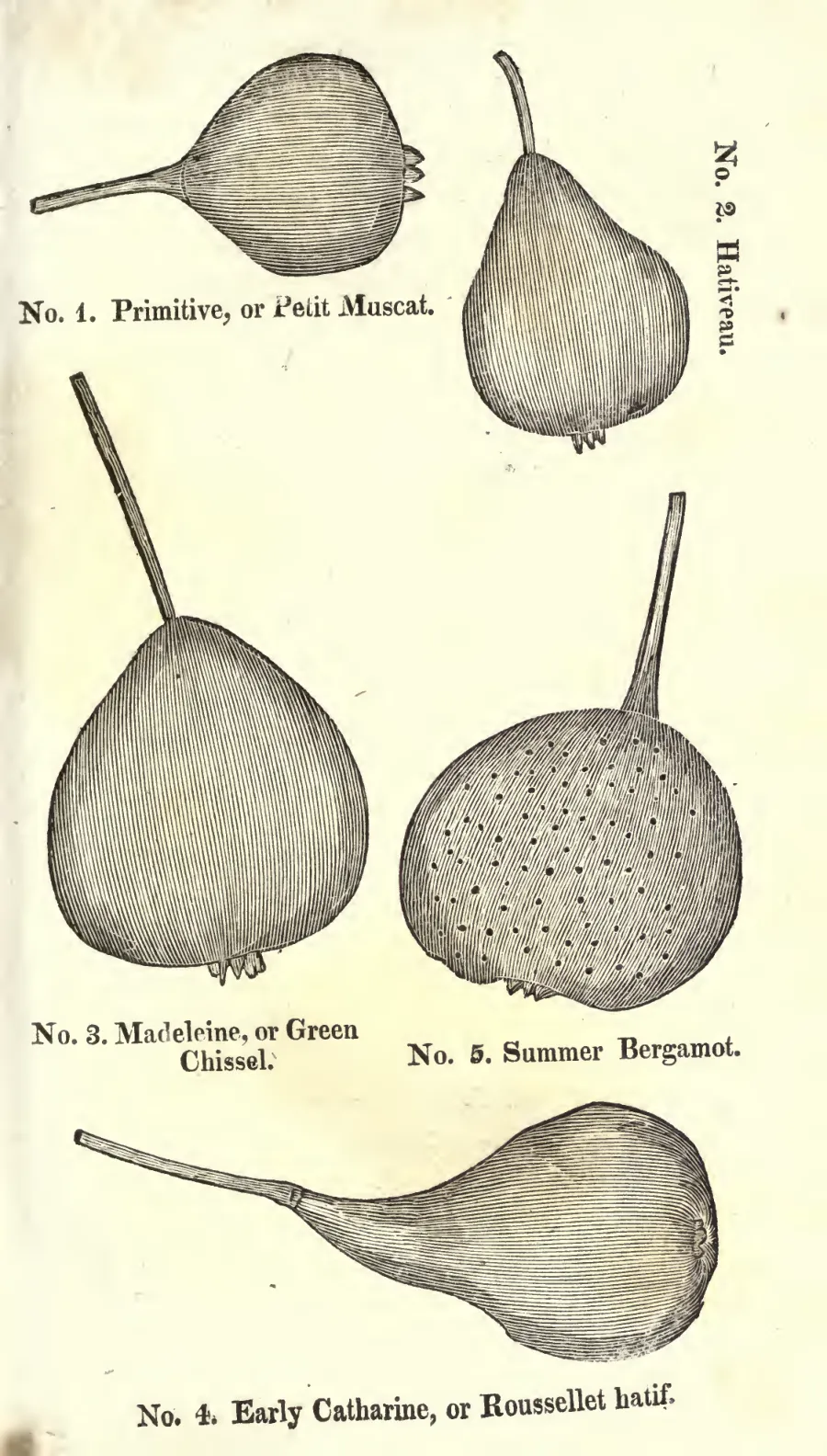
Rousselet Hatif
Origin / History
Origin uncertain, though probably French; according to Le Lectier, it was under cultivation at Orleans, France, in 1600 (Hedrick). Hedrick's references run from Duhamel (1768), through Downing (1869), where it stands as "Early Rousselet," to Hogg's Fruit Manual (1884). Coxe (1817) entered it as "Early Catharine or Rousselet Hatif." He called it "more generally admired than any summer pear."
Tree
Growth very vigorous. The tree grows to a large size before it bears and is then very fruitful (Coxe); productive. Limbs long, hanging like a willow when full of fruit (Coxe). Branches long, slender, of a dark dull reddish-brown color (Downing).
Fruit
Size: Rather small to small (Downing, Hedrick). Coxe's entry closes, after the growth of the tree, with "the size large."
Form: Pyriform, the sides often unequal (Hedrick). Downing calls it acute pyriform, and Hedrick slightly obtuse. Coxe likens the form to a calabash, with a long curved neck.
Stem: Long, fleshy (Coxe).
Cavity: Not described in source.
Calyx: Not described in source.
Basin: Not described in source.
Skin: Fine (Hedrick). The ground is yellow, lemon-yellow on the shaded side in Hedrick's account. On the sunny side it is brownish red: a brownish-red cheek when fully ripe, a rich russet or brownish red in Coxe's account, and vivid red in Hedrick's.
Dots: Gray spots sprinkled over the red of the side next the sun (Hedrick).
Flesh and flavor: Flesh yellowish, semi-breaking and crisp (Hedrick). Hedrick calls the flesh fine, while Downing calls it "a little coarse-grained." Sweet, pleasant, and slightly perfumed (Downing). Juice well perfumed, saccharine, abundant and aromatic (Hedrick). Coxe calls the fruit "remarkably fine, rich, waxy and luscious." Hedrick rates it "second."
Core and seeds: Apt to rot at the core.
Season
A summer pear. Coxe and Hedrick place ripening about the middle of July; Downing gives the middle of August. Coxe advises that the fruit "should be always suffered to hang on the tree till ripe."
Uses
Not described in source.
Subtypes / Variants
Not described in source.
Other
Not described in source.
Book Sources
Described in 4 period pomological works
- Coxe, A View of the Cultivation of Fruit Trees (1817) — listed as Early Catharine Or Rousselet Hatif
- Downing, Fruits and Fruit Trees of America (1900)
- Hedrick, The Pears of New York (1921)
- Thomas, The American Fruit Culturist (1903)
Nursery Catalog Sources
Found in 1 catalog (1845) from Massachusetts
- Winship's Nursery (Brighton Nurseries , operated by the Winship family), Brighton (Boston) , Massachusetts — 1845
View original book sources (4)
— William Coxe, A View of the Cultivation of Fruit Trees (1817)
- EARLY CATHARINE OR ROUSSELET HATIF.
This is more generally admired than any summer pear—it is remarkably fine, rich, waxy and luscious: its form is somewhat like a calabash, with a long curved neck, and a long fleshy stem, the skin is on one side yellow, the other a rich russet, or brownish red—the tree grows to a large size before it bears, it is then very fruitful. The limbs are long, and when full of fruit, hang like a willow—this pear should be always suffered to hang on the tree till ripe; the growth of the tree is very vigorous; the size large; the time of the fruit ripening is about the middle of July.
— A.J. Downing, The Fruits and Fruit Trees of America (1900)Rousselet Hatif.
Early Catharine. Early Rousselet. Kattern. Perdreau. Cyprus Pear. Poire de Chypre.
The Rousselet Hatif is productive, with long slender branches, of dark dull reddish brown color.
Fruit rather small, acute pyriform. Skin, when fully ripe, yellow, with a brownish-red cheek. Flesh a little coarse-grained, sweet, pleasant, and slightly perfumed. Ripens the middle of August. Apt to rot at the core.
— John J. Thomas, The American Fruit Culturist (1903)[No entry for 'Rousselet Hatif' found on page 790. This page contains alphabetical entries from 'Duchesse' through 'Eugene Appert'. The variety 'Rousselet Hatif' (French for 'Early Rousselet') would appear in the 'R' section of the book on a later page. The entry for 'Early Rousselet' appears here as: 'Early Rousselet. Rather small, pyriform, yellow and brownish-red; sweet, pleasant, perfumed; rots at core. August.']
[Additional entry in this volume: "Early Rousselet", pp. 790–790]
Early Rousselet. Rather small, pyriform, yellow and brownish-red; sweet, pleasant, perfumed; rots at core. August.
— U.P. Hedrick, The Pears of New York (1921)Rousselet Hatif.
i. Duhamel Trait. Arb. Fr. 2:148. 1768. 2. Downing Fr. Trees Am. 846. 1869. Early Rousselet. 3. Hogg Fruit Man. 571. 1884.
The origin of this pear is uncertain though it was probably French, for in 1600 it was under cultivation at Orleans, Fr., according to Le Lectier. Fruit small, pyriform, slightly obtuse, sides often unequal; skin fine, lemon-yellow on the shaded side, and vivid red sprinkled with gray spots on the side next the sun; flesh yellowish, fine, semi-breaking and crisp; juice well perfumed, saccharine, abundant and aromatic; second; mid-July.