Beurré Diel
Pear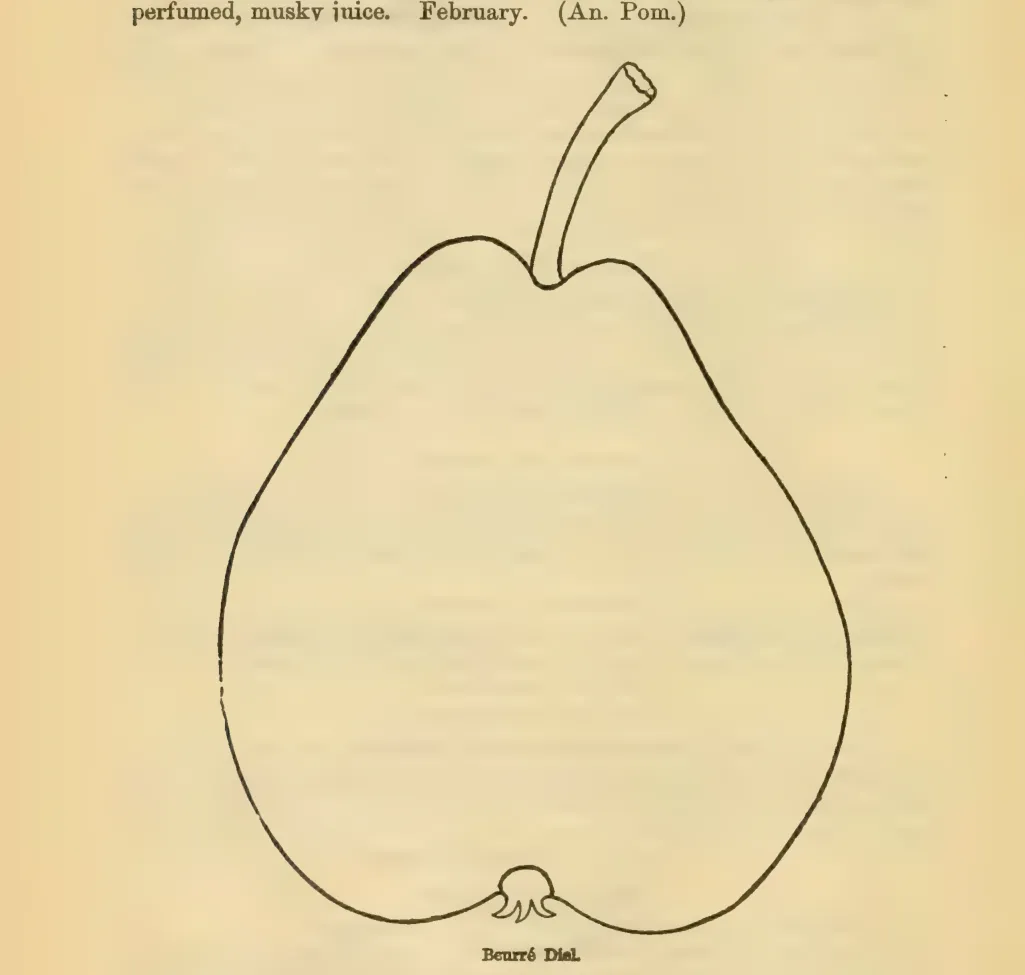
Beurré Diel
Origin / History
Belgian; Elliott lists it simply as foreign. Lindley says it was raised by Dr. Van Mons at Louvain, and Hovey calls it one of Van Mons' early seedlings, "raised as long ago as 1805." Downing and Hedrick give it as a chance seedling found near Brussels. Hedrick says it was found in 1805 by M. Meuris, head gardener for Van Mons, and that Van Mons dedicated it because it was unnamed and of fine quality. Bunyard says Meuris, Van Mons' gardener, found it about 1800 at the Chateau of Perck near Vilvorde, which once belonged to the painter David Teniers. It was named in honor of Dr. Augustus Frederick Adrian Diel (Downing spells it "Adrien"), Van Mons' friend and one of the most distinguished German pomologists.
Van Mons sent scions to the London Horticultural Society in 1817, and it soon after produced fruit in the Society's garden. In 1823 Thomas Andrew Knight sent scions, in a liberal donation through the Hon. John Lowell, to the Massachusetts Agricultural Society. From there it became disseminated generally throughout the United States. The American Pomological Society placed it on its catalog list in 1854. It was planted for test at the Central Experimental Farm, Agassiz, British Columbia, in spring 1890.
Lindley calls it "This noble Pear," whose great merit, independently of its excellence, is its fertility. Hovey writes that "If the epithet of a noble pear belongs to any variety, the Beurré Diel unquestionably deserves that appellation. It is a noble fruit, in every sense of the word." He praises it as "of handsome form," ripening late in the season when there are but few good pears, and "one of the very best which has been added to our collections." Downing says its "vigor, productiveness, and beauty" had made it "already a general favorite with our planters." Budd and Hansen report it much grown for market in New York and Michigan. Veitch calls it "One of the finest pears." Bunyard calls it "a pear which is still very largely grown despite many detractors."
Hedrick dissents: "The catalogs and text-books supply Beurré Diel with several virtues which Nature denies it as the variety grows in New York." He finds the pears in the eastern United States "dull and unattractive even at maturity," and concludes that "The variety is still being planted, but there are better autumn pears."
Tree
Vigorous to very or uncommonly vigorous, a free and strong grower acquiring considerable size. Hovey calls it one of the most vigorous and beautiful growing pear trees, conspicuous for its large, deep green, glossy leaves and smooth, clean bark, and valuable as an ornamental. Hedrick's introduction calls it hardy and uncommonly vigorous. His technical description gives the tree as medium in size and vigor, spreading, open-topped, slow-growing, and hardy, with trunk slender and smooth.
Branches long and twisting, needing to be pruned back heavily (Hedrick). Downing calls them very stout; Hedrick's technical description calls them slender. Shoots large, spreading, irregular. The lateral shoots are horizontal and often curved when young, and the tree assumes an upright and tolerably regular form as it grows older (Hovey). Annual wood long and remarkably stout.
Wood strong, flexuose, downy at the ends (Lindley), moderately long-jointed (Hovey). Its color is given as olive-green (Lindley), olive brown (Elliott), or grayish brown (Hovey). Downing gives the young shoots as "reddish yellow grayish brown." Hedrick gives the branches as reddish-brown mingled with grayish scarf-skin, and the branchlets as dark reddish-brown, smooth, glabrous, with short internodes. Old wood light gray or grayish olive. Specks a few scattered oval ash-colored spots, or large, oblong, grayish specks; Hedrick gives few lenticels, small and raised on the branchlets.
Buds medium size, broad, rather sharply pointed, erect, the ends curved inward, with prominent shoulders, and flower-buds medium size, ovate (Hovey). Hedrick gives leaf-buds obtuse and free, with prominent leaf-scars, and flower-buds large, long, conical, rather plump, and free.
Leaves large, thick, smooth, roundish, roundish ovate, broadly cordate, or round pointed. Hovey gives them as largest about the middle, shortly pointed, nearly flat, and dark green. Hedrick gives them as oval and leathery, 2½ in. long and 1½ in. wide, the apex abruptly pointed. Margin finely and irregularly serrated; Bunyard says sometimes finely, sometimes very coarsely. Petiole stout, of medium length, about 1¼ in. (Hovey); Hedrick gives ¾ in. (1½ in. in his Cyclopedia).
Flowers large, showy, opening early; petals round, cupped, with a rather short claw (Hovey). Hedrick gives them as nearly 1½ in. across (1¼ in. in his Cyclopedia), in dense clusters of 7 or 8 buds, on pedicels 1⅛ in. long, pubescent and greenish. Veitch calls it "a good flower."
Very productive, prolific, a good bearer of abundant crops, its fertility great. Lindley says it is fertile both trained on a wall and as a standard, and in the former case succeeds perfectly on an eastern aspect. Veitch calls it good wall fruit, and the George Bunyard & Co. catalog calls it fine for walls and standards. It succeeds well on quince stocks, growing very freely and soon acquiring a good size there; Elliott says it grows and fruits well on pear or quince but is best on quince. Very subject to blight (Hedrick).
Fruit
Size: Large to very large, uniform in size (Hedrick). Hovey calls it "of the very largest size." Lindley compares it to the Summer Bonchretien in size and figure and gives 3 in. broad and 4 in. long when in perfection. Hovey gives about 3½ in. long and 3 in. in diameter, and Hedrick 3 in. long and 2½ in. wide (3½ in. long in his Cyclopedia).
Form: Obovate to obtuse pyriform, or thick pyriform with a short, obtuse neck and a very large body; small specimens approach obovate. Swollen about or a little above the middle and full at the crown. It goes off to the eye either abruptly or gradually and tapers straight to an obtuse point at the stem without any contraction of figure. Lindley notes it is without the protuberances of the Summer Bonchretien. Slightly to often irregular, the surface rather uneven, the sides usually unequal (Hedrick). Bunyard calls it round oval and even, always, however, showing a certain flattening at the sides.
Stem: Stout to very stout, thick, strong, woody, curved, slightly curved, or nearly always curved. Most authors give 1 to 1¾ in., clustering at about 1½ in., and Hovey calls it rather long. Budd and Hansen write "from one to one-quarter inches." Bunyard alone gives a stem of ¾ in.
Cavity: Narrow, contracted, or very narrow, uneven, furrowed. The sources conflict on depth. Lindley sets the stalk in a deep, funnel-shaped hole and Hovey deeply in a contracted cavity, and Thomas calls it moderately sunk. Hedrick calls the cavity obtuse, shallow, russeted, and often lipped, and Bunyard gives only a very slight depression.
Calyx: Lindley calls the eye close and Downing the calyx nearly closed. Hovey, Elliott, and Bunyard call it open, and Hedrick partly open. Eye medium to large. Segments long, narrow, and projecting (Hovey), or erect (Bunyard); Hedrick gives the lobes as separated at the base, broad, acute. Calyx-tube short, wide, conical (Hedrick).
Basin: Ridged, furrowed or slightly furrowed, irregular, uneven, abrupt (Elliott). Lindley sets the eye in a deep cavity surrounded by knobs, ribs, or broad protuberances, and Hovey considerably depressed. Hedrick calls the basin shallow and obtuse, and Bunyard small.
Skin: Rather thick to very thick, granular, slightly rough to rough, uneven, roughened by russet markings and dots. Dull green or bright green, becoming yellow at maturity. The mature color is bright, deep, dull, or pale lemon yellow, becoming orange yellow, or bright orange (Lindley). The George Bunyard & Co. catalog gives "pretty golden yellow" and "dark golden." Hedrick's Cyclopedia gives dull greenish-yellow changing to lemon-yellow. Russet ranges from little trace, occasionally spotted (Lindley), or some to slight russet, to marblings, markings, flecks, and irregular patches. Elliott adds greenish brown patches. Hedrick gives a faint pinkish-red blush, and Bunyard a slight red-brown flush in favorable seasons. Hedrick finds it dull and unattractive in the eastern United States even when the pale lemon color is brightest.
Dots: Numerous, large, prominent, very conspicuous, russet or brown. Lindley says those on fruit from standard trees are usually surrounded with red.
Flesh and flavor: Yellowish white, white or clear white, creamy, or yellowish. Coarse to rather or a little coarse-grained, especially near the core; Budd and Hansen call it "quite fine except at core." A little gritty to quite granular toward the core, otherwise firm becoming tender, melting, perfectly melting, buttery; Downing calls it half melting, buttery and delicious only in good specimens. Juicy to very juicy.
Flavor rich, sugary or saccharine, sweet, aromatic, highly perfumed, delicious, luscious, "without any perceptible mixture of acid" (Lindley). The Agassiz report calls it "sweet and pleasant," and the George Bunyard & Co. catalog "one of the finest flavored autumn pears." Excellence depends on finish: delicious when well kept or well ripened, and "As well finished in France it is delicious" (Bunyard). Downing warns that on very young trees and in cold soils it is apt to be "rather coarse and astringent." Hedrick says that when the tree is ill suited to soil, climate, or care, "the flesh is coarse, the flavor insipid and astringent."
Quality "very good" (Downing, Budd and Hansen, Hedrick). Downing calls it "in every respect a first-rate fruit in favorable situations," and Lindley "of the first rank among dessert Pears." Thomas calls it "fine," Veitch "excellent," and the George Bunyard & Co. catalog "Pretty good." Hedrick calls it excellent, "delicious and ranking among the very best," when happily situated, but second or third rate when ill suited.
Core and seeds: Core very small with narrow cells (Lindley), medium (Hovey), or large, closed, with clasping core-lines (Hedrick). Seeds medium to large, dark brown; Hedrick gives them as wide, long, plump, acute. Lindley says usually abortive, and Hedrick often abortive ("usually plump but quite often abortive" in his Cyclopedia).
Season
The recorded season runs from September into the beginning of January. Most authors give late autumn, October or November through December, ripening in November, or late autumn and early winter. The fruit keeps till the beginning of January, and is fine for late use in December and January. Downing gives September to December in this country if picked and ripened in the house. Hedrick says the pears keep well.
Uses
Dessert, of the first rank among dessert pears (Lindley). Bunyard says that in a cold season it is only fit for stewing. A market pear; the pears ship well (Hedrick).
Subtypes / Variants
Not described in source.
Other
The George Bunyard & Co. catalog entry also carries the notations "? large" and "light, medium."
Book Sources
Described in 9 period pomological works
- Downing, Fruits and Fruit Trees of America (1900)
- Hedrick, The Pears of New York (1921)
- Hedrick, Cyclopedia of Hardy Fruits (1922)
- Bunyard, A Handbook of Hardy Fruits (1920)
- Elliott, The Western Fruit Book (1865)
- Budd & Hansen, Systematic Pomology (1914) — listed as Diel (Beurre Diel)
- Thomas, The American Fruit Culturist (1903) — listed as Diel
- Hovey, The Fruits of America (1852) — listed as THE BEURRÉ DIEL PEAR.
- Lindley, Pomologia Britannica Vol. 1 (1841) — listed as THE BEURRÉ DIEL PEAR
Nursery Catalog Sources
Found in 15 catalogs (1845–1917) from Arkansas, England, Massachusetts, Oregon, Washington
- Winship's Nursery (Brighton Nurseries , operated by the Winship family), Brighton (Boston) , Massachusetts — 1845
- Hovey & Co. , Cambridge , Massachusetts — 1849 — listed as Des Trois Tours
- Hovey & Co. , Cambridge , Massachusetts — 1849
- Azell Bowditch (Nursery / Fruit Catalog) , Boston , Massachusetts — 1850
- Joseph Breck & Co. , Boston , Massachusetts — 1855
- Woodburn Nurseries , Woodburn, Marion Co. , Oregon — 1894
- Kelway & Son , Langport, Somerset , England — 1897
- George Bunyard & Co. , Royal Nurseries, Maidstone, Kent , England — 1900
- Central Experimental Farm , Dominion Department of Agriculture, Agassiz, British Columbia (under test; Bulletin No. 3, Second Series) — 1900
- Yarbrough Bros. , Stephens , Arkansas — 1901
- James Veitch & Sons , Ltd., Royal Exotic Nursery, Chelsea, London (also Coombe Wood, Langley, and Feltham) , England — 1911
- Vineland Nurseries Company , Clarkston , Washington — 1912
- Thomas Rivers & Son , Sawbridgeworth, Hertfordshire , England — 1913
- George Bunyard & Co. , Royal Nurseries, Maidstone, Kent , England — 1914
- George Bunyard & Co. , Royal Nurseries, Maidstone, Kent , England — 1917
View original book sources (12)
— John Lindley, Pomologia Britannica, Vol. 1 (1841)THE BEURRÉ DIEL PEAR.
Beurré Diel. Hort. Soc. Fruit Cat. no. 95, p. 159. Diel's Butterbirne. Diel's versuch einer systematisch. beschreib. in Deutsch. vorhand. Kernobst. vol. xix. p. 70.
This noble Pear was raised by Dr. Van Mons at Louvain, and by him named in honour of Dr. Augustus Frederick Adrian Diel, one of the most distinguished of the German Pomologists. Its great merit, independently of its excellence, is its fertility, both when trained on a wall and as a standard. In the former case, it will succeed perfectly on an eastern aspect. Its period of maturity is the end of November, and it keeps well till the beginning of January. It is of the first rank among dessert Pears.
The tree is a free grower, and acquires considerable size.
WOOD long, strong, flexuose, olive-green, with a few scattered oval spots of an ash colour ; at the ends covered with down : when old, becoming light gray.
LEAVES large, either roundish or broadly cordate, smooth.
FRUIT about the size and figure of the Summer Bonchretien, without the protuberances of that variety ; it is much swoln a little above the middle, going off to the eye either abruptly or gradually, and tapering straight to the stalk without any contraction of figure ; when in perfection, it is 3 inches broad and 4 inches long.
SKIN when the fruit is first gathered bright green, changing in a short time to a bright orange, with little trace of russet ; occasionally it is spotted with russet ; and its dots upon fruit from standard trees are usually surrounded with red.
EYE close, in a deep cavity, surrounded by knobs, ribs, or broad protuberances.
STALK strong, woody, 1½ inch long, inserted in a deep, funnel-shaped hole.
FLESH clear white, a little gritty towards the core, but otherwise perfectly tender and melting, juicy, with a delicious, rich, aromatic, saccharine flavour, without any perceptible mixture of acid.
CORE very small, with narrow cells.
SEEDS usually abortive.
— C.M. Hovey, The Fruits of America (1852)THE BEURRÉ DIEL PEAR.
Beurré Diel. Pomological Magazine, vol. i. pl. 19.
Diel, Diel's Butterbirne. Dorothée Royal, Grosse Dorothée, Beurré Royal, Des Trois Tours, Beurré d'Yelle, (of some,) Gros Dillen, Dillen, De Melon, Melon de Kops, Beurré Magnifique, Beurré Incomparable, Sylvange Verte d'Hiver, of some Collections. } Hort. Soc. Catalogue, 3d Ed. 1842. Fourcroy Bouvier, Thompson, in Gard. Chron., 1845.
If the epithet of a noble pear belongs to any variety, the Beurré Diel unquestionably deserves that appellation. It is a noble fruit, in every sense of the word. Of the very largest size, — of handsome form, — with a deep yellow skin, — a perfectly melting flesh and luscious flavor, — and ripening late in the season, when there are but few good pears, it must be considered one of the very best which has been added to our collections.
The Beurré Diel was one of the early seedlings of Dr. Van Mons, and was raised as long ago as 1805. He first sent scions of it to the London Horticultural Society, in 1817, in whose garden it soon after produced fruit ; and it was first sent to this country by Mr. Knight, in his liberal donation of scions, — through the Hon. John Lowell, — to the Massachusetts Agricultural Society, in 1823. It was named in honor of Dr. Augustus Frederick Adrian Diel, one of the most distinguished German pomological writers.
The Beurré Diel, in addition to the high qualities of its fruit, is one of the most vigorous and beautiful growing pear trees, conspicuous for its large, deep green, glossy leaves, and smooth, clean bark, and is valuable as an ornamental tree. It grows very freely upon the quince, and soon acquires a good size, producing abundant crops.
Tree. — Very vigorous, with the lateral shoots horizontal, and often curved when young, but, as it becomes older, assuming an upright and tolerably regular form ; annual wood long and remarkably stout.
Wood. — Grayish brown, with large, oblong, grayish specks, strong, and moderately long-jointed ; old wood, grayish olive ; buds, medium size, broad, rather sharply pointed, erect, the ends curved inward, with prominent shoulders : Flower-buds, medium size, ovate.
Leaves. — Large, roundish ovate, largest about the middle, shortly pointed, nearly flat, thick, dark green, finely and irregularly serrated ; petioles, medium length, about one and a quarter inches long, stout.
Flowers. — Large, petals round, cupped, with a rather short claw.
Fruit. — Large, about three and a half inches long, and three in diameter : Form, obovate, slightly irregular, large about the middle, full at the crown, and tapering to an obtuse point at the stem : Skin, slightly rough, uneven, dull green, becoming bright yellow when mature, occasionally russeted in irregular patches, and sprinkled with prominent russet specks : Stem, rather long, about one and a half inches in length, stout, curved, and deeply inserted in a contracted cavity : Eye, medium size, open, and considerably depressed in a ridged basin ; segments of the calyx long, narrow and projecting : Flesh, yellowish white, coarse, slightly gritty at the core, buttery, melting and juicy : Flavor, rich, sugary, highly perfumed and delicious : Core, medium size : Seeds, medium size, dark brown.
Ripe in November and December, and keeps till January.
— F.R. Elliott, The Western Fruit Book (1865)BEURRE DIEL.
Diel, Beurré Royal, Melon de Kops, Diel's Butterbirne, Des Trois Tours, Beurre Magnifique, Dorothée Royal, De Melon, Beurre Incomparable. Grosse Dorothée,
Foreign. Grows and fruits well on Pear or Quince, but is best on Quince. Tree vigorous, the foliage large; wood, olive brown, with grayish specks, very productive.
Fruit, large, obovate obtuse pyriform, surface rather uneven; color, dull green, bright yellow when mature, russet specks, and scattered russet and greenish brown patches; stem, stout, and slightly curved; cavity, narrow; calyx, medium, open, long segments; basin, abrupt; core, large; seeds, dark brown; flesh, yellowish white, rather coarse, especially near the core, juicy, melting, perfumed. October to last November.
— A.J. Downing, The Fruits and Fruit Trees of America (1900)BEURRÉ DIEL.
Beurre Diel. Beurré de Gellet. Dillen. Dillen d'Hiver. Des Trois Tours. Dry Toren. Mabille. Gracioli d'Hiver. Beurré d'Yelle. Fourcroy. De Melon. Guillaume de Nassau. Melon de Kops. Beurré Vert. Beurré Magnifique. Beurré Incomparable. Diel's Butterbirne. Diel. Dorothée Royale. Grosse Dorothée. Sylvanghe vert d'hiver. Beurré Royale. Dorothée Royale. Gros Dillen.
A chance seedling near Brussels, Belgium, dedicated by Van Mons, and named in honor of his friend Dr. Augustus Frederick Adrien Diel, a distinguished German pomologist. Its vigor, productiveness, and beauty have made it already a general favorite with our planters. It is in every respect a first-rate fruit in favorable situations, but on very young trees and in cold soils it is apt to be rather coarse and astringent. The tree has long, very stout, twisting branches, and is uncommonly vigorous. Young shoots reddish yellow grayish brown.
Fruit large, varying from obovate to obtuse pyriform. Skin rather thick, lemon yellow, becoming orange yellow, marked with large brown dots, and marblings of russet. Stalk an inch to an inch and three-quarters long, stout, curved, set in a rather uneven cavity. Calyx nearly closed, and placed in a slightly furrowed basin. Flesh yellowish white, a little coarse-grained, especially at the core, but rich, sugary, half melting, and, in good specimens, buttery and delicious. Very good. In eating, in this country, from September to December, if picked and ripened in the house.
— John J. Thomas, The American Fruit Culturist (1903)Diel.* (Diel's Butter.) Large, sometimes very large, thick pyriform, neck short, obtuse, body very large; small specimens approach obovate; skin dull yellow, with numerous conspicuous dots, and some russet; stalk an inch and a fourth to an inch and a half long, stout, moderately sunk; basin slightly furrowed; flesh rather coarse, rich, sugary, buttery, juicy, fine. Late autumn and early winter. Shoots large, spreading, irregular; leaves roundish or broad. Succeeds well on quince stocks. Belgian. Fig. 693.
[Additional entry in this volume: "Gros Dillen", pp. 793–793]
Gros Dillen. See Diel.
— J.L. Budd & N.E. Hansen, American Horticultural Manual, Part II: Systematic Pomology (1914)Diel (Beurre Diel).— Large to very large, obovate; color yellow at maturity with numerous large brown dots and patches of russet; stalk stout, curved, and from one to one-quarter inches long set in uneven cavity. Flesh creamy color, quite fine except at core, buttery, sweet, aromatic, and when well kept delicious in flavor, very good. Much grown for market in New York and Michigan. Belgium.
— E.A. Bunyard, A Handbook of Hardy Fruits (1920)BEURRE DIEL. Her. Pom. II., 66. G. Diel's Butterbirne. (Belle Magnifique, Beurré des Trois Tours.) Dessert, October to December, large, round oval, tapering to stem, even, always, however, showing a certain flattening at the sides. Skin, rough, covered with large russet dots and slight russet. Colour, dull yellow with a slight red brown flush in favourable seasons. Flesh, white, melting, a little gritty at core with a delicious flavour when well ripened. Eye, open, segments erect, in a small irregular basin. Stem, very stout, ¾ in., nearly always curved, in a very slight depression. Growth, very vigorous; fertility, great. Leaf, large, round pointed, irregularly serrate, sometimes finely, sometimes very coarsely. Origin, found by Meuris, Van Mons' gardener, about 1800, at the Chateau of Perck near Vilvorde, which once belonged to the painter, David Teniers. It was named after Diel, the great German pomologist. A pear which is still very largely grown despite many detractors. As well finished in France it is delicious, but in a cold season it is only fit for stewing.
— U.P. Hedrick, The Pears of New York (1921)BEURRÉ DIEL
- Pom. Mag. 1:119, Pl. 1828. 2. Ibid. 3:131, Pl. 1830. 3. Lindley Guide Orch. Gard. 392. 1831. 4. Kenrick Am. Orch. 189. 1832. 5. Ibid. 156. 1841. 6. Downing Fr. Trees Am. 360, fig. 153. 1845. 7. Gard. Chron. 856. 1845. 8. Hovey Fr. Am. 1:77, Pl. 1851. 9. Am. Pom. Soc. Rpt. 231. 1854. 10. Pom. France 1: No. 7, Pl. 7. 1863. 11. Mas Le Verger 1:137, fig. 67. 1866-73. 12. Leroy Dict. Pom. 1:349, fig. 1867. 13. Downing Fr. Trees Am. 686, fig. 1869. 14. Hogg Fruit Man. 518. 1884. 15. Guide Prat. 234. 1895.
Diel's Butterbirne. 16. Liegel Syst. Anleit. 110. 1825. 17. Lauche Deut. Pom. IX: No. 8, Pl. 8. 1882. 18. Mathieu Nom. Pom. 203. 1889.
Diel. 19. Am. Pom. Soc. Cat. 36. 1883.
The catalogs and text-books supply Beurré Diel with several virtues which Nature denies it as the variety grows in New York. As grown in the eastern United States, the pears are dull and unattractive even at maturity when the pale lemon color is brightest. When the tree is happily situated as to soil and care, the quality of its product is excellent, its fruits being delicious and ranking among the very best, but when illy suited to soil, climate or care, the flesh is coarse, the flavor insipid and astringent, bringing the quality down to second or third rate. The pears keep and ship well. The tree is hardy, uncommonly vigorous and fruitful, but very subject to blight; it is characterized by its long twisting branches which need to be pruned back heavily. The variety is still being planted, but there are better autumn pears.
This variety came from a chance seedling found near Brussels in 1805 by M. Meuris, head gardener for Dr. Van Mons. Being unnamed and of fine quality, Van Mons dedicated it to his German friend, Diel, one of the most distinguished German pomologists. Van Mons sent cions of the variety to the London Horticultural Society in 1817. In 1823, Thomas Andrew Knight sent cions to the Massachusetts Agricultural Society whence it became disseminated generally throughout the United States. The American Pomological Society placed this variety upon its fruit catalog-list in 1854.
Tree medium in size and vigor, spreading, open-topped, slow-growing, hardy, productive; trunk slender, smooth; branches slender, twisting, reddish-brown mingled with grayish scarf-skin, with few lenticels; branchlets with short internodes, dark reddish-brown, smooth, glabrous, with few small, raised lenticels.
Leaf-buds obtuse, free; leaf-scars prominent. Leaves 2½ in. long, 1½ in. wide, oval, thick, leathery; apex abruptly pointed; margin finely serrate; petiole ¾ in. long. Flower-buds large, long, conical, rather plump, free; flowers open early, nearly 1½ in. across, showy, in dense clusters, 7 or 8 buds in a cluster; pedicels 1⅛ in. long, pubescent, greenish.
Fruit ripe in November; large, 3 in. long, 2½ in. wide, uniform in size, obovate-obtuse-pyriform, often irregular and usually with sides unequal; stem 1½ in. long, thick, curved; cavity obtuse, shallow, very narrow, russeted, furrowed and uneven, often lipped; calyx partly open, large; lobes separated at the base, broad, acute; basin shallow, obtuse, furrowed and uneven; skin very thick and granular, somewhat roughened by russet markings and by dots; color lemon-yellow, with a faint pinkish-red blush and markings and flecks of russet; dots many, russet, very conspicuous; flesh yellowish-white, firm, becoming tender and melting, quite granular around the core, very juicy, sweet, aromatic and rich; quality very good.
Core large, closed, with clasping core-lines; calyx-tube short, wide, conical; seeds large, wide, long, plump, often abortive, acute.
— U.P. Hedrick, Cyclopedia of Hardy Fruits (1922)BEURRE DIEL. Fig. 75. Diel. The catalogs and text-books supply Beurre Diel with several virtues which Nature denies it. As grown in the eastern United States, the pears are dull and unattractive even at maturity when the pale lemon color is brightest. If the tree is happily situated as to soil and care, the quality of its product is excellent, its fruits being delicious and ranking among the very best, but when illy suited to soil, climate or care, the flesh is coarse, the flavor insipid and astringent, bringing the quality down to second or third rate. The pears keep and ship well. The tree is hardy, uncommonly vigorous and fruitful, but very subject to blight; it is characterized by its long twisting branches which need to be pruned back heavily. The variety is still being planted, but there are better autumn pears. This pear was derived from a chance seedling found in 1805 by M. Meuris, Brussels, Belgium.
Tree medium in size and vigor, spreading, open-topped, slow-growing, hardy, productive; trunk slender, smooth; branches slender, twisting, reddish-brown, with few lenticels. Leaves 2½ inches long, 1½ inches wide, oval, thick, leathery; apex abruptly pointed; margin finely serrate; petiole 1½ inches long. Flowers open early, 1¼ inches across, showy, in dense clusters, 7 or 8 buds in a cluster.
Fruit ripe in November; large, 3½ inches long, 2½ inches wide, uniform in size, obovate-obtuse-pyriform, often irregular and usually with sides unequal; stem 1½ inches long, thick, curved; cavity obtuse, shallow, very narrow, russeted, furrowed and uneven, often lipped; calyx partly open, large; lobes separated at the base, broad, acute; basin shallow, obtuse, furrowed and uneven; skin very thick and granular, somewhat roughened by russet markings and dots; color dull greenish-yellow changing to lemon-yellow, with a faint pinkish-red blush and markings and flecks of russet; dots many, russet, very conspicuous; flesh yellowish-white, firm, becoming tender and melting, quite granular around the core, very juicy, sweet, aromatic, and rich; quality very good; core large, closed, with clasping core-lines; calyx-tube short, wide, conical; seeds large, wide, long, usually plump but quite often abortive, acute.
— Central Experimental Farm, Central Experimental Farm, Agassiz BC — Catalogue of Fruit Trees under Test (Bulletin No. 3, 1900) (1900)Planted Spring 1890. Tree a strong grower. Fruit large, obtuse, pyriform. Skin yellow. Flesh yellowish, a little coarse, juicy, sweet and pleasant. Season October and November.
— James Veitch & Sons, Veitch's Fruit Trees (1911) (1911)very large and excellent, the tree is a good flower and very productive. One of the finest pears. Fine for late use Dec. & Jan. Is a good bearer Good wall fruit
— George Bunyard & Co., George Bunyard Catalog of Fruit Trees (1914) (1914)Nov.; ? large; light, medium; pretty golden yellow; dark golden; flesh white, very juicy, buttery and sweet; one of the finest flavored autumn pears. Pretty good prolific; productive. Fine for walls and standards.