Worden Seckel
Pear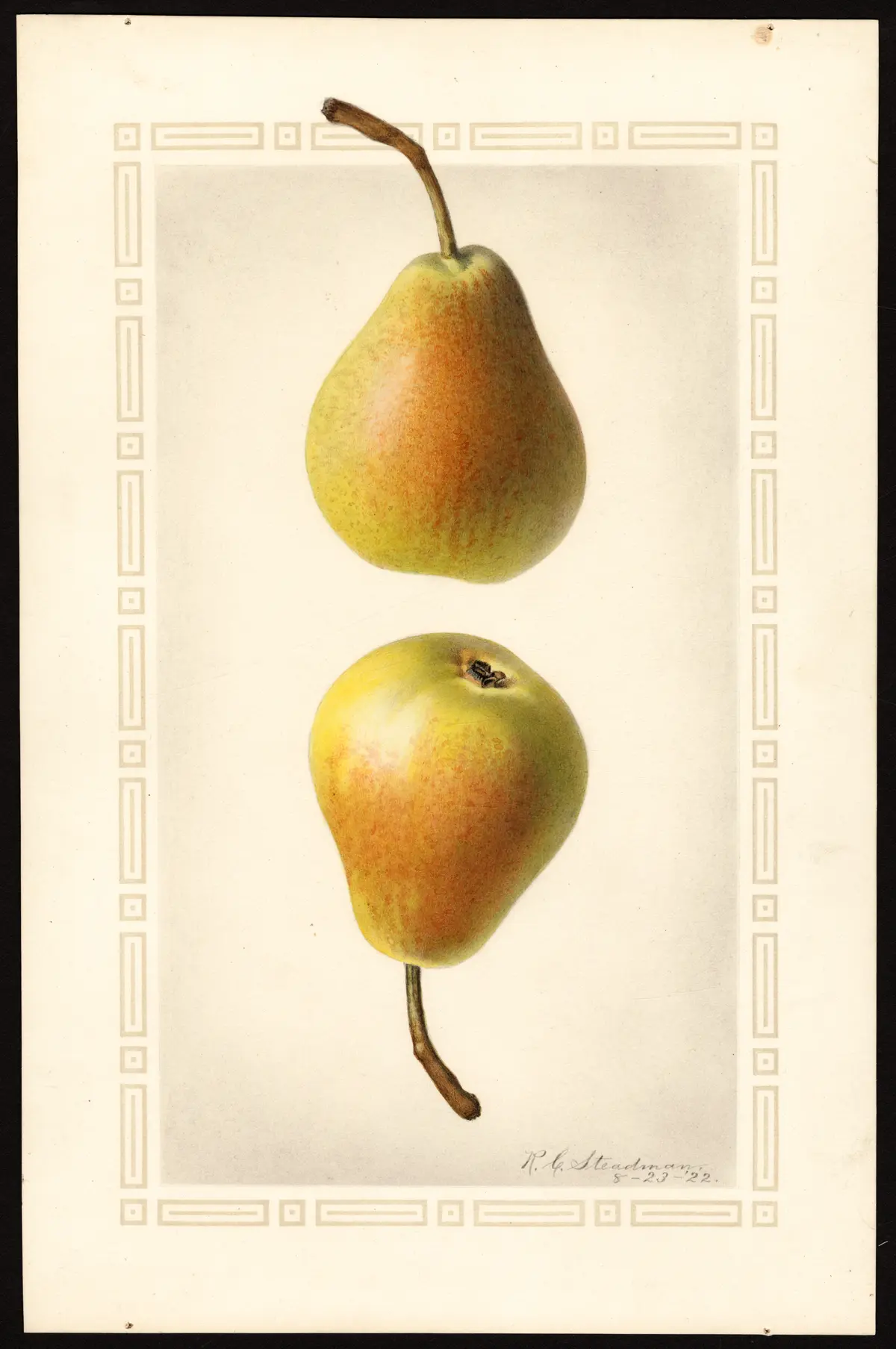
USDA Pomological Watercolor Collection
WORDEN SECKEL
Origin and History
A seedling of Seckel pear, raised by Sylvester Worden of Minetto, Oswego County, New York, about 1881. Placed on the market by Smiths and Powell, Syracuse, New York, about 1890. Added to the American Pomological Society's fruit-list in 1909.
Tree
Large, vigorous, upright-spreading, rapid-growing, very productive. Trunk thick. Branches reddish-brown, nearly covered with thin gray scarf-skin, marked with numerous lenticels. Branchlets short, with internodes variable in length, light greenish-brown, dull, glabrous except near the ends of the new growth, sprinkled with numerous small, conspicuous, raised lenticels.
Leaf-buds very small, short, pointed, appressed. Leaves 2½ in. long, 1¼ in. wide, thick, leathery; apex taper-pointed; margin tipped with few minute glands, finely or coarsely serrate; petiole 1¼ in. long, glabrous, slender, tinged with red; stipules very small when present.
Flower-buds small, short, conical, sharply pointed, plump, free, singly on very short spurs. Flowers showy, 1 in. across, in dense clusters of 8 or 10 buds; pedicels 1½ in. long, slightly pubescent.
Fruit
Size and Form: Medium, 2½ in. long, 2⅛ in. wide; obovate-acute-pyriform, symmetrical.
Stem: ¾ in. long, thick.
Cavity: Very shallow and obtuse or lacking; flesh folded up around the base of the stem and often lipped.
Calyx: Open, large; lobes narrow, acute.
Basin: Shallow, narrow, obtuse, smooth or gently furrowed, symmetrical.
Skin: Thin, tender, smooth, glossy. Color pale golden-yellow, blushed on the exposed cheek with solid bright red, becoming almost crimson in highly colored specimens. Dots numerous, small, russet, obscure.
Flesh and Flavor: Yellowish-white or dull white, fine-grained near the skin, granular at the center. Tender and melting, buttery, very juicy. Characteristically spicy and aromatic. Quality very good.
Core and Seeds: Core closed, axile, with meeting core-lines. Calyx-tube conical. Carpels ovate. Seeds wide, plump, obtuse.
Season and Storage
Ripens late September to October. Keeps longer than Seckel, lasting until December in cold-storage.
Character and Cultivation
The fruits, when well grown and thinned to full size, are voluptuously handsome in form and color, smooth, glossy, trim of contour, well-turned, and unusually uniform. When the crop is thinned so that fruits attain their largest size, no pear is handsomer and will bring a higher price on fruit-stands. The tree bears young but does poorly in the nursery. Commercial growers should give this variety a thorough test; amateurs everywhere will find it worth planting.
Other
Worden Seckel has been more widely advertised than perhaps any other pear during the quarter-century prior to this account's publication. Nurserymen and pear-growers describe it as a better variety than Seckel and assert it should replace that variety. However, it is not displacing Seckel in most pear regions, though in many it is considered the more profitable pear of the two. While a splendid pear, it falls short of Seckel in not being quite as dependable in different soils and climates. The trees are not as vigorous as Seckel (though just as productive in many places), are not quite as resistant to blight, and the fruits are not as high in quality. The pears are, however, larger and handsomer. The accompanying illustration referenced in the source does not do the pear justice in size or color and shows a lack of symmetry not usually present.
Book Sources
Described in 1 period pomological work
Nursery Catalog Sources
Found in 17 catalogs (1901–1921) from Missouri, Oregon, Washington
- Washington Nursery Co. , Toppenish , Washington — 1901
- The Dalles Nurseries , The Dalles , Oregon — 1906
- Stark Bros. Nurseries & Orchards Co. , Louisiana , Missouri — 1906
- Washington Nursery Company , Toppenish , Washington — 1909
- Island Nurseries & Fruit Farm , Vashon (Vashon Island) , Washington — 1910
- Stark Bros. Nurseries & Orchards Co. , Louisiana , Missouri — 1910
- Island Nurseries & Fruit Farm , Vashon (Vashon Island) , Washington — 1911
- Stark Bros. Nurseries & Orchards Co. , Louisiana , Missouri — 1911
- Stark Bros. Nurseries & Orchards Co. , Louisiana , Missouri — 1912
- Pacific Nursery Company , Portland , Oregon — 1912
- Washington Nursery Company , Toppenish , Washington — 1912
- Island Nurseries & Fruit Farm , Vashon (Vashon Island) , Washington — 1914
- Island Nurseries & Fruit Farm , Vashon (Vashon Island) , Washington — 1915
- Island Nurseries & Fruit Farm , Vashon (Vashon Island) , Washington — 1916
- Island Nurseries & Fruit Farm , Vashon (Vashon Island) , Washington — 1917
- Oregon Nursery Co. , Orenco , Oregon — 1920
- Island Nurseries & Fruit Farm , Vashon , Washington — 1921
View original book sources (1)
— U.P. Hedrick, The Pears of New York (1921)WORDEN SECKEL
- Rural N. Y. 50:888, figs. 326 and 327. 1891. 2. Thomas Am. Fruit Cult. 465, fig. 675. 1897. 3. Franklin Davis Nur. Cat. 23. 1901. 4. Budd-Hansen Am. Hort. Man. 2:268. 1903. 5. Banker Cat. 19. 1915.
Worden. 6. Am. Pom. Soc. Cat. 41. 1909.
Possibly no pear has been more widely advertised during the last quarter-century than Worden Seckel. Nurserymen and pear-growers alike describe it as a better variety than Seckel, and say that it ought to take the place of that good old sort of which it is a seedling. But it is not driving Seckel out in most pear regions, though in many it is considered the more profitable pear of the two. It is a splendid pear, but falls short of Seckel in not being quite as dependable in different soils and climates; the trees are not as vigorous, though just as productive in many places, they are not quite as resistant to blight, and the fruits are not as high in quality. On the other hand, the pears are larger and handsomer. Well grown, the fruits of Worden Seckel are voluptuously handsome in form and color. The pears are smooth, glossy, trim of contour, well turned, unusually uniform, with a beautifully blushed cheek on a handsome green and yellow background. The accompanying illustration does not do the pear justice in size or color and shows a lack of symmetry not usually present. When the crop is thinned so that the fruits attain their largest size, no pear is handsomer or will bring a higher price on the fruit-stands. The crop comes in with Seckel, but keeps longer, lasting until December in cold-storage. The tree is very hardy and bears young, but does poorly in the nursery. Commercial growers should give this variety a thorough test, and amateurs everywhere will find it worth planting.
Worden Seckel, as its name suggests, is a seedling of Seckel, raised by Sylvester Worden, Minetto, Oswego County, New York, about 1881. Smiths and Powell, Syracuse, New York, placed it on the market about 1890. The American Pomological Society added the variety to its fruit-list in 1909.
Tree large, vigorous, upright-spreading, rapid-growing, very productive; trunk thick; branches reddish-brown, nearly covered with thin, gray scarf-skin, marked with numerous lenticels; branchlets short, with internodes variable in length, light greenish-brown, dull, glabrous except near the ends of the new growth, sprinkled with numerous small, conspicuous, raised lenticels.
Leaf-buds very small, short, pointed, appressed. Leaves 2½ in. long, 1¼ in. wide, thick, leathery; apex taper-pointed; margin tipped with few minute glands, finely or coarsely serrate; petiole 1¼ in. long, glabrous, slender, tinged with red; stipules very small when present. Flower-buds small, short, conical, sharply pointed, plump, free, singly on very short spurs; flowers showy, 1 in. across, in dense clusters, 8 or 10 buds in a cluster; pedicels 1½ in. long, slightly pubescent.
Fruit ripe late September to October; medium in size, 2½ in. long, 2⅛ in. wide, obovate-acute-pyriform, symmetrical; stem ¾ in. long, thick; cavity very shallow and obtuse or lacking, the flesh folded up around the base of the stem and often lipped; calyx open, large; lobes narrow, acute; basin shallow, narrow, obtuse, smooth or gently furrowed, symmetrical; skin thin, tender, smooth, glossy; color pale golden-yellow, blushed on the exposed cheek with solid bright red, becoming almost crimson in highly colored specimens; dots numerous, small, russet, obscure; flesh yellowish-white or dull white, fine-grained near the skin, granular at the center, tender and melting, buttery, very juicy, characteristically spicy and aromatic; quality very good. Core closed, axile, with meeting core-lines; calyx-tube conical; carpels ovate; seeds wide, plump, obtuse.