Reeder
Pear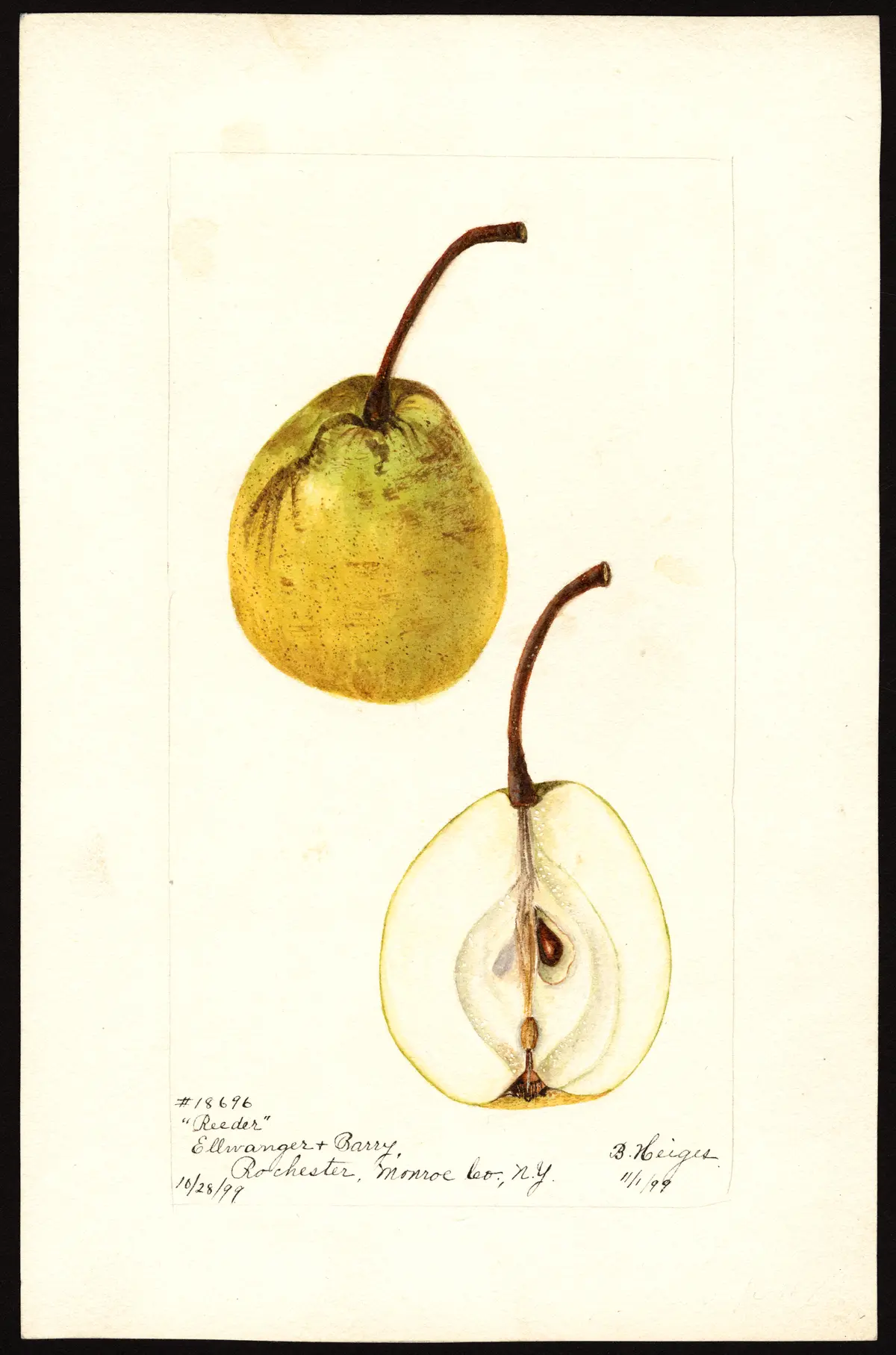
USDA Pomological Watercolor Collection
Reeder
Origin / History
Reeder was raised about 1855 by Dr. Henry Reeder at Varick, Seneca County, New York, from seed of Winter Nelis. Hedrick says the parent tree stood near a Seckel, and Reeder is considered a cross between the two varieties: Seckel is "probably one of its parents," and Winter Nelis is "the other parent."
The American Pomological Society's report of 1867 carried it as Reeder's Seedling. The Society added the variety to its fruit-catalog in 1871 under the name Doctor Reeder, and in 1883 changed the name to Reeder. Budd and Hansen say it is "usually grown as Doctor Reeder."
Hedrick judges it "another of the pears too good to discard, and not quite good enough to give an ardent recommendation."
Tree
Tree medium in size, vigorous, spreading and drooping, of open form, open-topped and productive. Downing calls it very hardy, healthy and an excellent bearer, while Thomas calls it a good bearer.
The trees do poorly in the nursery. They make but a short, slender growth until well established in the orchard, after which they become of medium size but very vigorous. The branches droop as do those of Winter Nelis, though not so markedly, and the tree becomes drooping with age. Hedrick calls the variety as nearly blight-proof as either of its parents.
Trunk and branches are medium in thickness and smoothness (Hedrick's Cyclopedia). Branches zigzag, reddish-brown partly overspread with gray scarf-skin, sprinkled with numerous lenticels. Branchlets slender, willowy, long, reddish-brown mingled with gray. Downing calls the young shoots warm olive brown. Hedrick gives the new growth as reddish-green, dull, smooth, glabrous except near the tips, with few very small, inconspicuous lenticels.
Leaf-buds small, short, pointed, appressed. Leaves leathery, 2½ inches long and 1¼ to 1⅜ inches wide; apex taper-pointed; margin crenate to nearly entire. Petiole ¾ inch long, tinged with red. Stipules few, very small, reddish-green.
Flower-buds small, short, conical, free, borne singly on short spurs. Flowers 1⅛ to 1¼ inches across, in dense clusters averaging 7 to 9 buds. Pedicels ⅝ inch long, slender.
Fruit
Size: Small to large. Most authors call it small, and Downing gives small to medium; Budd and Hansen alone call it large. Hedrick measures it averaging 1⅞ inches long and 1⅝ to 1⅞ inches wide. He finds it about the same size as Seckel as grown under average conditions.
Form: Roundish ovate to globular, obtuse pyriform. Hedrick finds it slightly ribbed and irregular. Downing describes it as compressed, often apparently slightly furrowed on one side.
Stem: About 1½ inches long, slightly curved. Downing calls it long and slender and a little inclined, and Hedrick slender. Budd and Hansen instead call it quite stout, and fleshy at the point of insertion.
Cavity: Small or very small, a symmetrical depression into which the base of the stem is inserted. Budd and Hansen describe the stem as inserted without cavity.
Calyx: Large, open. The segments are large, long, narrow and acuminate, separated at the base. Downing has them lying flat on the fruit, and Hedrick reflexed. Hedrick gives the calyx-tube as long, narrow and funnel-shaped.
Basin: Very shallow to medium, narrow to broad; smooth, regular or nearly regular. Hedrick finds it very shallow and narrow, and Budd and Hansen broad and shallow; Downing calls it medium.
Skin: Thick, smooth, tender. Ground yellow to light yellow or dull greenish-yellow. The skin is netted, patched, mottled and streaked with russet nearly over the whole surface, the patches especially around the basin (Budd and Hansen). The exposed cheek is faintly blushed with red or brownish-red. Hedrick finds the fruit "even duller and less attractive in color than the modest fruits of Seckel."
Dots: Russet. Downing has the skin thickly sprinkled with them, and Budd and Hansen also call them numerous. Hedrick finds them few, small and obscure, greenish or russet.
Flesh and flavor: White, juicy to very juicy, tender, melting, buttery. Downing calls it fine and a little granular. Hedrick finds it granular toward the center but fine-grained near the skin, and somewhat stringy. Very sugary, vinous, perfumed; Downing adds "a high musky perfume," and Hedrick calls it aromatic.
Quality "very good" in most accounts, and Downing gives "very good to best." Hedrick gives "good," ranking the fruits "but little below those of Seckel."
Core and seeds: Core large, closed, with clasping core-lines. Seeds unusually large, wide, long, plump, acute (Hedrick).
Season
Ripe in October and November; Downing and Thomas give November. The crop comes in season just after that of Seckel passes out.
Uses
Hedrick gives it a place in the home and markets as a pear to follow Seckel.
Subtypes / Variants
Not described in source.
Other
Not described in source.
Book Sources
Described in 5 period pomological works
- Hedrick, The Pears of New York (1921)
- Hedrick, Cyclopedia of Hardy Fruits (1922)
- Budd & Hansen, Systematic Pomology (1914) — listed as Reeder (Doctor Reeder)
- Thomas, The American Fruit Culturist (1903)
- Downing, Fruits and Fruit Trees of America (1900) — listed as Doctor Reeder
Nursery Catalog Sources
Found in 1 catalog (1900)
- Central Experimental Farm , Dominion Department of Agriculture, Agassiz, British Columbia (under test; Bulletin No. 3, Second Series) — 1900
View original book sources (5)
— A.J. Downing, The Fruits and Fruit Trees of America (1900)Doctor Reeder.
Reeder's Seedling.
Raised from seed of the Winter Nelis by Dr. Henry Reeder, Varick, Seneca Co., N. Y. Tree very hardy, healthy, vigorous, spreading, open form, an excellent bearer. Young shoots warm olive brown.
Fruit small to medium, roundish ovate obtuse pyriform, compressed, often apparently slightly furrowed on one side. Skin yellow, netted and patched with russet nearly over the whole surface, and thickly sprinkled with russet dots. Stalk long and slender, slightly curved, a little inclined, in a small cavity. Calyx large and open. Segments large, lying flat on the fruit. Basin medium, nearly regular. Flesh fine, juicy, melting, buttery, a little granular, very sugary, vinous, with a high musky perfume. Very good to best. November.
— John J. Thomas, The American Fruit Culturist (1903)Reeder. See Dr. Reeder.
[Additional entry in this volume: "Doctor Reeder", pp. 789–789]
Doctor Reeder. Small, roundish-ovate, yellow, netted with russet; melting, buttery, sugary, perfumed. Very good. November. Good bearer. Seneca County, N. Y.
— J.L. Budd & N.E. Hansen, American Horticultural Manual, Part II: Systematic Pomology (1914)Reeder (Doctor Reeder). — Large, roundish ovate, obtuse pyriform; color light yellow with numerous russet dots and patches of russet, especially around the basin; cheek faintly blushed with red; stalk one and one-half inches long, quite stout, and fleshy at point of insertion without cavity; basin broad, shallow, and regular. Flesh white, juicy, buttery, melting, vinous, very good. Usually grown as Doctor Reeder. New York.
— U.P. Hedrick, The Pears of New York (1921)REEDER
- Am. Pom. Soc. Cat. 40. 1883. 2. Budd-Hansen Am. Hort. Man. 2:260. 1903. Reeder's Seedling. 3. Am. Pom. Soc. Rpt. 150. 1867. Doctor Reeder. 4. Downing Fr. Trees Am. 739, fig. 1869. 5. Am. Pom. Soc. Cat. 20. 1871. Docteur Rheder. 6. Rev. Hort. 87. 1889.
Reeder is another of the pears too good to discard, and not quite good enough to give an ardent recommendation. In quality, the fruits rank but little below those of Seckel; are about the same size as grown under average conditions; but are even duller and less attractive in color than the modest fruits of Seckel, which is probably one of its parents. The fruits have a place in the home and markets as a pear to follow Seckel, the crop coming in season just after that of Seckel passes out. The trees do poorly in the nursery, as they make but a short, slender growth until well established in the orchard, after which they become of medium size but very vigorous. The branches droop as do those of Winter Nelis, the other parent, although not so markedly. The variety is as nearly blight-proof as either of its parents.
Reeder is a seedling raised about 1855 by Dr. Henry Reeder, Varick, New York, from seed of Winter Nelis. The parent tree stood near a Seckel and it is considered that Reeder is a cross between the two varieties. The American Pomological Society added the variety to its fruit-catalog in 1871 under the name Doctor Reeder, but in 1883 changed the name to Reeder.
Tree medium in size, vigorous, spreading, drooping, open-topped, productive; branches zigzag, reddish-brown partly overspread with gray scarf-skin, sprinkled with numerous lenticels; branchlets slender, willowy, long, reddish-brown mingled with gray, the new growth reddish-green, dull, smooth, glabrous except near the tips of the new growth, with few very small, inconspicuous lenticels.
Leaf-buds small, short, pointed, appressed. Leaves 2½ in. long, 1¼ in. wide, leathery; apex taper-pointed; margin crenate to nearly entire; petiole ¾ in. long, tinged with red; stipules few, very small, reddish-green. Flower-buds small, short, conical, free, singly on short spurs; flowers 1⅛ in. across, in dense clusters, average 9 buds in a cluster; pedicels ⅝ in. long, slender.
Fruit ripe in October and November; small, 1⅞ in. long, 1⅞ in. wide, globular-obtuse-pyriform, slightly ribbed and irregular; stem 1½ in. long, slender, curved; cavity a very small depression in which is inserted the base of the stem, symmetrical; calyx large, open; lobes separated at the base, long, narrow, reflexed, acuminate; basin very shallow and narrow, smooth; skin thick, smooth, tender; color dull greenish-yellow, mottled and streaked with russet, blushed faintly on the exposed cheek with brownish-red; dots few, small, obscure, greenish or russet; flesh white, granular toward the center but fine-grained near the skin, tender, somewhat stringy, very juicy, aromatic; quality good. Core large, closed, with clasping core-lines; calyx-tube long, narrow, funnel-shaped; seeds unusually large, wide, long, plump, acute.
— U.P. Hedrick, Cyclopedia of Hardy Fruits (1922)REEDER. Reeder is another of the pears too good to discard, and not quite good enough to give an ardent recommendation. In quality the fruits rank but little below those of Seckel; are about the same size as grown under average conditions; but are even duller and less attractive in color than the modest fruits of Seckel. The variety has a place in the home and markets as a pear to follow Seckel, as the crop comes in season just after that of Seckel passes out. The trees make but a short, slender growth until well established in the orchard, after which they become of medium size but very vigorous. The branches droop as do those of Winter Nelis, although not so markedly. The variety is nearly blight-proof. Reeder is a seedling raised about 1855 by Dr. Henry Reeder, Varick, New York, from seed of Winter Nelis.
Tree spreading, becoming drooping with age, open-topped, productive; trunk and branches medium in thickness and smoothness; branches zigzag, reddish-brown, sprinkled with numerous lenticels. Leaves 2½ inches long, 1⅜ inches wide, leathery; apex taper-pointed; margin crenate to nearly entire; petiole ¾ inches long, tinged with red; stipules few, very small, reddish-green. Flowers 1¼ inches across, in dense clusters, average 7 buds in a cluster. Fruit ripe October-November; small, averaging 1⅞ inches long, 1⅝ inches wide, globular-obtuse-pyriform, ribbed and irregular; stem 1½ inches long, slender, curved; cavity a very small depression in which is inserted the base of the stem, symmetrical; calyx large, open; lobes separated at the base, long, narrow, reflexed, acuminate; basin shallow and narrow, smooth; skin thick, smooth, tender; color dull greenish-yellow, mottled and streaked with russet, blushed faintly on the exposed cheek with brownish-red; dots few, small, obscure, greenish or russet; flesh white, granular toward the center but fine-grained near the skin, tender, somewhat stringy, very juicy, aromatic; quality good; core large, closed, with clasping core-lines; calyx-tube long, narrow, funnel-shaped; seeds unusually large, wide, long, plump, acute.