Kieffer
Pear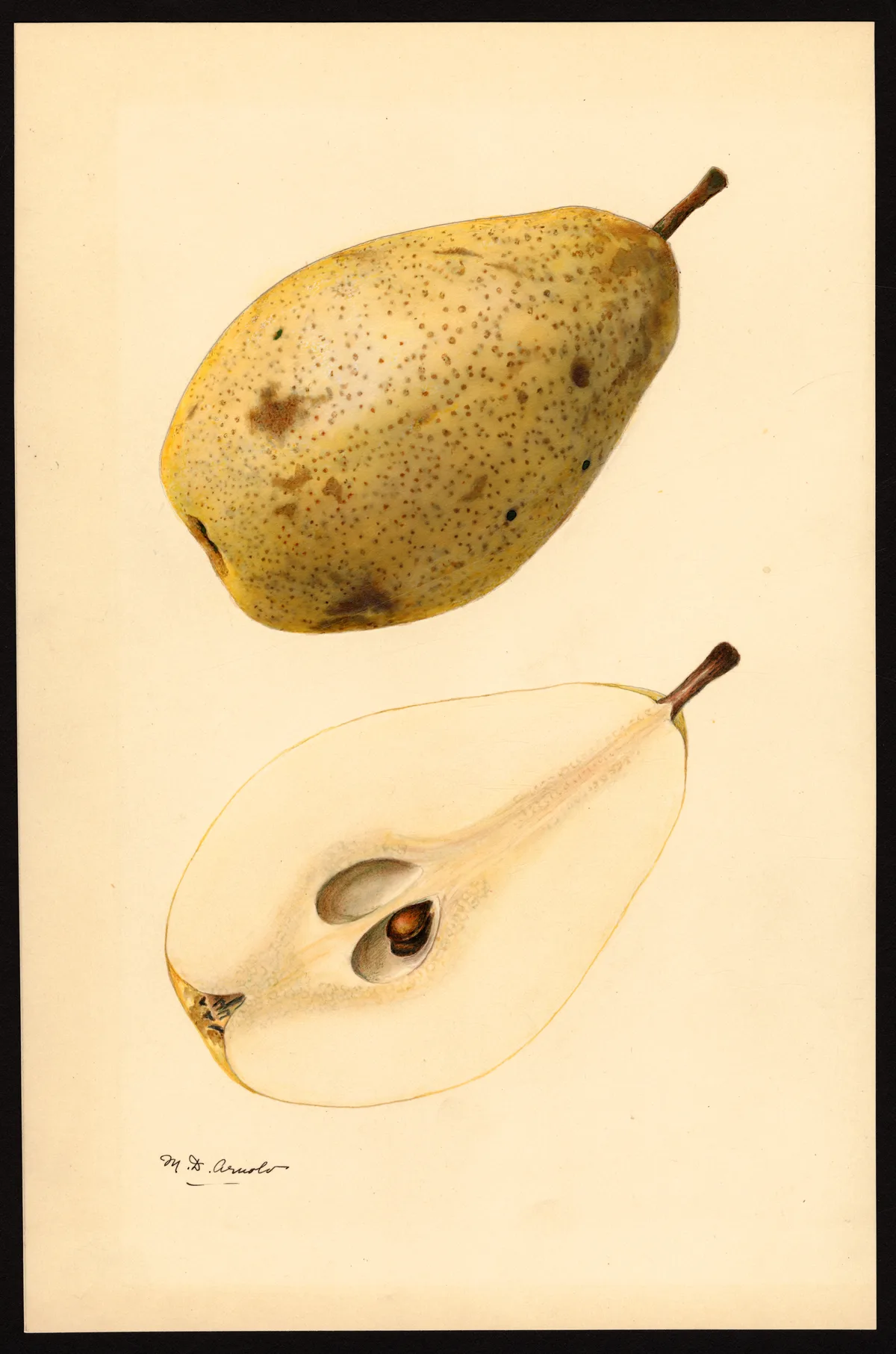
USDA Pomological Watercolor Collection
Kieffer
[NOTE: Source text may be incorrect — the Stark Bros. (1910) entry contains garbled sentences ("A good soil to plant among others, as improves them. Blight is pure absolute to it.") and a stray trailing "N.Y."; the Hedrick Pears of New York (1921) entry breaks off mid-word ("the most vigor-"). What can be salvaged is included below.]
Origin / History
Kieffer was raised by Peter Kieffer near Philadelphia. Downing spells the name "Keiffer" and places him at Roxbury, near Philadelphia. The seed parent was the Chinese Sand pear; the pollen parent is disputed. Downing says the seed was "accidentally crossed with Beurre d'Anjou, or some other kind grown near it." Thomas calls it a cross between Bartlett and the Chinese Sand pear.
Hedrick relates that Kieffer grew Chinese Sand pears as ornamentals, with trees of Bartlett in the same garden. Among chance seedlings he observed one "of peculiar growth" and saved it. Hedrick thinks it "probably" a hybrid between the two. It first bore fruit in 1863 and was the original Kieffer tree. Budd and Hansen call it "a Chinese hybrid."
Hedrick's references record it as "Kieffer's Hybrid" in W. N. Y. Hort. Soc. Rpt. for 1879. Under the present name it appears in Gard. Mon. for 1880 (figured) and in Am. Pom. Soc. Cat. for 1883. Downing gives it as "Keiffer" in the third appendix of 1881. It was planted for trial at the Central Experimental Farm, Agassiz, British Columbia, in spring 1890.
Downing called it "this new and unique pear." He credited the fruit with "good size, good color, good quality," and judged it "a promising variety for the table or market." Thomas writes that "the beauty, vigor, and productiveness of this variety have established it as the most popular market variety of the country." He calls it "wonderfully popular with growers and canners," but "consumers are finding that it generally lacks flavor." Budd and Hansen record it as double starred in many States as a market and kitchen variety.
Hedrick calls it "the most pretentious cheat in the orchard." In 1921 he says it is grown more commonly than any other pear in North America; in 1922 he adds "excepting Bartlett." He says its popularity "can be accounted for only by accepting Barnum's dictum that 'Americans love to be fooled.'" "Pears are grown to eat," yet people, "pleased by a bright cheek and a fair form, regardless of the potato-like flavor," buy and eat Kieffer pears "and persist in doing so." Among his reasons for its wide planting, no pear "has been advertised so widely and so unqualifiedly, growers of trees often supplying virtues to the variety which Nature denies it." Nurserymen like it because "of all pears the trees of Kieffer are most easily grown." By 1922 he judged that "the first flush of popularity is past."
Tree
Remarkably vigorous, a strong grower. Hedrick calls the trees "uniformly the most vigorous" of all pears grown in America, and in the orchard also the most fruitful. Tree of medium size, upright, dense-topped (Hedrick). Hedrick's technical description calls it hardy, yet the same entry calls the trees "tender to cold." Branches slender, nearly smooth, reddish-brown, marked with few small lenticels.
Leaves large, dark green, glossy (Downing). Hedrick gives them as 3¾ inches long and 1¾ inches wide; oval, thick, leathery; apex taper-pointed; margin often finely serrate; petiole 1¾ inches long. Flowers open early, 1¾ inches across, fairly well distributed, varying from 7 to 11 buds in a cluster (Hedrick).
An early, regular, very prolific bearer; Stark calls it "a tremendous bearer" and an "enormous producer." Thomas notes that in some sections it "fruits sparingly in large blocks unless another variety is intermingled." Hedrick says the trees "in some soils refuse to set fruit, are often self-sterile, and sometimes with the best of care bear only pears of small size." Stark's garbled line reads "A good soil to plant among others, as improves them."
Hedrick says the trees endure heat best of all pears, are least susceptible to blight, and withstand best the ravages of San José scale. Stark says it is "never known to blight in the extreme north" and writes, garbled, "Blight is pure absolute to it."
Fruit
Size: Medium to very large, most accounts calling it large. Hedrick gives above medium to large, 2¾ inches long and 2¾ inches wide. Thomas extends the range to very large. Downing and the Agassiz station call it medium. Hedrick adds that trees sometimes, "with the best of care," bear only pears of small size.
Form: Oval, narrowing or tapering toward both ends. Downing gives roundish oval, with the largest diameter near the center; some specimens are roundish, inclining to oblong obtuse pyriform. Budd and Hansen call it "variable in shape." Hedrick calls it symmetrical and uniform.
Stem: Short to medium, moderately stout to thick. Hedrick gives ¾ inch long, thick.
Cavity: Medium (Downing); very small, smooth (Hedrick).
Calyx: Open. Lobes separated at the base, short, narrow, acute; calyx tube short, wide, conical (Hedrick).
Basin: Medium, a little uneven (Downing); shallow, narrow, obtuse, nearly smooth (Hedrick).
Skin: Thick, tough, smooth (Hedrick). Yellow, deep or rich yellow, becoming orange yellow or a brighter shade in the sun; bright yellow when fully ripe.
Thomas gives a handsome red cheek in the South, and Stark a red cheek. Hedrick says it is occasionally blushed with dull pinkish-red on the exposed cheek, and elsewhere speaks of "a bright cheek." Downing gives a few patches and nettings of russet. Budd and Hansen say the russet and russet dots often nearly cover the yellow ground.
A handsome, showy fruit; Thomas calls it "beautiful to look at."
Dots: Many, small, brown russet, conspicuous.
Flesh and flavor: Whitish to white or, per Hedrick, yellowish-white; he also calls it "white and inviting" when canned. Coarse: a little or somewhat coarse, "usually somewhat coarse" (Thomas), rather coarse grained, and in Hedrick's words "very granular and coarse." Juicy. Half melting (Downing) against crisp (Hedrick).
Downing calls it sweet. Hedrick calls it "not sweet, often astringent," with a "potato-like flavor" and a "disagreeable natural taste" raw. The Agassiz station finds it "not high flavoured." Thomas says it "generally lacks flavor" and is "insipid," with low quality unless properly ripened; but "if ripened slowly in a dark place it develops a good flavor."
Quality is rated from "very good" down to "poor," and for dessert "worthless." Downing stands alone at the high end. He gives "quality very good, partaking slightly of the Chinese Sand pears," having called it "good quality" in his introduction. The middle verdicts are "good to poor" (Thomas), "only good" (Budd and Hansen), "fair quality" (Stark), and "medium or below medium" (Agassiz). Hedrick gives "poor" and "worthless for dessert," with "dire necessity alone compelling their consumption uncooked."
Core and seeds: Core large, closed, with clasping core lines. Seeds wide, plump, acute (Hedrick).
Season
The recorded season runs from October into late winter. Most authors give October and November: Downing all of October and part of November, Hedrick late October and November. Thomas gives late fall to late winter. Downing advises that "to have it in perfection, it should be gathered when fully grown, and ripened in the house." Thomas advises ripening slowly in a dark place.
Uses
A market, shipping, kitchen, and canning pear. Stark calls it "a splendid fruit for canning and shipping." Thomas calls it excellent for canning and grown largely for that purpose. Hedrick says the fruits are fit to eat only in culinary preparations, but "much can be said for the fruits of Kieffer for culinary preparation." Cooking removes the disagreeable raw taste "and leaves a good product."
Canned, the pears retain their shape, color, and flavor well. For this reason, and because of the white and inviting flesh, commercial canners prefer Kieffers. Hedrick advises growers to raise it chiefly for the cannery, supplying the demand for dessert pears with "worthier varieties."
Subtypes / Variants
Not described in source.
Other
Figured as Fig. 731 in Thomas and Fig. 86 in Hedrick's Cyclopedia. Hedrick's further references include Jour. Hort. 3rd Ser. (1886), Garden (1905, 1906), Cornell Sta. Bul. 332 (1913), Mathieu Nom. Pom. (1889), Am. Pom. Soc. Rpt. (1909), and Country Gent. (1919, figured).
Book Sources
Described in 5 period pomological works
Nursery Catalog Sources
Found in 74 catalogs (1881–1932) from Alabama, Arkansas, California, Florida, Illinois, Indiana, Kansas, Maryland, Massachusetts, Missouri, Nebraska, New Jersey, New York, Oregon, Pennsylvania, Virginia, Washington
- Hutchison Nursery , James Hutchison, Oakland , California — 1881
- Felix Gillet , Barren Hill Nursery, Nevada City , California — 1884
- Fancher Creek Nursery , Fresno , California — 1886
- Huntsville Wholesale Nurseries (Jessie S. Moss , Proprietor; W.F. Heikes, Manager), Huntsville , Alabama — 1886
- W.R. Strong & Co. , Capital and Orange Hill Nurseries (Robert Williamson, prop.), Sacramento , California — 1886
- Felix Gillet , Barren Hill Nursery, Nevada City , California — 1888
- California Nursery Co. , Niles , California — 1889
- Felix Gillet , Barren Hill Nursery, Nevada City , California — 1889
- Felix Gillet , Barren Hill Nursery, Nevada City , California — 1890
- William H. Moon Co. , Morrisville, Bucks County , Pennsylvania — 1890
- Felix Gillet , Barren Hill Nursery, Nevada City , California — 1891
- Missouri Nursery Co. , Louisiana , Missouri — 1891
- Puyallup & Yakima Nurseries , Puyallup, Washington (Lock Box 191) and North Yakima , Washington — 1892
- Glen St. Mary Nurseries (G.L. Taber , Proprietor), Glen St. Mary , Florida — 1893
- Milwaukie-Canby Nurseries , Canby, OR (and Milwaukie, OR) — 1893
- Rogers Nursery Co. , Moorestown , New Jersey — 1893
- Sherwood Hall Nursery Co. , Timothy Hopkins (Menlo Park Nurseries), San Francisco / Menlo Park , California — 1893
- Green's Nursery Co. (Charles A. Green) , Rochester , New York — 1894
- Knox Nurseries (H.M. Simpson Co. , Proprietors), Vincennes , Indiana — 1894
- Multnomah Nurseries , Russellville , Oregon — 1894
- The Vineland Nurseries (Kelsey & Co. , Proprietors), St. Joseph, Missouri (Office: 13th and Atchison Sts., 2 Blocks East of the Citizens St. Car Line) — 1894
- Woodburn Nurseries , Woodburn, Marion Co. , Oregon — 1894
- Felix Gillet , Barren Hill Nursery, Nevada City , California — 1895
- The Lovett Company , Little Silver , New Jersey — 1896
- Stark Bros. Nurseries & Orchards Co. , Louisiana , Missouri — 1896
- Felix Gillet , Barren Hill Nursery, Nevada City , California — 1897
- The Salem Nursery (John A. Francis , Proprietor), Salem , Virginia — 1897
- J.V. Cotta (Cotta Nursery) , Carroll County , Illinois — 1898
- Reading Nursery , Jacob W. Manning, Proprietor, Reading , Massachusetts — 1898
- Stark Bros. Nurseries & Orchards Co. , Louisiana , Missouri — 1898
- Brown Brothers Co. , Continental Nurseries, Rochester, NY (also operated from Toronto, Canada) — 1899
- Alabama Nursery Co. , Huntsville , Alabama — 1900
- Central Experimental Farm , Dominion Department of Agriculture, Agassiz, British Columbia (under test; Bulletin No. 3, Second Series) — 1900 — listed as Keiffer
- The Dalles Nurseries , The Dalles , Oregon — 1901
- Washington Nursery Co. , Toppenish , Washington — 1901
- Benjamin Buckman (personal inventory) , Farmingdale , Illinois — 1901
- Brown Brothers Co. , Continental Nurseries, Rochester, NY (also operated from Toronto, Canada) — 1901
- Mountain Grove Nurseries (Tippin & Moore , Proprietors; Geo. T. Tippin, J. W. Tippin, J. C. Moore), Mountain Grove , Missouri — 1901
- S.L. Watkins , Grizzly Flats, El Dorado County , California — 1901
- Yarbrough Bros. , Stephens , Arkansas — 1901
- Forestville Nurseries , T.J. True, Forestville , California — 1902
- Russellville Nursery Co. , Russellville, OR (three miles east of Portland, one mile from Montavilla car line) — 1903 — listed as Keiffer's Hybrid
- Pacific Nursery Company (W. O. Hudson & A. D. Hudson) , Tangent , Oregon — 1903
- Phoenix Nursery Company (W. E. Rossney , President; Sidney Tuttle, Vice-President), Bloomington , Illinois — 1904
- Stark Bros. Nurseries & Orchards Co. , Louisiana , Missouri — 1906
- Russellville Nursery Co. , Montavilla Station, Portland, OR (three miles east of Portland, one mile from Montavilla car line) — 1907 — listed as Kieffer's
- J.B. Pilkington , Portland , Oregon — 1907
- Carlton Nursery Co. , Carlton , Oregon — 1909
- Wm. J. Corse (successor to Robert Sinclair / Sinclair Nurseries) , Baltimore , Maryland — 1909
- Washington Nursery Company , Toppenish , Washington — 1909
- C.F. Lansing , Salem , Oregon — 1910
- Island Nurseries & Fruit Farm , Vashon (Vashon Island) , Washington — 1910
- Stark Bros. Nurseries & Orchards Co. , Louisiana , Missouri — 1910
- Galbraith Nursery Co. (DeWitt Hansen , Pres.-Mgr.), Fairbury , Nebraska — 1911
- Stark Bros. Nurseries & Orchards Co. , Louisiana , Missouri — 1911
- Island Nurseries & Fruit Farm , Vashon (Vashon Island) , Washington — 1911
- Ballygreen Nurseries , Hanford , Washington — 1912
- Pacific Nursery Company , Portland , Oregon — 1912
- Stark Bros. Nurseries & Orchards Co. , Louisiana , Missouri — 1912
- Vineland Nurseries Company , Clarkston , Washington — 1912
- Washington Nursery Company , Toppenish , Washington — 1912
- Samuel Fraser , Geneseo , New York — 1913
- Van Holderbeke Nursery Co. , Incorporated, Spokane, Washington (nurseries at Otis Orchards WA, Pasadena WA, Kennewick WA) — 1913
- Benjamin Buckman (personal inventory) , Farmingdale , Illinois — 1913
- Island Nurseries & Fruit Farm , Vashon (Vashon Island) , Washington — 1914
- Island Nurseries & Fruit Farm , Vashon (Vashon Island) , Washington — 1915
- Holsinger Bros. Nurseries (Holsinger Brothers Nursery) , Rosedale , Kansas — 1916
- Island Nurseries & Fruit Farm , Vashon (Vashon Island) , Washington — 1916
- Island Nurseries & Fruit Farm , Vashon (Vashon Island) , Washington — 1917
- Fancher Creek Nurseries , George C. Roeding, Fresno , California — 1918
- Oregon Nursery Co. , Orenco , Oregon — 1920
- Christopher Nurseries / John Stewart & Sons , Christopher , Washington — 1920
- Columbia & Okanogan Nursery Co. , Wenatchee , Washington — 1925
- Stark Bro's Nurseries , Louisiana , Missouri — 1932
View original book sources (7)
— A.J. Downing, The Fruits and Fruit Trees of America (1900)Keiffer.
Keiffer's Hybrid.
This new and unique pear was raised by Peter Keiffer, Roxbury, near Philadelphia, from seed of the Chinese Sand pear, accidentally crossed with Beurre d'Anjou, or some other kind grown near it. Tree remarkably vigorous, having large, dark green, glossy leaves, and is an early and very prolific bearer; the fruit is of good size, good color, good quality, and is a promising variety for the table or market.
Fruit medium, roundish oval, narrowing at both ends, with the largest diameter near the centre, some specimens roundish, inclining to oblong obtuse pyriform; skin deep yellow, orange yellow in the sun, a few patches and nettings of russet, and many brown russet dots; stalk short to medium, moderately stout; cavity medium; calyx open; basin medium, a little uneven; flesh whitish, a little coarse, juicy, half melting, sweet; quality very good, partaking slightly of the Chinese Sand pears. Ripens all of October and a part of November. To have it in perfection, it should be gathered when fully grown, and ripened in the house.
— John J. Thomas, The American Fruit Culturist (1903)Kieffer. Tree remarkably vigorous and very productive; fruit large to very large, oval, narrowing toward both ends; skin rich yellow, with a handsome red cheek in the South; flesh usually somewhat coarse, juicy, good to poor. Late fall to late winter. A cross between Bartlett and the Chinese Sand Pear. The beauty, vigor, and productiveness of this variety have established it as the most popular market variety of the country. It is excellent for canning, and is grown largely for that purpose. Unless properly ripened the quality of the fresh fruit is low; but if ripened slowly in a dark place it develops a good flavor. In some sections it fruits sparingly in large blocks unless another variety is intermingled. Wonderfully popular with growers and canners, but consumers are finding that it generally lacks flavor. Beautiful to look at but insipid. Fig. 731.
— J.L. Budd & N.E. Hansen, American Horticultural Manual, Part II: Systematic Pomology (1914)Kieffer.—Large, oval, narrowing at both ends, but variable in shape; often roundish and nearly obtuse pyriform; color yellow with brighter shade in sun; patches and netting of russet, and brown russet dots, often nearly covering the yellow ground; stalk rather short, stout, and inserted in medium cavity. Flesh whitish, somewhat coarse, juicy, half melting, sweet, only good. Double starred in many States as a market and kitchen variety. A Chinese hybrid.
— U.P. Hedrick, The Pears of New York (1921)KIEFFER
- Gard. Mon. 22:49, fig. 1880. 2. Am. Pom. Soc. Cat. 38. 1883. 3. Jour. Hort. 3rd Ser. 12:131. 1886. 4. Garden 68:398. 1905. 5. Ibid. 69:68. 1906. 6. Cornell Sta. Bul. 332:483. 1913. 7. Country Gent. 84:26, fig. 1919.
Kieffer's Hybrid. 8. W. N. Y. Hort. Soc. Rpt. 53. 1879. Keiffer. 9. Downing Fr. Trees Am. 3rd App. 179. 1881. 10. Mathieu Nom. Pom. 240. 1889. 11. Am. Pom. Soc. Rpt. 178. 1909.
Although the most pretentious cheat in the orchard, Kieffer is grown more commonly than any other pear in North America. Its popularity can be accounted for only by accepting Barnum's dictum that "Americans love to be fooled." Pears are grown to eat, but those of Kieffer are fit to eat only in culinary preparations, dire necessity alone compelling their consumption uncooked. Yet, pleased by a bright cheek and a fair form, regardless of the potato-like flavor, people buy and eat Kieffer pears and persist in doing so. There are several reasons why Kieffer is popular. No pear has been advertised so widely and so unqualifiedly, growers of trees often supplying virtues to the variety which Nature denies it, because of all pears the trees of Kieffer are most easily grown. Besides this virtue in the trees there are several others that commend the variety more highly. Thus, of all pears grown in America, the trees are uniformly the most vigor-
— U.P. Hedrick, Cyclopedia of Hardy Fruits (1922)KIEFFER. Fig. 86. Although the most pretentious cheat in the orchard, Kieffer is grown more commonly than any other pear in North America excepting Bartlett. Its great popularity can be accounted for only by accepting Barnum's dictum that "Americans love to be fooled." There are several reasons why Kieffer is widely planted. No pear has been advertised so widely and so unqualifiedly, growers of trees often supplying virtues to the variety which Nature denies it. Nurserymen like it because of all pears the trees of Kieffer are most easily grown; and in the orchard they are uniformly the most vigorous, fruitful, endure heat best, are least susceptible to blight, and withstand best the ravages of San José scale. On the other hand, the trees are tender to cold, in some soils refuse to set fruit, are often self-sterile, and sometimes with the best of care bear only pears of small size. Worthless for dessert, much can be said for the fruits of Kieffer for culinary preparation. Cooking removes the disagreeable natural taste of the raw pear, and leaves a good product. Canned, the pears retain their shape, color, and flavor well; therefore, and because of white and inviting flesh, Kieffers are preferred by commercial canners. Now that the first flush of popularity is past, it would seem a wise precaution on the part of pear-growers to grow this fruit chiefly for the cannery, supplying the demands for dessert pears with worthier varieties. Peter Kieffer, who lived near Philadelphia, grew Chinese Sand pears as ornamentals. In his garden there were also trees of Bartlett. Among chance seedlings, Kieffer observed one of peculiar growth which he saved. Probably it was a hybrid between the pears named. This bore fruit for the first time in 1863 and was the original Kieffer tree.
Tree of medium size, vigorous, upright, dense-topped, hardy, very productive; branches slender, nearly smooth, reddish-brown, marked with few small lenticels. Leaves 3¾ inches long, 1¾ inches wide, oval, thick, leathery; apex taper-pointed; margin often finely serrate; petiole 1¾ inches long. Flowers open early, 1¾ inches across, fairly well distributed, varying from 7 to 11 buds in a cluster. Fruit matures in late October and November; above medium to large, 2¾ inches long, 2¾ inches wide, oval, narrowing at both ends, symmetrical, uniform; stem ¾ inch long, thick; cavity very small, smooth; calyx open; lobes separated at the base, short, narrow, acute; basin shallow, narrow, obtuse, nearly smooth; skin thick, tough, smooth; color yellow, occasionally blushed with dull pinkish-red on the exposed cheek; dots numerous, small, russet, conspicuous; flesh yellowish-white, very granular and coarse, crisp, juicy; not sweet, often astringent; quality poor; core large, closed, with clasping core-lines; calyx-tube short, wide, conical; seeds wide, plump, acute.
— Central Experimental Farm, Central Experimental Farm, Agassiz BC — Catalogue of Fruit Trees under Test (Bulletin No. 3, 1900) (1900)Planted Spring 1890. Tree a strong grower and an early and regular bearer. Fruit of medium size, oval, tapering to both ends. Skin yellow and with many brown dots. Flesh white, coarse, juicy, not high flavoured, quality medium or below medium. Season October.
— Stark Bros. Nurseries & Orchards Co., Stark Bros. Year Book (1910) (1910)A large, juicy pear of fair quality but rather coarse grained, yet a splendid fruit for canning and shipping. The tree is a tremendous bearer; the fruit is bright yellow when fully ripe, with a red cheek. A good soil to plant among others, as improves them. Blight is pure absolute to it. Enormous producer and never known to blight in the extreme north. N.Y.