Garber
Pear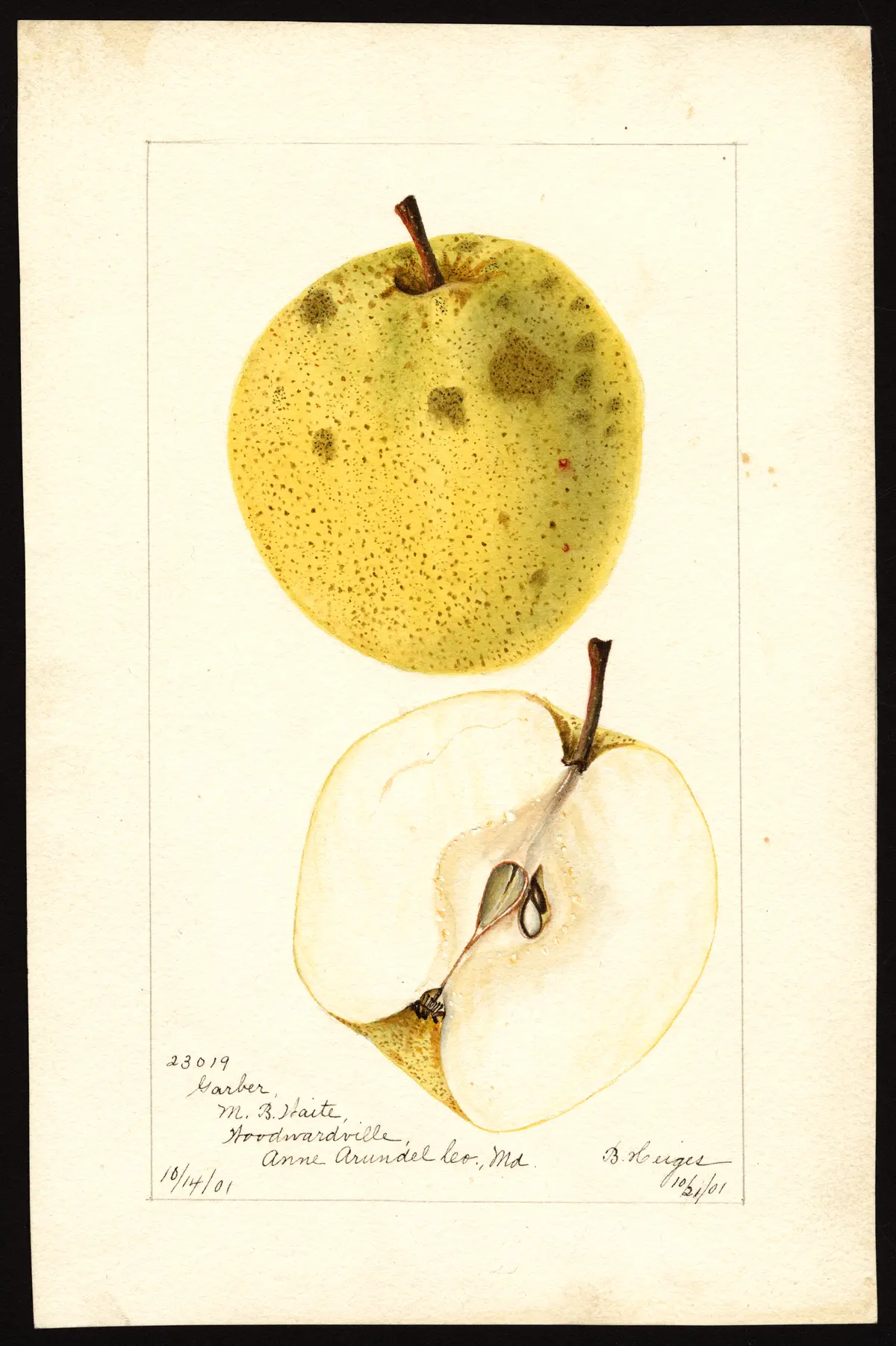
USDA Pomological Watercolor Collection
Garber
Origin / History
Garber is a pear, one of many seedlings of the Chinese Sand pear raised by J. B. Garber, Columbia, Pennsylvania, some time before 1880. Hedrick says it is supposed to be of hybrid origin. It appeared under the name "Garber's Hybrid" in Black's Culture of the Peach and Pear (1886), Harcourt's Florida Fruits (1886), and Hood's catalog (1905). It entered the American Pomological Society's list of recommended fruits in 1891 and has remained there since. Hedrick finds only "a few trivial differences" separating Garber from Kieffer. Budd and Hansen report it grown commercially in large quantity.
Tree
Tree medium in size, vigorous, upright-spreading, hardy to heat and cold, productive with age. Hedrick reports it much planted in the southern states and in the Mississippi Valley, North and South.
Branches smooth, zigzag, reddish-brown, partly covered with grayish scarf-skin. Branchlets thick, with long internodes, smooth, glabrous, sprinkled with small, round, very conspicuous, raised lenticels.
Leaf-buds small, short, pointed, with curved tips, appressed. Leaves 3½ in. long, 2½ in. wide, thick; apex taper-pointed; margin finely serrate, with very minute, reddish tips; petiole 2¼ in. long, thick.
Flower-buds small, conical, sharply pointed, free.
Fruit
Size: Large.
Form: Usually roundish-oblong, tapering toward both ends, pyriform (Budd and Hansen). A little rounder than Kieffer and flatter at the ends. Thomas alone calls it irregular oblate.
Stem: 1 in. long, stout, obliquely set.
Cavity: Small, narrow, often deep and furrowed.
Calyx: Variable in size, partly open; lobes slender.
Basin: Broad, abrupt, deep, furrowed.
Skin: Pale yellow to brownish yellow, with red on the sunny side (Budd and Hansen), often a brownish-red blush on the exposed cheek (Hedrick). Thomas alone gives the color as russet brown.
Dots: Small, numerous, russet.
Flesh and flavor: Flesh white, granular, juicy. Hedrick calls it crisp but tender, while Budd and Hansen call it firm. Hedrick finds it "neither sweet nor sour but with a peculiar, pleasant flavor"; Budd and Hansen call it acid.
Quality low. Budd and Hansen rate it "poor." Hedrick rates it "inferior" and says the fruits of both Garber and Kieffer "are poor." He adds that some say Garber is a little better in quality than Kieffer: "certainly they are no worse to eat out of hand."
Core and seeds: Not described in source.
Season
Ripe September to October, a week or two earlier than Kieffer.
Uses
Shipped in barrels for culinary use (Budd and Hansen). Hedrick finds it no worse than Kieffer to eat out of hand, and says it "might be sparingly planted in New York as an ornamental."
Subtypes / Variants
Not described in source.
Other
Not described in source.
Book Sources
Described in 4 period pomological works
Nursery Catalog Sources
Found in 27 catalogs (1891–1916) from Alabama, Arkansas, Florida, Illinois, Indiana, Kansas, Missouri, Nebraska, Oregon, Washington
- Missouri Nursery Co. , Louisiana , Missouri — 1891
- Glen St. Mary Nurseries (G.L. Taber , Proprietor), Glen St. Mary , Florida — 1893
- Knox Nurseries (H.M. Simpson Co. , Proprietors), Vincennes , Indiana — 1894
- The Vineland Nurseries (Kelsey & Co. , Proprietors), St. Joseph, Missouri (Office: 13th and Atchison Sts., 2 Blocks East of the Citizens St. Car Line) — 1894
- Stark Bros. Nurseries & Orchards Co. , Louisiana , Missouri — 1896
- J.V. Cotta (Cotta Nursery) , Carroll County , Illinois — 1898
- Stark Bros. Nurseries & Orchards Co. , Louisiana , Missouri — 1898
- Alabama Nursery Co. , Huntsville , Alabama — 1900
- Central Experimental Farm , Dominion Department of Agriculture, Agassiz, British Columbia (under test; Bulletin No. 3, Second Series) — 1900
- Washington Nursery Co. , Toppenish , Washington — 1901
- Benjamin Buckman (personal inventory) , Farmingdale , Illinois — 1901
- Mountain Grove Nurseries (Tippin & Moore , Proprietors; Geo. T. Tippin, J. W. Tippin, J. C. Moore), Mountain Grove , Missouri — 1901
- Yarbrough Bros. , Stephens , Arkansas — 1901
- Phoenix Nursery Company (W. E. Rossney , President; Sidney Tuttle, Vice-President), Bloomington , Illinois — 1904
- Stark Bros. Nurseries & Orchards Co. , Louisiana , Missouri — 1906
- Carlton Nursery Co. , Carlton , Oregon — 1909
- Washington Nursery Company , Toppenish , Washington — 1909
- Stark Bros. Nurseries & Orchards Co. , Louisiana , Missouri — 1910
- Galbraith Nursery Co. (DeWitt Hansen , Pres.-Mgr.), Fairbury , Nebraska — 1911
- Stark Bros. Nurseries & Orchards Co. , Louisiana , Missouri — 1911
- Pacific Nursery Company , Portland , Oregon — 1912
- Stark Bros. Nurseries & Orchards Co. , Louisiana , Missouri — 1912
- Vineland Nurseries Company , Clarkston , Washington — 1912
- Washington Nursery Company , Toppenish , Washington — 1912
- Van Holderbeke Nursery Co. , Incorporated, Spokane, Washington (nurseries at Otis Orchards WA, Pasadena WA, Kennewick WA) — 1913
- Benjamin Buckman (personal inventory) , Farmingdale , Illinois — 1913
- Holsinger Bros. Nurseries (Holsinger Brothers Nursery) , Rosedale , Kansas — 1916
View original book sources (4)
— John J. Thomas, The American Fruit Culturist (1903)Garber. Large, irregular oblate, russet brown.
— J.L. Budd & N.E. Hansen, American Horticultural Manual, Part II: Systematic Pomology (1914)Garber. — Large, roundish oblong, pyriform; color brownish yellow with red on sunny side. Flesh firm, granular, juicy, acid, poor. Grown commercially in large quantity and shipped in barrels for culinary use. Pennsylvania.
— U.P. Hedrick, The Pears of New York (1921)GARBER
- Am. Pom. Soc. Cat. 48. 1891. 2. Budd-Hansen Am. Hort. Man. 2:247. 1903. 3. Chico Nur. Cat. 12. 1904. 4. Cornell Sta. Bul. 332:481. 1913.
Garber's Hybrid. 5. Black Cult. Peach and Pear 229, 242. 1886. 6. Harcourt Fla. Fruits 255. 1886. 7. Hood Cat. 25. 1905.
A few trivial differences separate Garber from Kieffer — the fruits of both are poor. The pears ripen a week or two earlier than those of Kieffer, are a little rounder, flatter at the ends, and some say are a little better in quality — certainly they are no worse to eat out of hand. The tree is hardy to heat and cold, and is much planted in the southern states, and in the Mississippi Valley, North and South. The variety might be sparingly planted in New York as an ornamental.
Garber is one of many seedlings of the Chinese Sand pear, raised by J. B. Garber, Columbia, Pennsylvania, sometime previous to 1880. It is supposed to be of hybrid origin. The variety was added to the American Pomological Society's list of recommended fruits in 1891 where it has since remained.
Tree medium in size, vigorous, upright-spreading, hardy, productive with age; branches smooth, zigzag, reddish-brown partly covered with grayish scarf-skin; branchlets thick, with long internodes, smooth, glabrous, sprinkled with small, round, very conspicuous, raised lenticels. Leaf-buds small, short, pointed and with curved tips, appressed. Leaves 3½ in. long, 2½ in. wide, thick; apex taper-pointed; margin with very minute and reddish tips, finely serrate; petiole 2¼ in. long, thick. Flower-buds small, conical, sharply pointed, free.
Fruit ripe September to October; large, usually roundish-oblong and tapering toward both ends; stem 1 in. long, stout, obliquely set; cavity small, narrow, often deep and furrowed; calyx variable in size, partly open; lobes slender; basin broad, abrupt, deep, furrowed; color pale yellow, often with a brownish-red blush on the exposed cheek; dots small, numerous, russet; flesh white, granular, crisp but tender, juicy, neither sweet nor sour but with a peculiar, pleasant flavor; quality inferior.
— U.P. Hedrick, Cyclopedia of Hardy Fruits (1922)GARBER: Garber's Hybrid. A few trivial differences separate Garber from Kieffer. The pears ripen a week or two earlier than those of Kieffer, are a little rounder, flatter at the ends, and some say are a little better in quality — certainly they are no worse to eat out of hand. The tree is hardy to heat and cold, and is much planted in the Mississippi Valley, North and South. The variety might be sparingly planted as an ornamental. Garber is one of many seedlings of the Chinese Sand pear, raised by J. B. Garber, Columbia, Pennsylvania.