Le Conte
Pear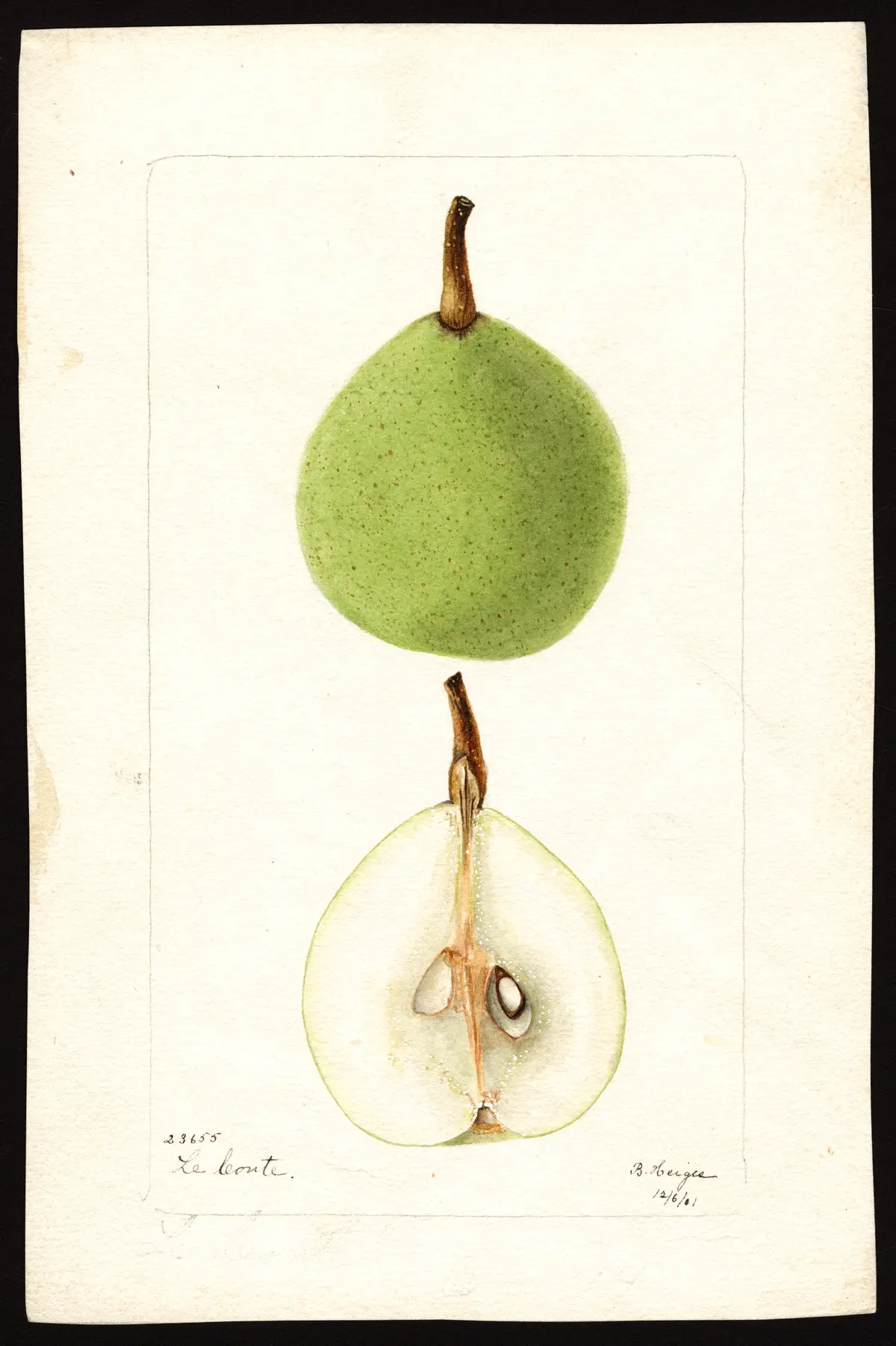
USDA Pomological Watercolor Collection
Le Conte
Origin / History
Le Conte originated in America. Hedrick calls it a hybrid between the Chinese Sand pear and a European sort, "similar in parentage to Kieffer" in 1921 and "of the same parentage as Kieffer" in 1922, a pear "which it greatly resembles in both tree and fruit." Elsewhere in the 1921 work he calls it "probably a hybrid between the Chinese Sand pear and some native." Budd and Hansen call it a Chinese seedling.
In The Pears of New York (1921), Hedrick says it is supposed to have been carried from Philadelphia to Georgia about 1850 by Major Le Conte. In the Cyclopedia (1922) he says it is supposed to have originated near Philadelphia about 1850. Hedrick's citations begin with a "Ca. Hort. Soc." report of 1878 and a "La. Hort. Soc." report of 1879. The American Pomological Society added Le Conte to its fruit catalog in 1883. In 1885 the Georgia Horticultural Society recommended it for cultivation in the middle region of that State. It was planted for trial at the Central Experimental Farm, Agassiz, British Columbia, in the spring of 1890.
Le Conte has since been extensively cultivated in the southern States for northern markets. Thomas calls it "exceedingly productive, vigorous and profitable at the South; of no value North." Hedrick finds "a place for Le Conte in the South," and in 1921 "possibly on parts of Long Island," but only "if a pear is wanted for culinary purposes only."
Tree
Tree medium in size, vigorous, upright, very to exceedingly productive, a free and regular bearer; Hedrick's 1922 account adds "slow-growing." Hedrick judges the tree "in no way superior" to that of Kieffer, its better-known rival, "but seems to succeed better in warm climates and light soils." It is more susceptible to blight than Kieffer. In the South the trees are often, if not usually, propagated from cuttings.
Branches strongly zigzag, brownish red mingled with green, covered or nearly covered with scarf-skin. Branchlets thick, reddish brown mingled with green, smooth, pubescent on the new growth, which later becomes glabrous. Lenticels numerous, very small, conspicuous, raised.
Leaf buds small, short, pointed, appressed. Leaves leathery, long-ovate or long-oval (ovate or oval in the 1922 account), with taper-pointed apex and finely serrate margin; petiole pale green, glabrous. Hedrick gives the leaves as 3½ in. long, and 1⅜ in. wide in 1921 or 1¾ in. wide in 1922.
Flower buds small, short, conical, plump, free, borne singly on very short spurs. Flowers open very early, 1¼ to 1½ in. across, in dense clusters of 7 to 10 buds. Pedicels 1 in. long, slender, lightly pubescent, pale green.
Fruit
Size: Large; the Agassiz station calls it of medium size. Uniform in size and shape. Hedrick measures it at 3 7/16 in. long by 2⅞ in. wide in 1921, and 3 9/16 in. long by 2¾ in. wide in 1922.
Form: Roundish-oval, tapering at both ends, ribbed, symmetrical. Budd and Hansen describe it as roundish, oblong, turbinate pyriform. The Agassiz station calls it bell shaped.
Stem: 1½ in. long, very thick, often curved.
Cavity: Obtuse, very shallow and narrow, smooth, slightly furrowed and wrinkled, often compressed.
Calyx: Partly open. Lobes usually dehiscent, separated at the base, short, narrow, acute. Calyx tube short, wide, broadly conical.
Basin: Usually very deep, abrupt, gently furrowed.
Skin: Thick, tough, dull, smooth or sometimes roughened. Yellow to pale yellow, occasionally marked with russet. Budd and Hansen add red on the sunny side.
Dots: Numerous, small, russet, conspicuous.
Flesh and flavor: Flesh white, firm, granular and stringy ("rather granular and stringy" in Hedrick's 1922 account), tender, juicy, sweet. Budd and Hansen call it melting, perfumed, and vinous. Hedrick gives "a strong and disagreeable flavor." Thomas rates it "moderate in quality" and Budd and Hansen "only good." Hedrick rates it "poor," "rather poorer in quality than those of Kieffer, if that be possible for an edible fruit."
Core and seeds: Core very large, closed, axile, with meeting core lines. Seeds large, 2 in each carpel, wide, long, very plump, acute.
Season
The recorded season runs from midsummer to November. Thomas and Budd and Hansen give midsummer. Hedrick gives the fruit as ripe late October to November. The fruit sometimes rots badly at the core and should usually be harvested as soon as it attains full size (Hedrick).
Uses
Culinary. The Agassiz station calls it "a handsome cooking pear," and Hedrick allows it a place only where a pear is wanted for culinary purposes. Budd and Hansen call it "much grown at the South for the northern market."
Subtypes / Variants
Not described in source.
Other
Not described in source.
Book Sources
Described in 4 period pomological works
Nursery Catalog Sources
Found in 40 catalogs (1881–1918) from Alabama, Arkansas, California, Florida, Illinois, Maryland, Massachusetts, Missouri, New Jersey, Oregon, Pennsylvania, Virginia, Washington
- Hutchison Nursery , James Hutchison, Oakland , California — 1881
- Felix Gillet , Barren Hill Nursery, Nevada City , California — 1884
- Fancher Creek Nursery , Fresno , California — 1886
- Huntsville Wholesale Nurseries (Jessie S. Moss , Proprietor; W.F. Heikes, Manager), Huntsville , Alabama — 1886
- W.R. Strong & Co. , Capital and Orange Hill Nurseries (Robert Williamson, prop.), Sacramento , California — 1886
- Felix Gillet , Barren Hill Nursery, Nevada City , California — 1888
- Felix Gillet , Barren Hill Nursery, Nevada City , California — 1889
- Felix Gillet , Barren Hill Nursery, Nevada City , California — 1890
- William H. Moon Co. , Morrisville, Bucks County , Pennsylvania — 1890
- Felix Gillet , Barren Hill Nursery, Nevada City , California — 1891
- Missouri Nursery Co. , Louisiana , Missouri — 1891 — listed as LeConte
- Puyallup & Yakima Nurseries , Puyallup, Washington (Lock Box 191) and North Yakima , Washington — 1892 — listed as LeConte
- Rogers Nursery Co. , Moorestown , New Jersey — 1893
- Glen St. Mary Nurseries (G.L. Taber , Proprietor), Glen St. Mary , Florida — 1893 — listed as LeConte
- The Vineland Nurseries (Kelsey & Co. , Proprietors), St. Joseph, Missouri (Office: 13th and Atchison Sts., 2 Blocks East of the Citizens St. Car Line) — 1894
- Woodburn Nurseries , Woodburn, Marion Co. , Oregon — 1894
- Multnomah Nurseries , Russellville , Oregon — 1894
- Felix Gillet , Barren Hill Nursery, Nevada City , California — 1895
- The Lovett Company , Little Silver , New Jersey — 1896
- Felix Gillet , Barren Hill Nursery, Nevada City , California — 1897
- The Salem Nursery (John A. Francis , Proprietor), Salem , Virginia — 1897
- J.V. Cotta (Cotta Nursery) , Carroll County , Illinois — 1898
- Reading Nursery , Jacob W. Manning, Proprietor, Reading , Massachusetts — 1898
- Brown Brothers Co. , Continental Nurseries, Rochester, NY (also operated from Toronto, Canada) — 1899
- Alabama Nursery Co. , Huntsville , Alabama — 1900
- Central Experimental Farm , Dominion Department of Agriculture, Agassiz, British Columbia (under test; Bulletin No. 3, Second Series) — 1900
- The Dalles Nurseries , The Dalles , Oregon — 1901
- Washington Nursery Co. , Toppenish , Washington — 1901
- Benjamin Buckman (personal inventory) , Farmingdale , Illinois — 1901
- Brown Brothers Co. , Continental Nurseries, Rochester, NY (also operated from Toronto, Canada) — 1901
- S.L. Watkins , Grizzly Flats, El Dorado County , California — 1901
- Yarbrough Bros. , Stephens , Arkansas — 1901 — listed as Le Conte, or Chinese Pear
- Mountain Grove Nurseries (Tippin & Moore , Proprietors; Geo. T. Tippin, J. W. Tippin, J. C. Moore), Mountain Grove , Missouri — 1901 — listed as LeConte
- Forestville Nurseries , T.J. True, Forestville , California — 1902
- Phoenix Nursery Company (W. E. Rossney , President; Sidney Tuttle, Vice-President), Bloomington , Illinois — 1904 — listed as LeConte
- Wm. J. Corse (successor to Robert Sinclair / Sinclair Nurseries) , Baltimore , Maryland — 1909
- Washington Nursery Company , Toppenish , Washington — 1909
- Washington Nursery Company , Toppenish , Washington — 1912
- Pacific Nursery Company , Portland , Oregon — 1912 — listed as LeConte
- Fancher Creek Nurseries , George C. Roeding, Fresno , California — 1918
View original book sources (5)
— John J. Thomas, The American Fruit Culturist (1903)Le Conte. Large, yellow, moderate in quality; exceedingly productive, vigorous and profitable at the South; of no value North. Mid-summer.
— J.L. Budd & N.E. Hansen, American Horticultural Manual, Part II: Systematic Pomology (1914)Le Conte. — Large, roundish, oblong, turbinate pyriform; color yellow with red on sunny side. Flesh melting, sweet, perfumed, vinous, quality only good. Much grown at the South for the northern market. Season, midsummer. Chinese seedling.
— U.P. Hedrick, The Pears of New York (1921)LE CONTE
- Ca. Hort. Soc. Rpt. 8, 29. 1878. 2. La. Hort. Soc. Rpt. 303. 1879. 3. Am. Pom. Soc. Cat. 38. 1883. 4. Gard. Mon. 27:282. 1885. 5. Ga. Hort. Soc. Rpt. 55. 1885. 6. Black Cult. Peach & Pear 234. 1886. 7. Cornell Sta. Bul. 332:484. 1913. 8. Ont. Dept. Agr. Fr. Ont. 169. 1914.
Le Conte is a hybrid between the Chinese Sand pear and a European sort, therefore similar in parentage to Kieffer which it greatly resembles in both tree and fruit. The fruits are rather poorer in quality than those of Kieffer, if that be possible for an edible fruit, and the tree is in no way superior to that of its better-known rival, but seems to succeed better in warm climates and light soils. There is, therefore, a place for Le Conte in the South, and possibly on parts of Long Island, if a pear is wanted for culinary purposes only. The fruits sometimes rot badly at the core, and should usually be harvested as soon as they attain full size. The trees are more susceptible to blight than those of Kieffer. In the South, the trees are often, if not usually, propagated from cuttings.
Le Conte originated in America, and is probably a hybrid between the Chinese Sand pear and some native. It is supposed to have been carried from Philadelphia to Georgia about 1850 by Major Le Conte, and has since been extensively cultivated in the southern States for northern markets. In 1885 it was recommended by the Georgia Horticultural Society for cultivation in the middle region of that State. The American Pomological Society added Le Conte to its fruit-catalog in 1883.
Tree medium in size, vigorous, upright, very productive, a regular bearer; branches strongly zigzag, brownish-red mingled with green and covered with scarf-skin; branchlets thick, reddish-brown mingled with green, smooth, pubescent on the new growth which later becomes glabrous, with numerous very small, conspicuous, raised lenticels.
Leaf-buds small, short, pointed, appressed. Leaves 3½ in. long, 1⅜ in. wide, long-ovate or long-oval, leathery; apex taper-pointed; margin finely serrate; petiole pale green, glabrous. Flower-buds small, short, conical, plump, free, arranged singly on very short spurs; flowers open very early, 1½ in. across, in dense clusters, 7 to 10 buds in a cluster; pedicels 1 in. long, slender, lightly pubescent, pale green.
Fruit ripe late October to November; large, 3 7/16 in. long, 2⅞ in. wide, uniform in size and shape, roundish-oval, tapering at both ends, ribbed, symmetrical; stem 1½ in. long, very thick, often curved; cavity obtuse, very shallow and narrow, smooth, slightly furrowed and wrinkled, often compressed; calyx partly open; lobes usually dehiscent, separated at the base, short, narrow, acute; basin usually very deep, abrupt, gently furrowed; skin thick, tough, smooth; color pale yellow, occasionally marked with russet; dots numerous, small, russet, conspicuous; flesh white, firm, granular, stringy, tender, juicy, sweet, with a strong and disagreeable flavor; quality poor. Core very large, closed, axile, with meeting core-lines; calyx-tube short, wide, broadly conical; seeds large, 2 in each carpel, wide, long, very plump, acute.
— U.P. Hedrick, Cyclopedia of Hardy Fruits (1922)LE CONTE. Fig. 88. Le Conte is a hybrid between the Chinese Sand pear and a European sort, therefore of the same parentage as Kieffer which it greatly resembles in both tree and fruit. The fruits are rather poorer in quality than those of Kieffer, if that be possible for an edible fruit, and the tree is in no way superior to that of its better-known rival, but seems to succeed better in warm climates and light soils. There is, therefore, a place for Le Conte in the South, if a pear is wanted for culinary purposes only. The fruits sometimes rot badly at the core, and should usually be harvested as soon as they attain full size. The trees are more susceptible to blight than those of Kieffer. In the South, the trees are often if not usually propagated from cuttings. Le Conte is supposed to have originated near Philadelphia about 1850.
Tree medium in size, vigorous, upright, slow-growing, very productive, a regular bearer; branches strongly zigzag, brownish-red mingled with green and nearly covered with scarf-skin. Leaves 3½ inches long, 1¾ inches wide, ovate or oval, leathery; apex taper-pointed; margin finely serrate; petiole pale green, glabrous. Flowers open very early, 1¼ inches across, in dense clusters, 10 buds in a cluster. Fruit ripe late October-November; large, 3⁹⁄₁₆ inches long, 2¾ inches wide, round-oval, tapering at both ends, ribbed, symmetrical; stem 1½ inches long, very thick, often curved; cavity obtuse, very shallow and narrow, smooth, slightly furrowed and wrinkled, often compressed; calyx partly open; lobes usually dehiscent, separated at the base, short, narrow, acute; basin usually very deep, abrupt, gently furrowed; skin thick, tough, smooth or sometimes roughened, dull; color pale yellow, occasionally marked with russet; dots numerous, small, russet, conspicuous; flesh white, firm, rather granular and stringy, tender, juicy, sweet, with a strong and disagreeable flavor; quality poor; core very large, closed, axile, with meeting core-lines; calyx-tube short, wide, broadly conical; seeds large, average in each carpel, wide, long, very plump, acute.
— Central Experimental Farm, Central Experimental Farm, Agassiz BC — Catalogue of Fruit Trees under Test (Bulletin No. 3, 1900) (1900)Planted Spring 1890. Tree a vigorous grower and free bearer. Fruit of medium size, bell shaped. Skin pale yellow. A handsome cooking pear.