Clapp's Favorite
Pear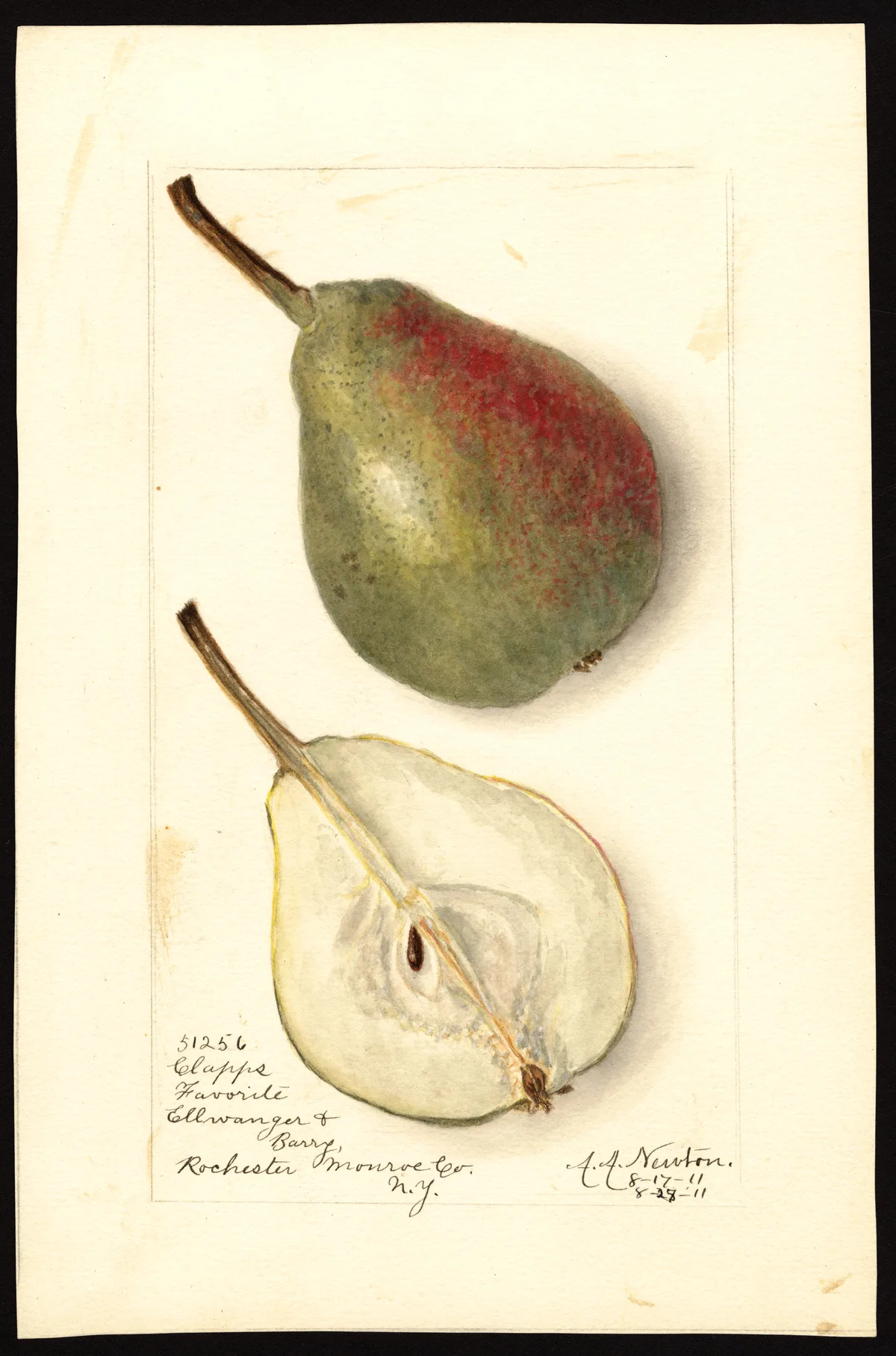
USDA Pomological Watercolor Collection
Clapp's Favorite
Origin / History
Raised from seed by the late Thaddeus Clapp, of Dorchester, Massachusetts (Downing); Hedrick gives the date of origin as uncertain. It was favorably mentioned as a promising new fruit at the meeting of the Massachusetts Horticultural Society in 1860. Thomas reports it supposed to be a cross of Flemish Beauty and Bartlett. Hedrick says this supposition cannot be proved. Early introduced into England and France, where it almost immediately received favorable commendation. First listed by the American Pomological Society in its fruit-catalog in 1867.
Downing calls it "this extremely fine and valuable Pear." Thomas calls it "popular everywhere," and Budd and Hansen say it is "grown across the continent."
Hedrick calls it "by universal consent the standard late summer pear to precede Bartlett, which it much resembles in size, shape, color, and flavor." In most regions of the United States and Canada where pears are largely grown for market, it is the first pear put on the market (Hedrick). He judges it "a desirable one wherever pears are grown" and "one of the half-dozen leading sorts in New York" (1921). His Cyclopedia (1922) calls it "one of the half-dozen leading sorts of the country." Its susceptibility to blight all but debars it from some regions in which pear-growing is a large industry (Hedrick).
Stark Bros. (1910) say it "will always be a favorite with every orchardist and fruit dealer everywhere."
Tree
Tree large, of great vigor, a strong, rapid grower. Habit upright-spreading, forming an open, well-shaped, round-topped head, on which the fruit is evenly distributed and almost uniform in size (Downing). Thomas likens the growth to that of Flemish Beauty. Stark Bros. praise its fine appearance.
Trunk stocky, rough. Branches characteristically shaggy, zigzag, reddish-brown overspread with gray scarf-skin, marked by few small, roundish, raised lenticels. Branchlets short, dull reddish-brown tinged with green, smooth, glabrous, with few small, inconspicuous lenticels (Hedrick). Young shoots dark reddish brown (Downing), dark purple (Thomas).
Leaf-buds medium in size, short, conical, pointed; leaf-scars prominent. Leaves oval, leathery; apex taper-pointed; margin glandular, finely serrate. Hedrick gives the leaves 2½ in. long and 1½ in. wide, with petiole ¾ in., in The Pears of New York, and 2¾ by 1¾ in., with petiole 1¼ in., in his Cyclopedia. Bunyard describes the leaf as moderate, oval, long, held out, finely and regularly serrate, turning a muddy brown yellow.
Flower-buds large, conical, pointed, plump, free, arranged singly on short spurs and branches. Flowers very showy, large, well distributed. Hedrick gives 1½ in. across, averaging 7 buds in a cluster, on lightly pubescent pedicels 1 to 1¼ in. long. His Cyclopedia gives 1¾ in. across and 5 buds in a cluster.
Very productive; Bunyard calls the fertility excellent and Veitch "a good bearer." Hedrick writes: "of all pears grown in America, Kieffer not excepted, the trees of Clapp Favorite are most fruitful." Bears early and regularly. Long-lived.
After Flemish Beauty and Tyson, hardier to cold than any other standard sort (Hedrick). The one weakness is susceptibility to blight. In Hedrick's words, "No standard pear goes down so quickly as this one when blight is epidemic"; except in this particular, the trees are "as nearly perfect as those of any variety in American orchards." He names two good characters, the hardiness and the fruitfulness, that redeem the variety from failure because of blight.
Shows a predilection for heavy soils, and may be set on the heaviest clays. Grown satisfactorily on dwarf as well as standard stocks (Hedrick). Veitch calls it "a good grower on all types of stock." At Agassiz, British Columbia, trees planted in spring 1890 proved strong growers and productive.
Fruit
Size: Large, usually a little larger than Bartlett (Hedrick), and almost uniform in size on the tree (Downing). Hedrick measures 4 in. long by 3½ in. wide in The Pears of New York, and 4¾ by 3¼ in. in his Cyclopedia. Bunyard alone calls it medium, 3½ by 2½ in.
Form: Pyriform: obovate to ovate, slightly obtuse-pyriform. Hedrick gives obovate-obtuse-pyriform, tapering slightly toward the apex, symmetrical. Body large, tapering to the crown; neck rather small (Thomas). Bunyard describes it as tapering to the eye, fairly even. Downing calls the surface uneven.
Stem: Nearly an inch to 1½ in. long. Stout to very thick, a little inclined to curved, somewhat fleshy. Thomas calls it rather short. Bunyard calls it slightly lipped.
Cavity: A slight depression. Hedrick describes it as very shallow, narrow, lipped, with a fleshy ring around the stem.
Calyx: Downing and Thomas call it partly closed; Bunyard and Hedrick call it open, Hedrick large and open. Segments stiff, erect. Hedrick adds lobes separated at the base, narrow, acuminate, usually erect and very stiff, and a calyx-tube long, narrow, funnel-shaped.
Basin: Shallow, corrugated and wrinkled; Downing calls it slightly corrugated. Hedrick adds wide, obtuse. Thomas calls it "small-wrinkled."
Skin: Smooth, glossy. Downing and Bunyard call it thin; Hedrick calls it thick, tough.
Ground pale lemon-yellow to pale milky yellow, yellowish green before becoming yellow (Thomas), golden yellow in Veitch's catalog.
Shaded and dotted on the sunny side with red. The red is marbled, mottled, and faintly splashed with crimson and fawn, or with bright red, deepening in highly colored specimens to a crimson blush. Bunyard gives a bright scarlet flush and stripes. At Agassiz it showed only a faint blush.
Sometimes patches and traces of russet, or only occasional faint traces (Hedrick); Veitch gives "a warm russet tinge."
Dots: Numerous, small, brown or russet, conspicuous, the skin thickly sprinkled with them.
Flesh and flavor: White to greenish or yellowish white, pale yellow, or tinged with yellow. Downing calls it fine-grained. Hedrick finds it very granular and gritty at the center, and Bunyard "rather too gritty and glassy in texture."
Tender and melting, buttery, juicy to very juicy (Bunyard). Rich, sweet, vinous. Perfumed or aromatic: "a little perfumed" (Downing), "with slight aroma" (Bunyard).
Quality "very good" by most authors. Bunyard alone rates it "a pear of fair quality."
Core and seeds: Core large, closed, with clasping core-lines. Seeds medium in size and width, plump (Hedrick).
Season
Late August and early September; September at Agassiz. Ripens just before Bartlett, usually a week or sometimes ten days ahead of it (Hedrick).
Soon softens at the center after ripening. It should be picked before fully ripe, or it will decay at the center (Thomas). Hedrick advises picking at least ten days before it would ripen on the tree.
Uses
A dessert pear (Bunyard). Chiefly a market fruit: Bunyard calls it "esteemed for market growth." Hedrick says the softening at the core debars it from distant markets and makes it suitable only for local trade.
Subtypes / Variants
Not described in source.
Other
Bunyard cites a figure in Le Verger, vol. II, 102. Hedrick notes that the camera so foreshortened the whole fruit in his plate that size and shape are not shown correctly, while the half-fruit illustrates them well.
Book Sources
Described in 6 period pomological works
- Downing, Fruits and Fruit Trees of America (1900)
- Hedrick, The Pears of New York (1921) — listed as CLAPP FAVORITE
- Budd & Hansen, Systematic Pomology (1914) — listed as Clapp Favorite
- Bunyard, A Handbook of Hardy Fruits (1920) — listed as CLAPP'S FAVOURITE
- Hedrick, Cyclopedia of Hardy Fruits (1922) — listed as Clapp Favorite
- Thomas, The American Fruit Culturist (1903)
Nursery Catalog Sources
Found in 81 catalogs (1850–1947) from Alabama, California, England, Florida, Illinois, Maryland, Massachusetts, Missouri, Nebraska, New Jersey, New York, Oregon, Pennsylvania, Virginia, Washington
- Azell Bowditch (Nursery / Fruit Catalog) , Boston , Massachusetts — 1850
- Hutchison Nursery , James Hutchison, Oakland , California — 1881
- Felix Gillet , Barren Hill Nursery, Nevada City , California — 1884
- Fancher Creek Nursery , Fresno , California — 1886
- Huntsville Wholesale Nurseries (Jessie S. Moss , Proprietor; W.F. Heikes, Manager), Huntsville , Alabama — 1886
- Felix Gillet , Barren Hill Nursery, Nevada City , California — 1888
- California Nursery Co. , Niles , California — 1889
- Felix Gillet , Barren Hill Nursery, Nevada City , California — 1889
- Felix Gillet , Barren Hill Nursery, Nevada City , California — 1890
- William H. Moon Co. , Morrisville, Bucks County , Pennsylvania — 1890
- Felix Gillet , Barren Hill Nursery, Nevada City , California — 1891
- Glen St. Mary Nurseries (G.L. Taber , Proprietor), Glen St. Mary , Florida — 1893
- Milwaukie-Canby Nurseries , Canby, OR (and Milwaukie, OR) — 1893
- Oregon Wholesale Nurseries , Salem , Oregon — 1893
- Rogers Nursery Co. , Moorestown , New Jersey — 1893
- Sherwood Hall Nursery Co. , Timothy Hopkins (Menlo Park Nurseries), San Francisco / Menlo Park , California — 1893
- Green's Nursery Co. (Charles A. Green) , Rochester , New York — 1894
- Multnomah Nurseries , Russellville , Oregon — 1894
- The Vineland Nurseries (Kelsey & Co. , Proprietors), St. Joseph, Missouri (Office: 13th and Atchison Sts., 2 Blocks East of the Citizens St. Car Line) — 1894
- Woodburn Nurseries , Woodburn, Marion Co. , Oregon — 1894
- Felix Gillet , Barren Hill Nursery, Nevada City , California — 1895
- The Lovett Company , Little Silver , New Jersey — 1896
- Felix Gillet , Barren Hill Nursery, Nevada City , California — 1897
- Kelway & Son , Langport, Somerset , England — 1897
- The Salem Nursery (John A. Francis , Proprietor), Salem , Virginia — 1897
- Arthur J. Collins & Sons , Moorestown , New Jersey — 1898
- Reading Nursery , Jacob W. Manning, Proprietor, Reading , Massachusetts — 1898
- Stark Bros. Nurseries & Orchards Co. , Louisiana , Missouri — 1898
- Brown Brothers Co. , Continental Nurseries, Rochester, NY (also operated from Toronto, Canada) — 1899
- George Bunyard & Co. , Royal Nurseries, Maidstone, Kent , England — 1900
- Central Experimental Farm , Dominion Department of Agriculture, Agassiz, British Columbia (under test; Bulletin No. 3, Second Series) — 1900
- The Dalles Nurseries , The Dalles , Oregon — 1901
- Washington Nursery Co. , Toppenish , Washington — 1901
- Benjamin Buckman (personal inventory) , Farmingdale , Illinois — 1901
- Brown Brothers Co. , Continental Nurseries, Rochester, NY (also operated from Toronto, Canada) — 1901
- Mountain Grove Nurseries (Tippin & Moore , Proprietors; Geo. T. Tippin, J. W. Tippin, J. C. Moore), Mountain Grove , Missouri — 1901
- S.L. Watkins , Grizzly Flats, El Dorado County , California — 1901
- Forestville Nurseries , T.J. True, Forestville , California — 1902
- Pacific Nursery Company (W. O. Hudson & A. D. Hudson) , Tangent , Oregon — 1903
- Russellville Nursery Co. , Russellville, OR (three miles east of Portland, one mile from Montavilla car line) — 1903
- Phoenix Nursery Company (W. E. Rossney , President; Sidney Tuttle, Vice-President), Bloomington , Illinois — 1904
- Stark Bros. Nurseries & Orchards Co. , Louisiana , Missouri — 1906
- J.B. Pilkington , Portland , Oregon — 1907
- Russellville Nursery Co. , Montavilla Station, Portland, OR (three miles east of Portland, one mile from Montavilla car line) — 1907
- Carlton Nursery Co. , Carlton , Oregon — 1909
- Milton Nursery Co. (A. Miller & Sons , Proprietors), Milton , Oregon — 1909
- Wm. J. Corse (successor to Robert Sinclair / Sinclair Nurseries) , Baltimore , Maryland — 1909
- Washington Nursery Company , Toppenish , Washington — 1909
- C.F. Lansing , Salem , Oregon — 1910
- Island Nurseries & Fruit Farm , Vashon (Vashon Island) , Washington — 1910
- Stark Bros. Nurseries & Orchards Co. , Louisiana , Missouri — 1910
- Galbraith Nursery Co. (DeWitt Hansen , Pres.-Mgr.), Fairbury , Nebraska — 1911
- Island Nurseries & Fruit Farm , Vashon (Vashon Island) , Washington — 1911
- Stark Bros. Nurseries & Orchards Co. , Louisiana , Missouri — 1911
- James Veitch & Sons , Ltd., Royal Exotic Nursery, Chelsea, London (also Coombe Wood, Langley, and Feltham) , England — 1911
- Ballygreen Nurseries , Hanford , Washington — 1912
- Pacific Nursery Company , Portland , Oregon — 1912
- Stark Bros. Nurseries & Orchards Co. , Louisiana , Missouri — 1912
- Vineland Nurseries Company , Clarkston , Washington — 1912
- Washington Nursery Company , Toppenish , Washington — 1912
- J. B. Pilkington , Nurseryman, Portland, OR (nurseries near Newberg, forty miles from Portland) — 1913
- Samuel Fraser , Geneseo , New York — 1913
- Thomas Rivers & Son , Sawbridgeworth, Hertfordshire , England — 1913
- Van Holderbeke Nursery Co. , Incorporated, Spokane, Washington (nurseries at Otis Orchards WA, Pasadena WA, Kennewick WA) — 1913
- George Bunyard & Co. , Royal Nurseries, Maidstone, Kent , England — 1914
- Island Nurseries & Fruit Farm , Vashon (Vashon Island) , Washington — 1914
- Island Nurseries & Fruit Farm , Vashon (Vashon Island) , Washington — 1915
- Union Nurseries , J.B. Weaver & Sons, Union , Oregon — 1915
- Ornamental & Fruit Nursery Company , Wapato, County of Yakima , Washington — 1915
- Island Nurseries & Fruit Farm , Vashon (Vashon Island) , Washington — 1916
- George Bunyard & Co. , Royal Nurseries, Maidstone, Kent , England — 1917
- Island Nurseries & Fruit Farm , Vashon (Vashon Island) , Washington — 1917
- Fancher Creek Nurseries , George C. Roeding, Fresno , California — 1918
- Oregon Nursery Co. , Orenco , Oregon — 1920
- Christopher Nurseries / John Stewart & Sons , Christopher , Washington — 1920
- Benedict Nursery Co. , Portland , Oregon — 1921
- Columbia & Okanogan Nursery Co. , Wenatchee , Washington — 1925
- OSU Bulletin 216 — 1925
- Hudson's Wholesale Nurseries , Tangent , Oregon — 1926
- Milton Nursery Co. , Milton-Freewater , Oregon — 1947
- North-Western Nurseries , Walla Walla , Washington
View original book sources (9)
— A.J. Downing, The Fruits and Fruit Trees of America (1900)Clapp's Favorite.
This extremely fine and valuable Pear was raised from seed by the late Thaddeus Clapp, of Dorchester, Mass. The tree is an upright spreading, vigorous grower, forming an open, well-shaped head, on which the fruit is evenly distributed and almost uniform in size. Very productive. Young shoots dark reddish brown.
Fruit large, obovate ovate, slightly obtuse pyriform. Surface uneven. Skin thin, pale lemon yellow, marbled and faintly splashed with crimson and fawn when fully exposed to the sun, thickly sprinkled with brown dots, and sometimes patches and traces of russet. Stalk nearly an inch long, a little inclined, stout, and somewhat fleshy, inserted in a slight depression. Calyx partially closed. Segments stiff, erect. Basin shallow, slightly corrugated. Flesh white, fine-grained, juicy, buttery, melting, rich, sweet, vinous, a little perfumed. Very good. Last of August or early September.
— John J. Thomas, The American Fruit Culturist (1903)Clapp's Favorite.* Large, pyriform, body large tapering to the crown, neck rather small; skin smooth, yellowish-green becoming yellow, dotted and shaded with red to the sun; stalk rather short, stout; calyx partly closed, basin small-wrinkled; flesh greenish or yellowish white, juicy, melting, perfumed, of very good quality. Ripens just before the Bartlett. Young shoots dark purple, growth strong and vigorous, resembling that of the Flemish Beauty, with which and the Bartlett it is supposed to be a cross. The fruit should be picked before it is fully ripe, or it will decay at the centre. Popular everywhere. Massachusetts.
— J.L. Budd & N.E. Hansen, American Horticultural Manual, Part II: Systematic Pomology (1914)Clapp Favorite. — Large, obovate, or ovate pyriform; stem one inch long, stout, inclined, and inserted in slight cavity; color pale yellow, marbled, and splashed with crimson, with russet patches. Flesh white, fine-grained, juicy, buttery, melting, rich, perfumed, very good. Grown across the continent. Massachusetts.
Clapp Favorite.
— E.A. Bunyard, A Handbook of Hardy Fruits (1920)CLAPP'S FAVOURITE. Verger II., 102. Dessert, early September, medium, 3½ by 2½, pyriform, tapering to eye, fairly even. Skin, thin, smooth. Colour, pale milky yellow with a bright scarlet flush and stripes. Flesh, pale yellow, melting, very juicy with slight aroma. Eye, open in a shallow basin. Stem, stout, 1 inch long, slightly lipped. Growth, vigorous, upright; fertility, excellent. Leaf, moderate, oval, long, held out, finely and regularly serrate, turns muddy brown yellow. Origin, raised by Thaddeus Clapp, of Dorchester, Mass., U.S.A. A pear of fair quality, esteemed for market growth, but rather too gritty and glassy in texture.
— U.P. Hedrick, The Pears of New York (1921)CLAPP FAVORITE
- Mass. Hort. Soc. Rpt. 50. 1860. 2. Am. Pom. Soc. Cat. 20. 1867. 3. Pom. France 4: No. 170, Pl. 170. 1867. 4. Downing Fr. Trees Am. 720, fig. 1869. 5. Thomas Am. Fruit Cult. 452. 1897.
Favorite de Clapp. 6. Mas Le Verger 2:207, fig. 102. 1866-73.
Clapp's Favourite. 7. Hogg Fruit Man. 548. 1884. 8. Bunyard-Thomas Fr. Gard. 134, 462, fig. 1904.
Clapp's Liebling. 9. Gaucher Pom. Prak. Obst. No. 31, Pl. 46. 1894.
Clapp Favorite is by universal consent the standard late summer pear to precede Bartlett, which it much resembles in size, shape, color, and flavor. In most regions in the United States and Canada where pears are largely grown for the market, Clapp Favorite is the first pear to be put on the market. The season is usually a week or sometimes ten days before that of Bartlett. The chief fault of the fruits is that they soon soften at the center after ripening, to obviate which they should be picked at least ten days before they would ripen on the tree. This softening at the core debars the fruit from distant markets, and makes it suitable only for local trade. The illustration of the whole fruit in the accompanying plate is so foreshortened by the camera that size and shape are not shown correctly, but the half-fruit illustrates the size and shape very well. The fruits are usually a little larger than those of Bartlett. Except in one particular, the trees of Clapp Favorite are as nearly perfect as those of any variety in American orchards. The weak character, unfortunately, is a most important one, and all but debars the variety from some regions in which pear-growing is a large industry. The weakness is susceptibility to blight. No standard pear goes down so quickly as this one when blight is epidemic. Two good characters of the trees redeem the variety from failure because of blight.
After those of Flemish Beauty and Tyson, the trees of this variety show greater hardihood to cold than those of any other standard sort; and of all pears grown in America, Kieffer not excepted, the trees of Clapp Favorite are most fruitful. Other merits of the tree are large size, great vigor, longevity, and earliness and regularity in bearing. The variety shows a predilection for heavy soils, and the trees may be set on the heaviest clays. Clapp Favorite is grown satisfactorily on dwarf as well as standard stocks. The variety is a desirable one wherever pears are grown, and is one of the half-dozen leading sorts in New York.
Clapp Favorite was raised by Thaddeus Clapp, Dorchester, Massachusetts, but the date of its origin is uncertain. It was favorably mentioned as a promising new fruit at the meeting of the Massachusetts Horticultural Society in 1860. By some writers this pear is supposed to be a cross between Flemish Beauty and Bartlett, but this supposition cannot be proved. The variety was early introduced into England and France where it almost immediately received favorable commendation. The American Pomological Society first listed Clapp Favorite in its fruit-catalog in 1867.
Tree large, upright-spreading, round-topped, very productive; trunk stocky, rough; branches characteristically shaggy, zigzag, reddish-brown overspread with gray scarfskin, marked by few small, roundish, raised lenticels; branchlets short, dull reddish-brown, tinged with green, smooth, glabrous, with few small, inconspicuous lenticels.
Leaf-buds medium in size, short, conical, pointed; leaf-scars prominent. Leaves 2½ in. long, 1½ in. wide, oval, leathery; apex taper-pointed; margin glandular, finely serrate; petiole ¾ in. long. Flower-buds large, conical, pointed, plump, free, arranged singly on short spurs and branches; flowers very showy, 1½ in. across, large, well distributed, averaging 7 buds in a cluster; pedicels 1-1¼ in. long, lightly pubescent.
Fruit ripe in late August and early September; large, 4 in. long, 3½ in. wide, obovate-obtuse-pyriform, tapering slightly toward the apex, symmetrical; stem 1½ in. long, very thick, curved, fleshy; cavity very shallow, narrow, lipped, with a fleshy ring around the stem; calyx large, open; lobes separated at the base, narrow, acuminate, usually erect and very stiff; basin shallow, wide, obtuse, corrugated and wrinkled; skin thick, tough, smooth, glossy; color pale lemon-yellow, mottled and dotted with bright red, deepening in highly colored specimens to a crimson blush, with occasional faint traces of russet; dots numerous, small, russet, conspicuous; flesh tinged with yellow, very granular and gritty at the center, tender and melting, buttery, juicy, sweet, rich, vinous, aromatic; quality very good. Core large, closed, with clasping core-lines; calyx-tube long, narrow, funnel-shaped; seeds medium in size and width, plump.
— U.P. Hedrick, Cyclopedia of Hardy Fruits (1922)CLAPP FAVORITE.
Fig. 79. Clapp Favorite is the standard late summer pear to precede Bartlett, which it much resembles in size, shape, color and flavor. The season is usually a week or sometimes ten days before that of Bartlett. The chief fault of the fruits is that they soon soften at the center after ripening, to obviate which they should be picked at least ten days before they would ripen on the tree. This softening at the core debars the fruit from distant markets, and makes it suitable only for local trade. The fruits are usually a little larger than those of Bartlett. The trees of Clapp Favorite are nearly perfect except that they go down quickly when blight is epidemic. Two good characters of the trees redeem the variety from failure because of blight. After those of Flemish Beauty and Tyson, the trees of this variety show greater hardihood to cold than those of any other standard sort; and of all pears in America, Kieffer not excepted, the trees of Clapp Favorite are most fruitful. Other merits of the tree are large size, vigor, longevity, and earliness and regularity in bearing. The variety shows a predilection for heavy soils, and the trees may be set on the heaviest clays. Clapp Favorite is desirable wherever pears are grown in America and is one of the half-dozen leading sorts of the country. This variety originated with Thaddeus Clapp, Dorchester, Massachusetts, but the date of its origin is uncertain. It was mentioned as a promising new fruit in 1860.
Tree large, upright-spreading, round-topped, productive; trunk stocky, rough; branches characteristically shaggy, zigzag, reddish-brown, marked by few small, roundish, raised lenticels. Leaves 2¾ inches long, 1¾ inches wide, oval, leathery; apex taper-pointed; margin glandular, finely serrate; petiole 1¼ inches long. Flowers very showy, 1¾ inches across, large, well distributed, averaging 5 buds in a cluster. Fruit ripe in late August and early September; large, 4¾ inches long, 3¼ inches wide, obovate-obtuse-pyriform, symmetrical; stem 1½ inches long, thick, curved, fleshy; cavity shallow, narrow, lipped, with a fleshy ring around the stem; calyx large, open; lobes separated at the base, narrow, acuminate, erect and very stiff; basin shallow, wide, obtuse, wrinkled; skin thick, tough, smooth, glossy; color pale lemon-yellow, mottled and dotted with bright red, deepening in highly colored specimens to a crimson blush, with faint traces of russet; dots numerous, small, russet, conspicuous; flesh tinged with yellow, very granular and gritty at the center, tender and melting, buttery, juicy, sweet, rich, vinous, aromatic; quality very good; core large, closed, with clasping core-lines; calyx-tube long, narrow, funnel-shaped; seeds medium in size and width, plump.
— Central Experimental Farm, Central Experimental Farm, Agassiz BC — Catalogue of Fruit Trees under Test (Bulletin No. 3, 1900) (1900)Planted Spring 1890. Tree a strong grower and productive. Fruit large, obtuse, pyriform. Skin yellow, with a faint blush and sprinkled with brown dots. Flesh white, fine grained, juicy, buttery, rich, sweet, quality very good. Season September.
— Stark Bros. Nurseries & Orchards Co., Stark Bros. Year Book (1910) (1910)The tree grows rapidly in form, fine appearance and productiveness. The fruit is large...will always be a favorite with every orchardist and fruit dealer everywhere.
— James Veitch & Sons, Veitch's Fruit Trees (1911) (1911)large, golden yellow, with a warm russet tinge. A good grower on all types of stock, a good bearer