Souvenir du Congrès
Pear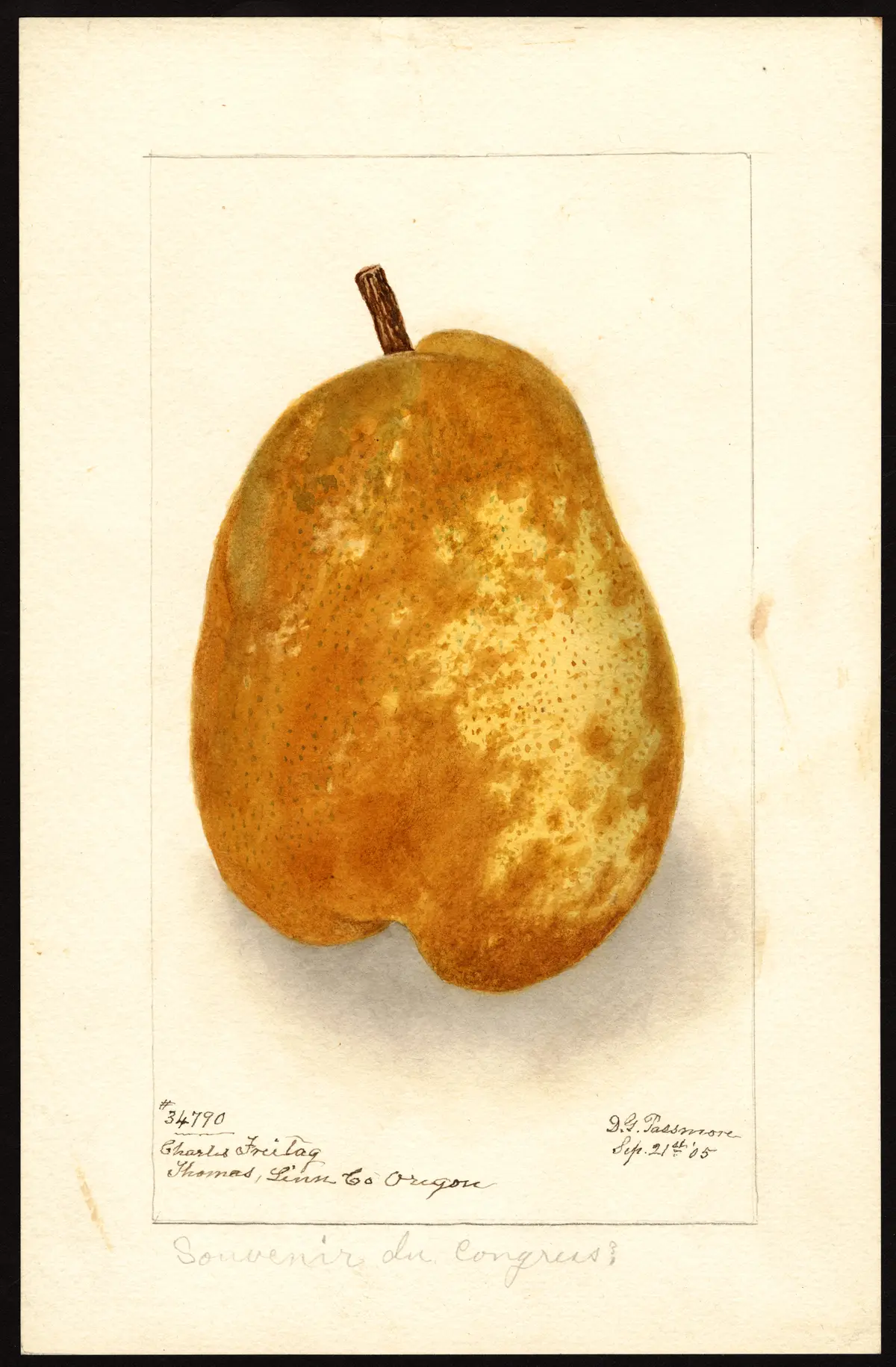
USDA Pomological Watercolor Collection
Souvenir du Congrès
Origin / History
Raised by M. François Morel, a nurseryman of Lyon-Vaise, France (Hedrick gives Lyons). The Herefordshire Pomona says it "is said to have been produced" about the middle of the century, 1850. Hedrick gives the following account. Morel grafted one of his pear trees with cions taken from several other varieties, Bartlett among them, and in 1852 sowed seeds from the fruit of that tree. One of the resulting trees first fruited in 1863. Its pears had so many earmarks of Bartlett that it was at once assumed to be a seedling of that variety. The tree continued to do well, and in due course the Rhône Horticultural Society judged the variety worthy of dissemination. Morel later dedicated it to the Pomological Congress of France. Downing's account rests on the Revue Horticole, and Hedrick's earliest reference is Pom. France, 1867. Introduced into the United States about 1870, and placed on the American Pomological Society's fruit-catalog list in 1875.
The Herefordshire Pomona finds "a great resemblance to Williams Bon Chrétien, but is quite a distinct fruit." Budd and Hansen report it "now quite widely grown east of the lakes." Hedrick judges it "very similar to Clapp Favorite and Bartlett, and not as good as either in fruit-characters," and says it "hardly merits a place in American pomology," though it "grows especially well in New York."
Tree
Vigorous, a strong grower, hardy to very hardy, healthy. Hedrick's introductory remarks call it "remarkable for vigor, hardihood to cold, and healthfulness," while his technical description gives it as medium in size and vigor. Fruits are said to be larger and of better quality when the tree is double-worked on the quince (Hedrick).
Growth upright-spreading. Hedrick calls it open-topped, and Bunyard calls it rather compact and spurring well. Pyramidal in form; the Herefordshire Pomona says it makes "an excellent pyramid on the quince stock."
Branches zigzag, dull reddish-brown, heavily overspread with ash-gray scarf-skin, marked by small, raised lenticels. Branchlets thick, long, reddish-brown, overspread with dull gray mingled with green, smooth, glabrous, with few small, slightly raised lenticels. Leaf-buds small, short, pointed, plump, free (Hedrick).
Leaves roundish-oval. Bunyard describes them as large, dark green, upfolded, neatly and regularly crenate, turning a fine crimson red. Hedrick describes them as leathery, apex abruptly pointed, margin finely serrate and tipped with very few glands, petiole glabrous and tinged with red. He measures them at 1½ in. long by 1 in. wide with a 1¼ in. petiole, and in his Cyclopedia at 1¾ in. by 1½ in. with a 1½ in. petiole.
Flower-buds short, conical or pointed, plump, free, borne singly on very short spurs or branchlets. Flowers with a disagreeable odor, 1⅜ in. across (1½ in. in Hedrick's Cyclopedia), pinkish-white as the buds unfold, becoming whitish, in dense clusters of 6 to 8 buds. Pedicels ¾ in. long, thick, heavily pubescent, light green.
Bears well; fertile, very productive. Hedrick says it bears so abundantly that the crop must be thinned to prevent breaking of branches.
Fruit
Size: Large to very large; Veitch alone calls it medium size. The Herefordshire Pomona measures it at 3½ in. long and 2¾ in. wide, "and often much larger." Hedrick measures it at 3⅞ in. by 2⅝ in. (3 5/16 in. by 2 7/16 in. in his Cyclopedia), uniform in size and shape, and larger than Clapp Favorite and Bartlett. Bunyard says the figure in the Herefordshire Pomona is rather too small.
Form: Oblong, obovate, obtuse pyriform, resembling Bartlett in form (Downing). Outline uneven and undulating, or rather uneven, and much flattened at the eye in Bunyard's calebasse form. Hedrick gives it as oblong-acute-pyriform, symmetrical, with unequal sides.
Stem: Stout to very stout and thick, ¾ in. to an inch or more long, much inclined, curved. Hedrick calls it short and measures it at 1 in. (⅞ in. in his Cyclopedia); Bunyard calls it rather long.
Cavity: Very shallow and narrow or lacking, obtuse, russeted, slightly furrowed to furrowed, the stem often inserted beneath a pronounced irregular lip (Hedrick). Budd and Hansen say the stem is inserted in the flesh without cavity. The Herefordshire Pomona says it is inserted either in a pretty deep cavity or on the end of the fruit in a slight cavity.
Calyx: Open. The Herefordshire Pomona calls the eye large and deeply set. Lobes separated at the base, narrow, acute; calyx-tube short, wide, conical (Hedrick).
Basin: Rather deep, uneven (Bunyard). Hedrick describes it as wide, obtuse and flaring, slightly furrowed to furrowed, symmetrical, smooth except for a thick russet covering.
Skin: Smooth, a handsome yellow to bright yellow at maturity, washed on the sunny side with bright red, carmine, scarlet, or a reddish blush. Considerably covered with smooth cinnamon-colored russet, striped or in nettings, with patches of the yellow ground exposed; russeted at the stem (Budd and Hansen). The Herefordshire Pomona gives streaks of bright crimson and "a warm glow of russet" on the sunny side. Very handsome.
Dots: Many, small, brown or russet, conspicuous.
Flesh and flavor: White to yellowish white, or yellowish (Bunyard), with a faint tinge of yellow (Hedrick). Tender, very juicy, melting, buttery. Hedrick also calls it firm and granular, and Budd and Hansen call it quite coarse.
Flavor sweet to very sweet, rich, vinous, slightly perfumed, with a musky flavor or musky aroma. Downing finds the flesh "much like the Bartlett, having the musky flavor, though in a less degree," and the Agassiz station calls it slightly musky and "of very pleasant flavour."
Quality "good" (Budd and Hansen, Hedrick). The Herefordshire Pomona calls it "a very handsome and excellent Pear," Veitch "extremely choice fine," and Rivers "of excellent flavour."
Core and seeds: Core closed, with clasping core-lines. Seeds wide, plump, acute; Hedrick calls them large, and in his Cyclopedia long.
Season
End of August to the beginning of November, the crop ripening between those of Clapp Favorite and Bartlett (Hedrick). Most authors give September, beginning in August. The Herefordshire Pomona alone carries it to the beginning of November. Rivers calls it an "excellent keeper."
Uses
Dessert; Bunyard calls it "a very valuable fruit for autumnal use." Hedrick finds it deserving a place in home orchards and fruit-collections. In his Cyclopedia he gives as reason that the crop ripens between those of Clapp Favorite and Bartlett and the fruits are larger and often handsomer. Veitch calls it "a valuable addition to the collection."
Subtypes / Variants
Not described in source.
Other
[NOTE: Source text may be incorrect — the Thomas Rivers & Son catalog fragment ("very fresh, vigorous fruit not in two pieces; a setting pear") appears garbled or truncated; its legible claims are placed above.] The Rivers catalog describes it as "very fresh, vigorous fruit not in two pieces; a setting pear." Hedrick says the color-plate accompanying his description "illustrates the size, shape, and color of this pear remarkably well."
Book Sources
Described in 6 period pomological works
- Hedrick, The Pears of New York (1921)
- Hedrick, Cyclopedia of Hardy Fruits (1922)
- The Herefordshire Pomona (1876–1885)
- Budd & Hansen, Systematic Pomology (1914) — listed as Souvenir (Souvenir du Congress)
- Bunyard, A Handbook of Hardy Fruits (1920) — listed as SOUVENIR DE CONGRES
- Downing, Fruits and Fruit Trees of America (1900) — listed as Souvenir du Congress
Nursery Catalog Sources
Found in 29 catalogs (1884–1917) from California, England, Missouri, Oregon, Washington
- Felix Gillet , Barren Hill Nursery, Nevada City , California — 1884
- Fancher Creek Nursery , Fresno , California — 1886
- Felix Gillet , Barren Hill Nursery, Nevada City , California — 1888
- California Nursery Co. , Niles , California — 1889
- Felix Gillet , Barren Hill Nursery, Nevada City , California — 1889
- Felix Gillet , Barren Hill Nursery, Nevada City , California — 1890
- Felix Gillet , Barren Hill Nursery, Nevada City , California — 1891
- Puyallup & Yakima Nurseries , Puyallup, Washington (Lock Box 191) and North Yakima , Washington — 1892
- Sherwood Hall Nursery Co. , Timothy Hopkins (Menlo Park Nurseries), San Francisco / Menlo Park , California — 1893
- Oregon Wholesale Nurseries , Salem , Oregon — 1893 — listed as Sov. du Congress
- Felix Gillet , Barren Hill Nursery, Nevada City , California — 1894
- The Vineland Nurseries (Kelsey & Co. , Proprietors), St. Joseph, Missouri (Office: 13th and Atchison Sts., 2 Blocks East of the Citizens St. Car Line) — 1894
- Woodburn Nurseries , Woodburn, Marion Co. , Oregon — 1894
- Felix Gillet , Barren Hill Nursery, Nevada City , California — 1895
- Felix Gillet , Barren Hill Nursery, Nevada City , California — 1897
- Kelway & Son , Langport, Somerset , England — 1897
- George Bunyard & Co. , Royal Nurseries, Maidstone, Kent , England — 1900
- Central Experimental Farm , Dominion Department of Agriculture, Agassiz, British Columbia (under test; Bulletin No. 3, Second Series) — 1900
- The Dalles Nurseries , The Dalles , Oregon — 1901
- Washington Nursery Co. , Toppenish , Washington — 1901
- Mountain Grove Nurseries (Tippin & Moore , Proprietors; Geo. T. Tippin, J. W. Tippin, J. C. Moore), Mountain Grove , Missouri — 1901
- Washington Nursery Company , Toppenish , Washington — 1909
- James Veitch & Sons , Ltd., Royal Exotic Nursery, Chelsea, London (also Coombe Wood, Langley, and Feltham) , England — 1911
- Ballygreen Nurseries , Hanford , Washington — 1912
- Pacific Nursery Company , Portland , Oregon — 1912
- Washington Nursery Company , Toppenish , Washington — 1912
- Thomas Rivers & Son , Sawbridgeworth, Hertfordshire , England — 1913
- George Bunyard & Co. , Royal Nurseries, Maidstone, Kent , England — 1914
- George Bunyard & Co. , Royal Nurseries, Maidstone, Kent , England — 1917
View original book sources (9)
— Woolhope Naturalists Field Club, The Herefordshire Pomona (1885)
- SOUVENIR DU CONGRÈS.
This Pear is said to have been produced by M. Morel, of Lyon-Vaise, in France, about the middle of the present century (1850).
Description.—Fruit: large, three inches and a half long, two inches and three quarters wide, and often much larger ; oblong, obovate, uneven and undulating in its outline. Skin: considerably covered with smooth cinnamon-coloured russet, with, here and there, patches of the yellow ground colour exposed ; on the side next the sun, there are streaks of bright crimson, and a warm glow of russet. Eye : large and open, deeply set. Stalk : an inch or more long, very stout, inserted either in a pretty deep cavity, or on the end of the fruit, in a slight cavity. Flesh : yellowish white, tender, very juicy and melting, with a rich, vinous flavour and a musky aroma.
A very handsome and excellent Pear ; in season from the end of August to the beginning of November. It has a great resemblance to Williams Bon Chrétien, but is quite a distinct fruit.
The tree is hardy and bears well, making an excellent pyramid on the quince stock.
— A.J. Downing, The Fruits and Fruit Trees of America (1900)Souvenir du Congress.
This Pear was originated by M. Morel, of Lyon-Vaise, France, and by him dedicated to the Pomological Congress of France. Tree vigorous and fertile, pyramidal in form.
Fruit large to very large, resembling in form the Bartlett. Skin smooth, of a handsome yellow at maturity, washed with bright red, or carmine, on the side exposed to the sun. Flesh much like the Bartlett, having the musky flavor, though in a less degree. Its maturity commences in August and continues in September. (Revue Horticole.)
— J.L. Budd & N.E. Hansen, American Horticultural Manual, Part II: Systematic Pomology (1914)Souvenir (Souvenir du Congress). — Large to very large, obovate obtuse pyriform; color yellow when ripe, with bright carmine in the sun, and many brown dots; russeted at the stem; stalk three-quarters of an inch long, stout, much inclined, and inserted in flesh without cavity. Flesh white, quite coarse, slightly perfumed, vinous; quality good. Now quite widely grown east of the lakes. France.
— E.A. Bunyard, A Handbook of Hardy Fruits (1920)SOUVENIR DE CONGRES. Her. Pom., I., 28. Dessert, September, large, calebasse form much flattened at eye, rather uneven. Colour, bright yellow, with scarlet cheek and cinnamon striped russet. Flesh, yellowish, tender, very sweet, musky flavour. Eye, open in a rather deep uneven basin. Stem, rather long, stout. Growth, upright spreading, spurring well, rather compact; fertility good. Leaf, large, roundish oval, dark green, upfolded, neatly and regularly crenate, turns fine crimson red. Origin, raised by M. Morel, a nurseryman of Lyon-Vaise, France, and first fruited in 1863. A very valuable fruit for autumnal use. The figure in the Herefordshire Pomona is rather too small.
— U.P. Hedrick, The Pears of New York (1921)SOUVENIR DU CONGRÈS
- Pom. France 4: No. 162, Pl. 162. 1867. 2. Am. Pom. Soc. Cat. 34. 1875. 3. Flor. & Pom. 37, Pl. 1875. 4. Jour. Hort. N. S. 38:120, fig. 19. 1880. 5. Hogg Fruit Man. 647. 1884. 6. Cat. Cong. Pom. France 350, fig. 1906.
Andenken an den Congress. 7. Oberdieck Obst-Sort. 237. 1881. 8. Mathieu Nom. Pom. 168. 1889. 9. Deut. Obstsorten 6: Pt. 16, Pl. 1910.
Souvenir. 10. Am. Pom. Soc. Cat. 24. 1897. 11. Ont. Dept. Agr. Fr. Ont. 179. 1914.
Very similar to Clapp Favorite and Bartlett, and not as good as either in fruit-characters, Souvenir du Congrès hardly merits a place in American pomology. The crop ripens between those of the two sorts with which it has been compared, and the fruits are larger and often handsomer. The fruits are said to be larger and of better quality when the tree is double-worked on the quince. The tree is remarkable for vigor, hardihood to cold, and healthfulness; and bears so abundantly that the crop must be thinned to prevent breaking of branches. The variety grows especially well in New York, and is deserving a place in home orchards and in fruit-collections. The accompanying color-plate illustrates the size, shape, and color of this pear remarkably well.
Souvenir du Congrès owes its origin to M. François Morel, Lyons, France. M. Morel grafted one of his pear-trees with cions taken from several other varieties, including Bartlett, and from the tree thus grafted he obtained fruit, seeds of which he sowed in 1852. One of the resultant trees bore fruit in 1863, and the pears had so many earmarks of Bartlett that it was at once assumed to be a seedling of that variety. The tree continued to do well and in due course the variety was judged to be worthy of dissemination by the Rhône Horticultural Society. Later, M. Morel dedicated the new pear to the Pomological Congress of France. The variety was introduced in the United States about 1870. The American Pomological Society placed Souvenir du Congrès on its fruit-catalog list in 1875.
Tree medium in size and vigor, upright-spreading, open-topped, very productive; branches zigzag, dull reddish-brown, heavily overspread with ash-gray scarf-skin, marked by small, raised lenticels; branchlets thick, long, reddish-brown, overspread with dull gray mingled with green, smooth, glabrous, with few small, slightly raised lenticels.
Leaf-buds small, short, pointed, plump, free. Leaves 1½ in. long, 1 in. wide, roundish-oval, leathery; apex abruptly pointed; margin tipped with very few glands, finely serrate; petiole 1¼ in. long, glabrous, tinged with red. Flower-buds short, conical or pointed, plump, free, arranged singly on very short spurs or branchlets; flowers with a disagreeable odor, 1⅜ in. across, pinkish-white as the buds unfold, becoming whitish, in dense clusters, 6 to 8 buds in a cluster; pedicels ¾ in. long, thick, heavily pubescent, light green.
Fruit ripe in September; large, 3⅞ in. long, 2⅝ in. wide, uniform in size and shape, oblong-acute-pyriform, symmetrical, with unequal sides; stem 1 in. long, short, thick, curved; cavity obtuse, almost lacking, very shallow, narrow, russeted, slightly furrowed, often with the stem inserted beneath a pronounced irregular lip; calyx open; lobes separated at the base, narrow, acute; basin wide, obtuse and flaring, slightly furrowed, symmetrical, smooth except for the thick, russet covering; color yellow, with a reddish blush on the exposed cheek, covered with nettings of russet and yellow patches; dots numerous, small, russet, conspicuous; flesh white, with a faint tinge of yellow, firm, granular, tender, very juicy, sweet, with a musky flavor; quality good. Core closed, with clasping core-lines; calyx-tube short, wide, conical; seeds large, wide, plump, acute.
— U.P. Hedrick, Cyclopedia of Hardy Fruits (1922)SOUVENIR DU CONGRES. Fig. 96. Congress, Souvenir. Very similar to Clapp Favorite and Bartlett, and not as good as either in fruit, Souvenir du Congres hardly merits a place in American pomology. Yet since the crop ripens between those of the two sorts with which it has been compared, and because the fruits are larger and often handsomer, the variety may be worthy a place in collections. The fruits are said to be larger and of better quality when the tree is double-worked on the quince. The tree is remarkable for vigor, hardihood to cold, and healthfulness; and bears so abundantly that the crop must be thinned to prevent breaking of branches.
Souvenir du Congres owes its origin to François Morel, Lyons, France. M. Morel sowed seeds in 1852, and one of the resultant trees bore fruit in 1863, and was named Souvenir du Congres.
Tree medium in size and vigor, upright-spreading, open-topped, very productive; branches zigzag, dull reddish-brown, marked by small, raised lenticels. Leaves 1¾ inches long, 1½ inches wide, roundish-oval, leathery; apex abruptly pointed; margin tipped with very few glands, finely serrate; petiole 1½ inches long, glabrous, tinged with red. Flowers with a disagreeable odor, 1½ inches across, pinkish-white as the buds unfold, becoming whitish, in dense clusters, 6 to 8 buds in a cluster. Fruit ripe in September; large, 3 5/16 inches long, 2 7/16 inches wide, quite uniform in size and shape, oblong-acute-pyriform, symmetrical, with unequal sides; stem ⅞ inch long, short, thick, curved; cavity obtuse, almost lacking, shallow, narrow, russeted, furrowed, often with the stem inserted beneath a pronounced irregular lip; calyx open; lobes separated at the base, narrow, acute; basin wide, obtuse and flaring, furrowed, symmetrical, smooth except for the thick russet covering; color yellow, with a reddish blush on the exposed cheek, covered with nettings of russet and yellow patches; dots numerous, small, russet, conspicuous; flesh white, tinged with yellow, firm, granular, tender, very juicy, sweet, musky; quality good; core closed, with clasping core-lines; calyx-tube short, wide, conical; seeds long, wide, plump, acute.
— Central Experimental Farm, Central Experimental Farm, Agassiz BC — Catalogue of Fruit Trees under Test (Bulletin No. 3, 1900) (1900)Tree a strong grower. Fruit very large, oblong, obtuse, pyriform. Skin smooth yellow, with bright red on the sunny side. Flesh juicy, buttery, slightly musky, of very pleasant flavour. Season September.
— James Veitch & Sons, Veitch's Fruit Trees (1911) (1911)medium size, melting and sweet-flavoured; extremely choice fine; a good bearer; a valuable addition to the collection.
— Thomas Rivers & Son, Thomas Rivers Catalogue of Fruits (1914) (1914)...very fresh, vigorous fruit not in two pieces; a setting pear of excellent flavour; excellent keeper very hardy and productive