Williams' Bon Chrétien
Pear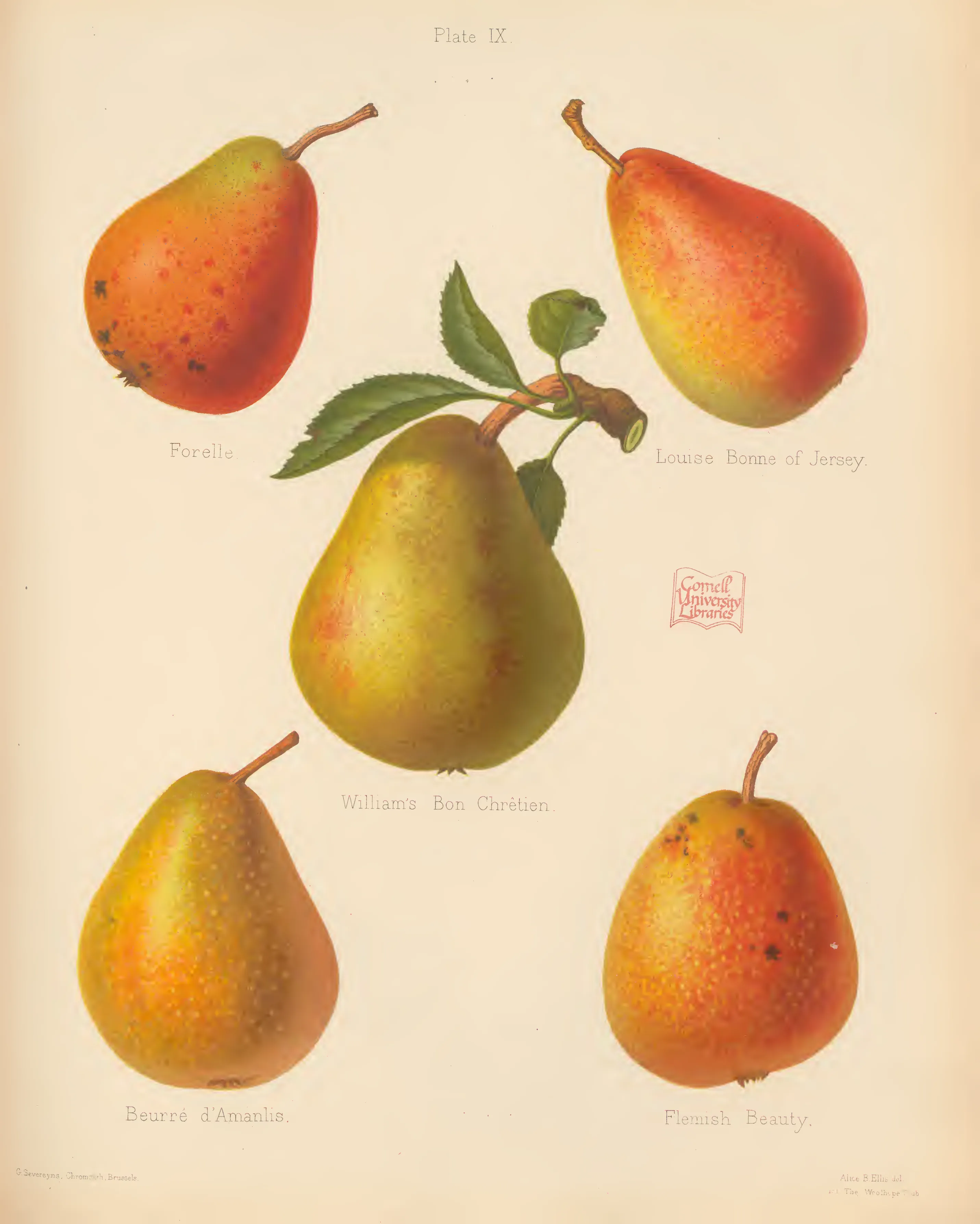
Williams' Bon Chrétien
Origin and History
This pear was raised shortly before 1770 by a schoolmaster named Wheeler, of Aldermaston, Berkshire. The variety was subsequently obtained by Mr. Williams, a nurseryman at Turnham Green, Middlesex, who distributed it widely under his own name. In 1799, it was introduced to America by Mr. Enoch Bartlett of Dorchester, near Boston, and became generally distributed under the name Bartlett Pear, by which it continues to be known in the United States. The variety attains its highest perfection in America, where it is esteemed as the finest and best keeping pear of its season. It has been reintroduced to England under its American name.
Tree
Healthy and vigorous, but not a regular and abundant bearer. Succeeds best as a pyramid or standard, on pear or quince stock. On quince stock, the fruit is much better flavored, though not as large as when grown on a wall.
Fruit
Size and Form: Large; obtuse-pyriform (rounded pear-shaped), with irregular and bossed outline.
Skin: Smooth; at first pale green, changing as it ripens to clear yellow, tinged with streaks of red on the side toward the sun.
Eye: Open, set in a very shallow depression, but more generally level with the surface.
Stalk: About an inch long, stout, fleshy; inserted in a shallow cavity.
Flesh: White, fine-grained, tender, buttery, and melting.
Flavor: Rich, sweet, and delicious, with a powerful musky aroma.
Season and Uses
An excellent autumn dessert pear, in season in August and September. The fruit should be gathered before it is fully ripe, at intervals of a few days, to prevent all fruit ripening simultaneously. When ripe, the pear quickly becomes mealy and decays. Its cultivation by London market gardeners has become more limited than formerly, owing to its fickleness in bearing.
Other
An excellent colored representation of this pear is given in the Transactions of the Horticultural Society (London), Vol. II, p. 250, where its history and description are also provided (Vol. II, p. 250; Vol. III, p. 357).
Book Sources
Described in 1 period pomological work
View original book sources (1)
— Woolhope Naturalists Field Club, The Herefordshire Pomona (1885)
- WILLIAMS' BON CHRÉTIEN. [Syn.: Wheeler's; Bartlett; De Lavault; Williams'.]
"In Amitermis vale, the Sabine boors Added Bon-cretiens to their former stores." (Rapin, "The Orchard," translated by Gardener.)
This highly esteemed Pear was raised a short time previous to 1770, by a person of the name of Wheeler, a schoolmaster at Aldermaston, in Berkshire; from him it was obtained by Mr. Williams, the nurseryman at Turnham Green, Middlesex, and being by him first distributed, it received the name it now bears. In 1799 it was introduced to America by Mr. Enoch Bartlett, of Dorchester, near Boston, through whom it became generally distributed, and has ever since been known there by the name of the Bartlett Pear. It attains the highest perfection in America, and is esteemed as the finest and best keeping Pear of its season, it has even been brought back to England with its new name.
Description.—Fruit, large, obtuse-pyriform, irregular, and bossed in its outline. Skin, smooth, at first pale green, changing as it ripens to clear yellow, and tinged with streaks of red next the sun. Eye, open, set in a very shallow depression, but more generally even with the surface. Stalk, an inch long, stout, and fleshy, and inserted in a shallow cavity. Flesh, white, fine-grained, tender, buttery, and melting, with a rich, sweet, and delicious flavour, and powerful musky aroma.
An excellent Autumn Dessert Pear; in season in August and September. The tree is healthy and vigorous, but not a regular and abundant bearer. It succeeds best as a pyramid or standard on the pear, or quince stock, when the fruit is much better flavoured, though not so large as when grown on a wall. The fruit should be gathered before it is ripe, at intervals of a few days, that they may not all ripen together—for when ripe, it soon becomes mealy and decays. Its cultivation by the London market gardeners has become more limited than it was, in consequence of its fickleness in bearing.
An excellent coloured representation is given of this pear in the Transactions of the Horticultural Society (London,) Vol. II., p. 250, where, and in Vol. III., p. 357, its history and description are given.