André Desportes
Pear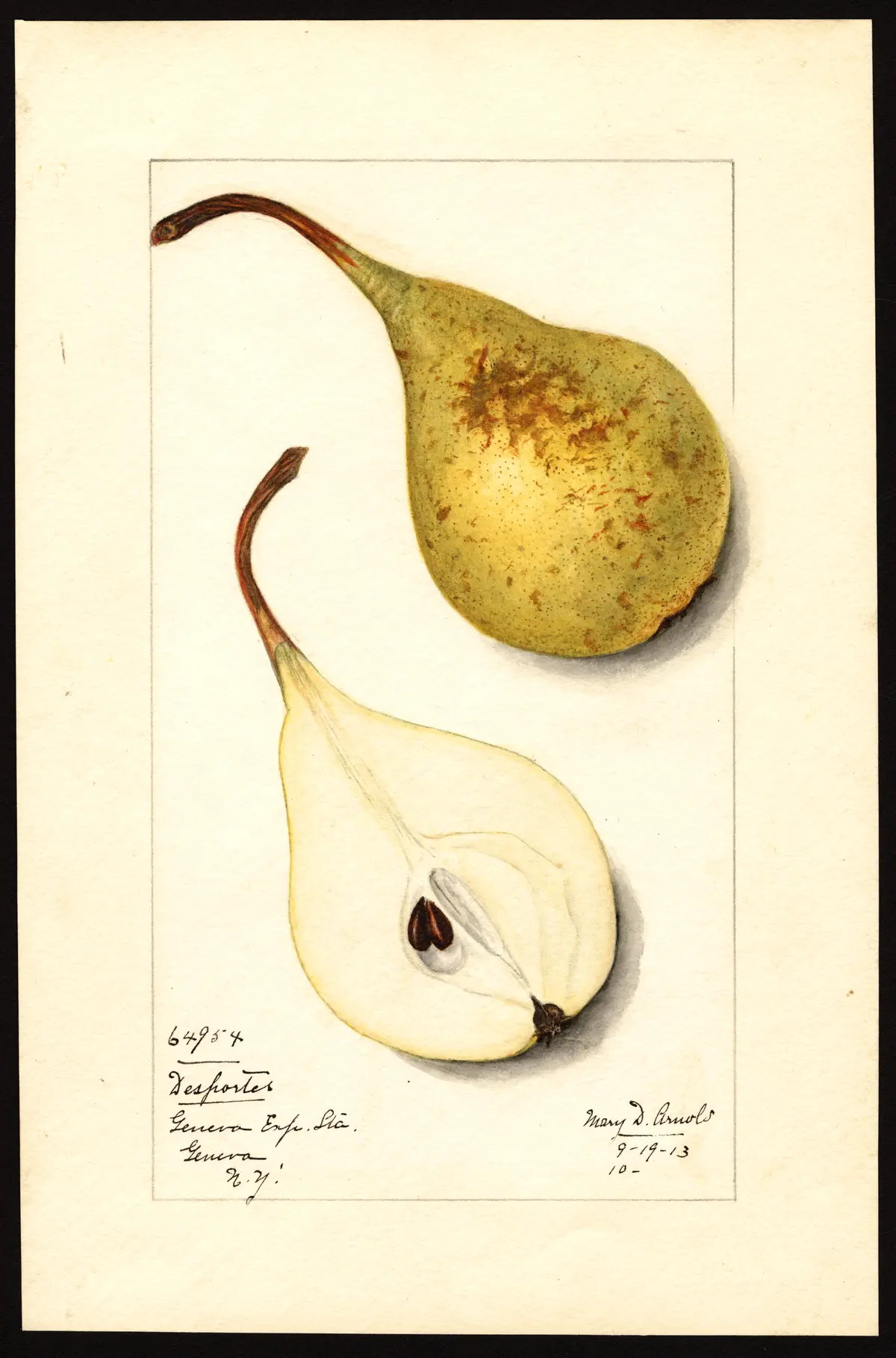
USDA Pomological Watercolor Collection
André Desportes
Origin/History
André Desportes is an old French pear variety. The parent tree grew in the seed beds of M. André Leroy, the well-known authority on pomology, at Angers, France. Leroy obtained it in 1854 from pips of Williams' Bon Chrétien (better known in America as the Bartlett pear). He named it after the son of M. Baptiste Desportes, manager of the business department of his establishment. The vigor and high quality of the fruit were quickly appreciated, and the variety was soon disseminated far and wide. By the early twentieth century it was sparingly grown in New York and still listed by a few American nurserymen. Downing places the origin in the gardens of M. André Leroy, in France, 1854.
Early published references include Leroy, Dict. Pom. 1:127, fig. 1867; Mas, Pom. Gen. 3:51, fig. 122, 1878; and Cat. Cong. Pom. France 138, fig. 1906.
Tree
Characteristically upright and vigorous, rapid-growing, hardy, productive. Bunyard describes growth as moderate and erect, with very great fertility. Branches slender, smooth, light brown overlaid with thin, grayish scarf-skin, marked with small lenticels. Branchlets thick, long, with short internodes, reddish-brown, slightly streaked toward the tips with ash-gray scarf-skin, dull, smooth, glabrous, with numerous small but very conspicuous raised lenticels.
Leaf-buds large, pointed, plump, appressed. Leaves ovate, stiff, leathery; apex taper-pointed; margin glandular, slightly crenate; petiole 1½ in. long. Hedrick (1921) gives leaves 2¾ in. long and 1¼ in. wide; Hedrick (1922) gives them 2½ in. long and 1¾ in. wide. Bunyard describes the leaf as long oval, a little twisted, upfolded, entire.
Flower-buds large, long, conical, plump, free, arranged singly as lateral buds or on short spurs. Flowers showy, occasionally tinged pink, in dense clusters, averaging 9 flowers per cluster. Hedrick (1921) gives flowers 1½ in. across; Hedrick (1922) gives them 1¼ in. across. Pedicels ¾ in. long, thick, pubescent.
Often grown on the quince (Budd & Hansen).
Fruit
Size: Medium, sometimes large, though the pears often run small. Hedrick gives the fruit as 2⅝ in. long by 2¼ in. wide. Bunyard gives 2½ by 3½ in.
Form: Obovate-obtuse-pyriform, symmetrical, uniform; oblique (Downing, Budd & Hansen). Bunyard describes the form as conical, even.
Stem: Thick, curved; 1 in. long (Hedrick 1921) or ¾ in. long (Hedrick 1922). Bunyard gives the stem as medium, ½ in., usually a little to one side.
Cavity: Obtuse, shallow, dotted with russet, often lipped.
Calyx: Small, open; lobes separated at the base, short, narrow, acute. Bunyard describes the eye as small and open. Calyx-tube short, wide, conical.
Basin: Shallow, narrow, obtuse, gently furrowed, symmetrical. Bunyard describes the basin as shallow and very even.
Skin: Thin, tender, smooth. Color dull greenish-yellow, dotted and marbled with reddish-brown, blushed on the sunny side (Hedrick). Downing and Budd & Hansen describe the skin as greenish yellow with patches/areas of fawn and bronze in the sun / on the exposed side. Thomas gives the color as pale green. Bunyard gives the color as pale yellow green with a dull brown red flush, with skin smooth and bearing numerous large white dots. Hedrick describes dots as numerous, small, light colored, and obscure.
Flesh/Flavor: Flesh tinged with yellow, fine, tender and melting, buttery, juicy, sweet, aromatic; quality very good (Hedrick). Downing and Budd & Hansen describe the flesh as yellowish white, fine, juicy, melting, granulous at the core, sugary acid (Downing) / sugary, acid, very good (Budd & Hansen). Thomas gives flesh as juicy and melting. Bunyard describes flesh as white, juicy, sweet, of fair flavour, and notes the variety is of better flavour than Dr. Jules Guyot.
Core/Seeds: Core large, closed, with clasping core-lines. Seeds small, wide, plump, acute.
Season
Ripe in August (Hedrick). Bunyard gives the season as September, coming in just before Williams. Downing gives July. Thomas gives summer. Budd & Hansen give the season as very early.
Uses
Dessert (Bunyard). The pears are handsome and very good in quality, but they quickly soften at the center and neither keep nor ship well. Well worth planting in a collection, but has no value in a commercial plantation; there are many better sorts for home orchards (Hedrick).
Subtypes/Variants
Not described in source.
Other
Not described in source.
Book Sources
Described in 6 period pomological works
Nursery Catalog Sources
Found in 4 catalogs (1889–1900) from California
- California Nursery Co. , Niles , California — 1889 — listed as Andrew Desportes
- Felix Gillet , Barren Hill Nursery, Nevada City , California — 1889 — listed as Andrew Desportes
- Sherwood Hall Nursery Co. , Timothy Hopkins (Menlo Park Nurseries), San Francisco / Menlo Park , California — 1893 — listed as Andrew Desportes
- Central Experimental Farm , Dominion Department of Agriculture, Agassiz, British Columbia (under test; Bulletin No. 3, Second Series) — 1900
View original book sources (6)
— A.J. Downing, The Fruits and Fruit Trees of America (1900)Andre Desportes.
Originated in the gardens of M. Andre Leroy, in France, 1854.
Fruit medium, obovate obtuse pyriform, oblique. Skin greenish yellow, with patches of fawn and bronze in the sun. Flesh yellowish white, fine, juicy, melting, granulous at the core, sugary acid. July. (Leroy.)
— U.P. Hedrick, The Pears of New York (1921)ANDRÉ DESPORTES
- Leroy Dict. Pom. 1:127, fig. 1867. 2. Mas Pom. Gen. 3:51, fig. 122. 1878. 3. Cat. Cong. Pom. France 138, fig. 1906.
This old French sort is sparingly grown in New York, and is still listed by a few American nurserymen. The pears are handsome and very good in quality, but they quickly soften at the center and neither keep nor ship well. While usually of medium size, or sometimes large, the pears often run small. The variety is well worth planting in a collection, but has no value in a commercial plantation, and there are many better sorts for home orchards.
The parent tree of this variety grew in the seed beds of M. André Leroy, the well-known authority on pomology, at Angers, France. M. Leroy obtained it in 1854 from pips of Williams' Bon Chrétien, or as it is better known here, the Bartlett pear. He named it after the son of M. Baptiste Desportes, manager of the business department of his establishment. The vigor and high quality of the fruit were quickly appreciated, and the variety was soon disseminated far and wide.
Tree characteristically upright and vigorous, rapid-growing, hardy, productive; branches slender, smooth, light brown overlaid with thin, grayish scarf-skin, marked with small lenticels; branchlets thick, long, with short internodes, reddish-brown, slightly streaked toward the tips with ash-gray scarf-skin, dull, smooth, glabrous, with numerous small, but very conspicuous, raised lenticels.
Leaf-buds large, pointed, plump, appressed. Leaves 2¾ in. long, 1¼ in. wide, ovate, stiff, leathery; apex taper-pointed; margin glandular, slightly crenate; petiole 1½ in. long. Flower-buds large, long, conical, plump, free, arranged singly as lateral buds or on short spurs; flowers showy, 1½ in. across, occasionally tinged pink, in dense clusters, averaging 9 flowers per cluster; pedicels ¾ in. long, thick, pubescent.
Fruit ripe in August; medium in size, 2⅝ in. long, 2¼ in. wide, obovate-obtuse-pyriform, symmetrical, uniform; stem 1 in. long, thick, curved; cavity obtuse, shallow, dotted with russet, often lipped; calyx small, open; lobes separated at the base, short, narrow, acute; basin shallow, narrow, obtuse, gently furrowed, symmetrical; skin thin, tender, smooth; color dull greenish-yellow, dotted and marbled with reddish-brown, blushed on the sunny side; dots numerous, small, light colored, obscure; flesh tinged with yellow, fine, tender and melting, buttery, juicy, sweet, aromatic; quality very good. Core large, closed, with clasping core-lines; calyx-tube short, wide, conical; seeds small, wide, plump, acute.
— John J. Thomas, The American Fruit Culturist (1903)Andre Desportes. Medium, obovate pyriform, pale green, juicy and melting. Summer. France.
— J.L. Budd & N.E. Hansen, American Horticultural Manual, Part II: Systematic Pomology (1914)Desportes (Andre Desportes). — Medium, obovate, obtuse pyriform, oblique; color greenish yellow with areas of fawn and bronze on exposed side. Flesh yellowish white, fine, melting, granulous at the core, sugary, acid, very good. Season, very early. Often grown on the quince. France.
— E.A. Bunyard, A Handbook of Hardy Fruits (1920)ANDRE DESPORTES. Dessert, September, medium, 2½ by 3½, conical, even. Colour, pale yellow green with dull brown red flush. Skin, smooth with numerous large white dots. Flesh, white, juicy, sweet, fair flavour. Eye, small open in a shallow very even basin. Stem, medium, ½in. usually a little to one side. Growth, moderate, erect; fertility very great. Leaf, long oval, a little twisted, upfolded, entire. Origin, raised by André Leroy at Angers in 1854. A nice early fruit coming in just before Williams and of better flavour than Dr. Jules Guyot.
— U.P. Hedrick, Cyclopedia of Hardy Fruits (1922)ANDRE DESPORTES. This old French sort is still listed by a few American nurserymen. The pears are handsome and very good in quality, but they quickly soften at the center and neither keep nor ship well. While usually of medium size, or sometimes large, the pears often run small. The variety is well worth planting in a collection, but has no value in a commercial plantation, and there are many better sorts for home orchards. The parent tree of this variety sprang from the seed-beds of M. André Leroy, the well-known authority on pomology, at Angers, France.
Tree characteristically upright and vigorous; hardy; branches slender, smooth, marked with small lenticels. Leaves 2½ inches long, 1¾ inches wide, ovate, stiff, leathery; apex taper-pointed; margin glandular, slightly crenate; petiole 1½ inches long. Flowers showy, 1¼ inches across, occasionally tinged pink, in dense clusters, averaging 9 flowers to a cluster.
Fruit ripe in August; medium in size, 2⅝ inches long, 2¼ inches wide, obovate-obtuse-pyriform, symmetrical, uniform; stem ¾ inch long, thick, curved; cavity obtuse, shallow, dotted with russet, often lipped; calyx small, open; lobes separated at the base, short, narrow, acute; basin shallow, narrow, obtuse, gently furrowed, symmetrical; skin thin, tender, smooth; color dull greenish-yellow, dotted and marbled with reddish-brown, blushed on the sunny side; dots numerous, small, light colored, obscure; flesh tinged with yellow, fine, tender and melting, buttery, juicy, sweet, aromatic; quality very good; core large, closed, with clasping core-lines; calyx-tube short, wide, conical; seeds small, wide, plump, acute.