Magnolia
Pear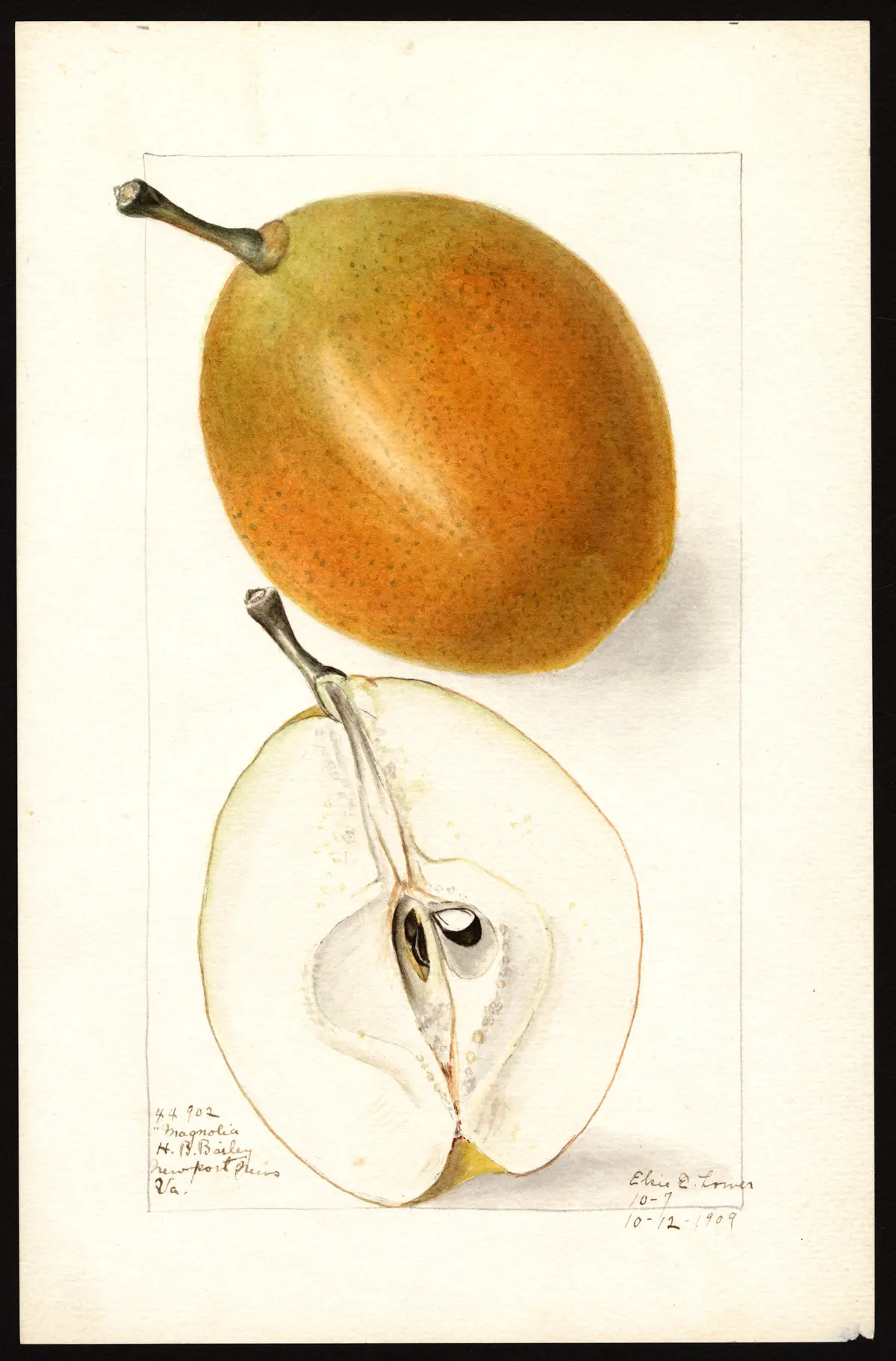
USDA Pomological Watercolor Collection
Magnolia
Origin/History
Magnolia is an oriental hybrid pear that originated in southern Georgia. It was listed in the American Pomological Society Catalogue (1909) and described in Cornell Station Bulletin 332:484 (1913).
Tree
Hedrick does not characterize the tree beyond its hybrid classification. Thomas Rivers & Son describe Magnolia as large and vigorous, and note it as the most prolific setting pear.
Fruit
Size: Large (both sources agree).
Form: Globular to pyriform (Hedrick).
Skin: Smooth (Hedrick). Hedrick describes the color as yellowish-russet with numerous irregular dots. Thomas Rivers & Son describe the fruit as dark-coloured, which conflicts with Hedrick's yellowish-russet. Both sources agree the fruit is handsome in appearance.
Flesh/Flavor: White, crisp, tender, juicy, mild, subacid (Hedrick). Quality rated "fair" by Hedrick; Thomas Rivers & Son characterize it as "fine choice" and "a very good pear," which is somewhat higher praise than Hedrick's assessment.
Cavity, Calyx, Basin, Stem, Core, Seeds: Not described in source.
Season
Ripens three or four weeks later than Kieffer in the South (Hedrick).
Uses
Not described in source.
Subtypes/Variants
Not described in source.
Other
Thomas Rivers & Son single out Magnolia specifically as the most prolific-setting pear, which may be relevant to identification in a nursery or orchard context where bearing habit is a distinguishing character.
Book Sources
Described in 1 period pomological work
Nursery Catalog Sources
Found in 1 catalog (1907)
- Russellville Nursery Co. , Montavilla Station, Portland, OR (three miles east of Portland, one mile from Montavilla car line) — 1907
View original book sources (2)
— U.P. Hedrick, The Pears of New York (1921)Magnolia,
- Am. Pom. Soc. Cat. 41. 1909. 2. Cornell Sta. Bul. 332:484. 1913.
An oriental hybrid which originated in southern Georgia. Fruit large, globular to pyriform, smooth, yellowish-russet, with numerous irregular dots; flesh white, crisp, tender, juicy, mild, subacid; fair; "three or four weeks later than Kieffer in the South."
— Thomas Rivers & Son, Thomas Rivers Catalogue of Fruits (1914) (1914)...large, vigorous, fine choice and dark coloured fruit; handsome in appearance; a very good pear; handsome; most prolific setting pear;