Sudduth
Pear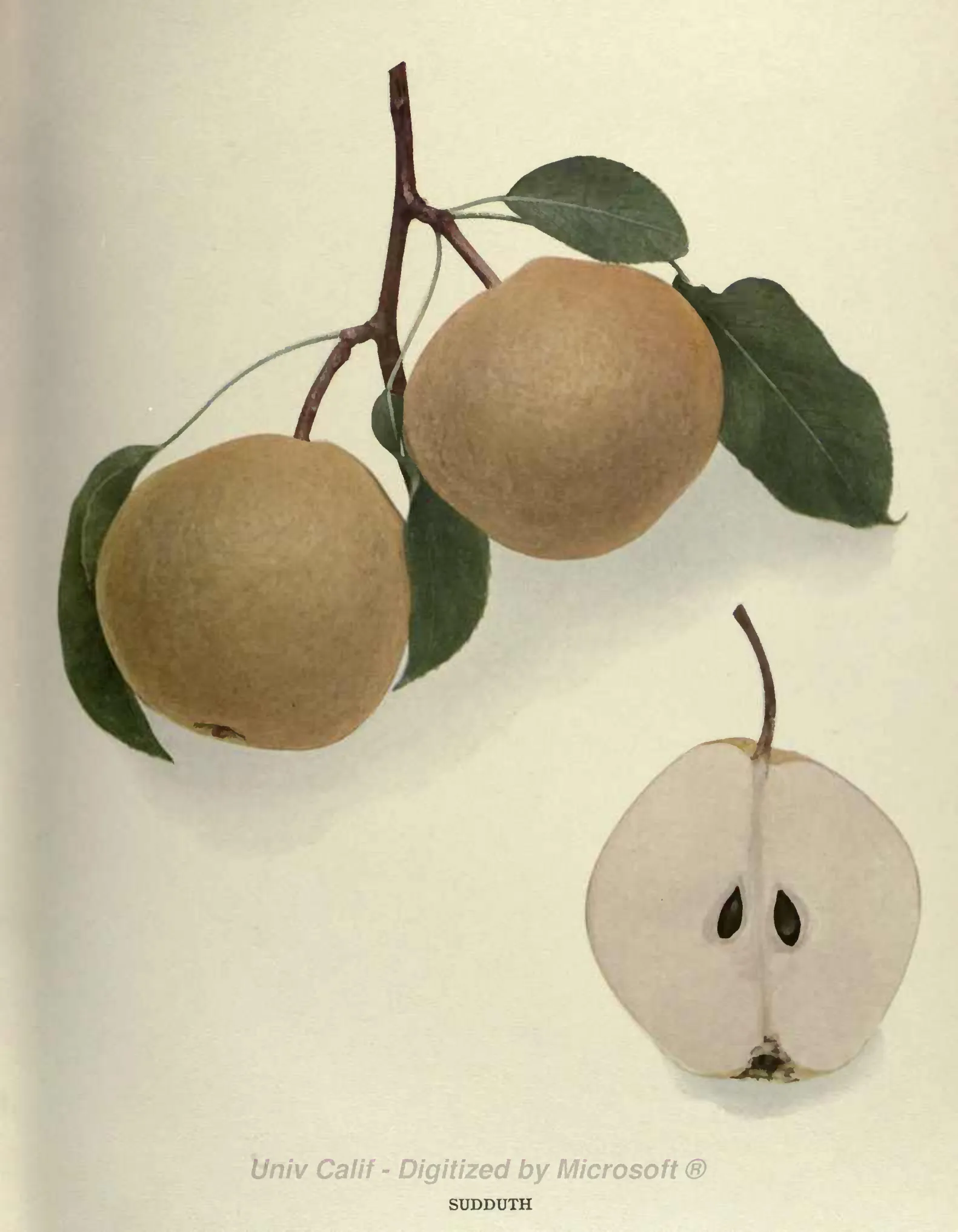
Sudduth
Origin/History
Sudduth originated from seed planted by Thomas Constant in 1820 in Sangamon County, Illinois. The parent tree was at that time fully seventy years old when the variety was introduced about 1895. Later, Judge Stephen A. Logan of Springfield — Abraham Lincoln's first law partner — acquired the property on which the tree stood. From Logan, Titus Sudduth bought the place in 1862. Sudduth was so impressed with the fruit that he had trees propagated by Augustine and Company, Normal, Illinois, and disseminated under his name.
Sudduth has little to recommend it for New York or eastern pear regions, but it is a standard sort in parts of the Mississippi Valley. The characters which give it a place in the pear flora of that region are remarkable freedom from blight, hardiness to cold and heat, capacity to withstand drought, early bearing, and great productiveness. The trees are nearly as hardy as those of the wild crab-apple. The variety is desirable only where hardiness and freedom from blight are prime requisites.
Tree
Tree large, vigorous, upright becoming quite spreading, open-topped, hardy, productive. Trunk stocky, shaggy. Branches thick, smooth, dull reddish-brown, almost entirely covered with gray scarf-skin, sprinkled with numerous large, raised lenticels. Branchlets slender, curved, long, with long internodes, dull reddish-brown, overspread with thin gray scarf-skin which is mingled with green, dull, smooth, glabrous, with conspicuous, raised lenticels. (The Cyclopedia of Hardy Fruits describes the branches as simply "sprinkled with numerous large, raised lenticels" without mention of gray scarf-skin on the branches, and does not describe the branchlets separately.)
Leaf-buds small, pointed, appressed, somewhat flattened. (The Pears of New York only.)
Leaves 3 inches long; width given as 1½ inches wide (The Pears of New York) or 1¾ inches wide (Cyclopedia of Hardy Fruits). Thin, velvety; apex taper-pointed; margin glandless, finely serrate. Petiole slender, tinged red, glabrous; length given as 2 inches (The Pears of New York) or 1¼ inches (Cyclopedia of Hardy Fruits).
Flower-buds small, short, conical, free, borne singly on very short spurs (The Pears of New York only). Flowers late, in dense clusters; diameter given as 1¼ inches across (The Pears of New York) or 1½ inches across (Cyclopedia of Hardy Fruits); average cluster size given as 8 buds (The Pears of New York) or 7 buds (Cyclopedia of Hardy Fruits). Pedicels ¾ inch long, thick, pubescent (The Pears of New York only).
Fruit
Size and Form
Medium or below in size. Length 2¼ inches long. Width given as 2¼ inches (The Pears of New York) or 2¾ inches (Cyclopedia of Hardy Fruits). Roundish-oblate, slightly conical toward the apex.
Stem
Stem ¾ inch long, slender.
Cavity
Cavity acute, deep, narrow, smooth, sometimes lipped.
Calyx
Calyx large, open; lobes separated at the base, long, acute.
Basin
Basin very shallow, narrow, obtuse, occasionally wrinkled.
Skin
Skin thin, tough, smooth, dull. Color light green, without blush. Dots very small, russet or greenish, very obscure.
Flesh and Flavor
Flesh greenish-white, firm, crisp, rather dry, subacid. Quality medium to poor. The fruits are neither attractive in appearance nor high in quality — hardly fit for dessert, being but a grade or two better than the disreputable Kieffer.
Core and Seeds
Core large, closed, axile, with meeting core-lines. Calyx-tube wide, conical. Carpels ovate. Seeds variable in size, wide, flat, obtuse.
Season
Fruit ripe in late September and October.
Uses
The fruits do very well for all culinary purposes, as do those of the Kieffer. The fruits do not keep well, as they soften at the center soon after becoming edible.
Subtypes/Variants
Not described in source.
Other
Sudduth is cited in the following references: Ill. Hort. Soc. Rpt. 144, Pl. 1894; Mich. Hort. Soc. Rpt. 141, 1894; Can. Hort. 19:126, figs. 936 and 937, 1896; Gard. Chron. 3rd Ser. 19:108, 1896; Ill. Hort. Soc. Rpt. 9, 1897; Budd-Hansen Am. Hort. Man. 2:264, 1903. (The Pears of New York only.)
Book Sources
Described in 2 period pomological works
Nursery Catalog Sources
Found in 5 catalogs (1895–1913) from Illinois
- Cotta Nursery (J.V. Cotta) , Carroll County , Illinois — 1895
- Augustine & Co. , Normal , Illinois — 1901
- Benjamin Buckman (personal inventory) , Farmingdale , Illinois — 1901
- Augustine & Co. , Normal , Illinois — 1902
- Benjamin Buckman (personal inventory) , Farmingdale , Illinois — 1913
View original book sources (2)
— U.P. Hedrick, The Pears of New York (1921)SUDDUTH
- Ill. Hort. Soc. Rpt. 144, Pl. 1894. 2. Mich. Hort. Soc. Rpt. 141. 1894. 3. Can. Hort. 19:126, figs. 936 and 937. 1896. 4. Gard. Chron. 3rd Ser. 19:108. 1896. 5. Ill. Hort. Soc. Rpt. 9. 1897. 6. Budd-Hansen Am. Hort. Man. 2:264. 1903.
Sudduth has little to recommend it for New York or eastern pear regions, but it is a standard sort in parts of the Mississippi Valley. The characters which give it a place in the pear flora of the region just named are remarkable freedom from blight, hardiness to cold and heat, capacity to withstand drought, early bearing, and great productiveness. The fruits are neither attractive in appearance nor high in quality — hardly fit for dessert, being but a grade or two better than the disreputable Kieffer. Like those of the Kieffer, however, the fruits do very well for all culinary purposes. They do not keep well as they soften at the center soon after becoming edible. The trees are said to be nearly as hardy as those of the wild crab-apple. The variety is desirable only where hardiness and freedom from blight are prime requisites.
The Sudduth pear was introduced about 1895, although the parent tree was at that time fully seventy years old. It originated from seed planted by Thomas Constant in 1820, in Sangamon County, Illinois. Later, Judge Stephen A. Logan of Springfield, Abraham Lincoln's first law partner, acquired the property on which the tree stood and from him Titus Sudduth bought the place in 1862. Sudduth was so impressed with the fruit that he had trees propagated by Augustine and Company, Normal, Illinois, and disseminated under his name.
Tree large, vigorous, upright becoming quite spreading, open-topped, hardy, productive; trunk stocky, shaggy; branches thick, smooth, dull reddish-brown, almost entirely covered with gray scarf-skin, sprinkled with numerous large, raised lenticels; branchlets slender, curved, long, with long internodes, dull reddish-brown, overspread with thin gray scarf-skin which is mingled with green, dull, smooth, glabrous, with conspicuous, raised lenticels.
Leaf-buds small, pointed, appressed, somewhat flattened. Leaves 3 in. long, 1½ in. wide, thin, velvety; apex taper-pointed; margin glandless, finely serrate; petiole 2 in. long, slender, tinged red, glabrous. Flower-buds small, short, conical, free, singly on very short spurs; flowers late, 1¼ in. across, in dense clusters, average 8 buds in a cluster; pedicels ¾ in. long, thick, pubescent.
Fruit ripe in late September and October; medium or below in size, 2¼ in. long, 2¼ in. wide, roundish-oblate, slightly conical toward the apex; stem ¾ in. long, slender; cavity acute, deep, narrow, smooth, sometimes lipped; calyx large, open; lobes separated at the base, long, acute; basin very shallow, narrow, obtuse, occasionally wrinkled; skin thin, tough, smooth, dull; color light green, without blush; dots very small, russet or greenish, very obscure; flesh greenish-white, firm, crisp, rather dry, subacid; quality medium to poor. Core large, closed, axile, with meeting core-lines; calyx-tube wide, conical; carpels ovate; seeds variable in size, wide, flat, obtuse.
— U.P. Hedrick, Cyclopedia of Hardy Fruits (1922)SUDDUTH. Sudduth has little to recommend it for eastern pear regions, but it is a standard sort in parts of the Mississippi Valley. The characters which give it a place in the pear flora of the region just named are: remarkable freedom from blight; hardiness to cold and heat; capacity to withstand drought; early bearing; and great productiveness. The fruits are neither attractive in appearance nor high in quality—hardly fit for dessert, being but a grade or two better than the disreputable Kieffer. Like those of the Kieffer, however, they do very well for all culinary purposes. The pears do not keep well, as they soften at the center soon after becoming edible. The trees are nearly as hardy as those of the wild crab-apple. The variety is desirable only where hardiness and freedom from blight are prime requisites.
Sudduth was introduced about 1895, although the parent tree was at that time fully seventy years old. It originated from seed planted by Thomas Constant in 1820, in Sangamon County, Illinois.
Tree large, vigorous, upright-spreading, open-topped, hardy, productive; trunk stocky, shaggy; branches thick, smooth, dull reddish-brown, sprinkled with numerous large, raised lenticels. Leaves 3 inches long, 1¾ inches wide, thin, velvety; apex taper-pointed; margin glandless, finely serrate; petiole 1¼ inches long, slender, tinged red, glabrous. Flowers late, 1½ inches across, in dense clusters, average 7 buds in a cluster. Fruit ripe in late September-October; medium or below in size, 2¼ inches long, 2¾ inches wide, roundish-oblate, slightly conical toward the apex; stem ¾ inch long, slender; cavity acute, deep, narrow, smooth, sometimes lipped; calyx large, open; lobes separated at the base, long, acute; basin very shallow, narrow, obtuse, occasionally wrinkled; skin thin, tough, smooth, dull; color light green, without blush; dots very small, russet or greenish, very obscure; flesh greenish-white, firm, crisp, rather dry, subacid; quality medium to poor; core large, closed, axile, with meeting core-lines; calyx wide, conical; carpels ovate; seeds variable in size, wide, flat, obtuse.