Mongolian
Pear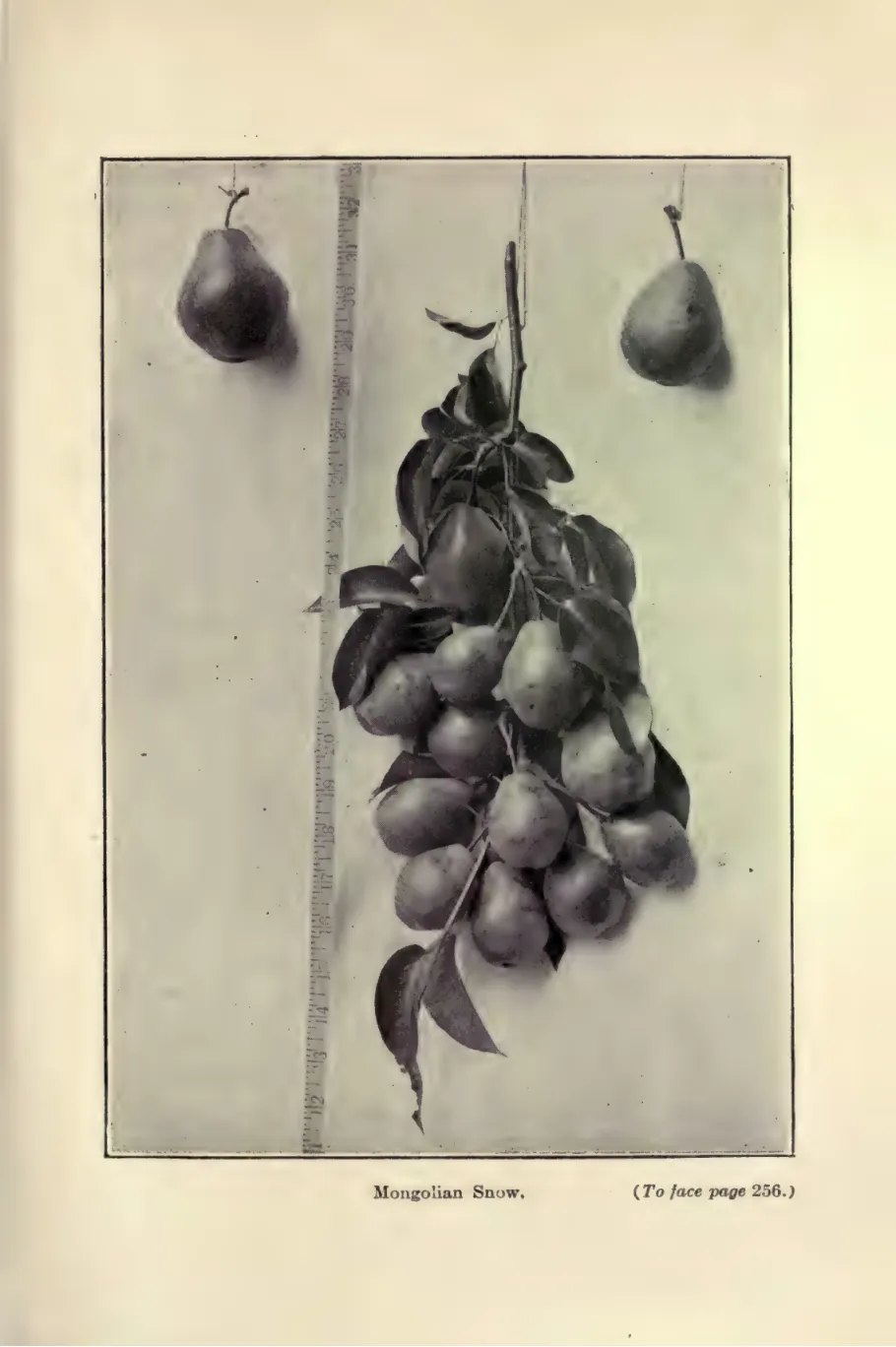
Mongolian
Origin / History
Obtained from seed at Ames, Iowa. Budd of Iowa considered it the best of the oriental varieties yet tested in this country; Budd and Hansen: "It is the best in quality of the oriental varieties yet tested." Cited in Iowa Horticultural Society Report, p. 215, 1896, and Cornell Station Bulletin 332, p. 482, 1913. Budd and Hansen place it in Iowa.
Tree
Fruit usually in clusters (Budd and Hansen).
Fruit
Size: Medium to large (Hedrick); large (Budd and Hansen).
Form: Pyriform (Budd and Hansen); globular-oval, narrowing at both ends, greatest diameter near the middle, similar to Kieffer in shape (Hedrick). Inclined to ridging toward the apex.
Stem: One to one and one-half inches long, stout; set in a cavity raised on one side, giving the stem a decided inclination (Budd and Hansen).
Cavity: Broad, shallow, raised on one side.
Calyx: Not described in source.
Basin: Quite deep, ridged, corrugated.
Skin: Greenish yellow, with blushed cheek.
Dots: Many, russet.
Flesh and flavor: Tender, melting, juicy; good when ripened indoors.
Core and seeds: Not described in source.
Season
Not described in source.
Uses
Not described in source.
Subtypes / Variants
Not described in source.
Other
Not described in source.
Book Sources
Described in 2 period pomological works
View original book sources (2)
— J.L. Budd & N.E. Hansen, American Horticultural Manual, Part II: Systematic Pomology (1914)Mongolian (Mongolian Snow). — Large, pyriform, inclined to ridging toward the apex; color greenish yellow with blushed cheek, and many russet dots; stalk from one to one and one-half inches long, stout, set in broad shallow cavity, raised on one side, giving the stem a decided inclination: basin quite deep, ridged, corrugated. When ripened indoors the flesh is tender, melting, juicy, good. It is the best in quality of the oriental varieties yet tested. Fruit usually in clusters. Iowa.
— U.P. Hedrick, The Pears of New York (1921)Mongolian.
- Ia. Hort. Soc. Rpt. 215. 1896.
- Cornell Sta. Bul. 332:482. 1913.
Considered by Budd of Iowa to be the best of the oriental varieties yet tested in this country. Obtained from seed at Ames, Iowa. Fruit medium to large, globular-oval, narrowing at both ends, with its greatest diameter near the middle, similar to Kieffer in shape, inclined to ridging near the apex, greenish, with blushed cheeks and russet dots; flesh tender, melting, juicy; good when ripened indoors.