Pound
Pear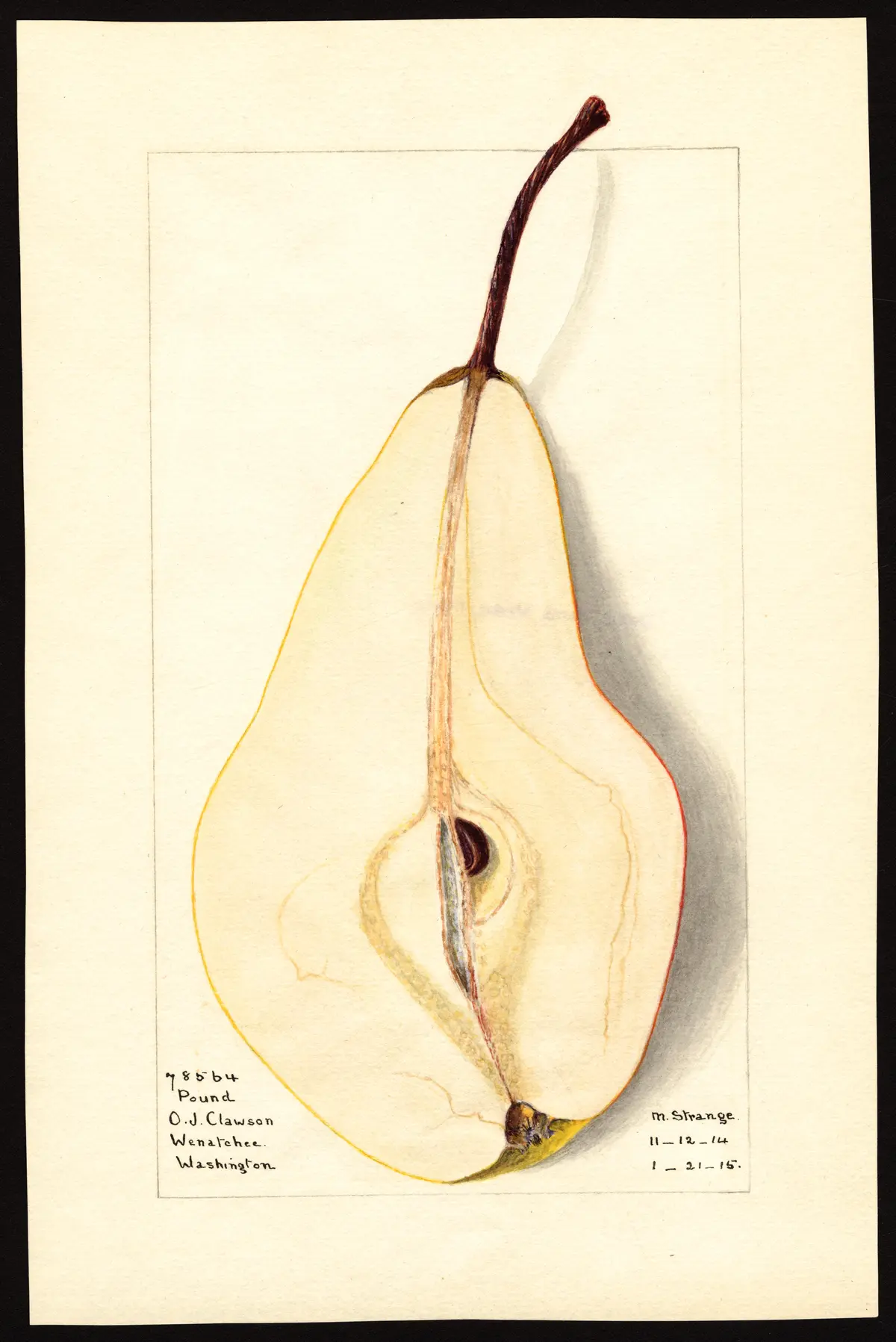
USDA Pomological Watercolor Collection
Pound
Origin / History
A very old European pear. The Herefordshire Pomona calls it a "celebrated English Pear" and says it was raised by Dr. Uvedale, a schoolmaster at Eltham, in Kent, in 1690, who appears to have removed to Enfield, where he continued his school. Bunyard gives the origin as uncertain and says only that it was named after Dr. Uvedale, who lived at Enfield about 1690. Hedrick, in the Cyclopedia, calls it a very old pear of uncertain origin, possibly dating back to Pliny, who wrote about eighty years after the beginning of the Christian era. Thomas and Budd and Hansen give its origin as Europe.
Miller, in the first edition of his Dictionary in 1724, speaks of Dr. Udal of Enfield as "a curious collector and introducer of many rare exoticks, plants, and flowers." Bradley in 1733 speaks of the pear as "Dr. Udale's great Pear, called by some the 'Union Pear.'" Hedrick's references for the variety begin with Langley's Pomona of 1729, under the name Pickering, and Miller's Gardeners Kalendar of 1734, under the name Union.
M. Leroy took much trouble to investigate its history. He found that it had received the name Belle Angevine from M. Audusson, a nurseryman at Angers. Audusson had obtained it in 1821 from the Garden of the Luxembourg at Paris under the name L'Inconnue à Compote, and beyond this Leroy could not trace it. Bunyard puts Audusson's naming about 1820 and calls Belle Angevine the later name, the pear being probably much older. The Herefordshire Pomona notes that it had been known in English gardens for upwards of a century before then and was most probably conveyed to Paris from England. Hedrick says the variety now known as Pound in America is more generally known in Europe as Belle Angevine or Uvedale's St. Germain.
Coxe described it as the Pound Pear in 1817, and William Robert Prince mentioned the Pound pear in 1831. The American Pomological Society added the variety to its fruit-catalog in 1862 under the name Uvedale's St. Germain and changed the name to Pound in 1871. The name continued to appear in the Society's catalogs until 1909, when it was dropped. Hedrick says Pound is grown in collections for its monstrous fruits, "which have few virtues other than large size." The Central Experimental Farm at Agassiz, British Columbia, planted it in spring 1896.
Tree
Strong, healthy, vigorous; a strong grower at Agassiz, and extra vigorous by Bunyard's account. Coxe says the tree grows large and is very hardy. Hedrick gives it as medium in size, upright, dense-topped, and hardy. Wood very stout, upright, dark-colored (Downing). Hedrick calls the trees unusually satisfactory, and says that for this reason the variety should make a good parent from which to breed.
Trunk stocky, shaggy. Branches thick, shaggy, zigzag, dull reddish-brown, heavily covered with gray scarf-skin, and marked with many large lenticels. Branchlets short, with short internodes, brownish-red, mottled with gray scarf-skin, smooth, glabrous, with few small, elongated lenticels. Leaf-buds large, long, conical or pointed, plump, free; leaf-scars prominent (Hedrick).
Leaves 4½ in. long and 3½ in. wide (the Cyclopedia condensation prints 3½ by 1½ in.), ovate, thin, stiff; apex taper-pointed; margin glandular, finely serrate; petiole 1½ in. long, slender (Hedrick). Bunyard gives the leaf as large, pointed oval, upfolded, pale, regularly and finely serrate, turning deep crimson.
Flower-buds large, long, conical or pointed, very plump, free, usually borne singly on short spurs. Flowers open early, 1½ in. across, large, well distributed, an average of 7 buds in a cluster; pedicels 1½ in. long, pubescent, pale green (Hedrick).
Most authors call it a great, abundant, or very productive bearer. Bunyard gives its fertility as moderate, and the Herefordshire Pomona says it bears well if nourished well. The same source says that "for obvious reasons" it should be grown only on a wall. Grown, as it should be, on the pear stock, it will occupy a large space.
Fruit
Size: Large to very large; "enormous" in Bunyard's account, who gives it as 3½ by 5½. Hedrick gives 4 in. long and 3½ in. wide (2½ in. wide in the Cyclopedia condensation), uniform in size and shape. Bradley wrote that "one may allow eight inches" of length.
Coxe calls it one of the largest winter pears, sometimes weighing from twenty-six to twenty-eight ounces. Prince wrote in 1831 that "it often weighs from twenty-five to thirty ounces, and one was exhibited in New Jersey about four years since, weighing forty and a half ounces." The Herefordshire Pomona says it sometimes weighs upwards of three pounds, and Hedrick says the pears not infrequently weigh three pounds. In 1870, according to Wickson, a Pound pear sent from Sacramento to the late Marshall P. Wilder, President of the American Pomological Society, weighed four pounds and nine ounces.
Form: Pyriform. Full, round, or swollen at the crown, which Thomas calls wide. Narrows or tapers gradually to a point at the insertion of the stalk, and obtusely toward the eye. Long pyriform or pyramidal, rather curved, and more swollen on one side of the axis than the other (Herefordshire Pomona). Bunyard calls it very long, pyriform or calabasse, and uneven. Hedrick gives it as obovate-acute-pyriform, with unequal sides, and coarse in form. Coxe alone calls the form regular.
Stem: Long, stout or thick, curved or bent: two inches or more long (Downing), long and large (Coxe), very long, stout, and fleshy (Bunyard). The Herefordshire Pomona alone gives a shorter stalk, an inch to an inch and a half long.
Cavity: Small and close (Herefordshire Pomona), or wanting. Budd and Hansen say the stem is inserted at the top of the neck without a cavity. Bunyard says it is inserted at the end of the fruit with a few uneven bosses around it. Hedrick describes the cavity as obtuse, very shallow, narrow, russeted, and furrowed, drawn up in a fleshy ring about the stem.
Calyx: Crumpled (Downing). The Herefordshire Pomona and Hedrick call it open. The Herefordshire Pomona gives the eye erect, rigid segments, and Hedrick calls the calyx large, with obtuse lobes separated at the base. Bunyard calls the eye closed and much twisted, surrounded by uneven bosses. Calyx-tube short, wide, conical (Hedrick).
Basin: Narrow; slight (Downing); shallow, obtuse, slightly furrowed, symmetrical (Hedrick). The Herefordshire Pomona alone calls it deep.
Skin: Green, dark green, or grass green to yellowish green, with a brown or brownish cheek; the Herefordshire Pomona gives dull brownish red on the exposed side, and at Agassiz the cheek was only sometimes present. In keeping, the ground turns yellow, pale yellow, or golden-yellow and the cheek red. Coxe says the cheek takes a lively red when the fruit is kept from the air toward spring. Hedrick gives the exposed cheek as often marked with a bronze or pinkish blush.
The Herefordshire Pomona and Bunyard call the skin smooth. Hedrick calls it thick, tough, and dull, with patches of russet, roughened by the dots and by the russet markings. Russet occurs as a few tracings (Herefordshire Pomona) or as a ring around the eye (Bunyard).
Dots: Numerous, brown russet, sprinkled all over; bright brown (Herefordshire Pomona); very conspicuous (Hedrick). Bunyard alone calls them sharp and black.
Flesh and flavor: Firm, solid, hard, granular or gritty; the Herefordshire Pomona calls it only slightly gritty. White by the Herefordshire Pomona and Bunyard, yellowish by Hedrick. The Herefordshire Pomona calls it crisp and juicy.
Hedrick calls it very tough, subacid, inferior in flavor, and coarse in texture and flavor, "but one degree better in flavor than the potato-like fruits of Kieffer and even more sappy." Coxe says keeping the fruit in bran, chaff, or paper, excluded from the air, renders it more juicy and tender.
The flesh turns red in cooking: red like a quince (Coxe), "naturally of a rich red colour" in stewing (Herefordshire Pomona), reddish (Thomas). Budd and Hansen call the cooked red flesh attractive and good. Thomas calls the flesh "poor," and Hedrick rates its quality "very poor."
Core and seeds: Core large, closed, axile, with meeting core-lines. Carpels pear-shaped. Seeds very large, brownish-black, wide, long, acuminate (Hedrick).
Season
A winter pear, kept through the winter toward spring. The Herefordshire Pomona gives January to April; Hedrick has the fruit maturing in February, and Bunyard keeps it till March. The pears keep well. Coxe directs that the fruit hang on the tree as late as possible, then be kept in bran, chaff, or paper, excluded from the air. This preserves its fullness and gives it a fine color.
Uses
Valued only for cooking: stewing, canning, baking, and preserving. Most authors approve it for the kitchen: "an excellent culinary pear … very good when baked or preserved" (Herefordshire Pomona), "excellent baked or preserved" (Downing), "a good culinary pear" (Thomas). Hedrick reports it "said to be fairly good for culinary purposes." Bunyard dissents: "Too gritty for stewing and quite valueless for any purpose except to 'epater les bourgeois.' As Leroy says, 'elle paie de mine, voila tout!'"
Downing calls it an abundant bearer and a profitable orchard crop. Budd and Hansen call it quite widely grown for market. The Herefordshire Pomona says that in its season it meets with a ready sale in the market at a high price.
Subtypes / Variants
Leroy (Dictionnaire de Pomologie, 1867) described a Belle Angevine that he held to be distinct. Hedrick reports it as a very beautiful pear, brilliant in color, of large size and handsome shape, but, unfortunately, not good for dessert and only second class for the kitchen. Hedrick holds that Belle Angevine is properly a synonym of Pound or Uvedale's St. Germain.
Other
Hedrick notes that the name "Pound" has been applied to a number of varieties, notably Black Worcester, Angora, Verulam, and others.
Book Sources
Described in 8 period pomological works
- Hedrick, The Pears of New York (1921)
- Budd & Hansen, Systematic Pomology (1914) — listed as Pound (Winter Bell)
- The Herefordshire Pomona (1876–1885) — listed as UVEDALE'S ST. GERMAIN
- Downing, Fruits and Fruit Trees of America (1900)
- Hedrick, Cyclopedia of Hardy Fruits (1922)
- Thomas, The American Fruit Culturist (1903)
- Bunyard, A Handbook of Hardy Fruits (1920) — listed as UVEDALES ST. GERMAIN
- Coxe, A View of the Cultivation of Fruit Trees (1817) — listed as 63. POUND PEAR
Nursery Catalog Sources
Found in 39 catalogs (1845–1936) from Alabama, California, England, Massachusetts, Oregon, Washington
- Winship's Nursery (Brighton Nurseries , operated by the Winship family), Brighton (Boston) , Massachusetts — 1845 — listed as Grosse de Bruxelles
- Winship's Nursery (Brighton Nurseries , operated by the Winship family), Brighton (Boston) , Massachusetts — 1845
- Hovey & Co. , Cambridge , Massachusetts — 1849 — listed as Bolivar
- Hovey & Co. , Cambridge , Massachusetts — 1849 — listed as Uvedale's St. Germain
- Hovey & Co. , Cambridge , Massachusetts — 1849 — listed as Belle Angevine
- St. Helena Nursery , Howell Prairie, Marion County, OR (Marion Co., Ogn.) — 1864
- Felix Gillet , Barren Hill Nursery, Nevada City , California — 1884
- Huntsville Wholesale Nurseries (Jessie S. Moss , Proprietor; W.F. Heikes, Manager), Huntsville , Alabama — 1886
- Fancher Creek Nursery , Fresno , California — 1886
- Felix Gillet , Barren Hill Nursery, Nevada City , California — 1888
- California Nursery Co. , Niles , California — 1889
- Felix Gillet , Barren Hill Nursery, Nevada City , California — 1889
- Felix Gillet , Barren Hill Nursery, Nevada City , California — 1890
- Felix Gillet , Barren Hill Nursery, Nevada City , California — 1891
- Puyallup & Yakima Nurseries , Puyallup, Washington (Lock Box 191) and North Yakima , Washington — 1892
- Sherwood Hall Nursery Co. , Timothy Hopkins (Menlo Park Nurseries), San Francisco / Menlo Park , California — 1893
- Multnomah Nurseries , Russellville , Oregon — 1894
- Woodburn Nurseries , Woodburn, Marion Co. , Oregon — 1894
- Felix Gillet , Barren Hill Nursery, Nevada City , California — 1895
- Felix Gillet , Barren Hill Nursery, Nevada City , California — 1897
- Kelway & Son , Langport, Somerset , England — 1897 — listed as Uvedale's St. Germain
- Central Experimental Farm , Dominion Department of Agriculture, Agassiz, British Columbia (under test; Bulletin No. 3, Second Series) — 1900
- George Bunyard & Co. , Royal Nurseries, Maidstone, Kent , England — 1900 — listed as Uvedale's St. Germain
- Central Experimental Farm , Dominion Department of Agriculture, Agassiz, British Columbia (under test; Bulletin No. 3, Second Series) — 1900 — listed as Belle Angevine
- Washington Nursery Co. , Toppenish , Washington — 1901
- Russellville Nursery Co. , Russellville, OR (three miles east of Portland, one mile from Montavilla car line) — 1903
- Henderson Luelling / Traveling Nursery (historical recall) , Oregon — 1904
- The Dalles Nurseries , The Dalles , Oregon — 1906
- Russellville Nursery Co. , Montavilla Station, Portland, OR (three miles east of Portland, one mile from Montavilla car line) — 1907
- Washington Nursery Company , Toppenish , Washington — 1909
- Carlton Nursery Co. , Carlton , Oregon — 1909
- James Veitch & Sons , Ltd., Royal Exotic Nursery, Chelsea, London (also Coombe Wood, Langley, and Feltham) , England — 1911 — listed as Uvedale's St. Germain
- Pacific Nursery Company , Portland , Oregon — 1912
- Washington Nursery Company , Toppenish , Washington — 1912
- Thomas Rivers & Son , Sawbridgeworth, Hertfordshire , England — 1913 — listed as Uvedale's St. Germain
- George Bunyard & Co. , Royal Nurseries, Maidstone, Kent , England — 1914 — listed as Uvedale's St. Germain
- George Bunyard & Co. , Royal Nurseries, Maidstone, Kent , England — 1917 — listed as Uvedale's St. Germain
- Fancher Creek Nurseries , George C. Roeding, Fresno , California — 1918
- Hudson's Wholesale Nurseries , Tangent , Oregon — 1936
View original book sources (9)
— William Coxe, A View of the Cultivation of Fruit Trees (1817)
- POUND PEAR.
This is one of the largest winter pears, it sometimes weighs from twenty-six to twenty-eight ounces ; the form is regular, full and round at the crown, lessening gradually towards the stem, which is long and large ; the skin is green, with a brown cheek ; it becomes yellow, and the cheek takes a lively red when kept from the air towards the spring ; it has a firm flesh, which becomes red like a quince when cooked, for which purpose only, it is preserved through the winter ; it is a great bearer ; the tree grows large, and is very hardy ; these pears should be suffered to hang on the tree as late as possible, they may be kept in bran, chaff or paper, excluded from the air, which preserves their fullness, renders them more juicy and tender, and gives them a fine colour.
[Additional entry in this volume: "No. 63. Pound Pear", pp. 341–342]
No. 63. Pound Pear.
This is one of the largest winter pears, it sometimes weighs from twenty-six to twenty-eight ounces; the form is regular, full and round at the crown, lessening gradually towards the stem, which is long and large; the skin is green, with a brown cheek; it becomes yellow, and the cheek takes a lively red when kept from the air towards the spring; it has a firm flesh, which
— Woolhope Naturalists Field Club, The Herefordshire Pomona (1885)
- UVEDALE'S ST. GERMAIN.
[Syn : Dr. Udal's Warden; Union Pear; Pickering Pear; Pickering's Warden; Piper; Pound Pear; Winter Bell Pear; Chambers Large; Lent St. Germain; German Baker; Audusson; Bolivar; Royale d'Angleterre; L'Inconnue à Compote; Belle Angevine; Abbé Mongein; Belle de Jersey; Angora; Beauté de Terueren; Comtesse de Terueren; Duchesse de Berry d'Hiver; Gros Fin Or d'Hiver; Berthebirne; Grosse de Bruxelles.]
This celebrated English Pear was raised by Dr. Uvedale, who was a schoolmaster, and lived at Eltham, in Kent, in 1690. Dr. Uvedale appears to have removed to Enfield where he continued his school. Miller, in the first edition of his Dictionary in 1724, speaks of him as "Dr. Udal of Enfield, a curious collector and introducer of many rare exoticks, plants, and flowers." Bradley in 1733 speaks of the pear as "Dr. Udale's great Pear, called by some the 'Union Pear,' whose fruit is about that length, one may allow eight inches." M. Leroy took much trouble to investigate the history of this pear. He found that it had received the name of Belle Angevine from M. Audusson, a nurseryman at Angers. M. Audusson had obtained it from the Garden of the Luxembourg at Paris in 1821, under the name of L'Inconnue à Compote. Beyond this, M. Leroy could not trace it. It had however been known in English gardens for upwards of a century before this time, and it is most probable therefore that it had been conveyed to Paris from England.
Description.—Fruit: very large, sometimes weighing upwards of three pounds; of a long pyriform, or pyramidal shape, tapering gradually towards the stalk and obtusely towards the eye, rather curved and more swollen on one side of the axis than the other. Skin: smooth, dark green, changing to yellowish green, and with dull brownish red on the exposed side, dotted all over with bright brown and a few tracings of russet. Eye: open, with erect rigid segments, set in a deep, narrow basin. Stalk: an inch to an inch and a half long, curved, inserted in a small close cavity. Flesh: white, crisp, juicy, and slightly gritty.
The tree grows vigorously and bears well if nourished well. For obvious reasons it should be grown only on a wall, and when grown, as it should be on the pear stock, will occupy a large space. It is an excellent culinary pear; it stews naturally of a rich red colour, and is very good when baked or preserved. It is in season from January to April, when it meets with a ready sale in the market at a high price.
— A.J. Downing, The Fruits and Fruit Trees of America (1900)Pound.
Uvedale's St. Germain. Bolivar d'Hiver. Winter Bell. Comtesse de Terweuren. Bretagne le Coux. Duchesse de Berry d'Hiver. Belle Angevine. Gros fin or long d'Hiver. Belle de Jersey. Union. Du Tonneau. Grosse de Bruxelles. Royal d'Angleterre. La Quintinye. Beaute de Tervueren. Grosse Dame Jeanne. Pickering Pear. Louise Bonne d'Hiver. Lent St. Germain. Bellissime d'Hiver, du Bur. Cordelier. Abbe Mongein. Anderson. Chamber's Large. Angora? Dr. Udales Warden. D'Horticulture. German Baker. Berthebirn. Pickering's Warden. Bolivar. Piper. Faux-Bolivar.
The Pound, or Winter Bell Pear, valued only for cooking, is an abundant bearer, and a profitable orchard crop. The trees are strong and healthy, with very stout, upright, dark-colored wood.
Fruit large, pyriform, swollen at the crown, and narrowing gradually to a point at the insertion of the stalk. Skin yellowish green, with a brown cheek (yellow and red when long kept), and sprinkled with numerous brown russet dots. Stalk two inches or more long, stout, bent. Calyx crumpled, set in a narrow, slight basin. Flesh firm and solid, stews red, and is excellent baked or preserved.
— John J. Thomas, The American Fruit Culturist (1903)Pound. (Winter Bell, Uvedale's St. Germain, Angora.) Very large, pyriform, crown wide; skin yellowish-green, with a brown cheek; stalk two inches long, calyx crumpled, basin narrow; flesh solid, hard, poor, stems reddish color; a good culinary pear. Tree strong, healthy, productive. Shoots stout, upright, dark. Europe. Fig. 651.
— J.L. Budd & N.E. Hansen, American Horticultural Manual, Part II: Systematic Pomology (1914)Pound (Winter Bell). — Large to very large, pyriform; color yellowish green with brown cheek that changes to yellow and red with keeping; dots numerous; stalk two inches long or more, stout, curved, and inserted at top of neck without cavity. Flesh firm, solid, granular. Only used for canning and stewing. When cooked its red flesh is attractive and good. Quite widely grown for market. Europe.
— E.A. Bunyard, A Handbook of Hardy Fruits (1920)UVEDALES ST. GERMAIN. Her. Pom., I., 15. F. Belle Angevine. (Belle Angevine.) Culinary, till March, enormous, 3½ by 5½, very long, pyriform or calabasse, uneven. Skin, smooth. Colour, grass green changing to pale yellow, covered with sharp black dots and a ring of russet around eye. Flesh, white firm, gritty. Eye, closed, much twisted, surrounded by uneven bosses. Stem, very long and stout, fleshy, inserted at end of fruit with a few uneven bosses around it. Growth, extra vigorous; fertility moderate. Leaf, large, pointed oval, upfolded, pale, regularly and finely serrate, turns deep crimson. Origin, uncertain. It was named Belle Angevine by M. Audusson, a nurseryman at Angers, about 1820, but it is probably much older. It was named after Dr. Uvedale, who lived at Enfield about 1690. Belle Angevine is therefore a later name. Too gritty for stewing and quite valueless for any purpose except to "epater les bourgeois." As Leroy says, "elle paie de mine, voila tout!"
Van Mons: see Thompson's.
— U.P. Hedrick, The Pears of New York (1921)POUND
- Coxe Cult. Fr. Trees 209, fig. 63. 1817.
- Prince Pom. Man. 1:149. 1831.
- Kenrick Am. Orch. 151. 1832.
- Downing Fr. Trees Am. 445. 1845.
- Ib. 835. 1869.
- Am. Pom. Soc. Cat. 22. 1871.
- Wickson Cat. Fruits 326, 338, 344. 1889. Pickering. 8. Langley Pomona 133, Pl. 71, fig. 1. 1729. Union. 9. Miller Gard. Kal. 31, 54. 1734.
- Miller Gard. Dict. 2: Pt. 1. 1807. Uvedale's St. Germain. 11. Lindley Guide Orch. Gard. 413. 1831.
- Am. Pom. Soc. Rpt. 70. 1862.
- Hogg Fruit Man. 657. 1884.
- Jour. Hort. 3rd Ser. 13:465. 1886.
- Bunyard Handb. Hardy Fr. 202. 1920. Bruderbirne. 16. Dochnahl Führ. Obstkunde 2:148. 1856. Winter Bell. 17. Watson Am. Home Gard. 404, fig. 264. 1859. Belle Angevine. 18. Gard. Chron. 979. 1860.
- Mas Le Verger 1:31 bis, fig. 22. 1866-73.
- Gard. Chron. 138. 1869.
- Guide Prat. 61, 233. 1876. Schöne Angevine. 22. Mathieu Nom. Pom. 279. 1889.
Pound is grown in collections for its monstrous fruits, which have few virtues other than large size. The pears not infrequently weigh three pounds, and one is noted in the next paragraph weighing four pounds, nine ounces. The pears are coarse in form, texture and flavor but one degree better in flavor than the potato-like fruits of Kieffer and even more sappy. The pears keep well and are said to be fairly good for culinary purposes.
The trees are unusually satisfactory, because of which the variety should make a good parent from which to breed.
The name "Pound" has been applied to a number of varieties, notably Black Worcester, Angora, Verulam, and others. The variety now known as Pound in America is more generally known in Europe as Belle Angevine or Uvedale's St. Germain. This sort appears to have been raised by a Dr. Uvedale, who was a schoolmaster at Eltham, England, in 1690. Miller in his Dictionary, in 1724, speaks of him as a Dr. Udal of Enfield, "a curious collector and introducer of many rare exotics, plants and flowers," and Bradley, in 1733, speaks of the pear as "Dr. Udale's great pear, called by some the Union pear." William Robert Prince mentions the Pound pear in 1831 saying that "it often weighs from twenty-five to thirty ounces, and one was exhibited in New Jersey about four years since, weighing forty and a half ounces." In 1870, according to Wickson, a Pound pear sent from Sacramento to the late Marshall P. Wilder, President of the American Pomological Society, weighed four pounds and nine ounces. In 1862, the American Pomological Society added this variety to its fruit-catalog under the name Uvedale's St. Germain, but in 1871 changed the name to Pound. The name continued to appear in the Society's catalogs until 1909 when it was dropped.
Tree medium in size, upright, dense-topped, hardy, very productive; trunk stocky, shaggy; branches thick, shaggy, zigzag, dull reddish-brown, heavily covered with gray scarf-skin, marked with many large lenticels; branchlets short, with short internodes, brownish-red, mottled with gray scarf-skin, smooth, glabrous, with few small, elongated lenticels.
Leaf-buds large, long, conical or pointed, plump, free; leaf-scars prominent. Leaves 4½ in. long, 3½ in. wide, ovate, thin, stiff; apex taper-pointed; margin glandular, finely serrate; petiole 1½ in. long, slender.
Flower-buds large, long, conical or pointed, very plump, free, usually singly on short spurs; flowers open early, 1½ in. across, large, well distributed, average 7 buds in a cluster; pedicels 1½ in. long, pubescent, pale green.
Fruit matures in February; large, 4 in. long, 3½ in. wide, uniform in size and shape, obovate-acute-pyriform, with unequal sides; stem long, thick, curved; cavity obtuse, very shallow, narrow, russeted, furrowed, drawn up in a fleshy ring about the stem; calyx large, open; lobes separated at the base, obtuse; basin shallow, narrow, obtuse, slightly furrowed, symmetrical; skin thick, tough, with patches of russet, dull, roughened by the dots and by the russet markings; color golden-yellow, often marked on the exposed cheek with a bronze or pinkish blush; dots numerous, russet, very conspicuous; flesh yellowish, firm, granular, very tough, subacid, inferior in flavor; quality very poor.
Core large, closed, axile, with meeting core-lines; calyx-tube short, wide, conical; carpels pear-shaped; seeds very large, brownish-black, wide, long, acuminate.
[Additional entry in this volume: "Belle Angevine", pp. 443–443]
Belle Angevine.
i. Leroy Dict. Pom. 1:188, 189, fig. 1867.
The Belle Angevine described by Leroy is a very beautiful pear, brilliant in color, of large size and handsome shape, but, unfortunately, not good for dessert and only second class for the kitchen. Properly Belle Angevine is a synonym of Pound or Uvedale's St. Germain, yet Leroy holds this Belle Angevine as distinct.
— U.P. Hedrick, Cyclopedia of Hardy Fruits (1922)POUND. Pound is grown in collections for its monstrous fruits. The pears not infrequently weigh three pounds, and one is noted weighing four pounds, nine ounces. The pears are coarse in form, texture and flavor—but one degree better in flavor than the potato-like fruits of Kieffer and even more sappy. The pears keep well, and are fairly good for culinary purposes. The trees are unusually satisfactory, because of which the variety should make a good parent from which to breed. This is a very old pear of uncertain origin, possibly dating back to Pliny, who wrote about eighty years after the beginning of the Christian era. Tree upright, dense-topped, hardy, very productive; trunk stocky, shaggy; branches thick, shaggy, zigzag, dull reddish-brown, marked with many large lenticels. Leaves 3½ inches long, 1½ inches wide, ovate, thin, stiff; apex taper-pointed; margin glandular, finely serrate; petiole 1½ inches long, slender. Flowers open early, 1½ inches across, large, well distributed, average 7 buds in a cluster. Fruit matures in February; large, 4 inches long, 2½ inches wide, obovate-acute-pyriform, with unequal sides; stem long, thick, curved; cavity obtuse, shallow, narrow, russeted, furrowed, drawn up in a fleshy ring about the stem; calyx large, open; lobes separated at the base, obtuse; basin shallow, narrow, obtuse, slightly furrowed, symmetrical; skin thick, tough, dull, roughened by the dots and by russet markings; color golden-yellow, often marked on the exposed cheek with a bronze or pinkish blush; dots numerous, russet, very conspicuous; flesh yellowish, firm, granular, very tough, subacid, inferior in flavor; quality very poor; core large, closed, axile, with meeting core-lines; calyx-tube short, wide, conical; carpels pear-shaped; seeds very large, brownish-black, wide, long, acuminate.
— Central Experimental Farm, Central Experimental Farm, Agassiz BC — Catalogue of Fruit Trees under Test (Bulletin No. 3, 1900) (1900)Planted Spring 1896. Tree a strong grower. Fruit very large, pyriform. Skin green, sometimes with a brownish cheek. Flesh solid, a cooking pear.