Catillac
Pear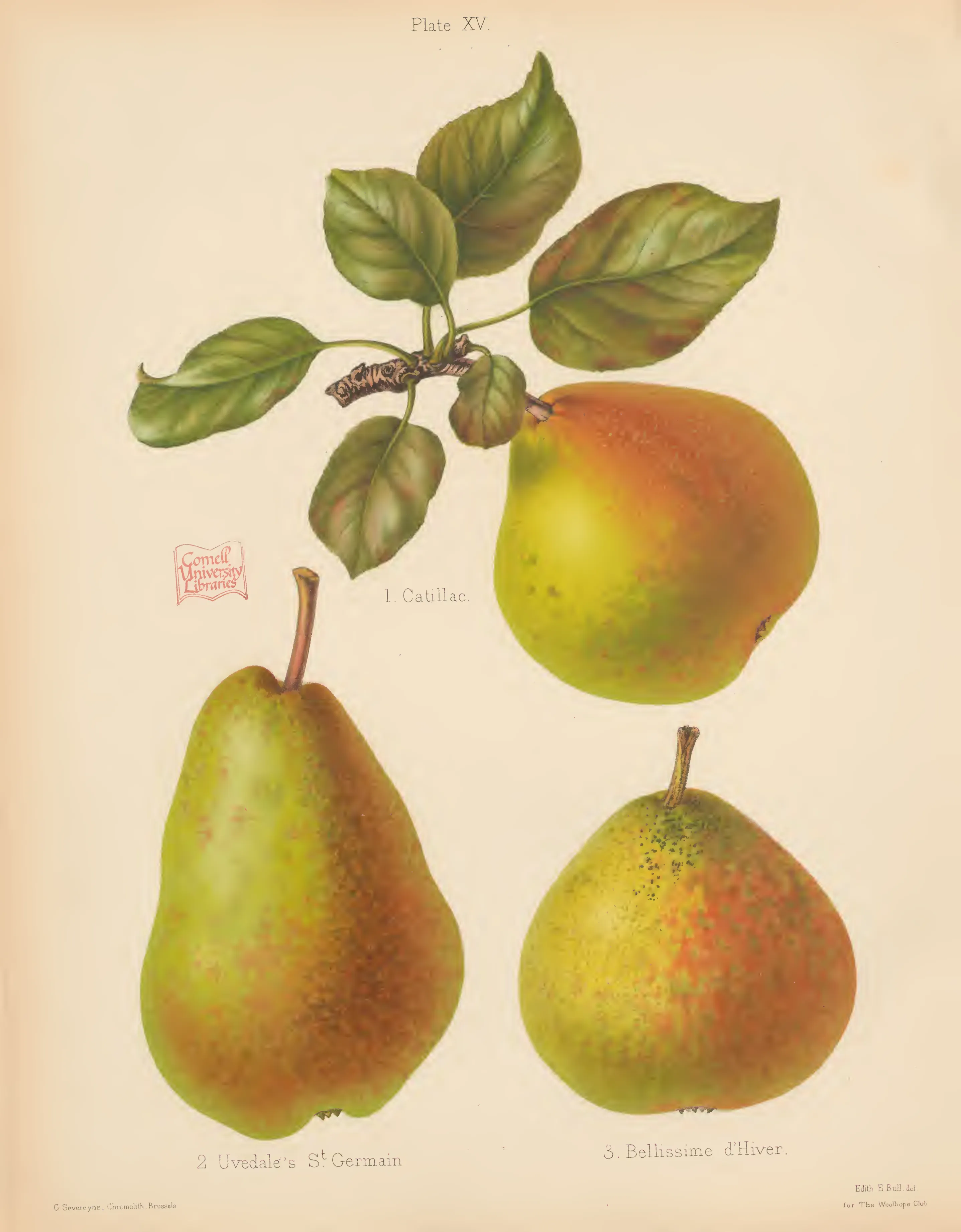
Catillac
Origin / History
Catillac is an old French pear, grown for baking and stewing; Thomas calls it French and Elliott lists it as foreign. The Herefordshire Pomona says its origin "is lost" and that it has been in cultivation for upwards of 200 years. It adds that "the number of its synonyms prove the esteem in which it has ever been held," and calls it "this excellent Pear." The Pomona notes that it has been many times figured, with good figures in Duhamel's "Traité des Arbres Fruitiers" (1768), Pl. lviii, and Brookshaw's "Pomona Britannica" (1812), Pl. lxxxvi; Hedrick cites the same Duhamel figure as 2:233, Pl. VIII, fig. 4.
Bunyard says it is generally supposed to have been found near Cadillac in the Gironde. He records that it was first described under this name by Bonnefond in the "Jardinier François," 1665, and he refers to the Herefordshire Pomona's account. Hedrick says it has over sixty synonyms. He adds that its great size has often caused it to be confused with the Pound pear, and that the latter's name has been applied as a synonym for the Catillac, "but the two are distinct." His references also include Leroy (1867), Downing (1869), and Bunyard (1920), and Knoop's "Fructologie" (1771) under the name Grand Monarque.
It was planted at the Central Experimental Farm, Agassiz, British Columbia, in the spring of 1893.
Tree
Vigorous, stout in growth, spreading, and productive, bearing abundantly. The Herefordshire Pomona calls it hardy and Bunyard rates its fertility good. At Agassiz the tree proved "a fine grower," and Veitch calls it "one of the last strong growing sorts." Leaf large, round, downy, regularly serrate; in autumn it turns clear yellow, with no red (Bunyard).
The Herefordshire Pomona says it is best grown on a wall on the pear stock, where it is one of the most profitable pears that can be grown. It may also be grown as an espalier in a very sheltered situation. As a pyramid or an ordinary standard it rarely succeeds, the size and weight of the fruit making the effect of wind most destructive to the crop. Bunyard, on the other hand, says it "makes a fine large spreading standard." Veitch says it is best grown as a dwarf.
Fruit
Size: Large to very large; 3½ by 3½ (Bunyard). In rich soil Downing finds the fruit often remarkably large and handsome.
Form: Turbinate. The Herefordshire Pomona calls it flatly turbinate and Downing broadly turbinate ("flattened-top shaped"). Thomas describes it as short, conic-pyriform, approaching broad-turbinate, with the crown broad and flattened. Bunyard gives the shape as Bergamotte, nearly even.
Stem: Stout, curved, about an inch to an inch and a half long; moderately long (Bunyard).
Cavity: Small and slight; very narrow (Downing), wavy (Thomas).
Calyx: Short and small; open (Herefordshire Pomona, Bunyard). Segments short and dry (Herefordshire Pomona), erect or spread (Thomas).
Basin: Wide or large and plaited or ribbed. It is moderately deep to rather deep; the Herefordshire Pomona and Downing call it rather deep. The Herefordshire Pomona calls it even rather than plaited, and Bunyard calls it slight rather than deep.
Skin: Pale green or dull green, becoming yellow to pale yellow; after keeping, "a beautiful bright lemon yellow" (Herefordshire Pomona). Smooth (Bunyard). There is a tinge, flush, or cheek of brownish red, reddish brown, or reddish next the sun. Thomas finds the cheek often present; Downing says it appears sometimes, at maturity. A handsome, beautiful fruit.
Dots: Brown; numerous, large, and russety (Herefordshire Pomona).
Flesh and flavor: White, hard, firm, crisp, and gritty; rough to the taste. The Herefordshire Pomona gives the flavor as "harsh and somewhat musky," and Veitch notes "a peculiar acidity." In cooking the flesh becomes tender (Thomas) and turns red: light red according to Thomas, deep red according to Bunyard.
Core and seeds: Not described in source.
Season
The recorded season runs from November into May. Most authors give November to March, and Thomas says it keeps through winter. The Herefordshire Pomona carries it from December to April "or even May," and Bunyard keeps it till April. Veitch gives it as excellent in December and January.
Uses
A culinary pear for baking and stewing, "more for cooking than the table" (Veitch). Downing calls it of good quality for these purposes and Thomas excellent for baking and stewing. Bunyard calls it "one of the very best of all stewing pears."
The Herefordshire Pomona calls it one of the best culinary pears and says a tree in full bearing "is a small fortune to the owner." Its fruit, the Pomona says, is so fine in size as always to command the best price in the market. The Pomona also quotes Brookshaw: "It is considered by confectioners … as the best pear for stewing, preserving, and wet sweetmeats."
Subtypes / Variants
Not described in source.
Other
Not described in source.
Book Sources
Described in 6 period pomological works
Nursery Catalog Sources
Found in 10 catalogs (1845–1917) from England, Massachusetts
- Winship's Nursery (Brighton Nurseries , operated by the Winship family), Brighton (Boston) , Massachusetts — 1845
- Hovey & Co. , Cambridge , Massachusetts — 1849
- Joseph Breck & Co. , Boston , Massachusetts — 1855
- Kelway & Son , Langport, Somerset , England — 1897
- George Bunyard & Co. , Royal Nurseries, Maidstone, Kent , England — 1900
- Central Experimental Farm , Dominion Department of Agriculture, Agassiz, British Columbia (under test; Bulletin No. 3, Second Series) — 1900
- James Veitch & Sons , Ltd., Royal Exotic Nursery, Chelsea, London (also Coombe Wood, Langley, and Feltham) , England — 1911
- Thomas Rivers & Son , Sawbridgeworth, Hertfordshire , England — 1913
- George Bunyard & Co. , Royal Nurseries, Maidstone, Kent , England — 1914
- George Bunyard & Co. , Royal Nurseries, Maidstone, Kent , England — 1917
View original book sources (8)
— F.R. Elliott, The Western Fruit Book (1865)Catillac.
Cadillac, | Grand Monarque, | Groote Mogul.
Foreign. Large, turbinate, yellow and brown. November to March.
— Woolhope Naturalists Field Club, The Herefordshire Pomona (1885)
- CATILLAC.
[Syn: Cadillac; Quenillac; Chartreuse; Admirable de Chartreux; Bon Chretien a Amiens; Cotillard; Monstreuse de Landes; Grand Monarque; Grand Mogol; Gratiole rond; Tete du chat; Gros Gilot; Besi de Marais; Bell Pear; Pound Pear]
The origin of this excellent Pear is lost. It is known to have been in cultivation for upwards of 200 years, and the number of its synonyms prove the esteem in which it has ever been held. It has been many times figured. Duhamel's "Traité des Arbres Fruitiers" (1768) Pl. lviii., gives a good figure as does Brookshaw's "Pomona Britannica" (1812,) Pl. lxxxvi.
Description.—Fruit: large, flatly turbinate. Skin: at first pale green, becoming after keeping a beautiful bright lemon yellow, with a tinge of brownish red next the sun, and covered with numerous large brown russety dots. Eye: open with short dry segments, set in a wide, even, and rather deep basin. Stalk: an inch and a half long, stout, curved and inserted in a small cavity. Flesh: white, crisp, gritty, with a harsh and somewhat musky flavour.
The tree is hardy, grows vigorously, and bears abundantly. It is best grown on a wall on the pear stock, when it is one of the most profitable pears that can be grown. A tree in full bearing is a small fortune to the owner, for it is one of the best culinary pears, and is so fine in size, as always to command the best price in the market. "It is considered by confectioners" says Brookshaw "as the best pear for stewing, preserving, and wet sweetmeats." It may be grown as an espalier in a very sheltered situation, but as a pyramid or an ordinary standard, it rarely succeeds, the size and weight of the fruit rendering the effect of wind most destructive to the crop. It is in season from December to April or even May.
— A.J. Downing, The Fruits and Fruit Trees of America (1900)Catillac.
Grand Monarque. Grand Mogrol. Cadillac. Gros Thomas. Katzenkop. De Bell Argentine. Groote Mogul. Tete de Chat. 40 Ounce. Gros Rateau. Bon Chretien d'Amiens Chartreuse. Grand Tamerlan. Monstrueuse de Landes. De Gros Rateau Raisenette? Cotillard de Livre. Roi de Louvain. Besi de Maraise. Gros Rateau gris. De Citrouille. Misporde Benoist? De Tout Temps.
The Catillac is an old French baking and stewing Pear, of very large size, and of good quality for these purposes. In rich soil the fruit is often remarkably large and handsome.
Fruit very large, broadly turbinate (flattened-top shaped). Skin yellow, dotted with brown, and having sometimes a brownish red cheek at maturity. Stalk stout, about an inch long, curved, and placed in a very narrow, small cavity. Calyx short and small, and set in a wide, rather deep plaited basin. Flesh hard and rough to the taste. November to March.
— John J. Thomas, The American Fruit Culturist (1903)Catillac, p. 537.
[Additional entry in this volume: "Catiliac", pp. 562–562]
Catiliac. Large, short, conic-pyriform, approaching broad-turbinate; crown broad, flattened; yellow, often with a reddish-brown cheek; stalk an inch to an inch and a half long, stout, cavity small, wavy; calyx short, erect, or spread, basin large, plaited; flesh hard, but excellent for baking and stewing, becoming tender, and of a light red color. Keeps through winter. French.
— E.A. Bunyard, A Handbook of Hardy Fruits (1920)CATILLAC. Her. Pom. I., 15. (Pound pear.) G. Katzenkopf. Culinary, till April, 3½ by 3½. Shape, Bergamotte, nearly even. Skin smooth, colour dull green, brown red flush. Stem, stout, moderately long in a slight cavity. Eye open in a slight ribbed basin. Growth, stout and vigorous; fertility, good. Leaf large round, downy, regularly serrate, turns clear yellow, no red. Generally supposed to have been found near Cadillac in the Gironde. It was first described under this name by Bonnefond in the "Jardinier François," 1665. One of the very best of all stewing pears, cooking a deep red. Makes a fine large spreading standard.
— U.P. Hedrick, The Pears of New York (1921)Catillac.
- Duhamel Trait. Arb. Fr. 2:233, Pl. VIII, fig. 4. 1768.
- Leroy Dict. Pom. 1:535, fig. 1867.
- Downing Fr. Trees Am. 716. 1869.
- Bunyard Handb. Hardy Fr. 162. 1920. Grand Monarque.
- Knoop Fructologie 1:125, 136, fig. 1771.
This old French baking pear with over sixty synonyms is supposed to have been found near Cadillac in the Gironde. Bonnefond in 1665 in the Jardinier Francois first described it under this name. The great size of the Catillac has often caused it to be confused with the Pound pear, and the latter's name has been applied as a synonym for the Catillac, but the two are distinct. Tree stout, vigorous, spreading, productive; leaf large, round, downy, serrate. Fruit very large, broadly turbinate, dull green to yellow, with brownish-red blush; stem stout, an inch long, in a small cavity; calyx open, in a moderately deep, ribbed basin; flesh hard, rough; one of the best of stewing pears, cooking a deep red; Nov. to Mar.
— Central Experimental Farm, Central Experimental Farm, Agassiz BC — Catalogue of Fruit Trees under Test (Bulletin No. 3, 1900) (1900)Planted Spring 1893. Tree a fine grower. Fruit very large, turbinate. Skin pale yellow, with brown dots and a reddish cheek. Flesh hard and gritty, a cooking pear. Season November to March.
— James Veitch & Sons, Veitch's Fruit Trees (1911) (1911)very large, firm flesh, with a peculiar acidity, more for cooking than the table. It is best grown as a dwarf, one of the last strong growing sorts. Excellent Dec. & Jan.