Bellissime d'Hiver
Pear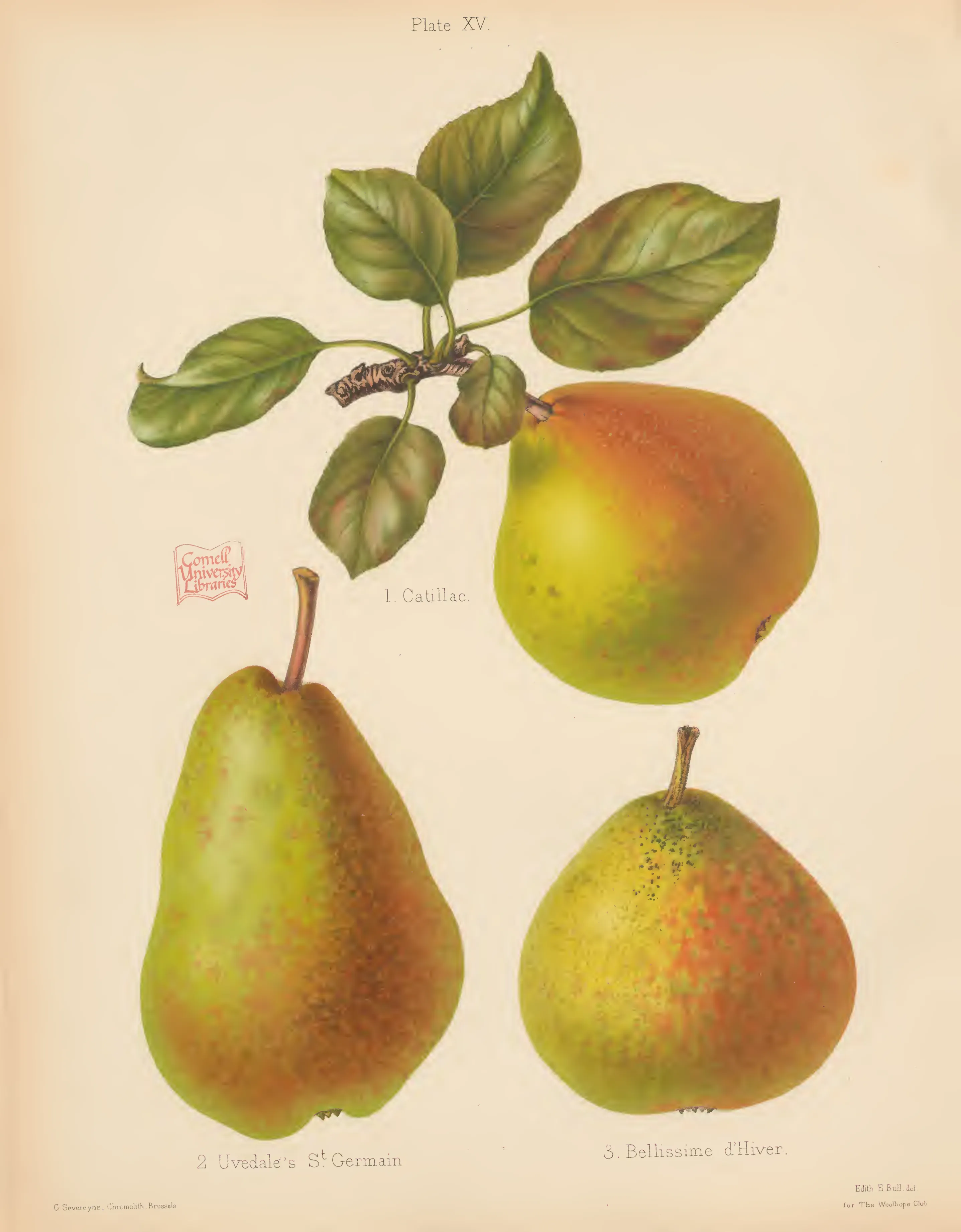
Bellissime d'Hiver
Origin / History
An old French pear of unknown origin, long known. The Herefordshire Pomona finds nothing on its origin and calls it a "fine pear," well described by Duhamel (1758) and other old writers. Hedrick dates the description of Duhamel du Monceau to 1768 and also cites Hogg's Fruit Manual (1884). Bunyard says it has been known in France since the 17th century. Hedrick adds that some believe Merlet referred to it in 1690 when writing of the Bellissime d'Hiver de Bur, but Leroy regards that pear as synonymous with Belle Angevine.
Tree
A free and vigorous grower, upright, making a well-spurred tree. An excellent bearer; Bunyard calls its fertility very good. Succeeds well as a standard on either pear or quince stock. Leaf narrow oval, slightly undulating, shallow crenate, turning pale yellow-red (Bunyard).
Fruit
Size: Large to very large, larger than the Catillac (Hedrick). The Herefordshire Pomona measures it four inches wide and three and three-quarter inches high, and Bunyard gives "3½ by 4." The Herefordshire Pomona says that in favorable situations it is superior to the Catillac in size and in every other respect.
Form: Roundish to globular, turbinate; mammillate (Hedrick). Downing gives obovate obtuse pyriform, and Bunyard oval to oval conical, even.
Stem: An inch long, stout, and somewhat fleshy, particularly at the insertion (Herefordshire Pomona). Bunyard calls it medium, slender, and woody.
Cavity: Rather deep, with a fleshy swelling on one side of the stem (Herefordshire Pomona). Bunyard gives a slight cavity.
Calyx: Eye open, rather large to large.
Basin: Rather deep (Herefordshire Pomona). Bunyard calls it even and shallow.
Skin: Smooth, somewhat shining to shining, thick (Hedrick). Ground green to greenish yellow or palish yellow, a fine deep green on the shaded side (Herefordshire Pomona); Hedrick gives green changing to dark yellow. The sunny side has a red flush or shade of red, fine vermilion in the Herefordshire Pomona, and in Hedrick washed with a beautiful tint of bright carmine.
Dots: Many, large, conspicuous, brown russet, strewed all over the fruit.
Flesh and flavor: White, fine-grained, crisp and tender, breaking (Downing), juicy (Hedrick), sweet, with a musky flavor. Free from the disagreeable grittiness peculiar to baking pears generally. Veitch credits it with "a good flavour."
Core and seeds: Not described in source.
Season
Winter, the recorded season running from November into May. Most authors carry it through the winter to March, April, or May. Downing alone ends it in January. Veitch calls it fine for late use.
Uses
A culinary pear; Downing calls it "an old Pear, valuable only for cooking." The Herefordshire Pomona ranks it one of the very best culinary pears. Hedrick repeats the verdict, and Bunyard says "undoubtedly." The Herefordshire Pomona quotes Duhamel (Vol. II., p. 235): "Elle est beaucoup meilleure cuite sous la cloche que le Catillac. On peut meme en faire d'assez bonnes compotes." Bunyard says "it does not turn dark in cooking like Catillac but is superior in every other respect."
Subtypes / Variants
Not described in source.
Other
[NOTE: Source text may be incorrect — the Herefordshire Pomona and Downing attach the name Belle de Noisette (Belle Noisette) to Bellissime d'Hiver, but Hedrick's additional entry "Belle de Noisette" describes, after Mas, a pear he treats as a separate variety, with acid flesh and lemon-yellow skin. It is kept apart here and not merged into the description of Bellissime d'Hiver.]
Hedrick describes the Belle de Noisette separately, citing Mas (Pom. Gen. 6:17, fig. 393, 1880), as a French pear of unknown origin. Fruit large, obovate-obtuse-pyriform, short and thick, broadest around the center. Skin thick and rather rough, at first green, sown with numerous grayish-brown dots scattered regularly; at maturity the green passes into lemon-yellow, and the sunny side is clouded with red. Flesh white, rather fine, breaking, with a small amount of sugary juice, acid, slightly perfumed. Suited only for culinary purposes; keeps well through the winter. Tree equally vigorous on quince or pear stock.
Book Sources
Described in 4 period pomological works
Nursery Catalog Sources
Found in 8 catalogs (1849–1917) from England, Massachusetts
- Hovey & Co. , Cambridge , Massachusetts — 1849 — listed as Belle de Noisette
- Kelway & Son , Langport, Somerset , England — 1897
- George Bunyard & Co. , Royal Nurseries, Maidstone, Kent , England — 1900
- Central Experimental Farm , Dominion Department of Agriculture, Agassiz, British Columbia (under test; Bulletin No. 3, Second Series) — 1900
- James Veitch & Sons , Ltd., Royal Exotic Nursery, Chelsea, London (also Coombe Wood, Langley, and Feltham) , England — 1911
- Thomas Rivers & Son , Sawbridgeworth, Hertfordshire , England — 1913
- George Bunyard & Co. , Royal Nurseries, Maidstone, Kent , England — 1914
- George Bunyard & Co. , Royal Nurseries, Maidstone, Kent , England — 1917
View original book sources (5)
— Woolhope Naturalists Field Club, The Herefordshire Pomona (1885)
- BELLISSIME d'HIVER.
[Syn : Teton de Venus; Belle de Noisette; Vermillion d'Espagne.]
Nothing is to be found with reference to the origin of this fine pear, but it is a variety which has long been known and is well described by Duhamel (1758) and other old writers.
Description.—Fruit : very large, four inches wide and three inches and three quarters high ; roundish, turbinate. Skin : smooth and somewhat shining, of a fine deep green colour on the shaded side, and fine vermillion next the sun ; strewed all over with large brown russet dots. Eye : large and open, set in a rather deep basin. Stalk : an inch long stout and somewhat fleshy, particularly at the insertion, where it is placed in a rather deep cavity with a fleshy swelling on one side of it. Flesh : white, fine grained, crisp and tender, sweet, and with a musky flavour.
The tree is a free and vigorous grower, an excellent bearer, and succeeds well as a standard either on the pear, or the quince stock. It is one of the very best culinary pears and quite free from the disagreeable grittiness which is peculiar to baking pears generally. " Elle est beaucoup meilleure cuite sous la cloche que le Catillac. On peut meme en faire d'assez bonnes compotes " says Duhamel, Vol. II., p. 235. In favourable situations, it is superior in size and in every other respect to the Catillac. It is in season from November to April.
— A.J. Downing, The Fruits and Fruit Trees of America (1900)Bellissime d'Hiver. Vermillon d'Hiver des Dames. Du Bur. Bellisime du Bur. Belle Noisette.
An old Pear, valuable only for cooking. Fruit large, obovate obtuse pyriform, greenish yellow, with shade of red in the sun, and many russet dots. Flesh white, fine, sweet, breaking, not gritty. November, January.
— E.A. Bunyard, A Handbook of Hardy Fruits (1920)BELLISIME D'HIVER. Her. Pom. I., 15. G. Schönster Winterbirn. Culinary, till March, large, 3½ by 4, oval to oval conical, even. Skin, smooth, shining. Colour, green to palish yellow with red flush and marked with conspicuous dots. Flesh, white, tender, free from grit. Eye, open, rather large in an even shallow basin. Stem, medium, slender, woody, in a slight cavity. Growth, vigorous, upright, makes a well spurred tree; fertility very good. Leaf, narrow oval, slightly undulating, shallow crenate, turns pale yellow red. Origin, an old variety known in France since the 17th century. Undoubtedly one of the very best culinary pears; it does not turn dark in cooking like Catillac but is superior in every other respect: it does well as a standard.
[Additional entry in this volume: "Bellissime d'Hiver", pp. 160–160]
BELLISIME D'HIVER. Her. Pom. I., 15. G. Schönster Winterbirn. Culinary, till March, large, 3½ by 4, oval to oval conical, even. Skin, smooth, shining. Colour, green to palish yellow with red flush and marked with conspicuous dots. Flesh, white, tender, free from grit. Eye, open, rather large in an even shallow basin. Stem, medium, slender, woody, in a slight cavity. Growth, vigorous, upright, makes a well spurred tree; fertility very good. Leaf, narrow oval, slightly undulating, shallow crenate, turns pale yellow red. Origin, an old variety known in France since the 17th century. Undoubtedly one of the very best culinary pears; it does not turn dark in cooking like Catillac but is superior in every other respect: it does well as a standard.
— U.P. Hedrick, The Pears of New York (1921)Bellissime d'Hiver.
- Duhamel Trait Arb. Fr. 2:234. 1768. 2. Hogg Fruit Man. 496. 1884.
An old French pear described by Duhamel du Monceau in 1768. By some, Merlet is believed to refer to it in 1690 when writing of the Bellissime d'Hiver de Bur, but this latter is regarded by Leroy as synonymous with Belle Angevine. Fruit very large, larger than the Catillac, globular, turbinate, mammillate; skin smooth, thick, green changing to dark yellow, washed on the side of the sun with a beautiful tint of bright carmine, strewed all over with large brown-russet dots; flesh white, fine grained, crisp, tender, juicy, sweet, musky; one of the very best culinary pears; all the winter till May.
[Additional entry in this volume: "Belle de Noisette", pp. 447–447]
Belle de Noisette,
i. Mas Pom. Gen. 6:17, fig. 393. 1880.
A French pear of unknown origin. Fruit large, obovate-obtuse-pyriform, short and thick, attaining its greatest breadth around its center; skin thick and rather rough, at first green sown with dots of grayish-brown, numerous and scattered regularly; at maturity the green passes into lemon-yellow and the side next the sun is clouded with red; flesh white, rather fine, breaking, with a small amount of sugary juice, acid and slightly perfumed; suited only for culinary purposes; keeps well through the winter; the tree is equally vigorous on quince or pear stock.
— James Veitch & Sons, Veitch's Fruit Trees (1911) (1911)Bellissime d'Hiver, large, with a good flavour, fine for late use