Angora
Pear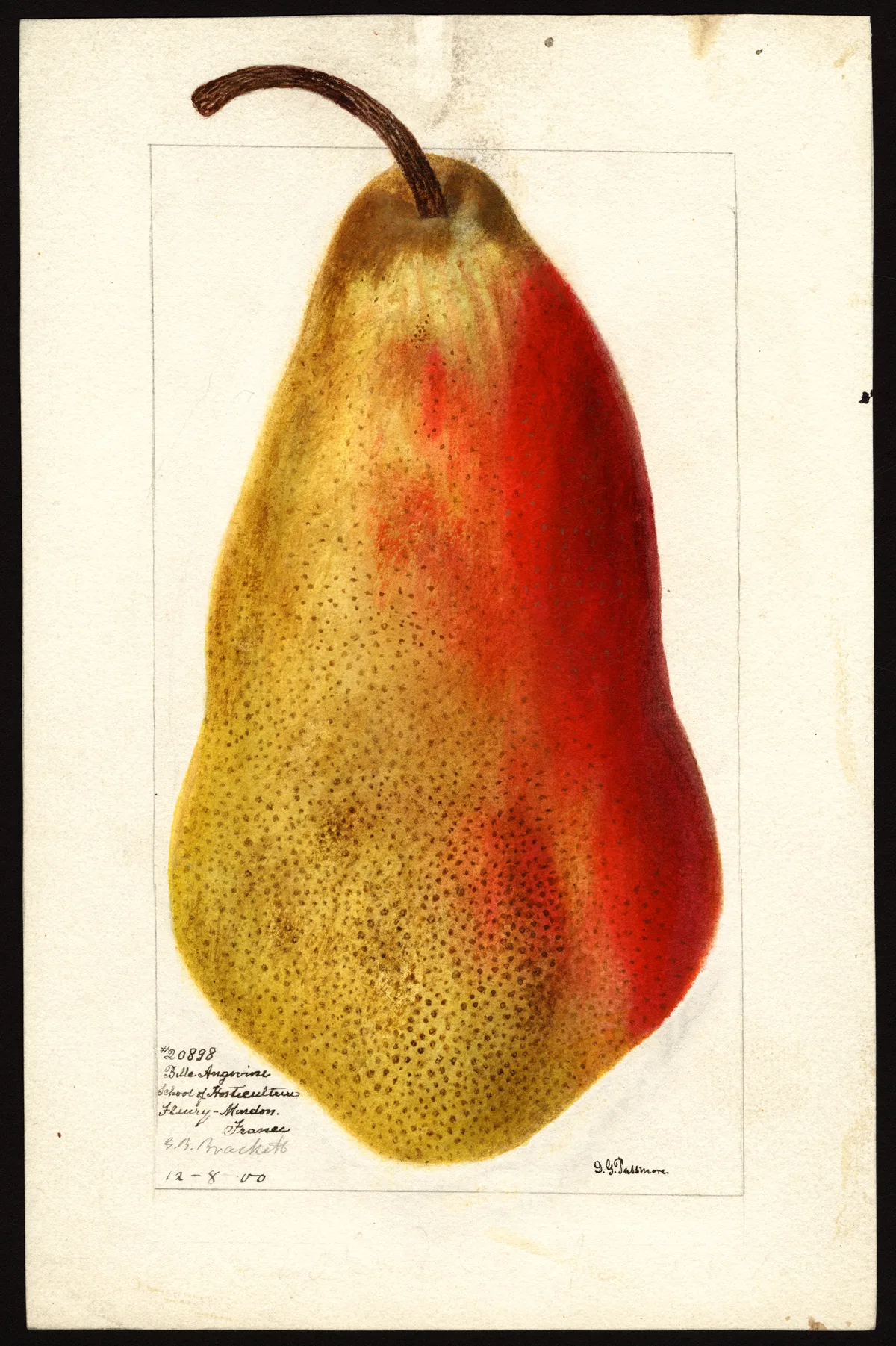
USDA Pomological Watercolor Collection
Angora
Origin / History
Angora is a member of a group of pears rather loosely termed Pound Pears. By some authors it is given as a synonym for Belle Angevine or Uvedale's St. Germain. M. Tournefort, the noted botanist, in an account of a voyage he undertook in 1700 on command of King Louis XIV of France, states that he saw at Beibasas, Asia Minor, the pears known in Constantinople as Angora. In 1832 Léon Leclerc imported it into France from Constantinople, having obtained it with difficulty through the French Ambassador at the Golden Horn.
Tree
Not described in source.
Fruit
Size: Above medium to large.
Form: Pyriform, obtuse, swelled around the center, rather irregular in form.
Stem: Not described in source.
Cavity: Not described in source.
Calyx: Not described in source.
Basin: Not described in source.
Skin: Thick, hard to cut, pale yellow, finely dotted with fawn and bearing some patches of fawn.
Dots: Fine, fawn.
Flesh and flavor: Flesh white, rather coarse, semi-melting, gritty at the center; juice plentiful and rich in sugar after the manner of sweet wine, little perfume. Quality second.
Core and seeds: Not described in source.
Season
October and November.
Uses
Not described in source.
Subtypes / Variants
Not described in source.
Other
Not described in source.
Book Sources
Described in 1 period pomological work
Nursery Catalog Sources
Found in 10 catalogs (1845–1917) from England, Massachusetts
- Winship's Nursery (Brighton Nurseries , operated by the Winship family), Brighton (Boston) , Massachusetts — 1845
- Hovey & Co. , Cambridge , Massachusetts — 1849 — listed as Uvedale's St. Germain
- Hovey & Co. , Cambridge , Massachusetts — 1849 — listed as Belle Angevine
- Kelway & Son , Langport, Somerset , England — 1897 — listed as Uvedale's St. Germain
- George Bunyard & Co. , Royal Nurseries, Maidstone, Kent , England — 1900 — listed as Uvedale's St. Germain
- Central Experimental Farm , Dominion Department of Agriculture, Agassiz, British Columbia (under test; Bulletin No. 3, Second Series) — 1900 — listed as Belle Angevine
- James Veitch & Sons , Ltd., Royal Exotic Nursery, Chelsea, London (also Coombe Wood, Langley, and Feltham) , England — 1911 — listed as Uvedale's St. Germain
- Thomas Rivers & Son , Sawbridgeworth, Hertfordshire , England — 1913 — listed as Uvedale's St. Germain
- George Bunyard & Co. , Royal Nurseries, Maidstone, Kent , England — 1914 — listed as Uvedale's St. Germain
- George Bunyard & Co. , Royal Nurseries, Maidstone, Kent , England — 1917 — listed as Uvedale's St. Germain
View original book sources (1)
— U.P. Hedrick, The Pears of New York (1921)Angora. 1. Leroy Dict. Pom. 1:147, fig. 1867. 2. Mas Pom. Gen. 5:35, fig. 306. 1880.
This is a member of a group of pears rather loosely termed Pound Pears. By some authors Angora is given as a synonym for Belle Angevine or Uvedale's St. Germain. In an account of a voyage he undertook in 1700 on command of King Louis XIV of France, M. Tournefort, the noted botanist, states that he saw at Beibasas, Asia Minor, the pears known in Constantinople as Angora. In 1832, Léon Leclerc imported it into France from Constantinople, having obtained it with difficulty through the French Ambassador at the Golden Horn. Fruit above medium to large, pyriform, obtuse, swelled around the center, rather irregular in form; skin thick, hard to cut, pale yellow, finely dotted with fawn and bearing some patches of fawn; flesh white, rather coarse, semi-melting, gritty at the center; juice plentiful and rich in sugar after the manner of sweet wine, little perfume; second; Oct. and Nov.