Messire Jean
Pear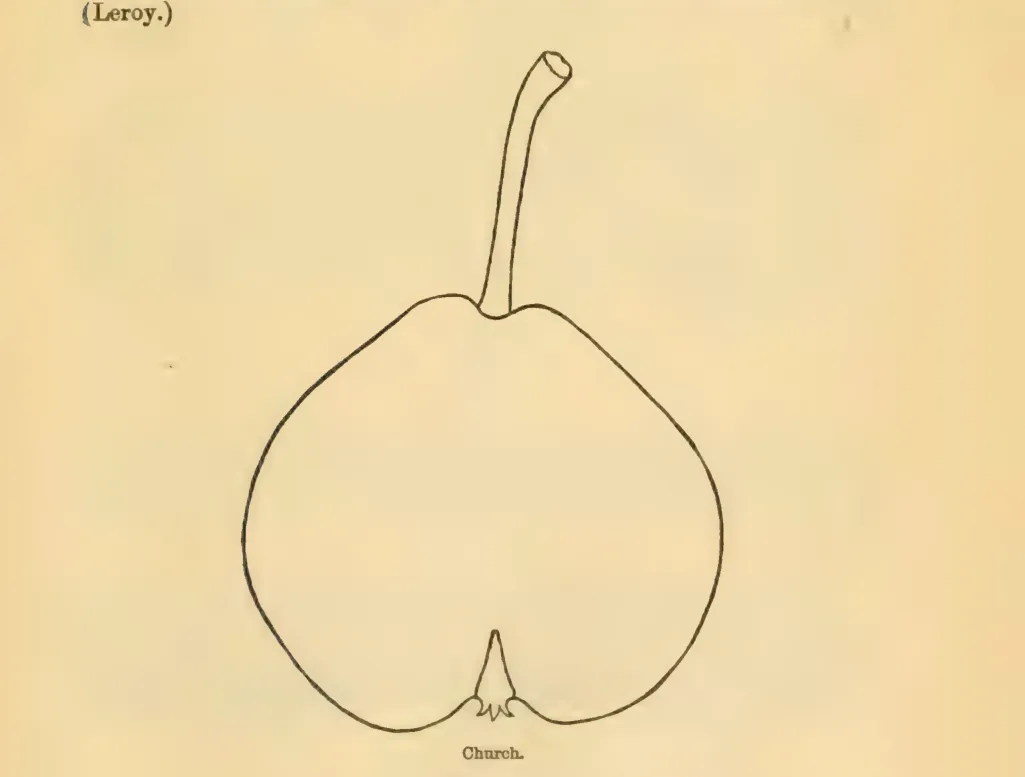
Origin/History
An old French pear of ancient and untraceable origin, but mentioned by Venette, Rochelle, France, in 1678 and 1683 (Hedrick). Held in high estimation in France (Coxe). Also documented by Duhamel in Traité des Arbres Fruitiers (1768) and by Hogg in The Fruit Manual (1884) (Hedrick).
Tree
Not described in source. Coxe notes that in America the fruit "is very apt to rot," suggesting the variety does not thrive in American conditions as well as in France.
Fruit
Size: Medium (Downing, Hedrick, Thomas); of moderate size, but sometimes on young trees and rich ground it grows large (Coxe).
Form: Turbinate (Downing, Hedrick, Thomas), sometimes slightly obovate, surface slightly bossed (Hedrick). Coxe describes the form as having a blossom end that is full and round, diminishing suddenly towards the stem.
Stem: Of moderate length (Coxe). Not otherwise described.
Cavity: Not described in source.
Calyx: Not described in source.
Basin: Not described in source (though Coxe's "blossom end is full and round" touches on the basin area).
Skin: Rough (Coxe, Hedrick); thick, dark green, passing to buff, washed with dark red on the side of the sun, strewed with speckles of darker russet (Hedrick). When fully ripe, yellow with a portion of russet (Coxe); yellow, nearly covered with brown russet (Downing); yellow and russet (Thomas). Sources agree on a yellow/buff ground with substantial russet coverage, though Hedrick uniquely notes a dark red sun-side flush and darker russet speckles.
Flesh/Flavor: Sources give somewhat varying characterizations:
- Coxe: "coarse, juicy, and sprightly; but not very rich or highly flavoured."
- Downing: "gritty, white, crisp, juicy, and breaking, with a very sweet flavor. Good." Also describes the variety overall as "rather coarse-grained and gritty."
- Hedrick: "white, slightly tinged with lemon, rather fine, breaking, juicy, richly saccharine, perfumed, sprightly; good."
- Thomas: "gritty; juicy, breaking, sweet."
Sources agree the flesh is juicy and breaking. Coxe, Downing, and Thomas describe it as coarse or gritty; Hedrick uniquely describes it as "rather fine." Sweetness is noted by Downing ("very sweet"), Hedrick ("richly saccharine"), and Thomas ("sweet"); Coxe characterizes the flavor as sprightly but "not very rich or highly flavoured."
Core/Seeds: Not described in source.
Season
October (Coxe); November (Thomas); November and December (Downing, Hedrick).
Uses
Good either for dessert or kitchen use (Hedrick). Downing rates it "Good." Coxe notes it is apt to rot in America.
Subtypes/Variants
Downing lists related forms under the synonymy including Messire Jean Gris and Messire Jean Blanc, suggesting gray and white strains. Coxe mentions it is sometimes called Monsieur Jean Doré ("gilded").
Other
Coxe specifically notes the variety's poor keeping in America ("very apt to rot"), in contrast to its high French reputation — a regional performance caveat relevant to identification in American orchards.
Book Sources
Described in 4 period pomological works
Nursery Catalog Sources
Found in 1 catalog (1900)
- Central Experimental Farm , Dominion Department of Agriculture, Agassiz, British Columbia (under test; Bulletin No. 3, Second Series) — 1900
View original book sources (4)
— William Coxe, A View of the Cultivation of Fruit Trees (1817)
- MESSIRE JEAN, OR MR. JOHN.
This pear is held in high estimation in France, but in this part of America it is very apt to rot; it is of moderate size, but sometimes on young trees and rich ground, it grows large; the blossom end is full and round, diminishing suddenly towards the stem, which is of moderate length; the skin is rough, and when fully ripe, yellow, with a portion of russet. It is sometimes called the Monsieur Jean doree; the flesh is coarse, juicy, and sprightly; but not very rich or highly flavoured---it ripens in October.
— A.J. Downing, The Fruits and Fruit Trees of America (1900)MESSIRE JEAN.
Chaulis. Messire Jean Doré. Emmilacour. Mr. John. Marion. John. Monsieur Jean. Communauté. Messire Jean Gris. Conlis. Messire Jean Blanc. Couvent.
An old French Pear, of rather coarse-grained and gritty.
Fruit of medium size, turbinate, yellow, nearly covered with brown russet. Flesh gritty, white, crisp, juicy, and breaking, with a very sweet flavor. Good. November and December.
— U.P. Hedrick, The Pears of New York (1921)Messire Jean.
i. Duhamel Trait. Arb. Fr. 2:173, Pl. XXVI. 1768. 2. Hogg Fruit Man. 616. 1884.
Of ancient and untraceable origin, but mentioned by Venette, Rochelle, Fr., in 1678 and 1683. Fruit medium, turbinate, sometimes slightly obovate, surface slightly bossed; skin rough, thick, dark green, passing to buff, washed with dark red on the side of the sun, strewed with speckles of darker russet; flesh white, slightly tinged with lemon, rather fine, breaking, juicy, richly saccharine, perfumed, sprightly; good, either for dessert or kitchen use; Nov. and Dec.
— John J. Thomas, The American Fruit Culturist (1903)Messire Jean. Medium, turbinate, yellow and russet; gritty; juicy, breaking, sweet. November. French.