Belle Lucrative
Pear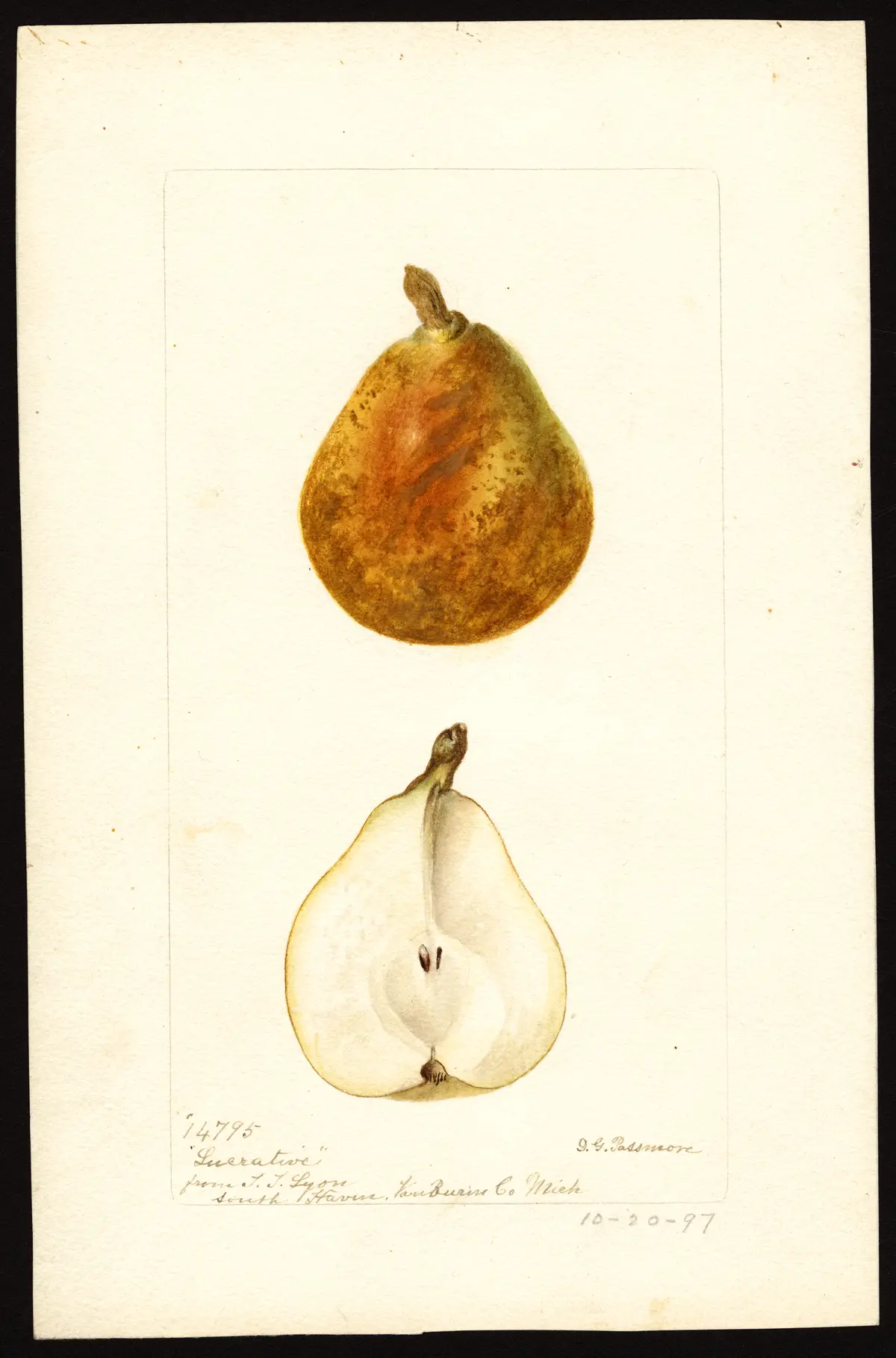
USDA Pomological Watercolor Collection
Belle Lucrative
Origin / History
A Flemish pear. Hovey writes that it "is supposed to be of Belgian origin," and Thomas gives it as Belgian. The originator is disputed. Hovey says the variety was "probably originated" by M. Stoffels of Malines, and Hedrick reports that some writers consider this probable. Hedrick adds that "the leading Belgian and French writers" say it was raised by Major Esperen, also of Mechlin, about 1827. Bunyard says it was raised by M. Fiévée at Maubeuge before 1825.
It was first brought to England by the late Mr. Braddick, who received the scions from M. Stoffels. Through Braddick's liberality, scions were distributed among all the principal nurserymen around London, and it soon became generally introduced (Hovey). In 1831 it was growing in the London Horticultural Society's gardens at Chiswick, and Lindley described it there as "another of the new Flemish pears" (Hedrick). According to Hovey, Lindley's work appeared before the Society's Catalogue and gave an accurate description, from fruit grown in the Society's garden, under the name Belle Lucrative. The Catalogue, by some error, described Belle Lucrative as a "crisp, second-rate pear." This induced some writers to adopt the name Fondante d'Automne, under which it was also described. Mr. Thompson has since ascertained that the original description under this name was incorrect. Downing and Bunyard describe the pear under the heading Fondante d'Automne.
In America, Belle Lucrative first fruited in Robert Manning's Pomological Garden at Salem, Massachusetts, in 1835 or 1836. The late Mr. Manning gave a brief account of it in the Magazine of Horticulture for 1837 (vol. iii, p. 15). The American Pomological Society added it to its catalog list in 1852 under the name Belle Lucrative. It was planted at the Central Experimental Farm, Agassiz, B.C., in spring 1893.
Hovey places it among the early autumn pears "which stand preëminent for their high and delicious flavor," second only to the Seckel. It has "not quite the spiciness" of the Seckel but possesses all its other excellences, and it more than makes up for the deficiency in the superior size of the fruit. As a hardy, vigorous tree and an early, abundant bearer, he says it "must be ranked as one of the very best pears yet added to our collections." Hedrick's Cyclopedia likewise holds it second only to Seckel in quality among pears of its season. Veitch calls it "one of the finest pears." Bunyard calls it "one of the most reliable of Autumn pears, doing well in any form." Budd and Hansen report it double-starred in many States.
Its excellence depends on culture. Downing finds it, when grown in perfection, "one of the very best," but "only second-rate" if the trees are overloaded, the soil unsuited, or the season dull, cloudy, and rainy. Thomas says that "when well grown and fully ripened, it has no superior and few equals," but is "sometimes of poor quality."
Hedrick calls it "this good old pear," a standard autumn sort for nearly a century. Its flesh and flavor are nearly perfect, "but externally much more might be desired as to shape and size," and "the trees are more satisfactory than the fruits."
Tree
Vigor is rated from very vigorous to rather dwarfish. Hovey calls it vigorous, a free and vigorous grower. Hedrick calls it very vigorous and rapid-growing, and the Agassiz station and Veitch call it strong or vigorous. Elliott and Thomas give moderate growth, and Downing calls it moderately vigorous. Bunyard alone calls the growth "rather dwarfish." Hedrick gives the tree as medium in size and dense-topped, with trunk and branches medium in thickness (Cyclopedia).
Habit upright (Hovey, Thomas), the longest and most vigorous branches inclining toward the main stem (Hovey). Hedrick calls it upright-spreading, a "somewhat distinct" habit, and Bunyard calls it a little spreading. Healthy (Downing). Hardy, hardier than the average pear, and rather more resistant to blight than the average variety (Hedrick).
Productive. Hovey calls it an early and abundant bearer, and Bunyard finds the fertility excellent. Hedrick says the trees bear "enormously and almost annually" on either standard or dwarfing stocks. It succeeds well on either quince or pear and is well adapted for a pyramidal or dwarf tree. Even on the latter stock, young trees may be brought into bearing very early by judicious pruning (Hovey). Elliott says that "thus far" it does well on the quince. Hedrick calls the trees so easily managed that they "grow so well." Downing finds the fruit second-rate when the trees are overloaded or the soil unsuited.
Young shoots yellowish gray, long (Elliott). Downing gives them as yellowish brown. Hovey describes the wood as yellowish, sparsely dotted with whitish specks, rather stout, and short-jointed, the old wood dull yellow somewhat mottled with grayish olive. Branches smooth, grayish brown mingled with red, covered with scarf-skin, with numerous elongated lenticels. Branchlets slender, short, light brown, glossy, smooth, and glabrous, with few small, inconspicuous lenticels (Hedrick).
Leaf-buds pointed and full or plump, but they differ in size and set. Hovey calls them large, sharply pointed, and diverging, with rather prominent shoulders. Hedrick calls them small, short, conical, and appressed.
Leaves medium in size, oblong-oval to narrow oval, tapering to a sharp or abruptly pointed apex, much waved or undulated at the edges, stiff, and deep glossy green. Margin regularly and finely serrate, tipped with very small sharp glands (Hovey, Hedrick); Bunyard calls the margin irregularly shallow crenate, the leaf down-curved, turning dull crimson red. Hovey calls the leaves delicately nerved. Leaves measure 3 inches long by 1⅞ inches wide (Hedrick), or 2½ by 1¾ inches in his Cyclopedia. Petioles slender, nearly 2 to 2 inches long, though the Cyclopedia gives 1½ inches.
Flower-buds medium in size, conical, pointed, plump, and free, borne singly on very short spurs. Flowers medium in size and showy, with an unpleasant odor. Petals roundish oblong and cupped (Hovey). Hedrick gives the flowers as 1⅞ inches across (1¼ in his Cyclopedia), averaging seven buds in a cluster, on pedicels 1⅛ inches long, thick, and thinly pubescent.
Fruit
Size: Medium, by most accounts. Budd and Hansen give medium to large, and Veitch calls it large. Hovey measures about 3 inches long by 3 inches in diameter. Hedrick measures 2⅝ inches long by 2⅞ inches wide, with 2½ inches wide in his Cyclopedia. Bunyard gives 2½ by 2¼. Hedrick finds the fruits "not as large as is desirable."
Form: Variable in shape. It runs from roundish obovate, conic-obovate, and obovate-conical through obovate pyriform and obtuse pyriform, and in Downing's range to globular. Thomas calls it sometimes remotely pyriform, and Budd and Hansen often pyriform. Full at the crown and regularly tapering to the stem, where it ends obtusely (Hovey). Sides unequal (Hedrick), the form turbinate in his Cyclopedia. Bunyard alone calls it of Bergamotte shape and "very even."
Stem: Stout, about 1 to 1½ inches long, often fleshy, obliquely inserted. Hovey calls it of medium length, nearly straight, knobby and wrinkled, and a little fleshy at the base, inserted on one side of a slight projection. Budd and Hansen call it curved, and Bunyard short.
Cavity: Slight to very shallow, small to very small, narrow, and irregular. Hedrick says it may be lacking, the flesh drawn up about the base of the stem.
Calyx: Open. Segments very short and round (Hovey) or very short with few divisions (Downing), and Elliott and Thomas call the calyx short. Hovey gives the eye as medium in size and a little sunk. Bunyard describes the segments as upright and claw-like. Hedrick calls the calyx large, with long, narrow, acuminate lobes, and the calyx-tube long, narrow, and funnel-shaped.
Basin: Shallow to moderate in depth, broad (Hovey), obtuse (Hedrick), and smooth. Thomas adds that it is sometimes furrowed.
Skin: Pale to dull yellowish green, or green fading to yellow; Hedrick calls it dull greenish yellow. Slightly to partly russeted with brownish russet, more or less traced with russet. Hedrick finds it often overspread with russet around the basin. Occasionally a little browned on the sunny side (Hovey). Hovey calls the skin slightly rough, while Hedrick calls it thin, tender, and smooth. Hedrick notes the fruit is variable in color, though "a rather handsome color" partly offsets its external defects.
Dots: Small, russet, numerous, thickly sprinkled over the skin. Hedrick calls them conspicuous.
Flesh and flavor: Fine-grained, juicy to very juicy, melting to very melting. Hovey gives the flesh as white, and Hedrick as tinged with yellow and buttery. Hedrick's technical description calls it firm and crisp. The Agassiz station found it soft, only moderately juicy, and "not very high flavoured."
Flavor rich, sugary, sweet, aromatic, and delicious: "rich and sugary, with a delicious aroma" (Hovey); "exceedingly rich, delicate, perfumed" (Thomas); "deliciously flavoured and aromatic" (Veitch). Hedrick places it in the Bergamot type, "fine-grained, buttery, juicy, and sugary, with a musky taste and perfume," and speaks of its "delectable flavor and luscious flesh." According to Hovey it has "not quite the spiciness" of the Seckel.
Quality "very good to best" (Downing; Budd and Hansen). Thomas calls it "excellent" and Hedrick "very good." Elliott calls it "one of the very best" if picked and ripened in the house. Downing calls it "only second-rate" under poor conditions, and Thomas "sometimes of poor quality."
Core and seeds: Core medium in size, closed, abaxile (Hedrick). Seeds medium in size and dark brown (Hovey); ovate (Elliott); narrow, plump, and acute (Hedrick).
Season
September into October, ripening from the middle or last of September. Hedrick and Bunyard carry the season through October. Hovey says it keeps two or three weeks. Elliott finds it at its best when picked and ripened in the house.
Uses
A dessert pear. Hedrick finds the fruits too small for a good commercial product. Their flavor and flesh make them "as desirable as any other pear for home use," and the variety is one of the very best for the home planter, or for the home orchard in his Cyclopedia.
Subtypes / Variants
Not described in source.
Other
Not described in source.
Book Sources
Described in 8 period pomological works
- Hedrick, The Pears of New York (1921)
- Downing, Fruits and Fruit Trees of America (1900)
- Hedrick, Cyclopedia of Hardy Fruits (1922)
- Budd & Hansen, Systematic Pomology (1914)
- Bunyard, A Handbook of Hardy Fruits (1920)
- Elliott, The Western Fruit Book (1865)
- Hovey, The Fruits of America (1852) — listed as The Belle Lucrative Pear
- Thomas, The American Fruit Culturist (1903)
Nursery Catalog Sources
Found in 28 catalogs (1845–1917) from Alabama, Arkansas, California, England, Florida, Illinois, Massachusetts, Oregon, Virginia
- Winship's Nursery (Brighton Nurseries , operated by the Winship family), Brighton (Boston) , Massachusetts — 1845
- Hovey & Co. , Cambridge , Massachusetts — 1849
- Joseph Breck & Co. , Boston , Massachusetts — 1855 — listed as Fondante d'Automne
- St. Helena Nursery , Howell Prairie, Marion County, OR (Marion Co., Ogn.) — 1864 — listed as Fondante d'Automne
- Felix Gillet , Barren Hill Nursery, Nevada City , California — 1884
- Felix Gillet , Barren Hill Nursery, Nevada City , California — 1888
- California Nursery Co. , Niles , California — 1889
- Felix Gillet , Barren Hill Nursery, Nevada City , California — 1889
- Felix Gillet , Barren Hill Nursery, Nevada City , California — 1890
- Felix Gillet , Barren Hill Nursery, Nevada City , California — 1891
- Glen St. Mary Nurseries (G.L. Taber , Proprietor), Glen St. Mary , Florida — 1893
- Sherwood Hall Nursery Co. , Timothy Hopkins (Menlo Park Nurseries), San Francisco / Menlo Park , California — 1893
- The Vineland Nurseries (Kelsey & Co. , Proprietors), St. Joseph, Missouri (Office: 13th and Atchison Sts., 2 Blocks East of the Citizens St. Car Line) — 1894
- Woodburn Nurseries , Woodburn, Marion Co. , Oregon — 1894
- Felix Gillet , Barren Hill Nursery, Nevada City , California — 1895
- Felix Gillet , Barren Hill Nursery, Nevada City , California — 1897
- The Salem Nursery (John A. Francis , Proprietor), Salem , Virginia — 1897
- Kelway & Son , Langport, Somerset , England — 1897
- J.V. Cotta (Cotta Nursery) , Carroll County , Illinois — 1898
- Alabama Nursery Co. , Huntsville , Alabama — 1900
- Central Experimental Farm , Dominion Department of Agriculture, Agassiz, British Columbia (under test; Bulletin No. 3, Second Series) — 1900
- George Bunyard & Co. , Royal Nurseries, Maidstone, Kent , England — 1900
- Yarbrough Bros. , Stephens , Arkansas — 1901
- Phoenix Nursery Company (W. E. Rossney , President; Sidney Tuttle, Vice-President), Bloomington , Illinois — 1904
- James Veitch & Sons , Ltd., Royal Exotic Nursery, Chelsea, London (also Coombe Wood, Langley, and Feltham) , England — 1911
- Thomas Rivers & Son , Sawbridgeworth, Hertfordshire , England — 1913
- George Bunyard & Co. , Royal Nurseries, Maidstone, Kent , England — 1914
- George Bunyard & Co. , Royal Nurseries, Maidstone, Kent , England — 1917
View original book sources (10)
— C.M. Hovey, The Fruits of America (1852)THE BELLE LUCRATIVE PEAR.
Belle Lucrative. Lindley's Guide to the Orchard.
Fondante d'Automne, } Beurré Lucrative, } Hort. Soc. Cat. 3d Ed. 1842. Bergamotte Lucrative, } Fruits and Fruit Trees of America. of some French Collections.
Among our early autumn pears, which stand preëminent for their high and delicious flavor, the Belle Lucrative maintains a place second only to the Seckel. It has not quite the spiciness of the latter variety, but, possessing all its other excellences, it more than makes up for this deficiency in the superior size of the fruit. As a hardy and vigorous tree, and an early and abundant bearer, it must be ranked as one of the very best pears yet added to our collections.
The Belle Lucrative first fruited in this country in the Pomological Garden at Salem, in 1835 or 1836, and the late Mr. Manning gave a brief account of it in the Magazine of Horticulture for 1837, (vol. iii. p. 15.) It is supposed to be of Belgian origin. It was first brought to England by the late Mr. Braddick, who received the scions from M. Stoffels, of Malines, and it was probably originated by that pomologist. Through Mr. Braddick's liberality, scions were distributed among all the principal nurserymen around London, and it soon became generally introduced.
By some error of the Catalogue of the London Horticultural Society, the Belle Lucrative is described as a "crisp, second-rate pear;" and this has induced some writers to adopt the name of Fondante d'Automne, under which name it was also described. Mr. Lindley, however, whose work appeared before the Catalogue, gave an accurate description of it, from fruit grown in the society's garden, under the name of Belle Lucrative; and it has since been ascertained, by Mr. Thompson, that the original description under this name was incorrect.
The Belle Lucrative is a free and vigorous grower, and succeeds well upon either the quince or pear, and is well adapted for a pyramidal or dwarf tree; even upon the latter stock, by judicious pruning, young trees may be brought into bearing very early.
Tree.—Vigorous, upright in habit, the longest and most vigorous branches inclining towards the main stem.
Wood.—Yellowish, sparsely dotted with whitish specks, rather stout and short-jointed; old wood dull yellow, somewhat mottled with grayish olive; buds large, full, sharply pointed, diverging, with rather prominent shoulders: Flower-buds medium size.
Leaves.—Medium size, oblong-oval, tapering to the point, much waved at the edges, deep glossy green, delicately nerved, and regularly and finely serrated; petioles slender, and nearly two inches long.
Flowers.—Medium size; petals roundish oblong, cupped.
Fruit.—Medium size, about three inches long and three inches in diameter: Form, roundish obovate, somewhat variable in shape, full at the crown, and regularly tapering to the stem, where it ends obtusely: Skin, slightly rough, dull yellowish green, occasionally little browned on the sunny side, more or less traced with russet, and covered with small, russet specks: Stem, medium length, about one inch long, stout, nearly straight, knobby and wrinkled, little fleshy at the base, and inserted, on one side of a slight projection, in a very shallow cavity: Eye, medium size, open, and little sunk in a broad, shallow basin; segments of the calyx very short and round: Flesh, white, fine, very melting and juicy: Flavor, rich and sugary, with a delicious aroma: Core, medium size: Seeds, medium size, dark brown.
Ripe the last of September, and keeps two or three weeks.
— F.R. Elliott, The Western Fruit Book (1865)Belle Lucrative.
Fondante d'Automne, | Signeur d'Esperia.
A Flemish variety. Tree, of moderate growth; productive bearer, young shoots long, yellowish gray. Thus far, does well on the Quince. If picked, and fruit ripened in house, one of the very best.
Fruit, medium, obovate pyriform; color, pale yellowish green, slightly russeted; stem, stout, often fleshy; calyx, short, open; basin, medium; core, medium; seeds, ovate; flesh, melting, juicy, aromatic, sweet. Last September.
— A.J. Downing, The Fruits and Fruit Trees of America (1900)FONDANTE D'AUTOMNE.
Belle Lucrative. Arbre Superbe. Seigneur d'Esperin. Lucrate. Bergamotte Fiévée. Fondante de Maubeuge. Gresillier. Autumn Melting. Du Seigneur. Esperin's Herrenbirne. Beurre Lucrative. Bergamotte Lucrative. Seigneur.
This Flemish Pear is, when grown in perfection, one of the very best; but if the trees are overloaded, soil unsuited, or a dull, cloudy, rainy season, it is only second-rate. The tree is moderately vigorous, healthy and productive. Young shoots yellowish brown.
Fruit medium size, variable in form, from obovate obtuse pyriform to globular. Pale yellowish green, slightly russeted. Stalk little more than an inch long, stout, often fleshy, obliquely inserted in a slight, irregular cavity. Calyx very short, open, with few divisions, set in a basin of moderate depth. Flesh juicy, melting, sugary, rich, and delicious. Very good to best. Last of September.
— John J. Thomas, The American Fruit Culturist (1903)Belle Lucrative.* (Fondante d'Automne.) Size medium, conic-obovate, sometimes remotely pyriform; surface pale yellowish-green, slightly russeted; stalk an inch and a quarter long, often fleshy, oblique; cavity very small and narrow; calyx short; basin smooth, sometimes furrowed; flesh very juicy, with a fine texture, melting, rich, excellent. Variable—when well grown and fully ripened, it has no superior and few equals, in its exceedingly rich, delicate, perfumed flavor—but sometimes of poor quality. Middle or last of September. Belgian. Growth moderate, upright, shoots yellowish-gray. Fig. 709.
— J.L. Budd & N.E. Hansen, American Horticultural Manual, Part II: Systematic Pomology (1914)Belle Lucrative.—Medium to large, conic obovate, often pyriform; color yellowish green, with some russeting; stalk about one inch long, stout, curved, and obliquely inserted in a small irregular cavity. Flesh juicy, melting, sugary, rich, delicious, very good to best. Double-starred in many States. Flemish.
— E.A. Bunyard, A Handbook of Hardy Fruits (1920)FONDANTE D'AUTOMNE. Her. Pom., II., 34. F. Bergamotte Lucrative. G. Esperen's Herrenbirn. Dessert, September to October, medium, 2½ by 2¼. Shape, Bergamotte, very even. Skin, green fading to yellow, partly covered with brownish russet. Eye, open, segments upright, claw-like. Stem, short and stout on a slight cavity. Growth, rather dwarfish, a little spreading; fertility excellent. Leaf, narrow oval, undulated at edge, irregularly shallow crenate, sharply pointed, down curved, turns dull crimson red. Origin, raised by M. Fiévée at Maubeuge before 1825. One of the most reliable of Autumn pears, doing well in any form.
— U.P. Hedrick, The Pears of New York (1921)BELLE LUCRATIVE
- Lindley Guide Orch. Gard. 364. 1831. 2. Kenrick Am. Orch. 135. 1841. 3. Hovey Fr. Am. 1:41, Pl. 1851. 4. Am. Pom. Soc. Rpt. 53. 1852. 5. Field Pear Cult. 194, fig. 68. 1858.
Fondante d'Automne. 6. Downing Fr. Trees Am. 387, fig. 168. 1845. 7. Hogg Fruit Man. 578. 1884. Seigneur. 8. Ann. Pom. Belge 7:5, Pl. 1859. 9. Pom. France 1: No. 28, Pl. 28. 1863. 10. Mas Le Verger 3: Pt. 1, 21, fig. 9. 1866-73. Bergamote Lucrative. 11. Leroy Dict. Pom. 1:247, figs. 1867. Seigneur d'Esperen. 12. Guide Prat. 59, 303. 1876. Esperen's Herrenbirne. 13. Mathieu Nom. Pom. 212. 1889. 14. Gaucher Pom. Prak. Obst. No. 37, Pl. 85. 1894. Lucrative. 15. Am. Pom. Soc. Cat. 36. 1889.
This good old pear has been a standard autumn sort for nearly a century. The internal characters of both flesh and flavor are nearly perfect, but externally much more might be desired as to shape and size. In flesh and flavor, the fruits are of the Bergamot type — fine-grained, buttery, juicy, and sugary, with a musky taste and perfume. The fruits are not as large as is desirable, and are variable in shape and color, external defects which a rather handsome color offsets in part. The trees are more satisfactory than the fruits. They bear enormously and almost annually on either standard or dwarfing stocks; they are very vigorous, with a somewhat distinct upright-spreading habit of growth; are hardier than the average variety of this fruit; and are rather more resistant to blight than the average variety. The fruits are too small for a good commercial product, but their delectable flavor and luscious flesh make them as desirable as any other pear for home use; besides which the trees grow so well, and are so easily managed that the variety becomes one of the very best for the home planter.
Belle Lucrative is of Flemish origin. In 1831 it was growing in the London Horticultural Society's gardens at Chiswick, and was then described by Lindley as "another of the new Flemish pears." It had been taken to England by a Mr. Braddick who received the cions from M. Stoffels of Mechlin. By some writers it is considered probable that it originated with M. Stoffels, but the leading Belgian and French writers say that it was raised by Major Esperen, also of Mechlin, about 1827. In this country it first fruited in the Pomological Garden of Robert Manning, Salem, Massachusetts, in 1835 or 1836. The American Pomological Society added the variety to its fruit catalog-list in 1852 under the name Belle Lucrative.
Tree medium in size, vigorous, upright-spreading, dense-topped, rapid-growing, hardy, productive; branches smooth, grayish-brown mingled with red, covered with scarf-skin, with numerous elongated lenticels; branchlets slender, short, light brown, glossy, smooth, glabrous, with few small, inconspicuous lenticels.
Leaf-buds small, short, conical, pointed, plump, appressed. Leaves 3 in. long, 1⅞ in. wide, stiff; apex abruptly pointed; margin finely serrate, tipped with very small, sharp glands; petiole 2 in. long. Flower-buds conical, pointed, plump, free, singly on very short spurs; flowers with an unpleasant odor, showy, 1⅞ in. across, average 7 buds in a cluster; pedicels 1⅛ in. long, thick, thinly pubescent.
Fruit ripe in late September and October; medium in size, 2⅝ in. long, 2⅞ in. wide, obovate, conical, with sides unequal; stem 1½ in. long; cavity very shallow and narrow, or lacking, the flesh drawn up about the base of the stem; calyx open, large; lobes long, narrow, acuminate; basin shallow, obtuse, smooth; skin thin, tender, smooth; color dull greenish-yellow, thickly sprinkled with small, russet dots, often overspread with russet around the basin; dots numerous, small, russet, conspicuous; flesh tinged with yellow, firm, fine-grained, crisp, buttery, juicy, sweet; quality very good. Core closed, abaxile; calyx-tube long, narrow, funnel-shaped; seeds narrow, plump, acute.
— U.P. Hedrick, Cyclopedia of Hardy Fruits (1922)BELLE LUCRATIVE. Fig. 71. Bergamote Lucrative. Lucrative. Seigneur d'Esperen. This pear has been a standard autumn sort for nearly a century, maintaining a place for high quality with the pears of its season second only to Seckel. Flesh and flavor are nearly perfect, but externally much more might be desired. The fruits are not as large as is desirable, and are variable in shape and color. The trees bear enormously and almost annually on either standard or dwarfing stocks; they are vigorous with a distinct upright-spreading habit of growth; hardier than the average variety of this fruit; and are more resistant to blight. The fruits are too small for a commercial product, but their delectable flavor and luscious flesh make them as desirable as any other pear for home use; besides which the trees grow so well, and are so easily managed that the variety becomes one of the very best for the home orchard. Belle Lucrative is of Flemish origin.
Tree medium in size, vigorous, upright-spreading, dense-topped, rapid-growing, hardy, productive; trunk and branches medium in thickness; branches smooth, grayish-brown mingled with red, covered with scarf-skin, with numerous, elongated lenticels. Leaves 2½ inches long, 1¾ inches wide, stiff; apex abruptly pointed; margin finely serrate, tipped with very small, sharp glands; petiole 1½ inches long. Flowers with an unpleasant odor, showy, 1¼ inches across, average 7 buds in a cluster. Fruit ripe in late September and October; medium in size, 2⅝ inches long, 2½ inches wide, turbinate, with sides unequal; stem 1½ inches long; cavity very shallow and narrow or lacking, the flesh drawn up about the base of the stem; calyx open, large; lobes long, narrow, acuminate; basin shallow, obtuse, smooth; skin thin, tender, smooth; color dull greenish-yellow, thickly sprinkled with small, russet dots, often overspread with russet around the basin; dots numerous, small, russet, conspicuous; flesh tinged with yellow, firm, fine-grained, crisp, buttery, juicy, sweet; quality very good; core closed, abaxile; calyx-tube long, narrow, funnel-shape; seeds narrow, plump, acute.
— Central Experimental Farm, Central Experimental Farm, Agassiz BC — Catalogue of Fruit Trees under Test (Bulletin No. 3, 1900) (1900)Planted Spring 1893. Tree a strong grower. Fruit of medium size, obtuse, pyriform. Skin yellowish green, with a little russet. Flesh soft, moderately juicy, not very high flavoured. Season September.
— James Veitch & Sons, Veitch's Fruit Trees (1911) (1911)large, melting, juicy, deliciously flavoured and aromatic, one of the finest pears. Tree vigorous and productive September