Ambrosia
Pear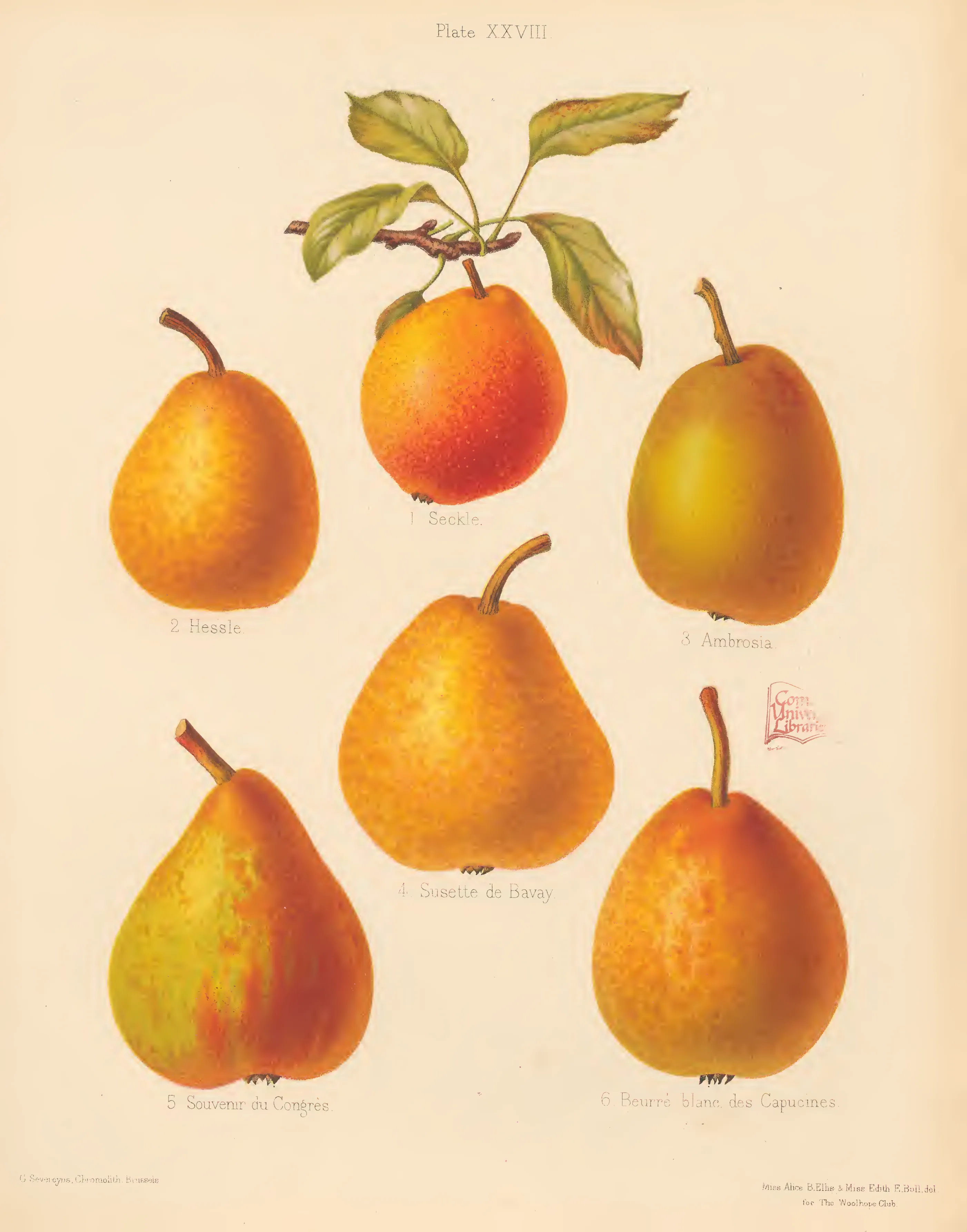
Ambrosia
Origin / History
A French pear, called simply "foreign" by Elliott. Switzer, writing in England in 1724, says Ambrosia was introduced to that country from France "among that noble collection of fruit that was planted in the Royal Gardens in St. James's Park soon after the Restoration, but is now (1724) cut down." The date in parentheses is inserted in the Herefordshire Pomona's account. No French author records it under this name. Jahn, in the "Handbuch," considers it synonymous with Diel's Braunrothe Pomeranzenbirne, which Metzger says is the same as the Orange Rouge of the French authors. The Herefordshire Pomona holds that Ambrosia is certainly not the same as the Orange Rouge. Hedrick says it was formerly to be found in many old English gardens but now seems to have dropped out of favor.
Tree
Hardy, vigorous in growth, a good bearer. Succeeds well as a standard, on either the pear or the quince stock (Herefordshire Pomona).
Fruit
Size: Medium.
Form: Roundish obovate, slightly flattened.
Stem: An inch and a half long, slender.
Cavity: Open.
Calyx: Eye closed.
Basin: A considerable depression.
Skin: Smooth, greenish yellow, a little russeted, with slight marks of russet.
Dots: Skin covered with small gray specks.
Flesh and flavor: Tender, buttery, melting, rich, sugary and perfumed, possessing a high flavor in England (Hedrick); "first-rate quality" (Herefordshire Pomona). Downing finds it "buttery, without much flavor," and rates it "Hardly good."
Core and seeds: Not described in source.
Season
September, though Elliott gives August. Keeps only a few days after being gathered.
Uses
A delicious summer dessert pear, ranked first for dessert.
Subtypes / Variants
Not described in source.
Other
Hedrick cites earlier descriptions in the Journal of Horticulture, N. S. 14:326, with figure (1868), and in Hogg's Fruit Manual, 177 (1884).
Book Sources
Described in 5 period pomological works
Nursery Catalog Sources
Found in 3 catalogs (1845–1900) from Massachusetts
- Winship's Nursery (Brighton Nurseries , operated by the Winship family), Brighton (Boston) , Massachusetts — 1845
- Hovey & Co. , Cambridge , Massachusetts — 1849
- Central Experimental Farm , Dominion Department of Agriculture, Agassiz, British Columbia (under test; Bulletin No. 3, Second Series) — 1900
View original book sources (5)
— F.R. Elliott, The Western Fruit Book (1865)Ambrosia. Early Beurre. Foreign. Medium, roundish obovate, greenish yellow, russeted. August.
— Woolhope Naturalists Field Club, The Herefordshire Pomona (1885)
- AMBROSIA.
[Syn.: Early Beurré; Summer Beurré.]
It is related by Switzer that this variety was introduced from France "among that noble collection of fruit that was planted in the Royal Gardens in St. James's Park soon after the Restoration, but is now (1724) cut down." Nevertheless there is no record of it in any French author under this name. Jahn, in the "Handbuch" considers it synonymous with Diel's Braunrothe Pomeranzenbirne, which, Metzger says, is the same as Orange Rouge of the French authors, but it is certainly not the same as this last fruit.
Description.—Fruit: medium sized; roundish obovate, and slightly flattened. Skin: smooth, greenish yellow, covered with small grey specks and slight marks of russet. Eye: closed, set in a considerable depression. Stalk: an inch and a half long, slender, inserted in an open cavity. Flesh: tender, buttery, melting, rich, sugary and perfumed.
A delicious summer dessert Pear of first-rate quality. It ripens in September, but keeps only a few days after being gathered.
The tree is hardy and vigorous in growth, and a good bearer. It succeeds well as a standard, either on the pear or quince stock.
— A.J. Downing, The Fruits and Fruit Trees of America (1900)Ambrosia. Early Beurre. A French Pear of medium size, roundish obovate. Skin greenish yellow, a little russeted. Flesh buttery, without much flavor. Hardly good. September.
— John J. Thomas, The American Fruit Culturist (1903)Ambrosia. Medium, roundish, obovate; buttery, without much flavor. September. French.
— U.P. Hedrick, The Pears of New York (1921)Ambrosia. 1. Jour. Hort. N. S. 14:326, fig. 1868. 2. Hogg Fruit Man. 177. 1884.
Switzer, writing in England in 1724, said that this variety was introduced to that country from France "among that noble collection of fruit that was planted in the Royal Gardens in St. James's Park soon after the Restoration, but is now cut down." No French author, however, appears to mention it under this name. It was formerly to be found in many old English gardens but now seems to have dropped out of favor. Fruit medium, globular-obovate, greenish-yellow, slightly russeted and covered with small, gray specks; flesh buttery and in England possessing a high flavor, melting, rich, sugary, perfumed; first for dessert; Sept. but does not keep long.